

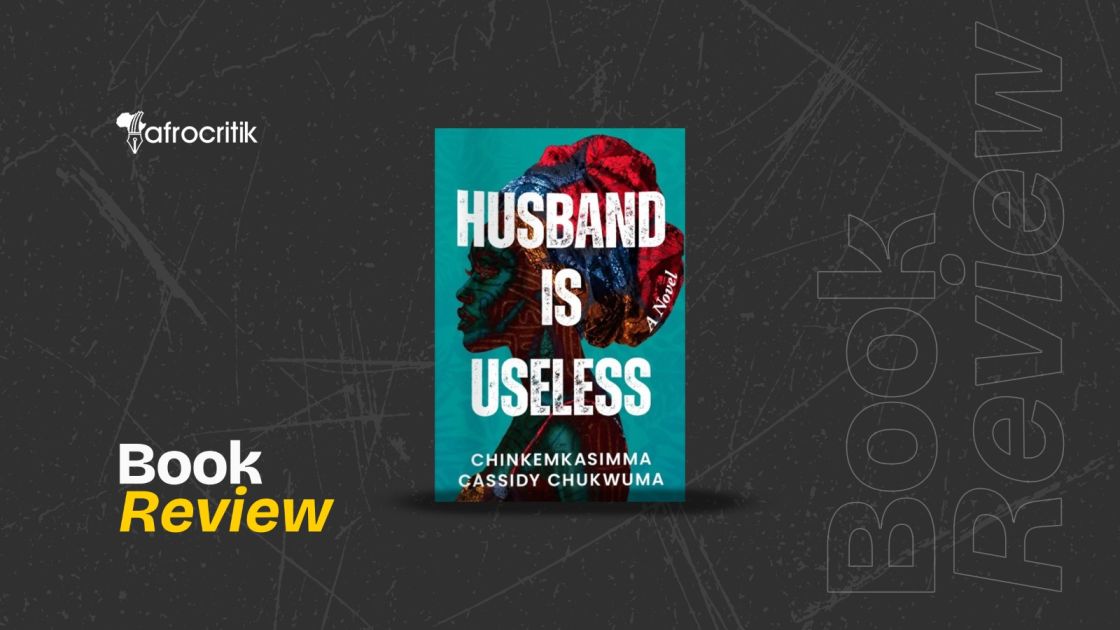

Husband Is Useless is a novel that surprises with its ability to hold one’s attention for 400 pages, beyond what the base ideological detritus that followed its announcement online would imply.
By Chimezie Chika
Almost three months ago, a debut author, Chinkemkasimma Cassidy Chukwuma, announced the impending publication of her debut novel, Husband Is Useless, on her social media accounts. Within a few hours, the announcement went viral and generated millions of impressions, eventually racking up over 21 million in the following days.
The majority of the attention was on the novel’s provocative title—a direct poke at the hate-filled gender-divide sections of X and Facebook. The reactions to Chukwuma’s announcement were either quick, impassioned rebuttals or affirmations of the title’s implication. That is, most of the responses were either along the lines of, Husbands/men are not useless, you fool, or Of course, girl, they are all useless.
Mind, at that point, that these responses were coming from people who hadn’t read the novel. One would have thought that, as a consequence, the incendiary reactions would have people reading the novel in a frenzy of triggered curiosity.
Months later, despite the hundreds who bought the book amidst that hullabaloo, there are scarcely any reviews of Chukwuma’s Husband Is Useless anywhere. Is this by any chance proof of the decades-old denigration that if you want to hide anything from Nigerians, you should put it in a book? Granted, of course, that the said book’s author knowingly chose an inflammatory title (for the publicity it would generate, no doubt), one cannot help but ask: if her rage-baiting succeeded in pushing sales, does the content of the novel justify the title?
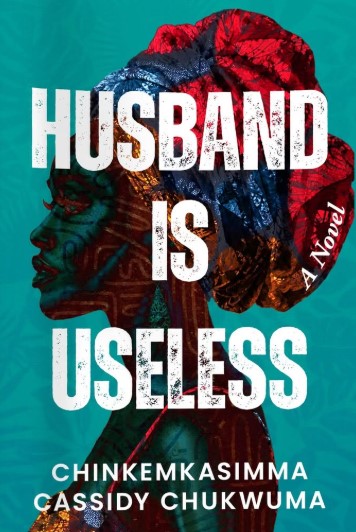
It is clear from the first paragraph of Husband Is Useless that Chukwuma’s is a remarkable narrative voice. In an often humorous and acerbic tone, inflected with Nigerian idioms and Yoruba and Igbo expressions, Chukwuma tells the first-person story of her feisty protagonist, Folashade Ajani, who grows up in a very poor area in Lagos and begins to experience the rude control of patriarchal expectations from her pre-pubertal years to adulthood. By twenty-four, Sade has already had two marriages foisted upon her in choice-less situations, suffering some of the worst indignities known to humankind. With time, she gradually gains more freedom and maturity with her personal choices around love and life.
From the get-go, this novel makes a point of parading all kinds of useless men. The first ‘useless husband’ specimens are the husbands of the neighbours, described so poignantly on the first page. The second ‘useless husband’ specimen is the narrator’s father, Pa Ajani, described unflatteringly as having “the patience of a mosquito and the entitlement of a king who ruled over absolutely nothing”.
Continuing in that vein, we are also told that Pa Ajani is a lowly civil servant who scratched “his round stomach like a fat, overfed lizard”, has the archaic conviction of valuing his sons over the only girl, Sade, believes that only men are worth educating, and thinks that men have no business doing anything at home. Pa Ajani also complained a lot and is an incurable philanderer.
Among the endless line of useless men are two of Sade’s brothers, Tunde and Kola, the latter being an astonishingly self-destructive never-do-well who squanders his father’s fortune on the promise of a spurious football scholarship. And then there are Sade’s two husbands, the old Chief Adekunle Olanrewaju and the younger Babalola, for whom she becomes a second wife. The former—a man whose son is described as a cruel, entitled troublemaker and whose daughter is “a loud, judgmental absence”—is something of a sadist a la Eugene of Chimamanda Ngozi Adichie’s Purple Hibiscus and ended almost the same way. The latter is a successful carpenter with a genuine grass-to-grace (and to grass again) story.
In these men, one could see the author’s desire to create monsters of men, for sometimes they don’t even make sense. With the last husband, the en-monstering must have taken extra effort, for Babalola, as even Sade tells us repeatedly, was not necessarily a bad man. He was only unfortunate to partake in the patriarchal meal of seeing women as purchasable artefacts able to satisfy his—and this society’s—regressive fixation on the supremacy of a male offspring. That Sade would cheat on him in a love affair with his own apprentice is a predictable outcome.
Which leads us into mentioning the few male specimens are not ‘useless’ in the novel. The first, and most supreme, is Sade’s last brother, Olawale. Then there are her two genuine loves, Tobi and Chidi, both of whom awakened and softened Sade’s growth and immaturity.
How do the women in Husband Is Useless fare? Much of the womenfolk constitute stereotypes of the suffering woman. Sade’s mother, Maami, sits at the top of that designation: a seemingly blameless saint, self-sacrificing for her kids, amidst a meaningless marriage. But more than this, she would later be shown to always be, eventually, on the side of her husband, and therefore, by extension, an aider of male chauvinism.
Of a fact, Chukwuma spends a great deal of time on the kinds of women who are always on the side of men to the detriment of their own sex. Such women as Maami, Alake, and others. To her credit, she also shows that women like this can be capable of change in the right direction, such as in the case of Chinelo, Babalola’s first wife. Women like these are in the intermediate mental state between the first type of women and women like Bisi, who would rather kill a man than endure male cruelty.
There is a lot to sing for in this book. There is merit in the genuine concerns this novel raises about women’s lives through Sade’s story, and there are many notable set-pieces that reveal Chukwuma’s undeniable promise as a storyteller. Though self-published, this book is far better written than many novels published by Nigeria’s major publishers. Perhaps those same publishers can try to sign her on.
Many of the descriptions here are pithy, accurate descriptions of Nigerian society. The introduction on the first page is an example of this:
“My father’s house sat directly opposite a long, noisy face-me-I-face-you compound that was louder than a motor park. If somebody sneezed in room three, someone in room five would bless them. If someone’s pot of food burned in room seven, room nine would come out to inspect the smoke. And if your parents fought? Forget it. By morning, the entire street would have the police report, the medical report, and the autopsy.”
This ability to paint a familiar society so vividly extends to emotions. Chukwuma understands the conflicting emotions that arise in one person, as she so often shows with her women characters. The description of forbidden sex between Sade and Chidi is emotionally alive for all the right reasons.
I admit to having a limited knowledge of Yoruba culture and language, yet it seems to me that this author’s understanding of the two is above average; even more remarkable because she is Igbo. It seems to me, in short, that she might know more Yoruba than Igbo.
These Nigerian language infusions never feel forced or artificial except one passage where an Igbo colloquialism was written anachronistically: “And then there are the ones the Igbo people call ndi yokometers—professional observers of all people’s lives.” The correct phrase should be ndị onyokometer—a denigrating colloquial term coined from the base verbal expression for spying (ị nyo), referring to gossips and people who have made it their duty to spy on other people’s lives.
By far Chukwuma’s greatest achievement in Husband Is Useless is the character of Sade, who is as humorous as she is spiteful and full of bile for anything man-related. She can be curiously vulnerable (the scene with Bisi at the saloon was particularly poignant) but also, per the author’s agenda (which we will come to), can be unconvincing.
Sade’s bile—being a projection of her author—can come as moments of actual illumination about the travails of the girl child, such as we find in the early scenes where she rages about women who try to force young girls into men-centred expectations:
It was always men, men, men. Men this, men that! Men like girls who smile, men don’t like girls who frown. Men want flexible waists. Men want quiet mouths. Men want respect. Men want enjoyment. Haba! …


But that selfsame bile, more often than not, reeks of the likeness of Nollywood melodrama cosplaying as a representation of bitter, misinterpreted feminism.
For this reason, the dialogue can be unrealistic, especially in cases where even Sade’s combative character does not justify her responses. In one, a friend of Baba’s needlessly tells her he bought a freezer, and her response, “Okay, congrats. But why are you telling me these things?”, completely offbeats the maturity Sade is supposed to be attaining at that point, and the appearances she is supposed to have learned to put up.
Seeing a number of strategically placed pointless dialogues is one of the things in this novel that builds up to one realisation: a lot in this book seems set up to provoke and rage-bait.
I doubt this novel can be called the twisted fictional vision of a talented but bitter, tortured, misandrist whose representation of the patriarchy is nearly undone by its insistent fidelity to agendaed falsehood, yet Chukwuma struggles at times to prop up what is supposed to be the honesty of her purpose. Not until halfway through the book does she allow the story to breathe on its own without some ulteriorities.
But go back to the first part of the book, and you find so many preposterous situations with characters making widely improbable statements, for the sake of the author’s desire to project one-dimensionalities, such as the manner in which Pa told Olawale to stop doing housework. If such a man wanted to say something like that to his son, that is not how he would say it.
What this does is that it constructs the world of this novel as a dystopia of advanced disdain. In this world—the world of Husband Is Useless, that is—almost everybody is terrible, horrible, corrigible, awful, unpleasant. There is a certain characterisation of villainy that is all-pervasive here, which a reader is certain to tire of. Where we see good people at all,—such as with Olawale in the early parts—the goodness is not always complex; it’s often a zombie kind of goodness, with nothing else of interest in them.
Large parts of this novel offer unrelentingly bleak pictures of women’s lives in marriages, and they do awaken our righteous anger, such as when Sade was repeatedly married off without her consent (“Only later,” Sade muses, “did it occur to me that this was exactly how animals were treated before slaughter”. And I agree!). But on the other side, other parts of this novel play no other role except to prove how terrible men can be. Scenes such as the quarrel between Nnanna and Sade, and between Chinelo’s family and Sade are mere surplus extensions.
To wit, the number of quarrelling scenes or scenes of open confrontation is unrealistic; there is a certain pointlessness that begins to set in when one continuously encounters instances of them every few pages. Is our protagonist a deranged, malevolent, respectless specimen of a woman (and we have no reason to think this), or did the author simply stage her in those situations to prove a point?
This would have been a better book had the author minimised these pointless episodes. For, notwithstanding all these misgivings, Husband Is Useless is a novel that surprises with its ability to hold one’s attention for 400 pages, beyond what the base ideological detritus that followed its announcement online would imply. And its author, Chukwuma, is not a literary charlatan, as far as I can tell, whatever other motives she might have.
One only feels that such an incredible storyteller would dedicate her talents not to the pugilistic arenas of entrenched social media misandry or petty gender wars, but to more nuanced representations of the selfsame issues confronting women in our patriarchal hegemonies and, ultimately, to the pursuit of literary immortality.
Chimezie Chika is a staff writer at Afrocritik. His short stories and essays have appeared in or forthcoming from, amongst other places, The Iowa Review, Dappled Things, Channel Magazine, Terrain.org, Lolwe, Isele Magazine, Efiko Magazine. He is the fiction editor of Ngiga Review. His interests range from culture, history, to art, literature, and the environment. You can find him on X @chimeziechika1