



Taken together, the selections offer more than a list of films competing for one of the Academy’s five Best International Feature nominations. They provide a snapshot of what different African film industries are choosing to put forward as representative of themselves.
By Afrocritik’s Film Board
For African filmmakers, the journey to the Oscars has always been about more than getting a film into a particular category. It is also about making a case for the stories a country believes can represent its cinema beyond its borders. Each year, selection committees are effectively asked to distill an entire national film culture into a single title, then send that film into an awards system where recognition has historically been difficult to secure.
That process is underway again for the 99th Academy Awards, which will honour films released during the 2026 eligibility period and culminate in the award ceremony in Los Angeles on 14th March 2027. The Best International Feature Film race is already taking shape as countries announce their official selections, with the Academy’s shortlist and nominations still to come.
There are a few notable absences. Tunisia, the 98th Academy Awards’ sole African nominee in the Best International Feature Film category (for Kaouther Ben Hania’s The Voice of Hind Rajab (2025)), has not announced a submission as at the 30th September 2026 submissions deadline. Neither has Madagascar, which submitted its first entry last year (Luck Razanajaona’s Disco Afrika: A Malagasy Story (2023)).
Nonetheless, Africa enters this year’s race with a slate that reflects the continent’s range of cinematic traditions and contemporary concerns. Nigeria and Kenya are returning to the race after failing to submit a film for the previous Oscars, while Rwanda is making its debut in the category, and the Democratic Republic of the Congo joins the field with its second ever submission. Elsewhere, countries with long and sometimes complicated histories in the category—from Algeria and Morocco to Egypt and South Africa—are continuing their campaigns, alongside submissions from Cameroon, Chad and Senegal.
Taken together, the selections offer more than a list of films competing for one of the Academy’s five Best International Feature nominations. They provide a snapshot of what different African film industries are choosing to put forward as representative of themselves at a moment when the continent’s cinema is increasingly travelling through festivals, international co-productions and global distribution networks.
Here is the full list of African submissions for the 99th Academy Awards’ Best International Feature Film race.
Algeria – Roqia (Dir. Yanis Koussim)
After missing out on submitting last year, Algeria returns with Roqia (2025), a psychological thriller/horror film that unfolds over two parallel time periods—a past in which a man suffers amnesia after an accident and returns to his village where his family and neighbours feel unfamiliar, and a present where the disciple of an ageing raqi worries that his master’s Alzheimer’s may unleash a long-contained evil.
Co-produced between France, Algeria, Qatar, and Saudi Arabia, the Arabic-language film had its world premiere at the International Critics’ Week sidebar of the Venice International Film Festival before screening at the Red Sea International Film Festival 2025, Carthage Film Festival 2025, Thessaloniki International Film Festival 2025, and Leeds International Film Festival 2025, amongst others.
Algeria has submitted a film in the Best International Feature Film category twenty-seven times, earning a record five nominations. In 1970, with its very first submission, the North African country became the first African country to win the category (Best Foreign Language Film, at the time), taking home the Oscar for the satirical political thriller Z (1969), directed by Greek-French filmmaker Costa-Gavras.
Cameroon – Mabanda (Dir. Kang Quintus)
Mabanda (2026), Cameroon’s Pidgin-English submission, follows a pregnant teenager trapped by her emotionally abusive father and rejected by her community after her mother’s death. As she struggles with grief, hallucinations and hidden trauma while searching for safety, she finds herself drawn into a dangerous slum underworld.
Mabanda notably won the public-voted Best Indigenous Language (Central Africa) category at the 2026 Africa Magic Viewers’ Choice Awards (AMVCA). Interestingly, the film’s lead role is played by Nchini Sylvia-Bright, who also co-led Hidden Dreams, Cameroon’s submission to the 2021 Oscars. If nominated for the 2027 Academy Awards, Mabanda would become the first Cameroonian film to be nominated for Best International Feature, out of eight submissions over the years.
Chad – Soumsoum, la Nuit des Astres (Soumsoum, the Night of the Stars) (Dir. Mahamat-Saleh Haroun)
For the fourth time in four submissions, Chad’s submission to the Academy Awards is a film by Mahamat-Saleh Haroun, regarded as the first Chadian filmmaker to direct a feature-length film. Haroun and his country return this year with Soumsoum, la Nuit des Astres (2026), a magical-realist coming-of-age drama about a supernaturally gifted seventeen-year-old whose disquiet and uncertainty change when she meets a mysterious and ostracised woman.
A co-production of France and Chad, the French and Arabic-language feature premiered in competition at the Berlin International Film Festival 2026 where it won the FIPRESCI Prize, before screening in the Centrepiece section of the Toronto International Film Festival 2026.
Democratic Republic of the Congo –Rumba Royale (Dirs. Yohane Dean Lengol, Hamed Mobasser)
The Democratic Republic of the Congo joins the Oscars’ International Feature race for the second time ever with Rumba Royale (2025), a historical thriller set in Léopoldville in 1959, in the final years of Belgian colonial rule. The film follows Daniel, a young photographer documenting the vibrant nightlife of the Rumba Royale nightclub, where Congolese and European patrons mingle as the city edges towards independence. When Olive, a waitress Daniel has fallen for, is found dead, he becomes entangled in a dangerous search for the truth.
Directed by Congolese filmmaker Yohane Dean Lengol and Belgian-Iranian filmmaker Hamed Mobasser, the French-language film premiered in 2025 before screening internationally at festivals including the New York African Film Festival, Montreal International Black Film Festival and Toronto International Nollywood Film Festival in 2026. The film is a co-production involving the Democratic Republic of the Congo, Belgium, France and the United States. It also marks Congolese music star Fally Ipupa’s first major film role.
The DRC’s first submission to the category was in 1997 with Zeka Laplaine’s Macadam Tribu, which debuted at the Cannes Film Festival in 1996. With the submission of Rumba Royale, the DRC joins this year’s African field with a historical drama that places Congolese rumba and the cultural life of pre-independence Léopoldville at the centre of its story.
Egypt – The Stories (Dir. Abu Bakr Shawky)
Algeria might be the most successful North African and African country at the Oscars’ Best International Feature race, but Egypt has certainly been the most frequent. Egypt’s fortieth entry comes with this year’s submission, The Stories (2025), director Abu Bakr Shawky’s second film to be submitted by Egypt. Inspired by the director’s parents’ story, the film follows a young aspiring concert pianist in Cairo whose life changes after beginning a pen-pal romance with an Austrian woman during the 1967 Six-Day War.
Co-produced between Egypt, France, Austria, Belgium, and Sweden, The Stories features Arabic and German alongside English. It world premiered at the Tallinn Black Nights Film Festival in 2025, along with Sarah Goher’s Happy Birthday (2025), which was Egypt’s submission for the 2026 Oscars. The Stories also screened in competition at the Red Sea International Film Festival 2025 and won the Carthage Film Festival Tanit d’Or (Best Film) in 2025. A nomination by the Academy’s nominating committee would make it Egypt’s very first nomination.
Kenya – One Woman One Bra (Dir. Vincho Nchogu)
Kenya’s official submission to the Oscars this year is One Woman One Bra, a Kenyan-Nigerian co-production set in a rural Kenyan village where an orphan tradeswoman searches for information to prove her family lineage so as to maintain ownership of her land and protect her livelihood.
The Swahili, Maa, and English-language film was developed under the Venice Biennale College Programme and world premiered at the Venice International Film Festival in 2025. It won the Sutherland Award for Best First Feature at BFI London Film Festival 2025.
Kenya’s first submission for Best International Feature was the acclaimed Nairobi Half Life in 2012. The country did not submit another film until 2017 in which year it started an eight-year streak that ended when the Kenya Oscar Selection Committee determined that none of the films submitted to it met the requirements for entry in 2025. With One Woman One Bra, Kenya re-enters the Oscars race with its tenth submission, hoping for its first ever nomination.
Read our interview with director Vincho Nchogu and producer Josh Olaoluwa here.
Morocco – La Más Dulce (Strawberries) (Dir. Laïla Marrakchi)
This year, Morocco continues its Oscars submission tradition with La Más Dulce (2026), an Arabic and Spanish-language drama centred around two young women who leave Morocco for seasonal work picking strawberries in Spain. Faced with abuse and exploitative working conditions, they choose to fight a powerful system with the help of a Spanish lawyer, at great risk to themselves.
Co-produced between France, Belgium, Spain, and Morocco, La Más Dulce premiered in Un Certain Regard at the 2026 Cannes Film Festival, later screening at the Melbourne International Film Festival 2026.
With La Más Dulce, Morocco has now submitted twenty-two films for the International Feature category, while also submitting an entry every year since 2011. The five most recent submissions have been notable for their complex female protagonists with four by female directors, including La Más Dulce and Maryam Touzani’s Spanish-language directorial debut, Calle Málaga (2025), which was submitted last year. To date, none of the submitted films have been nominated, though three have been shortlisted.
Nigeria – Dear Ajayi (Dir. Damilola Orimogunje)
Dear Ajayi (2026), Nigeria’s entry for the 2027 Academy Awards, is set in the 1990s and follows two estranged sisters—one a dutiful Christian and the other a defiant, aspiring singer—forced to live together while caring for their paralysed mother. A co-production between Nigeria and Germany, the film premiered in the Giornate degli Autori sidebar of the Venice International Film Festival 2026, becoming the first Nigerian feature film to do so.


It may be surprising to hear that Dear Ajayi is only Nigeria’s fifth official submission for Best International Feature, not merely because the country is the largest film producer in Africa and one of the largest in the world, but especially because when Nigeria gets involved in the Oscars, there is the tendency for controversy and complications.
Nigeria’s first submission, Genevieve Nnaji’s Lionheart (2018), made headlines when it was disqualified by the Academy in 2019 for not meeting the language requirement. In 2022, there was outrage when the Nigerian Official Selection Committee’s no submission decision stoked controversy in a year that boasted multiple popular indigenous language films. And just last year, Nigeria was back in the news when Akinola Davies Jr.’s My Father’s Shadow (2025) became the United Kingdom’s submission in a year when Nigeria, its home country, had no submission.
Despite the country’s reputation, no Nigerian film has ever been nominated or even shortlisted in the Best International Feature category. This year, the West African country hopes that Dear Ajayi, featuring Nigerian Pidgin English, Igbo, and Yoruba, could become the first.
Rwanda – Ben’Imana (Dir. Marie Clémentine Dusabejambo)
Rwanda makes history this year with Ben’Imana (2026), Marie-Clémentine Dusabejambo’s debut feature and the country’s first-ever submission for the Academy’s Best International Feature Film category. Set in 2012, eighteen years after the 1994 Genocide against the Tutsi, the film follows Vénéranda, a survivor who spends her life helping survivors and families of perpetrators confront the past and participate in community efforts towards reconciliation. Her convictions are tested when her teenage daughter’s unexpected pregnancy brings the family’s own history to the surface, forcing Vénéranda to confront the limits of the forgiveness and reconciliation she has spent years advocating for.
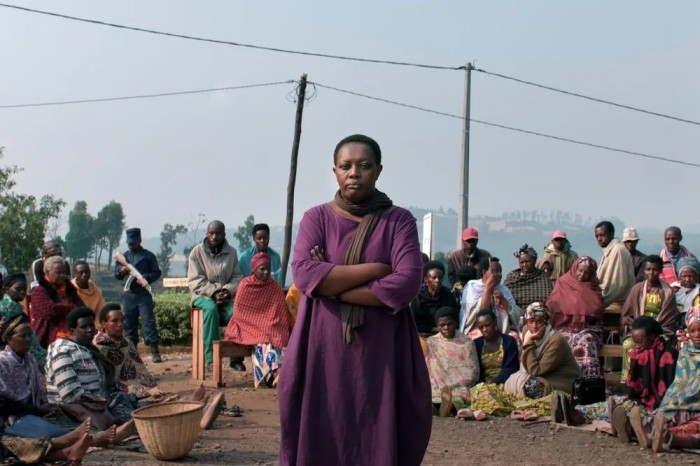
A Rwanda-Gabon co-production with France, Norway and Côte d’Ivoire, Ben’Imana premiered in Un Certain Regard at the 2026 Cannes Film Festival, where it became the first Rwandan film to screen in the festival’s official selection. Dusabejambo subsequently won the Caméra d’Or for Best First Feature, while the film also received the FIPRESCI Prize. It later screened at the Toronto International Film Festival and is scheduled for its UK premiere at the BFI London Film Festival.
Ben’Imana was filmed entirely in Rwanda with a primarily Rwandan crew. Its historic submission gives Rwanda an immediate contender with a significant international festival pedigree while marking a new chapter for the country’s presence at the Academy Awards.
Read our review of Ben’Imana here.
Senegal – Liti Liti (The Attachment) (Dir. Mamadou Khouma Gueye)
The sole documentary submission from Africa, Senegal’s Liti Liti (2025) documents a neighbourhood on the outskirts of Dakar—where debut feature director Mamadou Khouma Gueye grew up and where his mother lives—which is now being destroyed with the construction of a high-speed rail line. The Wolof and French Language film is co-produced between Senegal, Belgium and France. It premiered at Visions du Réel in 2025 and won the Audience Award at the 3 Continents Festival the same year.
Although Senegal has never been nominated, the country has had one of West Africa’s most fruitful relationships with the Oscars, making the shortlist three times so far, out of eight total submissions all of which were submitted in the past decade. Senegal’s submission for the 98th Oscars (Mamadou Dia’s Demba (2024)) did not appear on the Academy’s final list, but Liti Liti marks the country’s fifth consecutive submission.
South Africa – Variations on a Theme (Variasies op ‘n Tema) (Dirs. Devon Delmar, Jason Jacobs)
South Africa’s submission to the 99th Oscars is one of the most widely travelled and acclaimed African films of the year—a drama and docufiction drawn from co-director Jason Jacobs’ community and starring his grandmother, Hetti Farmer. Variations on a Theme (2026) follows an octogenarian goat herder and members of her community who are drawn into a scam offering overdue reparations for their ancestors’ unpaid World War II service.
Variations on a Theme premiered at the 2026 International Film Festival Rotterdam (IFFR) where it won The Tiger Award, the festival’s top prize, before coming home to win Best African Feature Film at the Joburg Film Festival 2026 and Jury Prize for Best Feature Narrative at the BlackStar Film Festival 2026. The film also screened at the 2026 editions of the Melbourne International Film Festival and Hong Kong International Film Festival and is scheduled to screen at the BFI London Film Festival this October.
The Afrikaans-language film is a co-production of South Africa, Qatar, and the Netherlands, and is the twenty-second film submitted by South Africa in thirty-eight years. The country famously won Africa’s third and latest Oscar in the International Feature category in 2006, with Gavin Hood’s Tsotsi (2005), after Darrell Roodt’s Yesterday (2004) earned a nomination in the previous year. South Africa has also had two other films shortlisted in later years. The country’s most recent submission before Variations on a Theme, Imran Hamdulay’s The Heart Is a Muscle (2025), did not make the shortlist.
Read our review of Variations on a Theme here.