


Variations on a Theme is proof that the most political act available to cinema is also its most ancient: to look at a person fully, and refuse to look away.
By Joseph Jonathan
In 1944, somewhere between the deserts of North Africa and the mudfields of Italy, a young man from the Kamiesberg mountains of South Africa’s Northern Cape was fighting a war that his country had decided he could serve but not fully join. He was among the approximately 80,000 Black South Africans who enlisted in the Native Military Corps during the Second World War.
They were permitted to carry picks and shovels but, under the racial logic that preceded formal apartheid, were largely denied the right to carry arms. They served in the same theatres of war as their white counterparts. But when they returned home, those counterparts were rewarded with land, livestock, and the infrastructure of a future. His reward, after four years of service, after whatever he had seen and survived in dark and foreign lands, was a pair of boots and a bicycle. He went home to his goats.
His granddaughter is named Hettie. She is 79 years old and closely approaching her 80th birthday. She wakes each morning in Kharkams, a small settlement in the Northern Cape’s Kamiesberg region, and walks her goats through a landscape of ruddy fynbos and putty-coloured soil. Little about it has changed substantially in the decades since her grandfather returned from Europe with his bicycle and boots and whatever it was he preferred never to speak about. She watches her flock with the patient, narrow stare of a woman who has been watching things for a very long time, and occasionally wonders — the film’s narration tells us — whether the goats think of her as a mother or a god. She is not inclined toward sentimentality. She has had enough children of her own.
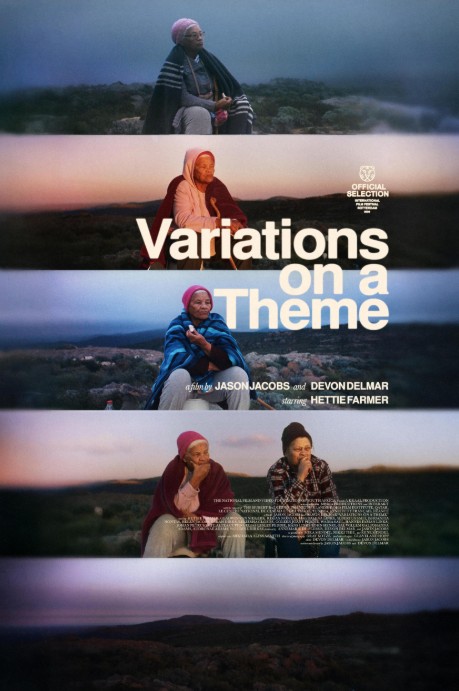
Written and directed by Jason Jacobs and Devon Delmar and shot by cinematographer Gray Kotzé, Variations on a Theme is a film about Hettie and the community her life is embedded in. It won the Tiger Award at the International Film Festival Rotterdam (IFFR) and Best African Film at the Joburg Film Festival before screening at the Melbourne International Film Festival (MIFF).
But more precisely, it is a film about what history does to a place when it never fully leaves. The Kamiesberg region has been shaped by successive systems of extraction: colonial dispossession, apartheid’s racial geography, and post-apartheid governmental neglect. The latter has left communities like Kharkams economically stranded in a democratic South Africa that has not yet found a way to convert its constitutional promises into material reality. These are not the film’s subject matter in any didactic sense. They are its atmospheric condition; the air the characters breathe, the soil beneath their feet, the specific texture of their daily waiting.
The film’s most structurally audacious move is to hold this history and its contemporary continuation in the same frame. Into Hettie’s quiet, self-sufficient existence arrives news of a government reparations scheme, promising long-overdue compensation to the descendants of Black veterans like her grandfather. The catch, delivered through car-mounted loudspeakers and WhatsApp audio messages that serve as the film’s most mordantly contemporary sound design, is a processing fee: pay a little to receive a lot. It is, of course, a scam: an analogue version of the kind of digital fraud that preys on hope and financial desperation with equal efficiency. And it has taken in Hettie and several of her neighbours, who wait for a payday that will not come with the specific patience of people who have spent generations waiting for things that do not arrive.
The continuity between these two acts of extraction — the colonial state’s bicycle and boots, and the scammer’s processing fee — is the deepest and most precise historical argument in Variations on a Theme. Both operate on the same logic: identify a community that has been made economically vulnerable by history, offer them a version of what they were always owed, and extract something further in the transaction.
The British military’s reward for Hettie’s grandfather was not merely insulting; it was the foundation of the economic disadvantage that made his granddaughter, eighty years later, a viable target for people running the same basic scheme with updated technology. Variations on a Theme does not state this argument. It does not need to. It simply shows Hettie signing up for the reparations scheme, and the image (a woman whose entire material life bears the marks of what was taken from her grandfather) contains the argument whole.
Variations on a Theme belongs to a rich tradition of African documentary-fiction hybrid cinema. Think Jean Rouch’s ethnofiction experiments of the 1950s and 1960s, or Mati Diop’s Dahomey (2024). In these films, the boundary between observation and invention is not a problem to be resolved. It is part of the point. Reality and the stories we tell about it are never fully separable, and the space between them can be artistically productive.
Hettie is played by co-director Jacobs’ own grandmother, Hettie Farmer, whose face carries the specific authority of a person who is not performing a life but living one in front of a camera. The non-professional cast drawn from the Kharkams community gives the film its texture of documentary intimacy. The scripted narrative elements — the reparations scam, the family’s arrival for Hettie’s birthday, the slowly gathering pressure to leave Kharkams for a child’s city home — give it dramatic shape.
The result is a film that occupies the productive space between these registers without belonging fully to either, and whose most powerful moments are precisely those where the boundary between them becomes impossible to locate.
Kotzé’s cinematography is among the most quietly accomplished works in recent South African cinema. Every frame of Variations on a Theme is composed with the attention of someone who understands that the Kamiesberg landscape is not merely beautiful but politically significant. That the wide, unpopulated expanses of the Northern Cape carry the history of who was removed from them, who was permitted to remain. They also suggest the limits of life in a place the post-apartheid economy has largely forgotten.
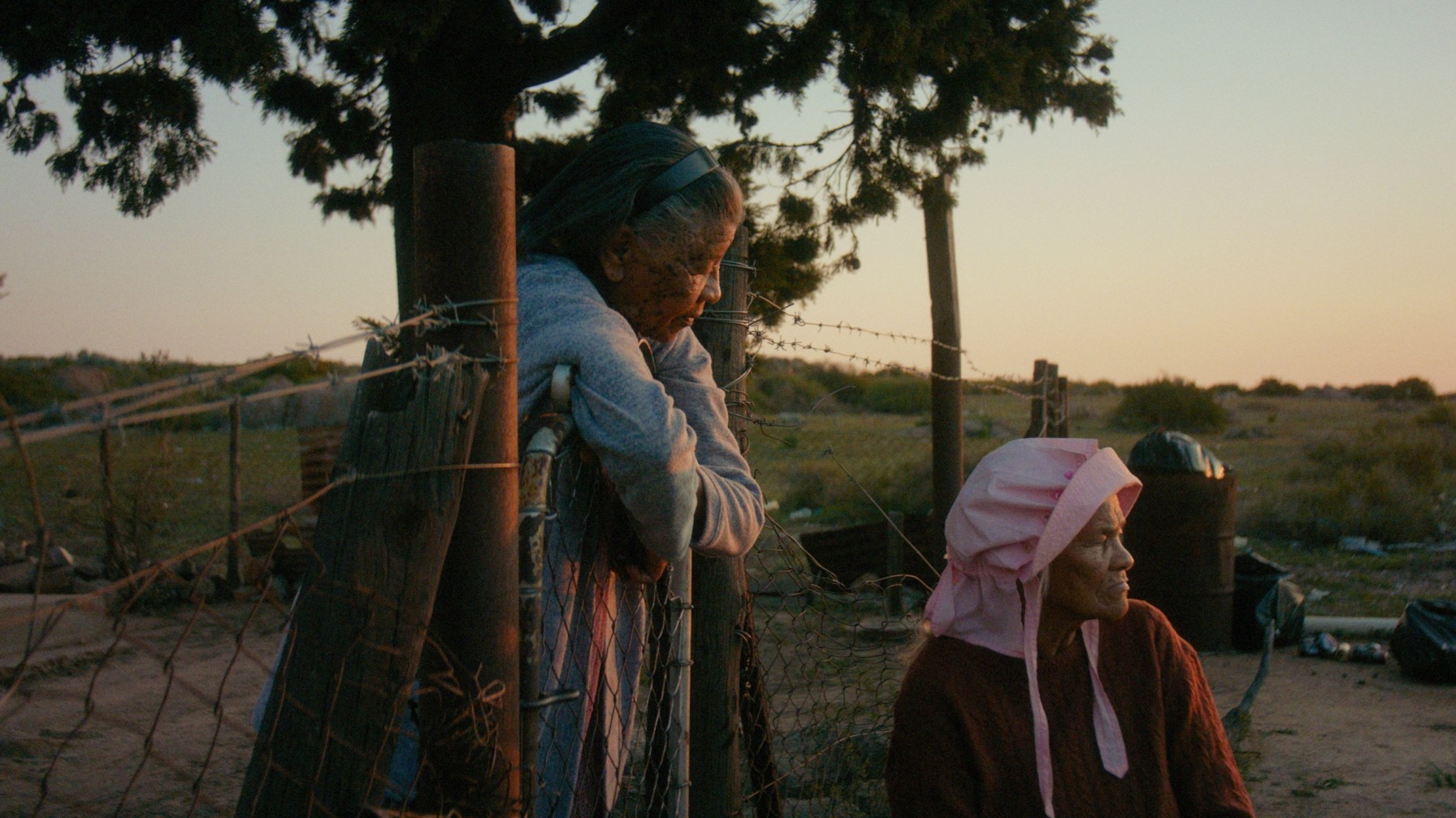
The widescreen format is used with intelligence and restraint, giving the landscape its full geological scale while keeping Hettie small within it, not diminished, but properly placed, a human figure in a world that precedes and will outlast her. The zinc buildings and barbed-wire fences that mark human presence are photographed with the same attention as the fynbos and the mountain light, refusing the temptation to aestheticise poverty while also refusing to make it merely grim.
The film’s formal organisation around routine, the daily rhythm of Hettie’s goatherd life, repeated across several mornings with the specific variations that give the film its title, is one of its most intelligent structural choices.
The repetition is not redundancy but accumulation. Each return to the familiar sequence reveals something slightly different, either in the world or in the viewer’s attention to it. What feels initially like stillness gradually reveals itself as a kind of depth. Jacobs and Delmar understand that the lives they are documenting are organised around routine not because nothing happens in them but because routine is the form that endurance takes; the daily structure that makes it possible to keep going in conditions that have not substantially improved across generations.
Where the film is most vulnerable to criticism and where my own viewing experience diverged most productively from straightforward admiration, is in its use of the voiceover narration. Read by Jacobs in a characterful Afrikaans vernacular, the narration is genuinely lyrical in its best passages, finding the philosophical substance in ordinary moments with a literary intelligence that recalls Dylan Thomas or the South African prose tradition of Herman Charles Bosman. But it is also, at times, explanatory in ways that the film’s extraordinary images do not require. There is a sequence involving delivery boxes in the hairdresser’s garage (boxes that represent the money he has spent in anticipation of reparations that will not come) whose image alone carries the full weight of what the narration moves to explain. The boxes tell the story. The voiceover tells it again. The film’s visual intelligence, which is remarkable and consistent, deserves to be trusted further than the narration trusts it.
This is not a fatal flaw; the narration earns its place often enough that its occasional redundancy reads as a productive excess rather than a structural failure. But it is the gap between a very good film and the masterpiece that lives inside it, visible in the best frames. One suspects that budgetary and time constraints may have influenced the decision to use narration where expanded scope might have served better. The film is sixty-five minutes long. It could have been ninety and lost nothing, gained much.

Hettie herself is the film’s most complete achievement. She does not speak or barely speaks, and when she does, it is with the economy of someone who has long since understood that silence communicates more reliably than words. Her face, in Kotzé’s patient compositions, is a landscape in itself: the specific topography of a long life, marked by work and weather and the accumulated experience of being a Black woman in a country that has not known what to do with her except ask her to wait.
Mikhaila Alyssa Smith’s solo piano score moves through her scenes with a lyrical restraint that matches the film’s visual register, suggesting an alternative history of this community — a version of Kharkams where the wealth generated by its people’s labour remained in their hands — without sentimentalising the distance between that imagined history and the actual one.
At sixty-five minutes, Variations on a Theme is concise in a way that intensifies rather than limits its impact, each scene earning its place, the runtime refusing the indulgence that this material might have invited from a less disciplined filmmaking team.
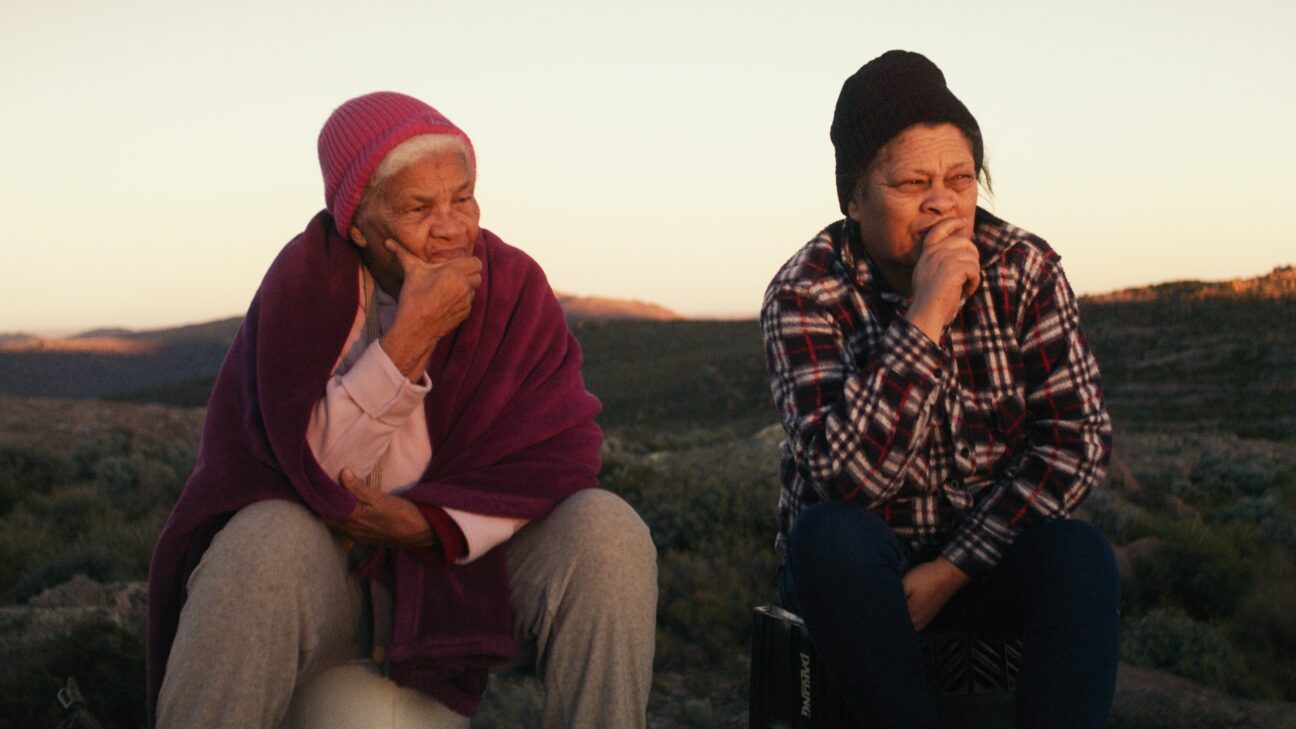
The community of Kharkams is rendered with the warmth of filmmakers working close to home and the rigour of filmmakers who understand that affection without honesty is merely sentiment. Its domino players and diamond-diggers, teenage mothers and spendthrift hairdressers, ghosts and stubborn dreamers are all part of the film’s generous portrait.
What the film offers instead is something rarer: the specific dignity of being fully seen, in all of your complexity, by people who have taken the trouble to understand what your life costs and what it contains.
Hettie’s grandfather came home from the Second World War with a pair of boots and a bicycle. His granddaughter now waits for a reparations payment that will not come, in the same landscape he returned to, tending the same animals, enduring the same specific quality of governmental indifference.
Variations on a Theme does not offer resolution to this continuity. It offers something more honest: witness. And in the tradition of the best Southern African storytelling, witness turns out to be enough. Variations on a Theme is proof that the most political act available to cinema is also its most ancient: to look at a person fully, and refuse to look away.
Rating: 4/5
Joseph Jonathan is a historian who seeks to understand how film shapes our cultural identity as a people. He believes that history is more about the future than the past. When he’s not writing about film, you can catch him listening to music or discussing politics. He tweets @Chukwu2big.