


While The Road Home enters development with strong international backing, its announcement also inevitably recalls the growing visibility of African talent in large-scale global adaptations.
By Joseph Jonathan
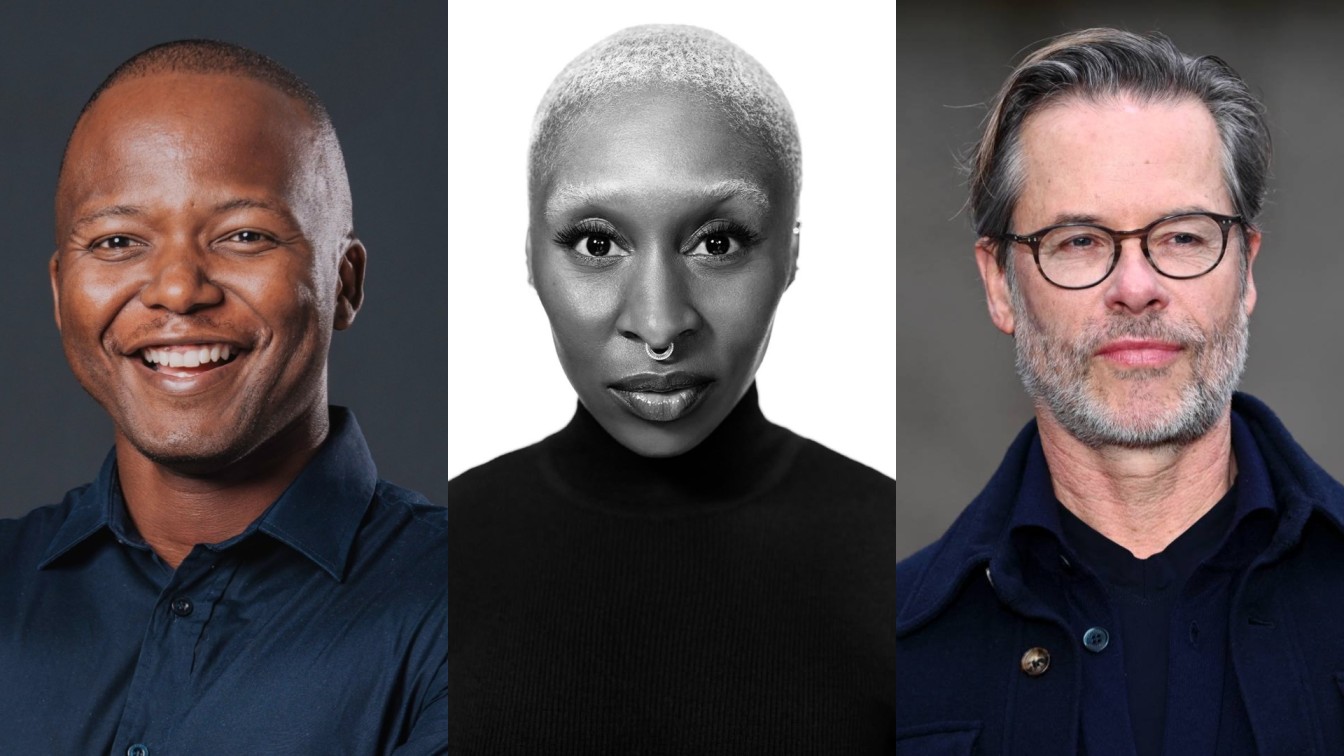
A new musical drama tracing one of the most politically charged intersections of music and resistance in modern history is set to begin production, as Cynthia Erivo, Thabo Rametsi, and Guy Pearce join the cast of The Road Home, a film exploring the lives of South African music legends Miriam Makeba and Hugh Masekela during the apartheid era and their global entanglement with Paul Simon’s Graceland project.
At its core, The Road Home revisits a moment when music, politics, and global culture collided. Rametsi takes on the role of Masekela, the iconic trumpeter whose exile from apartheid South Africa left him navigating between memory and displacement, while Erivo portrays Makeba, the internationally revered vocalist whose artistry and activism made her one of the most powerful cultural figures of the liberation struggle. Pearce plays Archbishop Trevor Huddleston, the anti-apartheid cleric whose mentorship and activism positioned him at the moral centre of the cultural boycott debates surrounding Simon’s Graceland album.
The film situates itself within the late 1980s cultural boycott movement, when Simon’s Grammy-winning Graceland—inspired by South African township music—sparked global controversy over accusations of violating the United Nations-led cultural boycott of apartheid South Africa. Within this tension, Masekela and Makeba’s collaboration emerges as both artistic expression and political intervention, forming a “supergroup” whose music becomes inseparable from the liberation struggle itself.
According to the production team, the film is described as a story of “defiance, sacrifice and the resilience of the human spirit,” with director Bill Condon framing it as an exploration of how art and activism intersect in ways that remain deeply contested and politically resonant.
“This is a powerful story about art intersecting with activism, a friction that’s only become more complex with time,” Condon said. “I’m honoured to be a part of this extraordinary team.”
The screenplay was originally developed by Daniel Bronner following research commissioned by the Hugh Masekela Heritage Foundation, with additional contributions from South African writer Zakes Mda, who conducted extensive interviews with Masekela. Music producer Hilton Rosenthal—who worked closely with Paul Simon during the original Graceland sessions—joins as co-producer and has secured rights to the catalogue of both Simon and the South African icons at the centre of the story, alongside plans to produce new recordings for the soundtrack.
Financing is led by Studiocanal alongside Flora Films and Rob Bath, with international sales handled by Palisades Park Pictures ahead of the Cannes Film Market. Production is expected to begin in South Africa in June, with Studiocanal also set to distribute the film across multiple territories, including South Africa, the UK, France, Germany, Italy, Benelux, Poland, Australia and New Zealand.
The film’s ensemble is rounded out by producers including Laura Bickford, Anant Singh, and Greg Yolen, with executive production credits spanning Studiocanal leadership and the Hugh Masekela Heritage Foundation, which has described the project as an extension of Masekela’s lifelong commitment to cultural preservation and political expression through music.


While The Road Home enters development with strong international backing, its announcement also inevitably recalls the growing visibility of African talent in large-scale global adaptations. The casting of Erivo in particular draws a parallel with her role in another major African-rooted production, Children of Blood and Bone, which also features cross-continental collaborations and a pan-African narrative ambition. That film notably placed South African actor Thuso Mbedu in a leading role alongside Nigerian and African diaspora talent, a reflection of Hollywood’s increasing but still uneven interest in African-centred storytelling.
In both cases, the industry’s shifting landscape is evident: African stories are no longer confined to regional cinema circuits but are increasingly positioned within global prestige frameworks. Yet the question that continues to linger is not visibility, but authorship; who gets to shape these narratives, and how faithfully they reflect the histories they draw from.
As executive producer Fiona Druckenmiller noted, “Our constant goal is to bring local stories to a global audience, rooted in South Africa’s identity. This story speaks far beyond its borders, showing how music can become a force for identity and change.”
For South African cinema, The Road Home signals another moment in a long tradition of politically engaged storytelling rooted in music and memory. For audiences, it promises a return to an era when sound itself was a battleground—and when voices like Makeba and Masekela carried the weight of a nation’s longing for freedom.
The film is slated to begin shooting in South Africa ahead of its anticipated launch at the Cannes Film Market.