

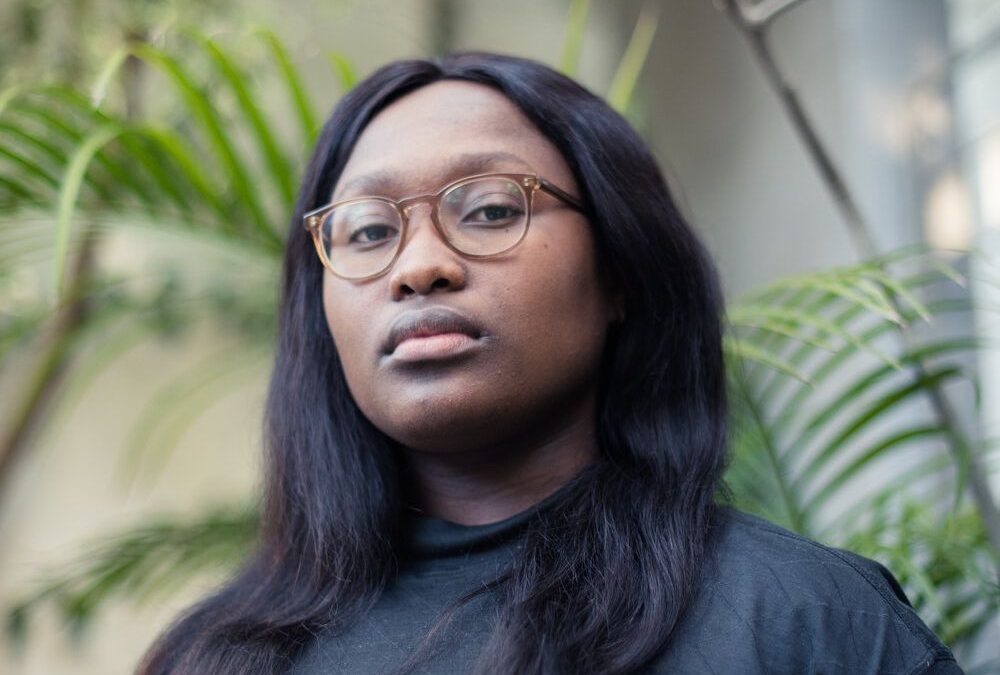


“I really wanted a view on queerness, especially in Africa, that is joyful and colourful, because we need that”. – Sandulela Asanda
By Jerry Chiemeke
There’s a moment early in Black Burns Fast (2026) when 17-year-old Luthando spots the object of her affections across the classroom, and literal hearts on sticks are held up in front of her eyes. It is, in the best possible way, exactly the kind of moment you don’t expect from an African coming-of-age film arriving on the international festival circuit. And that, in many ways, is precisely the point.
It’s silly, irresistible, and it tells you everything you need to know about the kind of director that South African filmmaker Sandulela Asanda is. Her debut feature, expanding the short film Mirror Mirror (2022) that premiered at the Berlinale’s Generation 14plus section in 2023, arrives with an almost startling sense of arrival: a fully-formed voice, a distinct aesthetic universe, and a filmmaker who knows exactly what story she wants to tell and why.
Sandulela Asanda has described Black Burns Fast as a love letter to her younger self, and you feel that devotion everywhere in the film: in the irreverent dialogue, and in the way it refuses to let queer Black girlhood be defined only by its suffering.
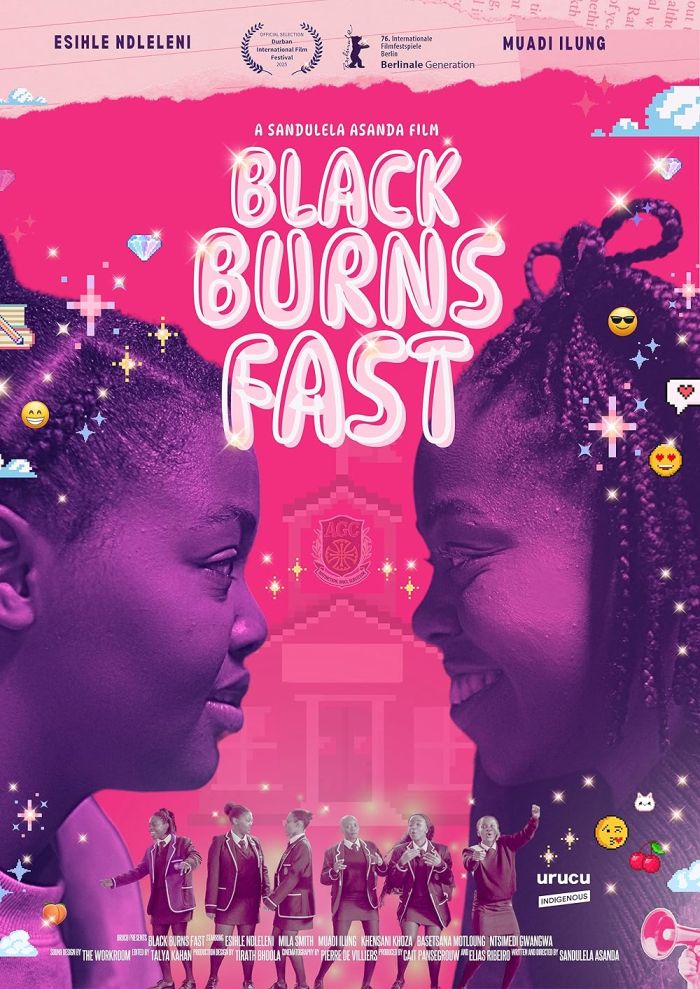
This 96-minute feature unfurls with the confidence of something made under real creative urgency, unshackled from the familiar burden of trauma that too often governs how African stories are received. Insisting on joy as a legitimate (and maybe even radical) mode of storytelling, it brings its unique visual language to the table: video game-style inserts, meme culture, playful special effects, and a cinematographic energy that keeps pace with the tenor of the plot.
The film unfolds against the backdrop of an Anglican boarding school still tightly tethered to its old hierarchies, but Sandulela Asanda’s gaze remains fixed on her protagonist’s inner world: its confusions, its dawning desires, and its raucous, life-saving friendships. Luthando (Esihle Ndleleni), a high-achieving Black scholarship student, has built her identity around academic excellence, quiet obedience and the approval of a conservative institution that views her largely as its token success story. Everything shifts when the ebullient, exuberant Ayanda Khumalo (Muadi Ilung) arrives and begins to pull Luthando out of herself.
What audiences are presented with is a queer coming-of-age story steeped in the DNA of Hollywood high school classics, from Mean Girls (2004) to Booksmart (2019), yet rooted in a specifically South African texture: the residual cultural tensions racial hierarchies of a post-apartheid elite, the suppression of indigenous language in corridors that police what is deemed “vernacular”, and the particular weight carried by Black girls in spaces that were never designed with them in mind.
Afrocritik sat down with Sandulela Asanda to discuss the making of Black Burns Fast, queer joy as resistance, and what it means for African women to create art on their own terms.
Black Burns Fast feels defiantly joyful. In a landscape where so many African films treat queer identity as a source of shame or suffering, was that a conscious act of resistance, or did the story simply demand it?
Yes, that was my intention from the beginning. I really wanted a view on queerness, especially in Africa, that is joyful and colourful, because we need that. My experience as a queer person has been a great joy in my life, and it’s helped me self-actualise in other areas as well. I wanted to show that element, that point of view, because I think that African queer people and (by extension) queer people everywhere need to see that. As much as other stories are valid and there is a place for them, since they come from a very real place, I think this one does, too. We deserve to have joy, and to see that (play out).
You’ve managed to hold flamboyance and tenderness in the same hand throughout this film, which is incredibly difficult. How did you protect the film’s emotional sincerity while leaning so hard into its camp, playful aesthetic?
It was a long process, involving a lot of writing and a lot of thinking. My first draft was very “in-your-face” and anti-establishment. Also, when I started writing it, I think I was working through things that had happened in my high school. To be honest, this (screenplay) is tame compared to my high school.
As I kept reworking the drafts and getting to know the characters better, I realised that to serve the story properly, I really need to maintain that balance. There’s no way that I could have spoken about who Luthando is and her journey without addressing what’s happening, because it’s so prevalent not just in that space, but also in general discourse across South African society.
The visuals feel like a genuine extension of how Luthando and her friends actually inhabit the world. How early did this visual layout reveal itself to you, and how did you work with your cinematographer to execute it without it overwhelming the story?
In writing the feature from the beginning, that had always been an element. But before the feature, I’d done a short film called Mirror Mirror in 2022, and that’s where I started playing with those elements. It was a short film that was shot over a laptop and phone, and I had to find a way to make things really interesting. And then I realised “oh, this actually works”, but also it was a really great way to express the internal world of Luthando and the girls. As I was writing it, I really did my best to integrate that as well.
My cinematographer, Pierre de Villiers, also worked on the short with me, and we spent about three months going through the script page by page, looking at what I had written, but also looking at any ideas that he had. In his office, we put all these sticky notes on his wall, and we plotted out the entire film based on these visual effects. Then we were like, “okay cool, does this work? When we look at this, does this pattern work in terms of pacing? How is this going to affect things?”
Then, we just kept going through that, even in post-production, with him giving input. So it was really a collaboration between both of us.
Another really interesting thing was your writing of Luthando’s mother. She is conservative and comes from a different generation, but you succeeded in creating an individual whose arc is quite multidimensional. How did you approach writing and directing her so that audiences could find some sort of complexity around her?
I think she was actually the most difficult character for me to write, because I didn’t want her to be the antagonist in this story. There’s a generational element in the way Luthando navigates the world and sees herself. She is a child of a single mother who has also had to deal with being an outcast in certain ways, especially as a woman who’s also religious, unmarried and raising a child. As a result, her mother keeps her sheltered and wants her to act a certain way. So it was important to keep that in mind.
Also, when I started writing (this film), I started really seeing my own mother and her complexities. The older you get, especially as a woman, the more you start to see the way that the world treats women in general. It’s like “okay, I may not have liked this thing that you did, but I can see why.” I really worked hard to try not to make her (Luthando’s mother) a caricature or one-dimensional, but to give her space to grow a little bit. The relationship between black mothers and black daughters is quite complex.
This film possesses all the attributes common to the YA genre, and even if foreign audiences may want to draw parallels with flicks like Confessions of a Teenage Drama Queen, the truth is that Black Burns Fast is unmistakably its own thing. Were those reference points that you actively engaged with, or comparisons you anticipate and want to push back on?
I definitely expect the references, because they are right. The reason why I chose this genre, you know, coming-of-age, is because it’s a genre that’s really well known and allows me to access a wider audience. In my mind, I reasoned that if I was going to do this, I wanted as many people to be able to watch it and, in some way, relate it in terms of impact. I was a big fan of the 2000s teen comedy films, but at the same time, as much as I loved them, I always walked away with the same thing, which was the feeling that I wished I could see someone who looked like me. So that really played into the writing of this (film).
I once read a review that was written in the lines of my film “not revolutionising the genre”, and that’s fine, because I wasn’t trying to. The intent was to do it my way, do it in a South African way, do it in a queer way. My approach is what makes it unique, and that’s enough for me. My film doesn’t have to upend or disrupt the canon. I just want to be an African filmmaker and do my thing that my people resonate with, and if the rest of the world resonates with it, that is amazing.
Choosing the genre and the tone is a conscious decision. What I think I might struggle with sometimes is hearing people argue that in choosing this tone, I’m watering down these (social) conversations I am trying to have, but I don’t think so. I think it’s an easier way to access them, because people may get closed off if it’s too serious from the get-go, whereas laughter and comedy allow you to open an avenue for discussion where everyone has their guard down. In South Africa, there’s a saying that (roughly translates to) “if we don’t laugh, we’ll cry.” That’s how I think we deal with a lot of issues in the country as well, for better or for worse. Maybe that’s where the choice to go with comedy comes from.
What would you want people watching this film to go home with when the credits roll, and what doors do you hope this film opens for queer stories?
I think this film is definitely meant to start a discussion on post-apartheid South Africa, and I think what the film does is talk about the simmering tension that pervades the country despite this image of peace and unity that we put forward to the world.
I hope it opens up more acknowledgement and welcoming of queer stories from South Africa because we don’t have many, and that it opens the doors for other queer and young filmmakers, because they find it tough to get a chance in this industry.
In terms of what I hope people walk away with, I look forward to the acknowledgement and embracing of queer joy and queer black joy. I’d also love those who watch to think about the world around them and how they can help in creating safe environments for young queer people and black people, because those are important things.
*Black Burns Fast has been selected as the closing night film at the 2026 BFI Flare: London LGBTQIA Film Festival. This follows a screening in the Generation 14plus section of Berlinale 2026 for its international premiere.
Jerry Chiemeke is a Nigerian-born writer, film critic, journalist, and lawyer based in the United Kingdom. His writing has appeared in Die Welt, The I Paper, The Africa Report, The British Blacklist, Berlinale Press, The Johannesburg Review of Books, The Lagos Review, Culture Custodian and Olongo Africa, among others. Chiemeke’s work has won or been nominated for the Pushcart Prize, Ken Saro Wiwa Prize, Diana Woods Memorial Award for Creative Nonfiction, Best Small Fictions, and the Quramo Writers Prize. He is the author of the critically-acclaimed short story collection, Dreaming of Ways to Understand You.