

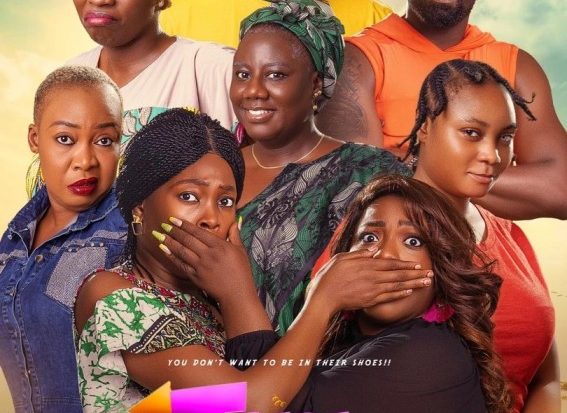

What Trade by Bata is really staging is a transaction in aspiration: the exchange of one identity for another and the discovery that the new identity comes with costs not visible in the original longing.
By Joseph Jonathan
The work of the renowned Nigerian novelist, poet and critic, Chinua Achebe, consistently argues that the most profound and lasting impact of colonialism was the psychological alteration of the colonised, who were conditioned to abandon their own worldviews and adopt the perspective of the coloniser. In that sense, the colonial enterprise’s most lasting psychological damage was the installation of a value system that taught Africans to see themselves through borrowed eyes.
To speak with a foreign accent, to carry a foreign education, to perform foreignness with sufficient conviction; these became, in the colonial and postcolonial imagination, not mere affectations but evidence of arrival, of having transcended the limitations of origin. The person who could pass, who could make the performance convincing, occupied a different social register than the one who could not. And the one who could not (the village girl, the local, the one whose English carried the honest music of her mother tongue) learned, often painfully, that her world and all its textures were the thing to be escaped rather than inhabited.
Achebe’s ideas were central to his literary mission to repair the damage of having one’s history and culture framed as inferior by Western narratives. But he was also, without knowing it, describing the premise of Trade by Bata.
Directed by Biodun Stephen, Trade by Bata is a Yoruba-inflected culture-clash comedy built around a body-swap conceit: Fiyinfoluwa (Solape Ogundimu), a Nigerian-American woman who returns to her ancestral village of Ori Ope to claim an inheritance, and Abebi (Bukunmi “KieKie” Adeaga-Ilori), the village girl who watches her with the hungry admiration of someone who has organised her entire self-image around a life she has never lived.
When a supernatural incident causes their voices and with them, their identities to switch, the film sets in motion what should be its central argument: that the thing Abebi has been reaching toward is not freedom but a different kind of cage, and that Fiyinfoluwa, for all her performed sophistication, has been running from something she cannot name. These are serious ideas. Trade by Bata is only intermittently serious about them.
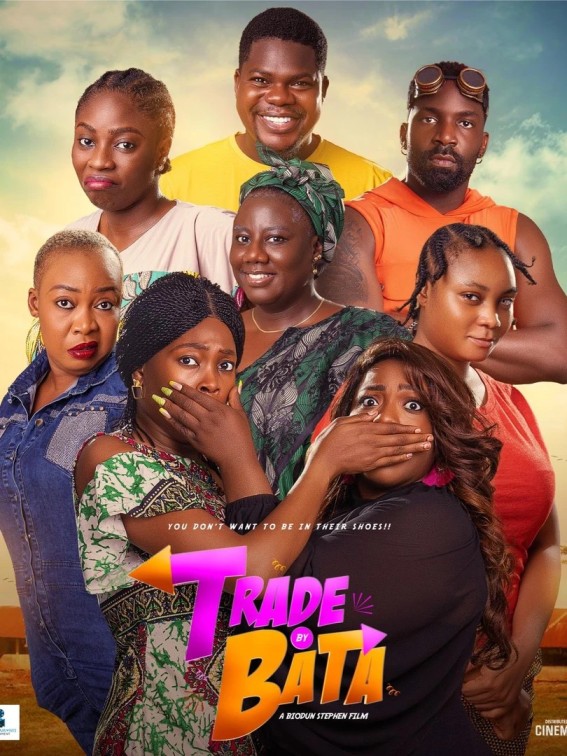
Body-swap comedy is one of cinema’s oldest formal devices, and its longevity rests on a simple truth: that the most efficient way to expose a person’s assumptions is to make them live inside the life they have been judging. From Turnabout (1940) to Freaky Friday (1976) to the more recent Good Fortune (2025), the genre works best when the switch is not merely comic but epistemological; when it forces a genuine reckoning with what the characters thought they knew about each other and themselves. The Nigerian context gives this formula a specific and potent charge, because the class and cultural hierarchies it is built to expose are not abstract in Nigeria.
They are daily, operational, and enforced through language and accent, postcode and the particular way certain people learn to minimise themselves in the presence of others who have mastered the performance of superiority. Abebi’s yearning for Fiyinfoluwa’s life is not simply personal ambition. It is the logical emotional response to a social order that has spent decades telling her that who she is, where she is from, and how she speaks are deficits to be overcome.
The film’s most honest and resonant moment arrives quietly, almost without announcement. When Abebi acquires Fiyinfoluwa’s accent and finds herself suddenly legible to the world in the way she has always wanted to be, her first instinct is not gratitude or liberation. It is condescension. She begins to look down on the people around her with the same casual contempt that was directed at her moments earlier.
The film does not editorialise this. It simply shows it, and in showing it makes its sharpest observation: that in a society organised around hierarchies of aspiration, the desire to rise is frequently inseparable from the desire to dominate. Abebi does not become cruel because Fiyinfoluwa’s personality infected her. She becomes cruel because cruelty was always embedded in the position she wanted, and the position has now arrived.
That is a genuinely sophisticated reading of class aspiration in Nigerian society, the way the oppressed, given the tools of the oppressor, so often reproduce the logic of oppression rather than dismantling it. It is the most Fanonian moment in recent Nollywood comedy, and the film, to its credit, earns it without quite realising how good it is.
This is also, unfortunately, the clearest illustration of Trade by Bata’s central limitation: it has better instincts than it has the discipline to follow. The film reaches toward something genuinely sharp and then retreats into the comfortable warmth of entertainment before the sharper thing can fully form.
The supernatural mechanism driving the switch (which is vaguely articulated, medically dressed but not medically convincing) creates a logical instability that the screenplay never resolves. More problematically, the internal rules of the identity displacement are inconsistently applied: a revelation late in the film, suggesting that Fiyinfoluwa has always had more Yoruba fluency than she let on quietly dismantles the premise that the first act worked to establish. A story built on identity displacement cannot afford to be careless about what, precisely, was displaced. When the rules of the game shift mid-play, the audience stops believing in the stakes.
The first twenty minutes are a particular test of patience. Before the switch occurs, which is, after all, the film’s entire reason for existing, there is a prolonged establishment period that moves with the unhurried confidence of a production that assumes its audience’s goodwill without doing enough to earn it. The characters are positioned, the village world is sketched, and the tone is calibrated, but none of it yet compels.
The comedy that trickles through in this opening stretch feels like it belongs to an earlier era of Nollywood entertainment, and the theatrical ambition the film subsequently attempts sits awkwardly against this foundation. When the switch finally arrives, it lands with genuine surprise, and the film briefly catches fire. The problem is that it has built a slow engine and must now ask it to move at a different speed.
Perhaps Trade by Bata belongs to the same canon as the Jenifa and Alakada franchises, built on the premise of “local” women who speak poor English and are willing to do anything to rise to a higher social standing. However, it is important to note that those franchises, at their most effective, achieved a specific kind of comic confidence where every formal element of filmmaking was oriented toward the same goal. The comedy was not only in the performances but in the pacing, the editing rhythm, the framing, and the sound design. Making a total comic architecture that made the jokes feel inevitable rather than attempted.
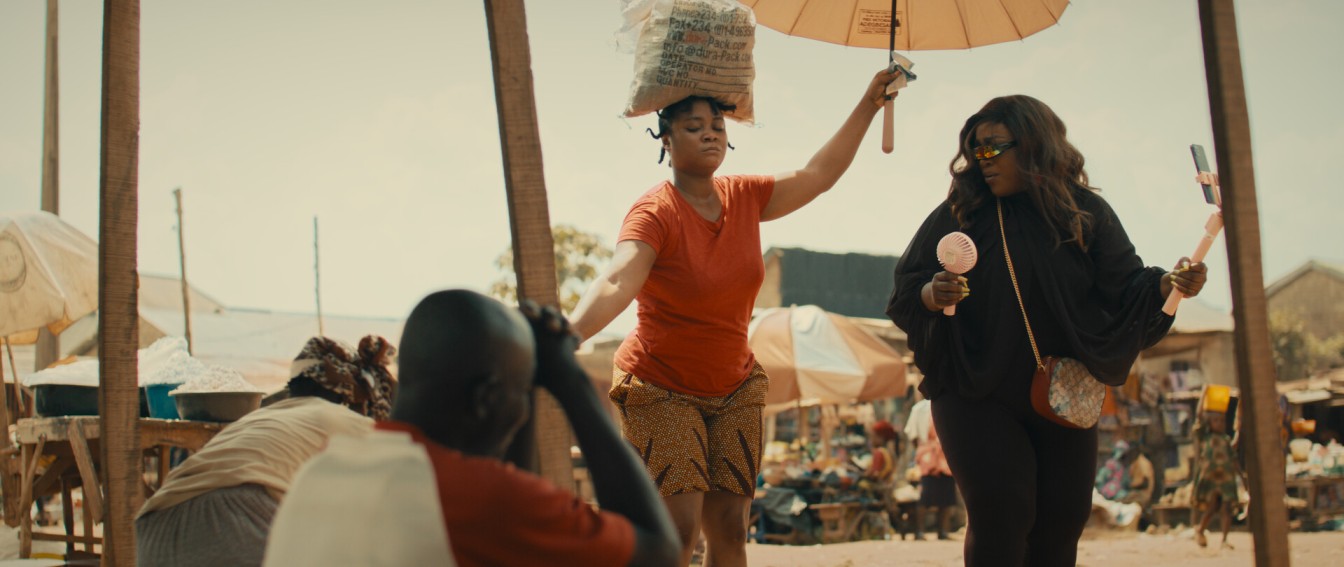
Trade by Bata has the premise and, in stretches, the performances, but it does not yet have that total architecture. The humour is carried almost entirely by situation and actor, which means that when those elements don’t land, there is nothing underneath to catch the fall. Biodun Stephen is a director whose reputation rests on emotionally grounded romantic drama, and that instinct is legible throughout as the film is more comfortable in its dramatic register than its comic one, and the best-constructed scenes tend to be the ones asking the most from its performers emotionally rather than comedically.
Those performers, it should be said, are doing significant work. Solape Ogundimu as Fiyinfoluwa is the film’s most technically committed presence. Her American accent carries the specific texture of a persona internalised rather than merely learned, the performance of someone who has not just acquired a sound but constructed an identity around it.
When she transitions to a Yoruba-inflected register following the switch, the shift is clean and confident. But there is a revealing irony in how much more believable her Yoruba register is than her American one, which exposes that the exaggeration was always the point, that Fifi was always a caricature of the aspirational Nigerian-American rather than a portrait, the kind of figure that Nollywood’s comic tradition has long used to explore the absurdities of diaspora performance. There is a version of Fiyinfoluwa that could have been both absurd and interior, both caricature and character. This film mostly chose the former.
Adeaga-Ilori’s Abebi is the more interior and ultimately more affecting performance. She carries the film’s emotional argument with a restraint that the broader comic register rarely affords, finding the psychological consistency beneath the character’s transformation without overstating it. The moment she acquires Fifi’s voice and immediately begins to deploy it as a social weapon is handled with a precision that the screenplay deserves more credit for writing, and Adeaga-Ilori deserves full credit for landing.
Debo Adedayo, as Wale — Fifi’s city boyfriend, whose arrival introduces an inheritance-adjacent subplot that the film never quite integrates into its main emotional arc — brings warmth and capable chemistry to a role that functions more as connective tissue than as a fully developed character. He is at his best in the quieter scenes, where the loverboy dimension of the role has room to breathe, and slightly less convincing in the scenes that ask him to carry comedic weight alone.


The most quietly interesting casting decision in the film involves Modola Osifuwa, who plays the househelp at the pivot of the central mystery. Osifuwa is known, to the Nigerian digital audience most likely to be watching this film, almost entirely for a specific persona: polished, accent-perfect, coded upper-class in ways that her social media presence has made into a kind of personal brand.
In Trade by Bata, she appears stripped of all of this; cast deliberately against the identity her audience associates with her, placed in a role that makes her the quiet instrument of someone else’s accent being taken away. The irony is almost architecturally precise: the woman Nigerians know for her perfect accent is the one responsible for removing someone else’s. Whether this was deliberate meta-casting or a fortunate coincidence, it is the film’s most interesting creative gesture, and it lands fully only for the audience that knows what it’s looking at.
Visually, the film is competent rather than inventive. The village setting carries its weight as a moral and physical environment; there is intelligence in the way Ori Ope’s unhurried rhythms quietly humiliate the characters’ self-importance, but the cinematography does not exploit the location with any formal ambition. Framing is functional and consistent, and the production design gives the village world sufficient credibility, particularly in the domestic spaces that feel lived-in rather than constructed.
The editing keeps the film moving at a workable pace without using rhythm as a comic instrument in the way that the best Nollywood comedies do. The sound design is workmanlike. There is also a small but telling error that deserves mention: the signboard welcoming visitors to the film’s setting spells Ori Ope as “Ori Okpe” — a phonetic transcription that makes visual nonsense of a Yoruba word and communicates, however unintentionally, a carelessness about the specific linguistic and cultural world the film is claiming to inhabit.
This is because Yoruba words generally do not have two consonant sounds occurring without an intervening vowel, and the letter ‘p’ in Yoruba already acts as a “kp” sound. Writing “kp” explicitly is often considered non-Yoruba. In a film whose central argument is about the dignity of local identity against the condescension of those who look down on it, this is an irony the production should have caught.
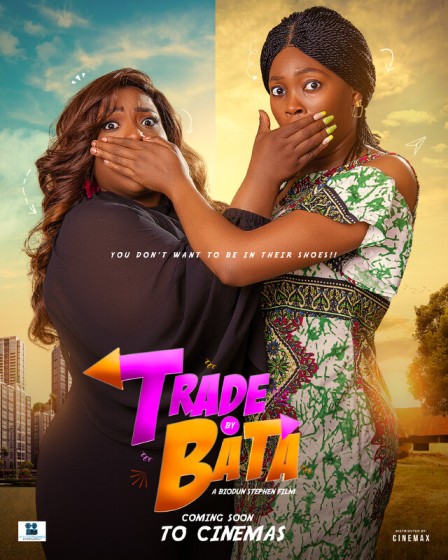
Trade by Bata arrives at a moment when Nollywood’s Yoruba-language and Yoruba-adjacent comedy tradition is in a period of productive self-examination, navigating between the grassroots energy of the YouTube pipeline and the more technically ambitious productions that streaming platforms and theatrical distribution demand.
It is a film that sits uncomfortably between these registers, with instincts that belong to a more ambitious film and execution that periodically retreats to a more familiar one. What it has is a premise with real cultural intelligence and two lead performances that do more with it than the screenplay fully deserves.
The title itself is worth sitting with. Trade by Bata: a swap, an exchange, a transaction. Bata is the Yoruba word for a specific traditional drum, but it is also, in the film’s punning logic, a phonetic cousin of “barter”.
What the film is really staging is a transaction in aspiration: the exchange of one identity for another and the discovery that the new identity comes with costs not visible in the original longing. Abebi wanted Fifi’s life. She got Fifi’s voice. And the first thing she did with it was use it to diminish someone else. That is the oldest transaction in the Nigerian social playbook, and Trade by Bata, at its best moments, knows it. It deserved a film more fully equipped to hold that knowledge from beginning to end.
Rating: 2.2/5
Joseph Jonathan is a historian who seeks to understand how film shapes our cultural identity as a people. He believes that history is more about the future than the past. When he’s not writing about film, you can catch him listening to music or discussing politics. He tweets @Chukwu2big