


Once punishment becomes something to be watched rather than merely witnessed, the question is no longer only why Nigerians have embraced mob justice. It becomes why justice itself now appears to demand an audience.
By Joseph Jonathan
In June 2026, at a campus of the National Open University of Nigeria, a man accused of stealing office laptops stood in the middle of a crowd of students and security personnel. He had already been beaten; an eyewitness later described the moment someone struck him on the head, knocking him to the ground. The people around him had recovered what they believed he stole, and the immediate danger had passed. By every conventional understanding of justice, the story should be over. Instead, someone tells him to dance.
As music and laughter erupt around him, dozens of phones are raised into the air. Some record from a distance; others move in for a closer shot. The objective was no longer merely to apprehend an alleged thief but to produce a spectacle. Within hours, the video had travelled far beyond the university campus where it was filmed, finding new audiences on X, Facebook, TikTok, Instagram and WhatsApp. There, another crowd took over. They reposted clips, added humorous captions, quoted their favourite moments and turned the man’s humiliation into the day’s entertainment.
The incident is hardly unique. In recent months, Nigerian social media has seen a noticeable stream of videos showing alleged thieves tied up, paraded with stolen items, stripped to their underwear, or compelled to sing and dance before jeering crowds after being apprehended. Some videos provoke outrage, many provoke laughter, and almost all of them are consumed with astonishing speed before the country’s attention shifts to the next spectacle. What once would have remained a local incident now acquires a potentially permanent afterlife online, where punishment is no longer confined to a place or a moment but endlessly replayed for strangers who were never there.
It would be easy to read these videos simply as evidence of Nigeria’s enduring problem with mob justice. Certainly, they speak to a society where confidence in formal institutions has eroded so profoundly that many citizens believe justice is more likely to be found in the hands of an angry crowd than in a police station or courtroom. But stopping there misses something equally revealing. The beatings are only one part of the story. So too are the stripping, the forced dancing, the public parading, the filming, the posting, and, perhaps most tellingly, the jokes that almost inevitably follow. Each is a distinct act, serving a different purpose, yet together they form a ritual that says as much about contemporary Nigerian society as it does about crime itself.
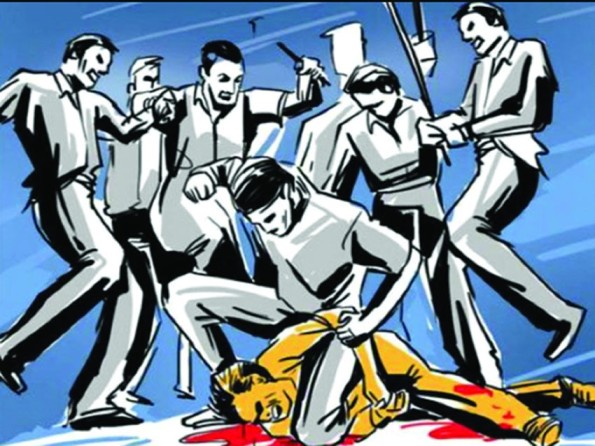
These videos reveal more than a crisis of law enforcement. They reveal a crisis of imagination about what justice itself is supposed to look like. They expose a culture in which punishment has become performance, cameras have become participants rather than passive observers, and humour has transformed another person’s degradation into a form of public entertainment. Without the possibility of virality, many of these humiliations would probably never happen in the form they now do.
If mob justice reflects a failure of the state, then its viral afterlife reflects something else entirely: the emergence of a digital spectatorship in which justice is no longer simply administered or denied, but performed, consumed and shared. To understand why these videos have become so familiar—and why so many Nigerians watch, laugh and move on—we must look beyond the alleged crimes they depict and examine the society that has turned humiliation into content.
The Vacuum Left by the State
The temptation, when confronted with these videos, is to reduce them to evidence of individual cruelty or a uniquely Nigerian penchant for mob justice. But neither explanation is sufficient on its own. Public violence does not become normal because societies suddenly lose their moral compass. More often, it flourishes where institutions fail to inspire confidence. The crowd steps in because the state has stepped back.
For decades, Nigerians have lived with a criminal justice system that inspires more scepticism than reassurance. Stories of victims being discouraged from reporting crimes, investigations stalling indefinitely, suspects bribing their way out of custody, or police officers extorting both complainants and the accused have become so commonplace that they scarcely register as extraordinary anymore. Court cases can drag on for years. Conviction rates remain low. In such an environment, many citizens have come to believe that handing a suspect over to the authorities is less an act of justice than an invitation for the person to return to the streets a few days later. Whether this perception always reflects reality is almost beside the point. Public trust, once eroded, reshapes behaviour regardless of the facts.
This is not to legitimise vigilante violence. Rather, it is to recognise it for what it is: a symptom of institutional collapse rather than a substitute for justice. Across history, communities have repeatedly resorted to forms of informal justice whenever formal systems were absent, inaccessible or distrusted. In Nigeria, from neighbourhood vigilante groups to spontaneous acts of mob punishment, the impulse often springs from the same source: a conviction that the state cannot or will not protect ordinary people. The crowd’s confidence in its own authority grows in direct proportion to its distrust of official authority.
Yet even this does not fully explain the scenes unfolding in today’s viral videos. If the crowd’s objective were simply to prevent an alleged thief from escaping before the police arrived, or more troublingly, to exact immediate punishment for a perceived offence, then the beatings alone would satisfy that objective. But increasingly, they do not. There is often a deliberate pause after the violence, a moment when the spectacle begins. The suspect is ordered to hold up the stolen item for the camera. He is made to dance. To sing. To repeat phrases dictated by the crowd. Sometimes he is stripped almost naked before being paraded through streets or marketplaces. These acts do not make stolen property easier to recover, nor do they make future prosecutions more likely. Their purpose lies elsewhere. They transform punishment into theatre.
This distinction is crucial because violence and humiliation are not identical. The variations are limited only by the crowd’s imagination. In Benin City, a man accused of stealing electrical wires was made to twist the wires into a makeshift crown, place it on his own head, and rap for the crowd’s amusement while they filmed. The stolen wire was not simply recovered; it was repurposed as a prop. Violence seeks to inflict pain; humiliation seeks to destroy dignity before an audience. The difference may seem subtle, but it changes the entire meaning of the act. A person who is beaten suffers physical harm. A person who is forced to dance after being beaten is being compelled to participate in his own degradation. The crowd is no longer merely asserting control over his body; it is asserting control over his identity, reducing him from an individual accused of wrongdoing into a spectacle designed for collective amusement and moral affirmation.
It is here that the smartphone begins to alter the ritual in fundamental ways. Public punishment has always relied on witnesses. Today’s punishments rely on viewers. The camera is no longer an incidental observer documenting events as they unfold; it has become part of the performance itself. Those issuing instructions to dance, sing or pose often do so with the lens in mind, aware that the true audience extends far beyond the people physically present. What begins as an act of vigilante justice increasingly ends as a piece of content awaiting circulation.
And once punishment becomes something to be watched rather than merely witnessed, the question is no longer only why Nigerians have embraced mob justice. It becomes why justice itself now appears to demand an audience.
When Punishment Becomes Performance
The French philosopher Michel Foucault begins Discipline and Punish (1975) with one of history’s most infamous public executions: the brutal torture of Robert-François Damiens in eighteenth-century France. The details are deliberately difficult to read, not because Foucault wishes to revel in violence, but because they reveal something fundamental about how power once operated. Punishment was not simply about correcting the offender. It was theatre. Executions, floggings and other forms of corporal punishment were staged before crowds as spectacular demonstrations of sovereign power. The public was not merely expected to witness punishment; it was expected to absorb its message.

Foucault’s point is not simply that punishment became less violent over time, but that it ceased to be public theatre. As modern justice moved into courtrooms and prisons, punishment increasingly disappeared from public view, governed, at least in principle, by legal procedures rather than the emotional impulses of a crowd. That is what makes today’s viral humiliation videos so striking. Without restoring the authority of the state, the smartphone has restored one of its oldest rituals: punishment as spectacle.
The videos circulating across Nigerian social media are not public executions, nor are they state-sanctioned punishments. Yet they reproduce one of spectacle’s defining features: the insistence that punishment must be seen. The alleged thief is not merely restrained or assaulted. He is displayed. He is made to perform his shame before an audience, while the audience itself performs its outrage, amusement or approval through cheers, laughter and the cameras held aloft. The recording is not incidental to the event; it has become one of its central purposes.
In this sense, the smartphone has done more than document vigilante justice. It has transformed it. A punishment that might once have been witnessed by a few dozen people in a market square can now reach millions within hours. Every repost recruits another spectator. Every meme extends the life of the humiliation. Every comment section becomes another gathering around the proverbial public square, except this one has no closing time and no geographical limits.
This transformation also redistributes responsibility in ways we rarely acknowledge. It is easy to assign blame to those physically assaulting an alleged thief because their violence is immediate and visible. Less obvious is the role played by everyone else. The person who decides to film rather than intervene. The friend who forwards the clip to five WhatsApp groups. The content creator who overlays comic sound effects or reaction memes. The thousands of strangers who laugh, share and move on. None of them threw the first punch, yet each helps ensure that the punishment continues long after the crowd has dispersed.
There is an uncomfortable tendency to think of online audiences as passive observers, as though watching carries no moral weight. But digital spectatorship is rarely passive. Social media platforms reward engagement above all else, and engagement gives spectacle its value. A video that attracts millions of views does not simply reflect public interest; it encourages the production of more videos like it. Visibility becomes its own incentive. The possibility of virality begins to shape behaviour on the ground, making the camera not just a witness to humiliation but one of the reasons it is performed in the first place.
This is perhaps the most profound difference between today’s public humiliations and those of earlier eras. Medieval crowds eventually went home. Their memories faded, their stories changed with retelling, and the spectacle dissolved into history. The internet does not forget so easily. A viral video can outlive the event itself, detached from context and endlessly rediscovered by people with no knowledge of what actually happened.
Even where an accused person is later found innocent—or where the facts prove more complicated than the original video suggested—the digital record remains stubbornly intact. The punishment acquires a permanence that no court ever imposed.
And permanence changes the nature of humiliation. It is one thing to suffer disgrace before a crowd gathered in a single place. It is another to have that disgrace preserved, replicated and consumed indefinitely by audiences who were never there. The crowd is no longer confined to a street corner, a market or a university campus. It now stretches across timelines, feeds and comment sections, growing larger with every click.
If the first failure in these videos is institutional (the inability of the state to command public confidence) then the second is cultural. Somewhere between the smartphone lens and the algorithm, punishment ceases to be merely an act of retribution and becomes a form of entertainment. The question is no longer simply why these videos are made. It is why so many of us find ourselves willing to watch.
When Humiliation Becomes a Joke
If the smartphone gives these performances an audience, humour ensures they travel. Scroll through the comment section beneath one of these videos and the emotional rhythm is strikingly predictable. There will be outrage, certainly. There will be those who insist that no one deserves such treatment, guilty or otherwise. But before long, another mood begins to take over. Someone isolates the suspect’s awkward dance and pairs it with a trending song. Another turns a still image into a reaction meme. Others quote whatever the suspect was forced to say, transforming a moment of degradation into an inside joke. Within hours, the conversation has shifted. The alleged crime recedes into the background, replaced by the entertainment value of the punishment itself.
To dismiss this simply as callousness would be too easy and, perhaps, inaccurate. Humour has long been one of Nigeria’s most reliable survival mechanisms. In a country where political disappointment, economic uncertainty and insecurity have become routine features of everyday life, laughter often performs the work that optimism no longer can.
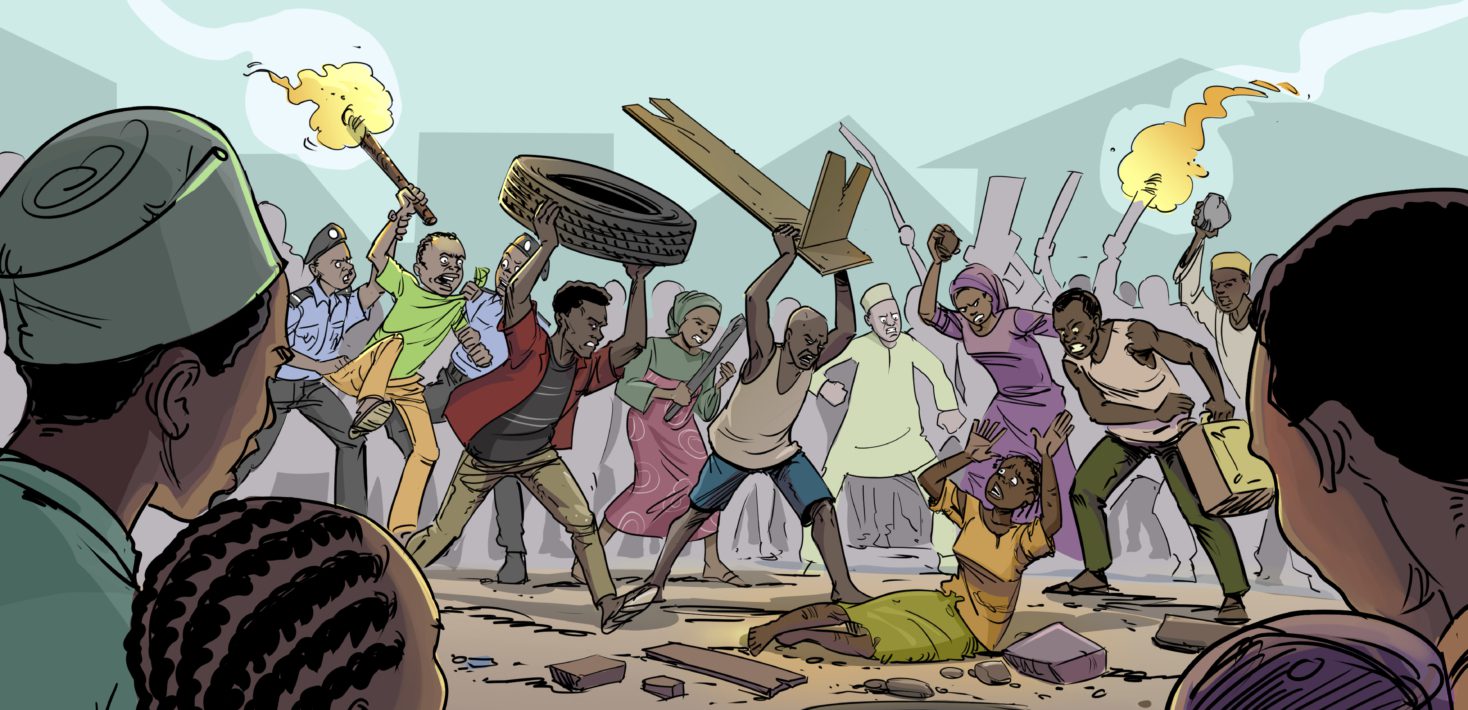
Nigerians joke about fuel prices, power cuts, inflation, impossible commutes and broken promises not because these realities are insignificant, but because they are so overwhelming that humour becomes one way of enduring them. Sometimes, laughter is less an expression of joy than a refusal to surrender to despair.
This is precisely the tension that the writer Chimezie Chika explores in his essay, “Why Nigeria’s Joke Culture Has Become Its Biggest Handicap”. Chika argues that the country’s instinct to turn every crisis into comedy, while understandable as a coping mechanism, can also dull the sense of urgency that meaningful social and political problems demand. Constant humour, in his view, risks becoming a form of emotional disengagement, a way of surviving dysfunction without ever confronting it. Whether one agrees with his conclusion or not, the recent wave of humiliation videos suggests that this culture of joking has entered an even more troubling phase.
The issue is no longer simply that Nigerians joke about hardship. It is that we increasingly joke about humiliation. That distinction matters. There is a profound moral difference between laughing at one’s own predicament and laughing at another person’s degradation. The former can create solidarity. It says, “we are all enduring this together”. The latter creates distance. It transforms another person’s suffering into something to be consumed rather than understood.


Even where the subject of that suffering is someone accused of committing a crime, the ease with which punishment slips into comedy should give us pause. The internet, of course, accelerates this transformation. Digital platforms are indifferent to moral categories. Their algorithms do not distinguish between joy, grief, violence or humiliation; they distinguish only between content that captures attention and content that does not.
This is not a uniquely Nigerian problem. Across the world, social media has normalised the conversion of deeply human experiences into fleeting spectacles for public consumption. But Nigeria’s particular social realities give the phenomenon a sharper edge. In a society already marked by institutional distrust and chronic hardship, humour can become more than a coping mechanism. It can become a defence against feeling too much. The joke creates just enough emotional distance to prevent discomfort from turning into reflection.
Yet there is a cost to this distance. Every time another humiliation becomes a meme, the humanity of the person at its centre becomes slightly easier to overlook. This observation is not an appeal for sentimentalism, nor is it an argument that people accused of theft should be exempt from accountability. Rather, it is a reminder that the dignity we deny to those we dislike is often the first dignity a society learns to discard. Once degradation becomes entertaining in one context, it becomes easier to accept in others.
Perhaps this explains why these videos so quickly lose their moral gravity. The internet conditions us to move rapidly from one spectacle to the next, rarely lingering long enough to ask difficult questions. We laugh, we repost, we scroll. Another video appears. Another alleged thief. Another crowd. Another performance. The cycle repeats until what should have disturbed us begins to feel ordinary. And perhaps that is the greatest danger, not that Nigerians have become incapable of empathy, but that repeated exposure has taught us to suspend it, if only for the length of a video.
Who Gets Humiliated?
There is one final question these videos force us to confront, and it may be the most uncomfortable of all. Who gets humiliated?
The answer is revealing. The people stripped to their underwear, forced to dance before crowds, made to carry placards, or paraded through markets are rarely the Nigerians accused of stealing the most. They are usually alleged phone thieves, pickpockets, or young men suspected of petty crimes; people with little social, economic or political power to resist the crowd assembled before them.
This is not to diminish the harm of street crime. Losing a phone, a bag or a month’s earnings can be devastating in an economy where many people already live precariously. Communities have every right to demand safety, and victims deserve justice. But justice loses its moral authority when its severity appears to depend less on the offence than on the offender’s powerlessness.
Compare these scenes with the public treatment of those accused of looting public funds or abusing political office. Corruption scandals involving billions of naira routinely dominate newspaper headlines. Anti-graft agencies announce investigations. Press conferences are held. Lawyers issue statements. Court dates are adjourned and readjourned. The language surrounding these cases is procedural, restrained and legalistic. Due process, rightly, becomes the guiding principle.
Yet the same society that insists on the presumption of innocence for the politically connected often abandons that principle altogether when confronting someone accused of stealing a laptop or a mobile phone. The contrast is difficult to ignore. Dignity, it seems, is distributed unevenly. This disparity reveals something deeper than inconsistency. It suggests that these spectacles are not simply about punishing wrongdoing. They are also performances of power.

Public humiliation flows downwards because it is easiest to inflict upon those least able to resist it. Crowds cannot strip a governor in the village square. They cannot force a politically connected contractor to dance before a ring of smartphones. They cannot parade an influential businessman through the streets while strangers laugh. Those people are protected by wealth, influence, security and legal representation. The poor rarely enjoy such insulation.
In this sense, the videos expose two parallel systems of accountability operating in contemporary Nigeria. One belongs to the powerful, where allegations are filtered through institutions, however imperfectly. The other belongs to the powerless, where accusation itself can become conviction, and humiliation becomes both sentence and spectacle. The irony is difficult to escape: in a society where many people distrust the justice system because they believe it treats the powerful too gently, informal justice often compensates by treating the powerless with extraordinary cruelty.
Perhaps this is why these videos feel so unsettling. They are not simply records of isolated acts of mob violence. They are mirrors reflecting multiple failures at once. They reflect a state that has struggled to earn public confidence. They reflect digital platforms that reward spectacle over reflection. They reflect a culture increasingly accustomed to processing suffering through humour. And they reflect a society whose harshest forms of accountability often fall upon those with the fewest means of defending themselves.
None of this requires us to romanticise criminality or overlook the fear and frustration that drive communities to apprehend suspected thieves. Crime is real. So too is the anger of those who have repeatedly watched offenders escape meaningful consequences. But a society’s moral character is revealed not only by how it responds to crime, but by the methods it comes to accept in the name of justice. The treatment of society’s most despised members—those accused, guilty or innocent, whom few people feel compelled to defend—often says more about a community’s ethical boundaries than the treatment of its most celebrated citizens.
The viral videos of alleged thieves dancing, singing or standing half-naked before jeering crowds will eventually disappear beneath the next cycle of trending topics. Another clip will replace them. Another crowd will gather. Another suspect will become another day’s content. But before we laugh, repost or scroll past the next one, perhaps the more pressing question is not whether the person in the middle of the crowd deserves punishment. It is why punishment no longer seems complete until the rest of us have watched it.
Joseph Jonathan is a historian who seeks to understand how film shapes our cultural identity as a people. He believes that history is more about the future than the past. When he’s not writing about film, you can catch him listening to music or discussing politics. He tweets @Chukwu2big.