

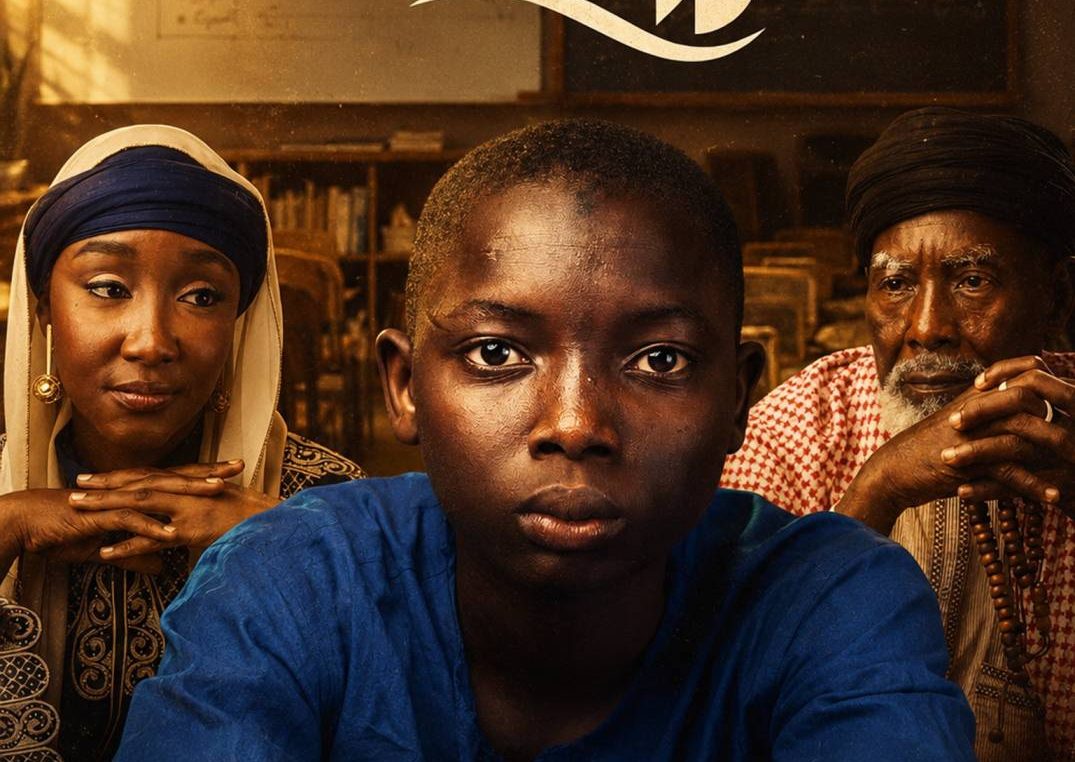

Perhaps The Almajiri’s greatest achievement is that it refuses simplistic answers to deeply complicated questions.
By Joseph Jonathan
Few educational systems in Nigeria have attracted as much misunderstanding, politicisation, and genuine concern as the Almajiri system. For centuries, it functioned as a respected institution of Islamic scholarship across Northern Nigeria, producing generations of Qur’anic scholars under the guidance of mallams who were entrusted with both religious and moral instruction.
But colonial disruption, rapid urbanisation, declining public investment, and widening economic inequality gradually transformed many of these schools into spaces where children were left to fend for themselves on city streets, surviving through alms while pursuing religious education. In public discourse, the word Almajiri has since become less associated with learning than with poverty, neglect, and political exploitation.
It is into this complicated historical terrain that actor-turned-director Jammal Ibrahim makes his feature directorial debut with The Almajiri, the final film from the First Features Project. Written by Comfort Chikainene Nwaobasi, the film follows Rabiu (Ahmad Isa), a gifted Almajiri whose dream of becoming a tech engineer places him at the centre of an ideological struggle over education, faith, and the future of Northern Nigeria.
Ibrahim, best known to audiences for his acting work in The Delivery Boy (2018), The Milkmaid (2020), and Crime and Justice Lagos (2022), approaches the material with visible empathy. Rather than reducing the Almajiri system to simplistic binaries of backwardness or victimhood, the film attempts to examine the competing worldviews that continue to shape educational debates across northern Nigeria.

Rabiu is an unusually compelling protagonist because his conflict never emerges from rejecting Islam itself. Instead, he believes that his religious education and his scientific ambitions can coexist. That belief, however, is not shared by his teacher, Mallam Bala (Musa Muhammad Abdullahi), who fears that Western education will distract the boy from becoming a respected Islamic scholar. Prevented from attending formal school, Rabiu secretly receives after-school lessons from Teacher Safiya (Ijapari Ben-Hirki), creating a quiet but persistent act of resistance against the limitations imposed upon him.
The screenplay wisely refuses to caricature Mallam Bala into a one-dimensional antagonist. His opposition emerges from conviction rather than cruelty. He genuinely believes he is protecting Rabiu’s future, even if his understanding of that future feels increasingly incompatible with the realities surrounding him. That nuance prevents the film from collapsing into an easy argument that tradition itself is the enemy.
The film expands this educational debate through Lami (Jamila Ibrahim), an activist who rescues vulnerable children from their families without parental consent, hoping to enrol them in a STEM programme in Abuja. Her intentions are difficult to dismiss. Many of the children she encounters face futures shaped by child marriage, poverty, or exploitation. Yet The Almajiri also understands that noble intentions cannot excuse ethically troubling methods.
Unfortunately, this storyline also exposes one of the screenplay’s biggest weaknesses. Local politicians quickly manipulate Lami’s activities into allegations that she is recruiting children for Boko Haram, a development with enormous dramatic and political implications. Yet the conflict is resolved so hastily that the narrative barely explores the consequences of such accusations. A subplot capable of interrogating misinformation, political opportunism, and public distrust instead arrives at a resolution that feels surprisingly underdeveloped.

Politics surfaces again through Honourable Magaji (Yakubu Mohammed), who recruits Almajiri children into criminal activities while publicly presenting himself as their benefactor. Here, the film reminds viewers that vulnerable children often become convenient tools within larger systems of political violence and corruption. But even this thread stumbles during one of the screenplay’s least convincing moments.
After Rabiu, Sani (Muhammad Abdullahi Ashraf), and Mustapha (Abdullahi Ibrahim Ramadan) discover that a bag entrusted to Sani contains a bomb, their reaction is curiously subdued. Rather than responding with the panic such a discovery would reasonably provoke, the boys calmly discuss the explosive, close the bag, and casually deliver it to Teacher Safiya. The scene undermines the danger it attempts to establish, exposing a lapse in dramatic credibility. The screenplay’s structural looseness extends to its pacing.
At just over two hours, The Almajiri occasionally stretches material that might have benefited from greater economy. Certain sequences linger beyond their emotional usefulness, slowing the narrative’s momentum even when its thematic concerns remain engaging.
Yet the film consistently compensates for many of these shortcomings through its craft. Ibrahim directs with an evident affection for northern Nigeria, allowing Kano’s architecture, streets, and landscapes to become active participants in the storytelling rather than mere backdrops. The cinematography captures the city’s rhythms with warmth and texture, while the film’s colour grading lends the narrative a visual richness that complements its emotional register. The dialogue similarly feels grounded, particularly in the exchanges between Rabiu and his closest friends, Sani and Mustapha. Their conversations possess the easy familiarity of children whose dreams have developed together despite living within circumstances designed to suppress them.



The performances elevate the material even further. Ahmad Isa, who first drew attention in Finding Nina (2025), delivers an assured lead performance built on quiet determination rather than exaggerated heroism. His Rabiu is thoughtful, intelligent, and hopeful without ever becoming sentimental.
Muhammad Abdullahi Ashraf and Abdullahi Ibrahim Ramadan provide equally convincing support, their chemistry reinforcing the emotional stakes of the boys’ shared aspirations. Musa Muhammad Abdullahi also deserves recognition for portraying Mallam Bala with enough restraint to preserve the character’s humanity even when audiences disagree with his choices.
Perhaps The Almajiri’s greatest achievement is that it refuses simplistic answers to deeply complicated questions. It neither dismisses Islamic education nor blindly celebrates Western education. Instead, it asks whether children should ever be forced to choose between faith and opportunity when both can coexist.
Its screenplay sometimes struggles to sustain the complexity of the ideas it introduces, and tighter editing could have produced a more focused, dramatically satisfying film. Nevertheless, Ibrahim’s debut remains an important contribution to contemporary Nigerian cinema precisely because it chooses conversation over condemnation. In a country where discussions around the Almajiri system are often reduced to political slogans and cultural stereotypes, The Almajiri insists on restoring the humanity of the children living inside that debate.
Rating: 3/5
Joseph Jonathan is a historian who seeks to understand how film shapes our cultural identity as a people. He believes that history is more about the future than the past. When he’s not writing about film, you can catch him listening to music or discussing politics. He tweets @Chukwu2big.