

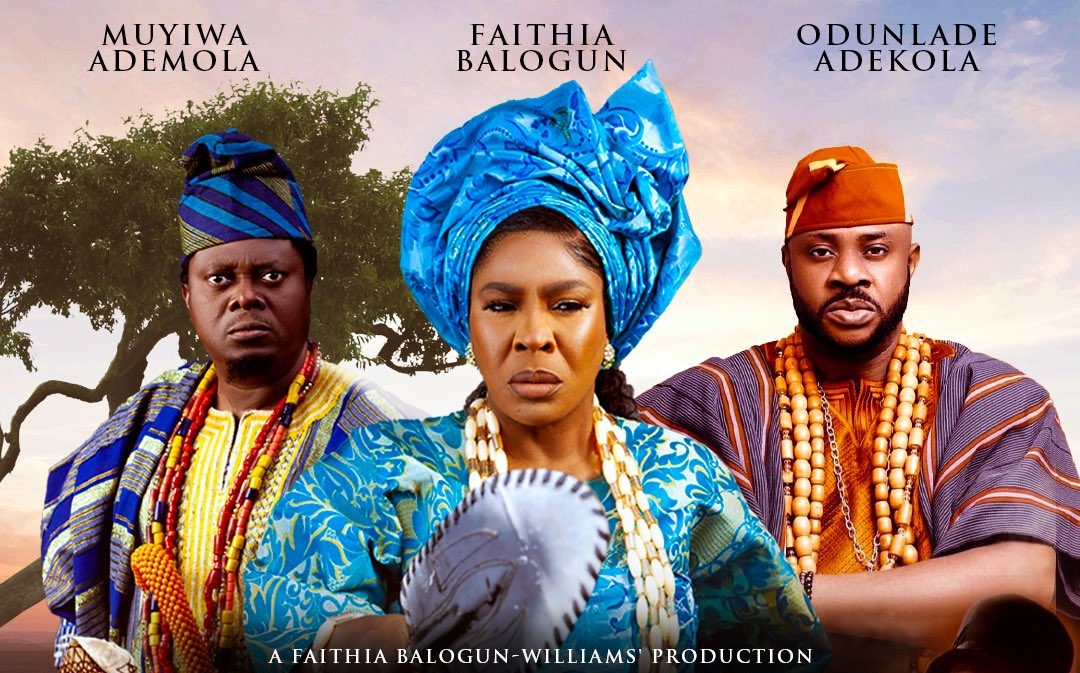

The film that genuinely reckons with Efunroye Tinubu will not be able to leave its audience feeling inspired in the uncomplicated way this one does.
By Joseph Jonathan
In 1855, Benjamin Campbell, the British Consul to Lagos, wrote to his superiors in London describing Efunroye Tinubu as the most destabilising force in Lagos politics, a woman whose commercial empire and political influence had made her, in his estimation, ungovernable. He was not wrong. By the time Campbell orchestrated her exile to Abeokuta in 1856, Efunroye Tinubu had survived the death of two husbands, built a trading network that stretched from the interior Yoruba kingdoms to the Atlantic coast, financed the installation of at least one Oba, and operated one of the most significant slave trading businesses in the region.
She was, depending on your vantage point and your priorities, a victim of colonial power, an instrument of African patriarchal structures, a self-made capitalist in one of the most dangerous commercial environments in 19th-century West Africa, and a woman who sold other human beings into bondage with the same strategic intelligence she applied to every other dimension of her life. She was all of these things simultaneously, and the impossibility of reducing her to any single one of them is precisely what makes her one of the most compelling figures in Nigerian history.
It is also, in 2026, precisely what makes a film about her a political act. Efunroye: The Unicorn, directed by Tope Adebayo Salami, Adebayo Tijani, and Abbey Lanre, and executive produced by Faithia Williams Balogun alongside Niyi Akinmolayan, Diran Adeyinka, and Kemi Anibaba, is a film that announces its revisionism in its subtitle. A unicorn is a mythological creature of purity and rarity.
To name Efunroye Tinubu a unicorn is to have already decided for her, before a single frame has been shot, before a single scene has been written, before the audience has been given any opportunity to form their own view. The title is not a description. It is a verdict. And the film, for all its visual ambition and period craft, never escapes the gravity of that pre-emptive judgment.
Before it arrived in cinemas, a version of this argument had already been rehearsed elsewhere. In 2022, Gina Prince-Bythewood’s The Woman King (a visually stunning epic about the Agojie warriors of the Dahomey Kingdom) generated one of the most substantive critical debates in recent cinema discourse. It asked audiences to celebrate women warriors whose kingdom was, historically, one of the most active suppliers of enslaved Africans to the transatlantic trade.
The film’s defenders argued that all historical cinema involves selection and emphasis, that the Agojie’s military brilliance and female agency were worth celebrating on their own terms. Its critics (among them historians, diaspora scholars, and cultural commentators who had not forgotten what Dahomey’s participation in the slave trade meant for millions of people) argued that selective memory in the service of a feel-good narrative is not artistic licence but moral evasion.
The debate was never resolved, because it cannot be: it sits at the intersection of history, identity, and the politics of representation in ways that resist clean conclusion. That debate is the doorway through which Efunroye: The Unicorn enters. What happens once it is inside is a distinctly Nigerian story, carrying a distinctly Nigerian charge.
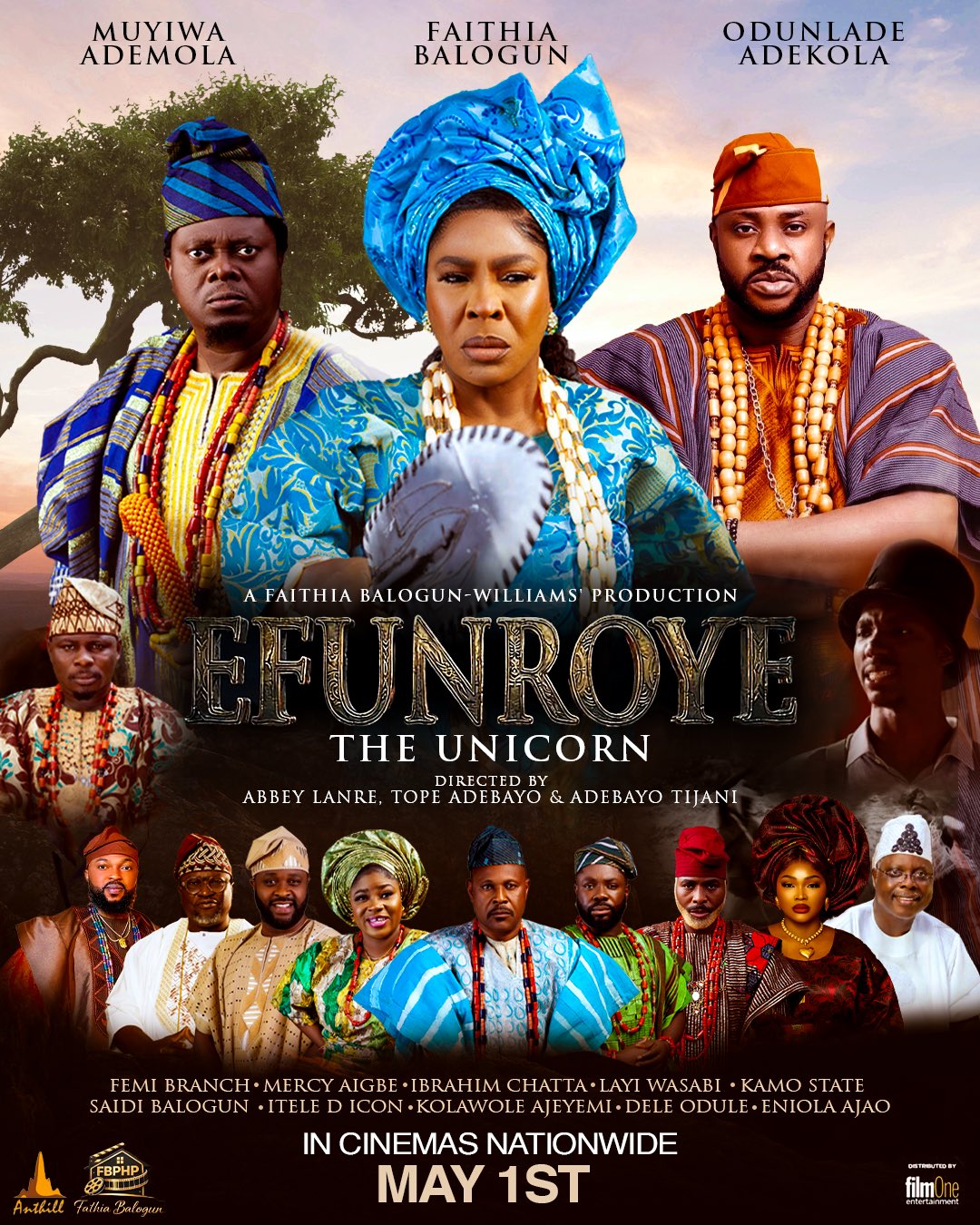
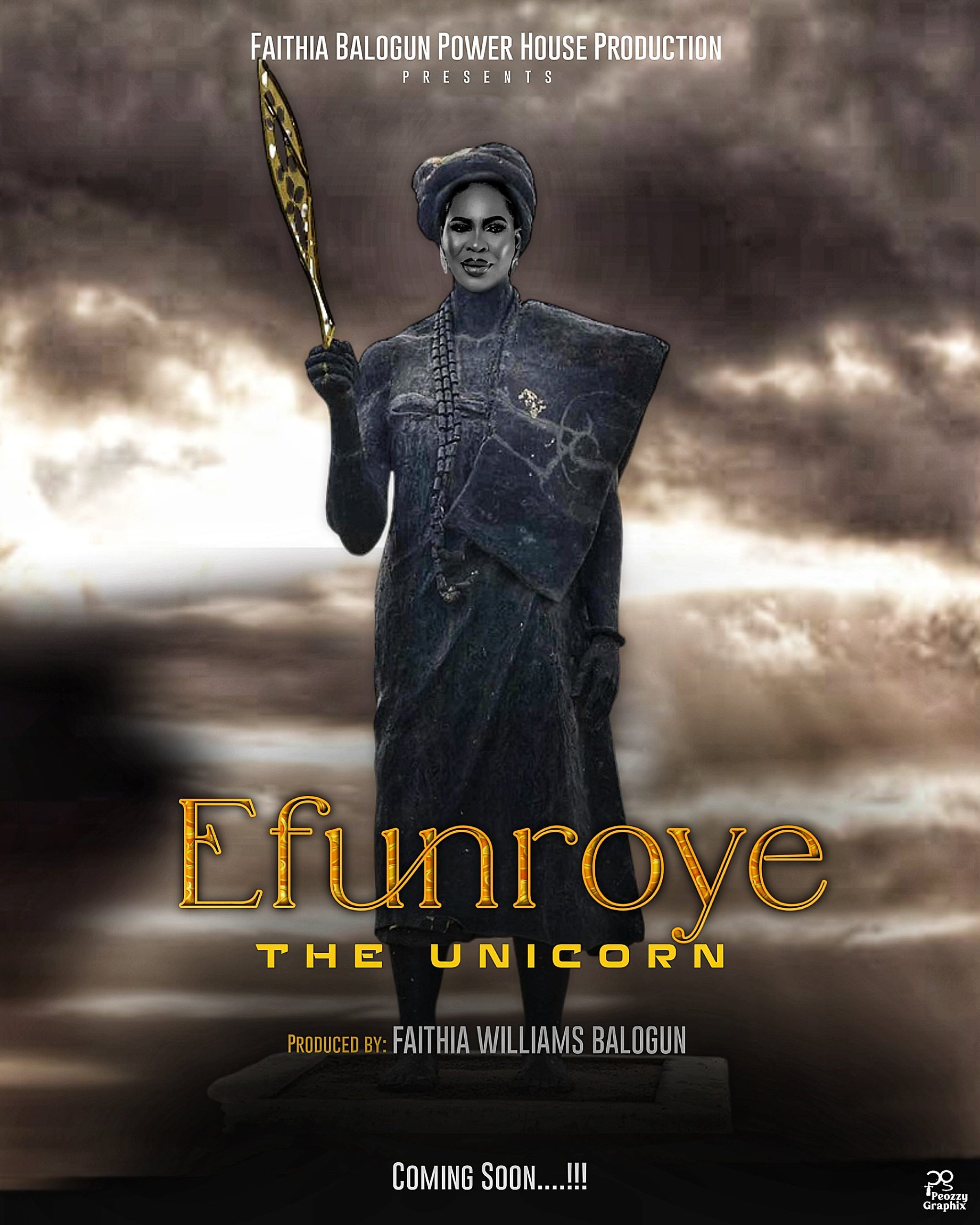
The backlash that greeted Faithia Williams Balogun’s 2024 teaser (a poster captioned “Power. Trade. Legacy. She was more than a warrior, she was a ruler who rewrote history”) was not simply about the film alone. It was about an anxiety that runs deep in Nigerian cultural life and one that the industry has never seriously addressed: the tendency of prestige historical projects to launder morally complicated figures into usable icons, to take the rough, unbearable parts of a history and smooth them into inspiration. The public understood what the teaser was doing before a single frame had been shot. The title, announced alongside it, confirmed the direction of travel. It was not just a title; it was in some ways a political position dressed as a marketing choice.
And the politics of it run deeper than the film’s own historical subject. Efunroye Tinubu’s name does not exist in a vacuum in Nigeria in 2026. Tinubu Square in Lagos, named in her honour, is one of the most recognisable landmarks in a city now governed by a president who shares her surname, whose own relationship to power, accumulation, and political manoeuvring has been the subject of sustained national conversation.
Whether or not the filmmakers intended it, a hagiographic film about a Tinubu arriving in this particular moment will be read through the lens of that coincidence. This is not an accusation of intent. It is an observation about context, and context is not something cinema gets to opt out of. A film released into a specific political atmosphere inherits that atmosphere. Efunroye: The Unicorn has not reckoned with what it has inherited.
What it has reckoned with, at least partially, is the question of what Nigerian popular culture owes its historical women. The women who shaped 19th-century Lagos have been consistently underwritten in the histories that colonial and post-colonial scholarship produced.
The instinct to correct that underwriting through cinema is legitimate and necessary. But restoration is not the same as idealisation, and giving a woman back her complexity is not the same as giving her back only her virtues. This is the distinction that Nigerian historical cinema has not yet learned to hold, and Efunroye: The Unicorn is the most expensive demonstration yet of that failure.
It is worth being precise about what that failure looks like in practice, because it is not a failure of production. The film is visually accomplished in ways that matter: the slave market sequence, framed under a high midday sun with compositional depth that gives the space a genuine scale, communicates its historical reality with directness and confidence. The Yoruba period world is constructed with sufficient detail to create the illusion of habitation rather than recreation.
Where Efunroye: The Unicorn achieves something close to genuine distinction is in its sound; the Yoruba musical tradition deployed throughout the soundtrack does what it has always done, finding in rhythm and melody the frequencies at which grief and joy and dread actually operate in the body. In the sequence where Efunroye loses her children, the layering of eulogies and cries over the images produces a rawness that bypasses intellectual engagement entirely.
It is the film’s most affecting passage, and it is telling that its power comes from music rather than from writing: that the emotional work the screenplay cannot consistently do is carried instead by a tradition old enough to predate the story it is serving.
This failure is a failure of conviction. Nollywood has a specific and recurring problem with politically charged historical material: it reaches for complexity and retreats from it, gestures toward the difficult question and turns away before the answer becomes uncomfortable. Efunroye: The Unicorn performs this retreat with particular clarity.
Consider the film’s opening. We meet Efunroye not in a market or a council chamber but in something approaching the liminal, a woman emerging from a coffin and confronting a fundamental choice between two forms of power, the feminine and the masculine. She chooses the masculine, and the film plants this decision as the root of every conflict that follows, including her inability to conceive in her later years.
It is a bold and mythologically resonant opening, drawing on the deep well of Yoruba cosmological thinking in which spiritual choice and earthly consequence are inseparable, in which the Orí (destiny, spiritual intuition) is not fixed but negotiated. Having planted this seed, the film does not tend to it. The supernatural dimension recedes almost entirely as the narrative moves forward, without explanation, without the sense of loss that its disappearance should produce. A film that begins in myth and ends in commerce must earn that transition. Efunroye: The Unicorn does not do this work, and the supernatural strand becomes a promissory note the film writes to itself and never honours.
What replaces it is devotion. Loyal wife, grieving mother, and betrayed ally. The film repeatedly reaches for the register of feminine virtue under siege rather than the register of strategic intelligence in operation. This is the central evasion, and it matters because it is not accidental. The historical Efunroye Tinubu was, above all else, a strategist. Her genius (if that word can be applied without sanitising its object) was her understanding of how power moved in 19th-century Lagos: through trade relationships, matrimonial alliances, the careful management of obligations and debts, and the deployment of information as currency.
She did not marry powerful men out of love or ambition in the simple sense. She married them because marriage, in that world and that time, was the most efficient mechanism available to a woman for converting commercial wealth into political influence. Benjamin Campbell did not fear her because she was fierce, though she was. He feared her because she was intelligent. After all, her intelligence competed with his own interests, and because she understood the colonial game well enough to play it on her own terms for longer than colonial authority found comfortable. The film shows us a woman defined by her relationships with the men around her. That woman and the woman Campbell feared are not the same person.
The single scene that escapes this gravitational pull is the drowning of the slaves. It is the film’s most morally honest moment; a sudden intrusion of the historical record into a narrative that has been, until that point, building a rather different case. Efunroye, faced with the prospect of her human merchandise falling into the hands of British authorities, makes the decision that confirms what the rest of the film works to soften. The scene earns its discomfort. It forces the audience to sit with a woman whose complexity cannot be absorbed into the category of hero or villain, whose choices resist the moral taxonomies that historical cinema usually provides. But one scene of honesty cannot carry the weight of a full film’s evasion. And the evasion is not merely aesthetic; it is symptomatic of something the Nigerian cultural conversation has not yet found a way to say directly.
Nigeria’s relationship to the slave trade is one of the most consistently avoided subjects in its popular culture. The trade was not only done with Africans. It was done by some Africans, including figures now memorialised as founding heroes, whose statues stand in public squares and whose names grace streets and institutions. Efunroye Tinubu is one of those figures. The discomfort this creates is not unique to Nigeria.
It mirrors the discomfort that the Dahomey debate produced in West African diaspora communities, the discomfort that arrives whenever the clean narrative of African victimhood meets the messier historical record of African participation. But in Nigeria, the discomfort has a specific texture, because the participation was not incidental.


The Yoruba wars of the 19th century produced enormous numbers of enslaved people. The trading networks that figure as Efunroye Tinubu operated were not marginal enterprises. They were central to the political economy of Lagos in the period the film depicts. To make a hagiography of a central figure in that economy without engaging seriously with what the economy was is not historical filmmaking. It is historical cosplay.
This is what connects Efunroye: The Unicorn to the broader tradition of Nigerian historical epics it now joins. Films like The Legend of Inikpi (2020), Lisabi: The Uprising (2024) have generally chosen legible heroism over moral complexity, usable legend over difficult history. They have asked which parts of the Nigerian past can be made to feel like inspiration and have filmed those parts, leaving the remainder in the dark where it has always lived.
The question Efunroye: The Unicorn raises, more urgently than any of its predecessors, because its subject is more morally exposed than any of its predecessors, is whether the industry will ever develop the critical maturity to film the remainder. To make a Nigerian historical epic that does not just celebrate what the past produced but examines what the past cost. That asks not only who won but who paid.
The feminist framing of the film markets itself through making this question more pointed, not less. There is a version of the Efunroye story that is genuinely feminist: the story of a woman who accumulated power in a world designed to prevent it, who understood the rules of that world well enough to use them against their architects, who was ultimately destroyed not by her moral failures but by her political inconvenience to men with more institutional power than she had.
That story is worth telling. But the feminist framing becomes dishonest when it is used to occlude the question of what power was built on and who paid for it. Female power exercised through the enslavement of other Africans is not a feminist story. It is a story about power, which is more interesting and more honest than the feminist packaging allows. The women whose bodies labour and futures Efunroye Tinubu traded were also African women. Their absence from the film’s moral accounting is not a feminist oversight. It is a feminist failure.
Faithia Williams Balogun inhabits the role with a commitment that is beyond question. She moves through the film’s considerable emotional and physical demands with a presence that commands the screen, and in the scenes that ask for grief, she finds the specific weight of a woman whose emotional reserves have been drawn down to nothing by a life of perpetual strategic vigilance.
The difficulty is structural rather than performative: a character written primarily as loyal and devoted cannot reveal the full architecture of a woman history records as strategically brilliant and morally unbounded. Williams Balogun does what the writing allows, and what the writing allows is not enough. The supporting cast assembles Yoruba cinema’s institutional memory in a single production — Adebayo Salami, Odunlade Adekola, Ibrahim Chatta, Femi Adebayo — and their collective presence gives the film a cultural legitimacy that no amount of production design could manufacture.
The Efunroye Tinubu that history recorded was not a unicorn. She was something more difficult and more interesting: a woman of extraordinary capability operating in a world that offered women extraordinary capability only at extraordinary cost, who made choices that empowered her and choices that damned others, who accumulated power through intelligence and ruthlessness in proportions that cannot be cleanly separated, and who was ultimately exiled by a colonial apparatus that found her inconvenient precisely because she was so effective.
To call her a unicorn is to domesticate her. To make her pure is to make her smaller. The film that genuinely reckons with Efunroye Tinubu will not be able to leave its audience feeling inspired in the uncomplicated way this one does. It will leave them unsettled, arguing with each other in the car park, carrying something they cannot immediately resolve. That film has yet to be made.
Nigeria has many such films still to make. The history is there; dense, morally complex, politically alive, full of figures who resist the categories of hero and villain that popular cinema prefers. What the industry needs is not better production values or bigger budgets, though both would help. What it needs is the courage to film the parts of the story it has always looked away from. Efunroye Tinubu deserved that courage. She did not receive it. And the audience, who came to a cinema to watch history and were given legend instead, deserved it too.
Rating: 2.2/5
Joseph Jonathan is a historian who seeks to understand how film shapes our cultural identity as a people. He believes that history is more about the future than the past. When he’s not writing about film, you can catch him listening to music or discussing politics. He tweets @Chukwu2big