

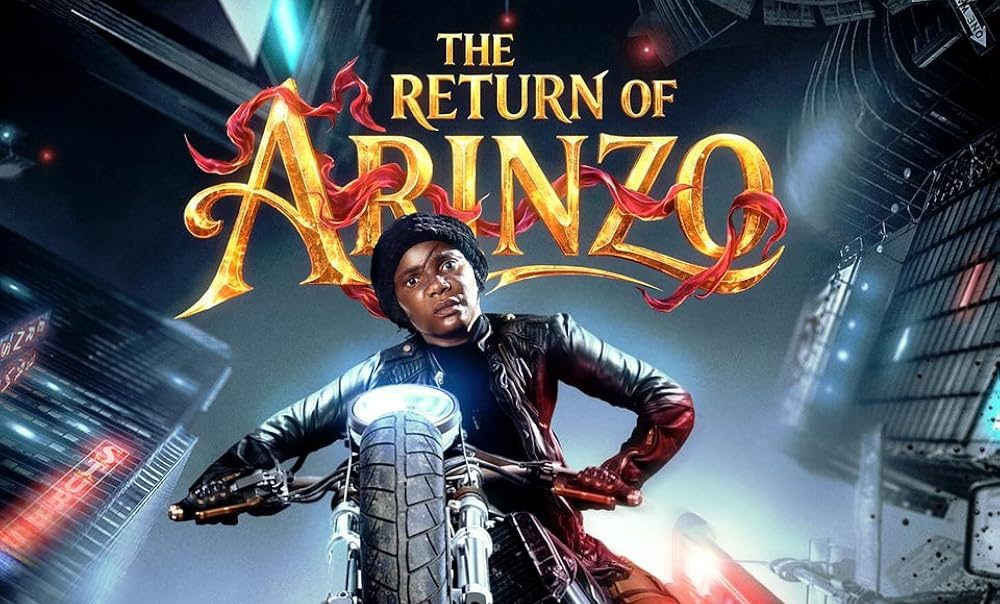

Beyond cheap thrills, The Return of Arinzo falls apart when treated as part of a franchise, coming across as a superfluous cash grab rather than a creative necessity or tellingly commemorative experience.
By Adedamola Jones Adedayo
Like its two-part home video production released in 2012, The Return of Arinzo unfolds as a melodramatic tale of rights, wrongs, and nemesis, centred on a moral-justice theme that has long defined much of Nollywood storytelling. In this latest film, producer-director Iyabo Ojo resorts to a dubious sense of ambition in extending the narrative world established in Arinzo 1 & 2.
Some characters from the earlier films have either completely evaporated or forfeited partial relevance, while new ones have emerged. Mercy Aigbe, a member of the old guard, takes centre stage in her role as Aisha Williams (formerly Bolatito from her criminal past). Still, understanding The Return of Arinzo requires returning to the foundation of the micro-universe on which it is built.
Arinzo 1 & 2, produced by Ojo and co-directed by Muhydeen S. Ayinde and Abiodun Olanrewaju, is a crime story about the intersecting lives of three ladies caught up on different sides of the law. One of them is Arinola (Iyabo Ojo), also known as Arinzo, a notorious crime boss who, partly emboldened by her possession of diabolical powers, leads an all-female armed robbery gang. The second is Louisa (also Kemisola, played by Toyin Abraham), a rebellious lady who takes up arms against Arinzo on a vengeful mission. The third is Bridget (Bimbo Akintola), a diligent police officer and foster sibling to Louisa, committed to combating persistent armed robberies. Both film parts are set in Nigeria and Ghana, showcasing the ambition that the latest installment inherits as they navigate the titular character’s descent from grace. At the end of part 2, Arinzo and Louisa discover they are from the same biological parents, but it is too late for reconciliation as the former falls by the treacherous gunshot of an ally, Bolatito, and the latter faces imprisonment.

In The Return of Arinzo, there is a palpable nod to nostalgia through sporadic allusions to previous events, but the narrative increasingly prioritises Aisha Williams, the post-prison, reinvented version of Bolatito, rather than the supposed protagonist herself. The story resumes seventeen years later, with Aisha having successfully distanced herself from her past by exploiting an unscrupulous prison system, in what reads as an indictment of Nigeria’s fragile institutional structures, and getting married to Marcus Williams (William Benson), a presidential aspirant.
Her revamped present begins to unravel with the arrival of her Tanzania-based son, Olamide (Eniola Adeoluwa), and his fiancée, Simisola Fijabi, who turns out to be the daughter of the supposedly late Arinzo. This revelation unsettles Aisha, and ensuing developments threaten to expose her buried past while jeopardising her husband’s political ambitions. Much of the narrative is devoted to this conflict. However, what feels particularly disingenuous is the delayed introduction of the eponymous character, who does not appear until well over an hour into the film, which weakens the film’s titular emphasis.
The Return of Arinzo comes across as a mélange of genres, straddling political and family drama, high-stakes action, romance, investigative thriller, and supernatural thriller elements; it also takes a transgenerational tilt, with settings encompassing Nigeria, Ghana, and Tanzania. It’s a crossover of ideas intended to excite, only that the ideas are half-baked, hastily woven, refuse to congeal, and end up sickening the original story itself.
The romance between Olamide and Simisola gets a lukewarm treatment, while their Tanzania-based cronies come off as negligible. References to Marcus’s rivals as architects of mischief remain at a lip-service level and do not materialise on screen, detracting from the film’s posture as a political drama. The involvement of Omar (Funky Mallam), a mercenary hired by Aisha, hints at the beginning of an investigative thread, but this soon collapses into a charade. In a scene where Omar visits Bridget, a former police officer turned pastor, in Ghana, hoping to uncover who is behind the attacks on Aisha’s reputation, she divulges her past to a man who offers little credible proof of being an acclaimed investigator.
Here, Bridget’s indiscretion feels inconsistent with the disciplined and excellent police inspector she was portrayed as in Arinzo 1 & 2. As the narrative progresses and the account of Arinzo’s resurrection surfaces, the film’s supernatural motif starts to feel like an apology for narrative implausibility rather than a purposeful tool for plot advancement.

In production, a film sequel makes sense when the original story, world, or characters retain meaningful narrative potential. This arises when the original story is intentionally left incomplete or open-ended, making it possible for the filmmaker to further expand the narrative world. Film sequels are justified in situations where the fictional worlds have profound untapped possibilities, with central characters reserved to evolve beyond the immediate construct.


Often, a cliffhanger signals the ending of a film or series that leaves room for a sequel. Nollywood productions such as Òlòtūré (2019) and Blood Sisters (2022) bear markings of narratives receptive to continuity. Òlòtūré the film ends on a deliberately grim note where the protagonist’s undercover mission falters as she becomes trapped as a victim in a criminal network, which prepared the floor for the sequel series Òlòtūré: The Journey (2024). Similarly, Blood Sisters (2022), a crime thriller series, bows out with the unresolved case of two female on-the-run murder suspects as they struggle against both the chokehold of the law and the vengeance of the victim’s family, which makes the idea of anticipating a sequel worthwhile at least.
However, in The Return of Arinzo, grounds for a sequel are weak since the older home video narrative already shut the door to the future, with its protagonist and most gang members dead and justice taking its course on surviving criminals. The decisiveness of the original resolution precludes further organic evolution. And for an original narrative that neither amassed a cult following nor garnered critical reception during its time, its contemporary rejuvenation defies reason.
Treated as a standalone, this film is begrudgingly enjoyable, provided one is willing to turn a blind eye to its questionable excesses, fluff, half-hearted pursuits, and the generally either unremarkable (as in William Benson’s rendition of Marcus, which leaves no mark) or hyperbolic (as in Funke Akindele’s embodiment of Bolanle, Marcus’ malevolent elder sister) acting performances. Its enjoyability value arises from pretentiously addictive suspense, thematic familiarity, and a glamorous cinematic surface. But then, beyond cheap thrills, the plot falls apart when treated as part of a franchise, coming across as a superfluous cash grab rather than a creative necessity or tellingly commemorative experience.
Rating: 2/5
Adedamola Jones Adedayo is a film journalist and critic with a special interest in African cinema. Through writing and audiovisual mediums, he creates conversations around cinema in Africa and the Diaspora. You can find him on Instagram @jonesthegoodboy and X on AdedamolaAdeda4.