

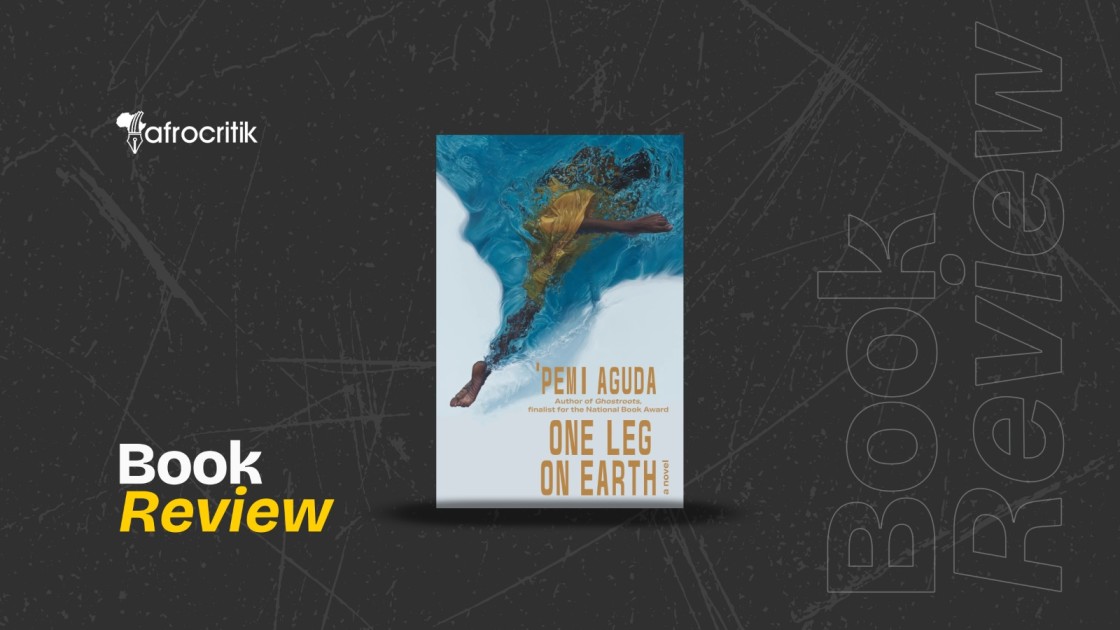

Pemi Aguda’s One Leg on Earth is the story of the strange pull of a place; the people in it are mere pieces in a chess game.
By Chimezie Chika
The Nigerian writer Pemi Aguda (finalist for the National Book Award with her first collection, Ghostroots) sets up the story in her tightly woven debut novel, One Leg on Earth (2026), spectacularly, drawing us urgently into its story from the first sentence. A pregnant woman locked in traffic on one of Lagos’ many bridges leaves her baffled husband in the car, goes to the edge of the bridge and, before the eyes of other cars in the traffic, plunges into the lagoon below.
Meanwhile, a young graduate, Yosoye Bakare, arrives in Lagos from Ibadan for her NYSC at a new city development being constructed on land reclaimed from the ocean. Drawn by the city’s seductive pull (or by more private, sinister urges), she has a one-night stand, subsequently gets pregnant, and decides manically to keep it. It doesn’t end here. As soon as she finds out her condition, she begins to navigate an almost liminal existence in which she appears to sneak in and out of reality, surrounded by the horror of hallucinatory dreams and the horror of a Lagos increasingly fractured by the mass suicides of pregnant women, the cause of which is unknown.
As expected, the unexplained suicidal onslaught catches Lagos unawares. People obsessively begin to connect the patterns, most of all Yosoye, who sleeps in gossip blogs and internet spaces, trying to find the latest on the suicides. Meanwhile, she must also prove herself at work against the odds of not having studied anything related to architecture—one of the many oddities of Nigeria’s failing NYSC scheme (now being reformed, the details still leave rather too much to be desired).
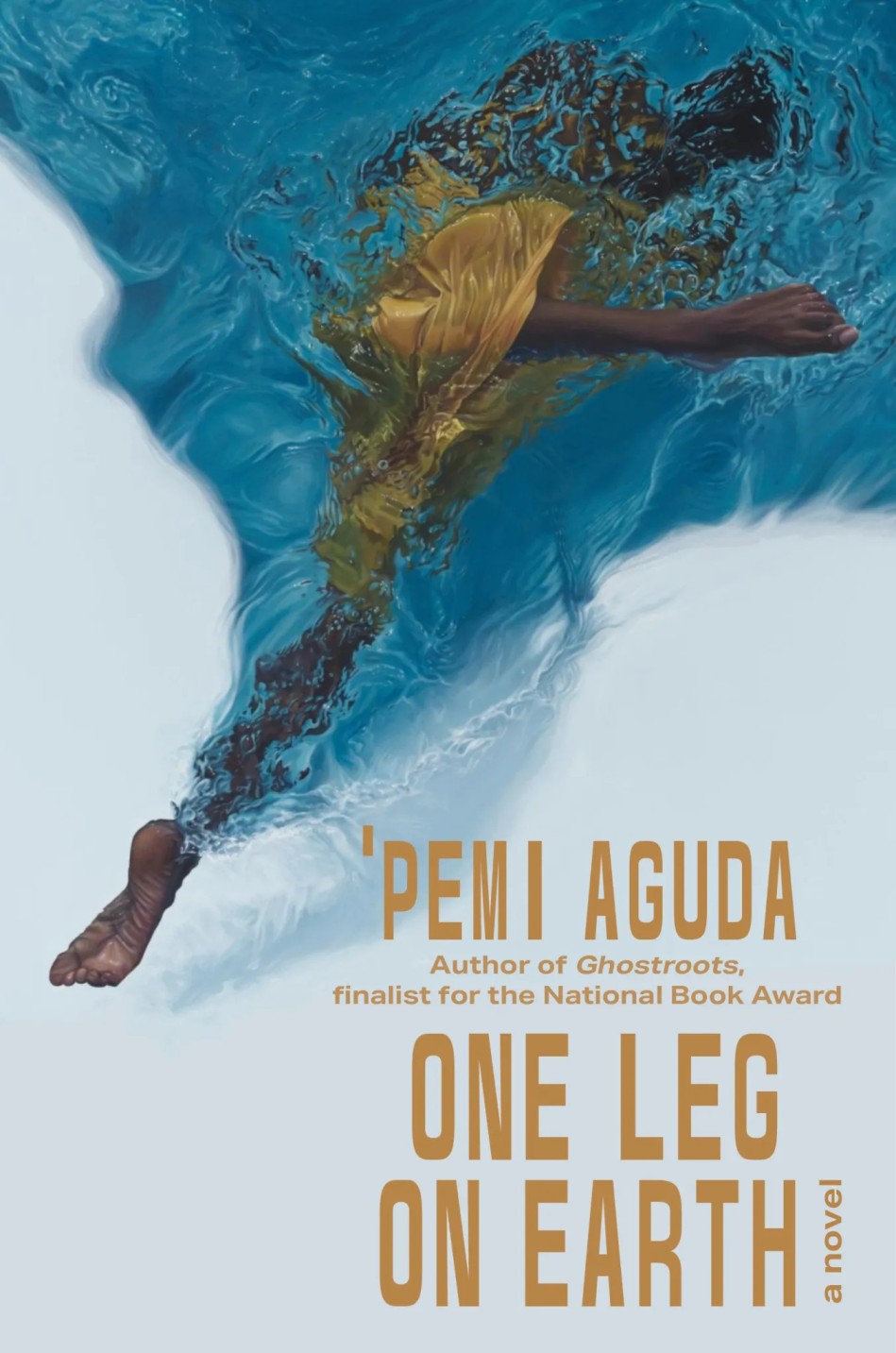
While Aguda’s One Leg on Earth imagines Lagos in a magical realist frame, where surreal events are normalised, we must make no mistake that everything here is more or less a portrait of Lagos—a city whose visual presentation will leave you doubting reality. In Aguda’s Lagos, the nights crawl with dreamlike occurrences, featuring pregnant women fished out of the gaping lagoon that surrounds the city; the days emerge with cacophonies of traffic and mud-smeared naked women protesting against the city’s massive inequality. Aguda takes that Lagos personality and transforms it into a fictional canvas that lays out Lagos for what it truly is. In other words, it is sublime, alive, ugly, baffling, and consistently abnormal.
I don’t think I have read a more acute portrait of Lagos in the 21st century than Aguda’s One Leg on Earth. The polyphonic excesses of Lagos are everywhere in the narrative. Here is one of the best descriptions of the endless, breathless, physical chaos that is Lagos, captured with a prose that has that same breathless physicality:
“When she got off the bus at Obalende, Lagos screamed. Noise. Noise. Noise. Okadas honked at each other to say hello, to say move, honked at pedestrians to say come, to say go, to say can’t you see me, aren’t you afraid? Cars honked, too, less melodious—the horn press directly proportional to the degree of impatience or anger or boredom or do you know who I am? The trucks transporting fuel and goods and inhumanely cramped goats needed to honk only once, the bass sending every lesser vehicle scampering. The people lifted their voices, too. Bus conductors called for passengers. Other bus conductors raised their voices higher to redirect those passengers. Hawkers sold Pure Water, Sweet Pure Water, and Cold Coca-Cola and Pure Bliss and Kuli-Kuli here and Hot Moi-Moi, singing in the exact notes that must have been decided in a meeting among all the original hawkers, decades ago. The preachers warned of death, of an apocalypse, of an impending end, and the roadside herbalists promised to cure cancer and impotence, and the bold ones offered pills for everlasting life.”
We find a city populated with seemingly normal but apparently strange characters and events. Names appear to be deterministically symbolic, primed to represent something in the story: Yosoye’s regular okada man who puts up with Yosoye’s strange attitudes is Endurance. Yosoye’s intrusive co-worker who discovers her pregnancy is Adam. And so on. These are certainly not mere fictional keepsakes.

Aguda is trying to make us let go of our standard definitions of reality. What the hell is even reality? Where does it begin and end? The author is often reaching for the epical, designed to knowingly discomfit the reader, perk them up to every little strange set-piece, almost as if she is telling us to join in solving the puzzle of the story like Yosoye, to join the author in a collective act of storytelling. But we are never really given enough to do the quasi-defective work with; we simply find ourselves trusting the author’s often assured hand.
Behind the novel’s speedy trumping of events is a small story locked within a mass event (the suicides, that is). Yosoye is a strange young woman, whose decisions mostly baffle. Sometimes we can’t even connect the pieces or tell what’s really going on. This is not helped by the way in which the author presents Yosoye to us. Yosoye can be less human at times, coming across as more a purveyor of the author’s fictional schema, or something we can identify with or at least react to. We are asked to suspend disbelief over some of Yosoye’s unreasonable actions, but how much is the line between the suspension of disbelief and sheer incredulity?


Aguda’s prose is propulsive and fast-moving, hewing closely to imitate its register of strangeness: short sentences, broken and periodic, tentatively humorous, flirting around and imbuing each scene, movement, and occurrence with a surreal aura. She constructs them in a way that gives her prose a sort of spiralling, ascending music, pushing events with expeditious speed towards the story’s reckoning. Characters are given this extraordinary aura in every situation. When the leader of the architecture firm in charge of Omi City development, Architect Jegede (simply mythified as The Architect among his workers), is told that Yosoye is pregnant, he thinks of it in terms of omens and declares it is a good omen. At the end of the meeting, “His smile lingered for seconds longer, then slid off slowly. He nodded and turned his attention back to his monitor, jiggling a mouse until the awakened electronic light turned him extraterrestrial.”
Ever and always, Aguda’s prose is endlessly inventive, cinematic, but also operating with a narrative framework beyond mere images; the prose alights on things, searches, elucidates, and litters its core moments with elliptic curiosities. Aguda’s technical mastery is delightful. Not since much of Chigozie Obioma’s The Fishermen and Ifeakandu’s collection God’s Children Are Little Broken Things have I read a more refreshing language in contemporary Nigerian fiction. One wishes that more Nigerian writers would push prose beyond its comfort zones, for there is a tendency in this clime to wallow in a sort of comfortable pedestrian prose, the overuse of which, over time, becomes a performance of mediocrity.
But Aguda is in a league of first-rate writers. Here is a description of the vagaries of Lagos traffic: “The trip could take anywhere between an hour and three, depending on the deities of traffic.” The entrance of a hallway is described as “the lip of the hallway”. Here is the most comically accurate description of Ibadan’s ubiquitous taxis: “Micras zipped about like drunken toys.”
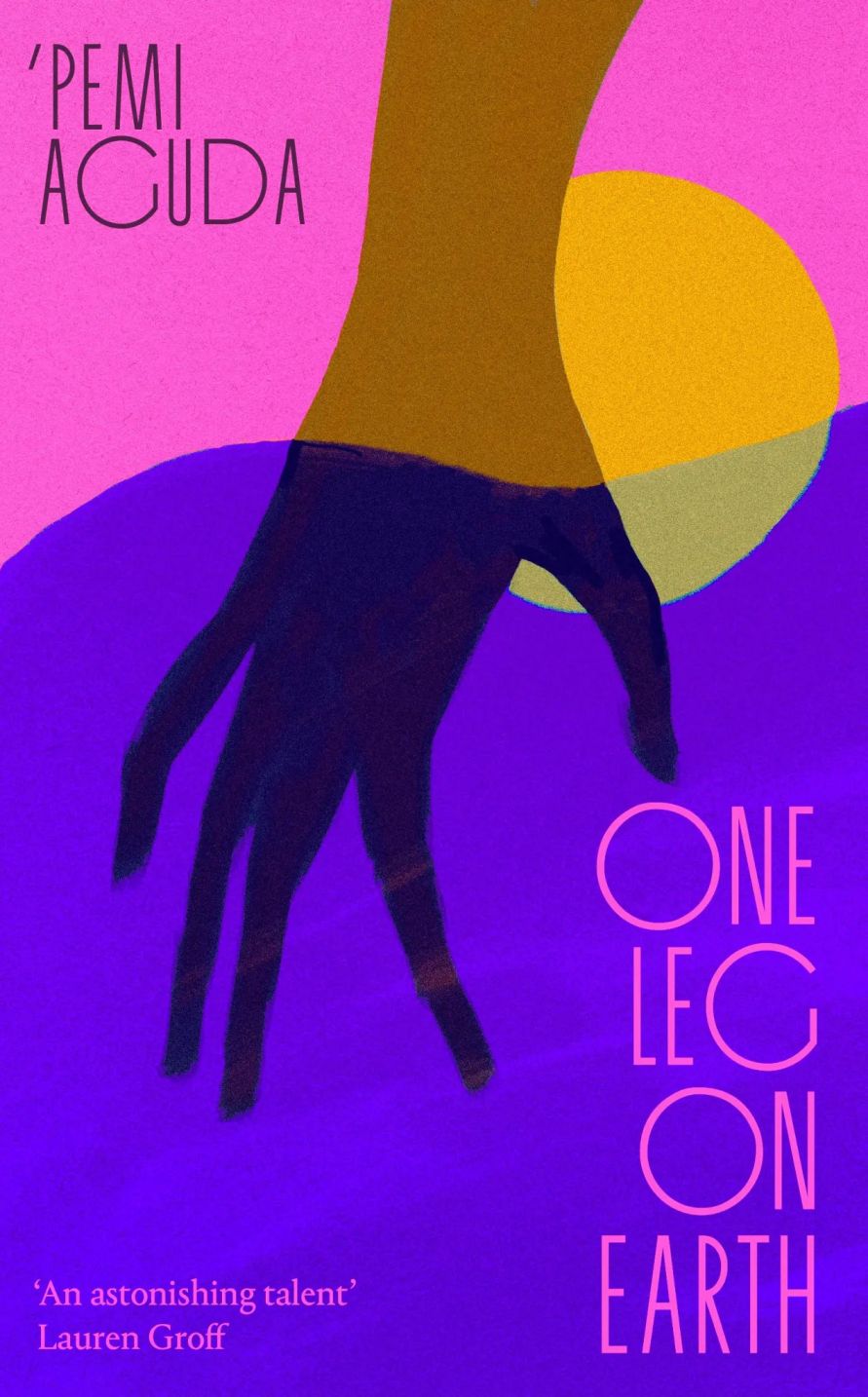
More than anything, Aguda’s One Leg on Earth is the story of the strange pull of a place; the people in it are mere pieces in a chess game. How many people in Lagos are makers of their own destiny? Or is it really that the city is deciding their fate for them? One Leg on Earth mythologises the mystery of Lagos, and all such places living between land and water, where nothing is ever too sure or too firm, where the giving and taking of life in a divine feminine performance beyond the quibbles of mortality, where the spirit of the place—surrounding as it were by so much water, a living entity in Nigerian traditional religions—is the most dominant character, with everybody and everything else sucked into its churning whirlpool. As Yosoye grows into an impending motherhood, Lagos is shown to be the encompassing mother of all life within it. Again, this is a strange, unusual, but nearly faultless novel.
Chimezie Chika is a staff writer at Afrocritik. His short stories and essays have appeared in or forthcoming from, amongst other places, The Weganda Review, The Republic, The Iowa Review, Terrain.org, Isele Magazine, Lolwe, Fahmidan Journal, Efiko Magazine, Dappled Things, and Channel Magazine. He is the fiction editor of Ngiga Review. His interests range from culture and history to art, literature, and the environment. You can find him on X @chimeziechika1