

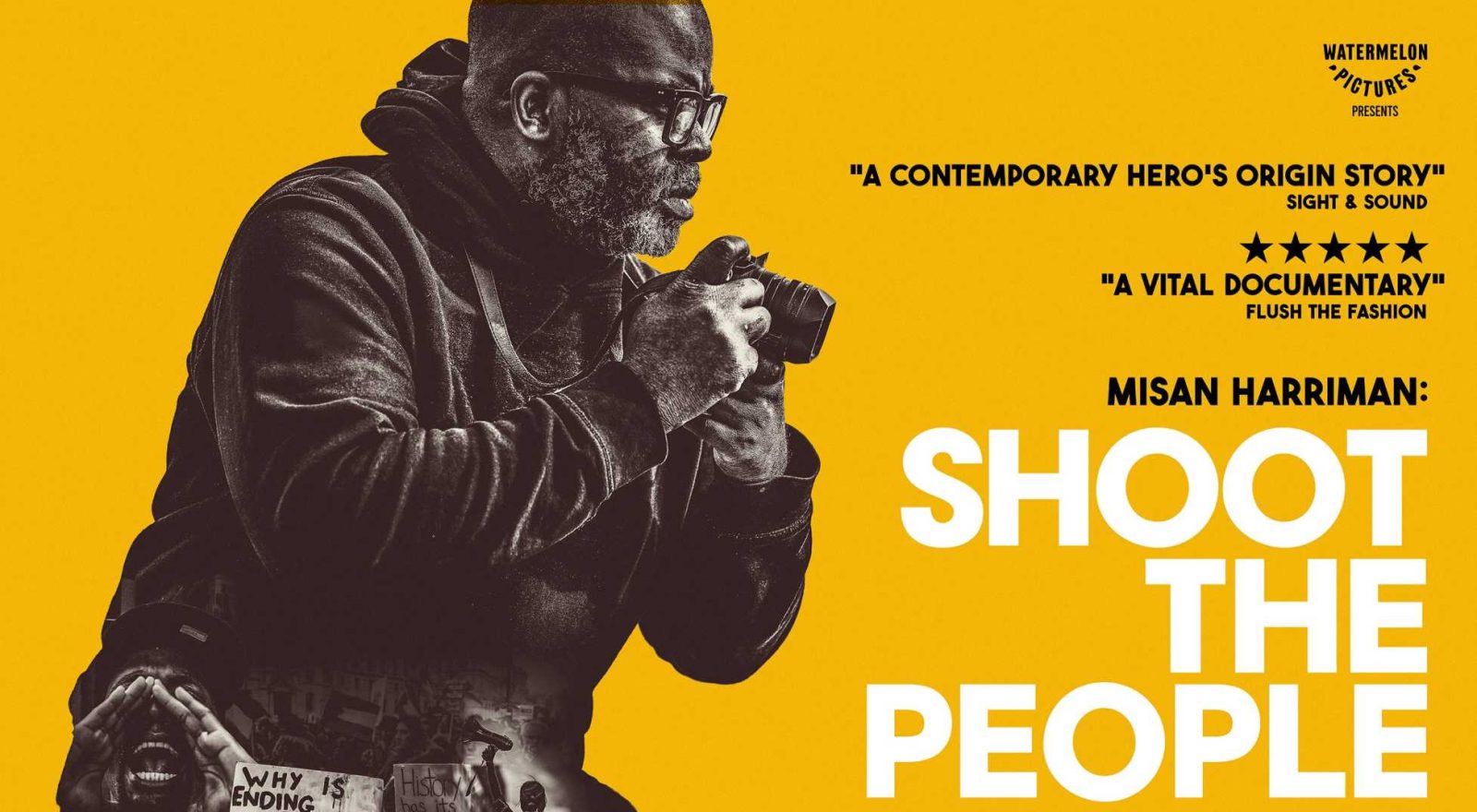

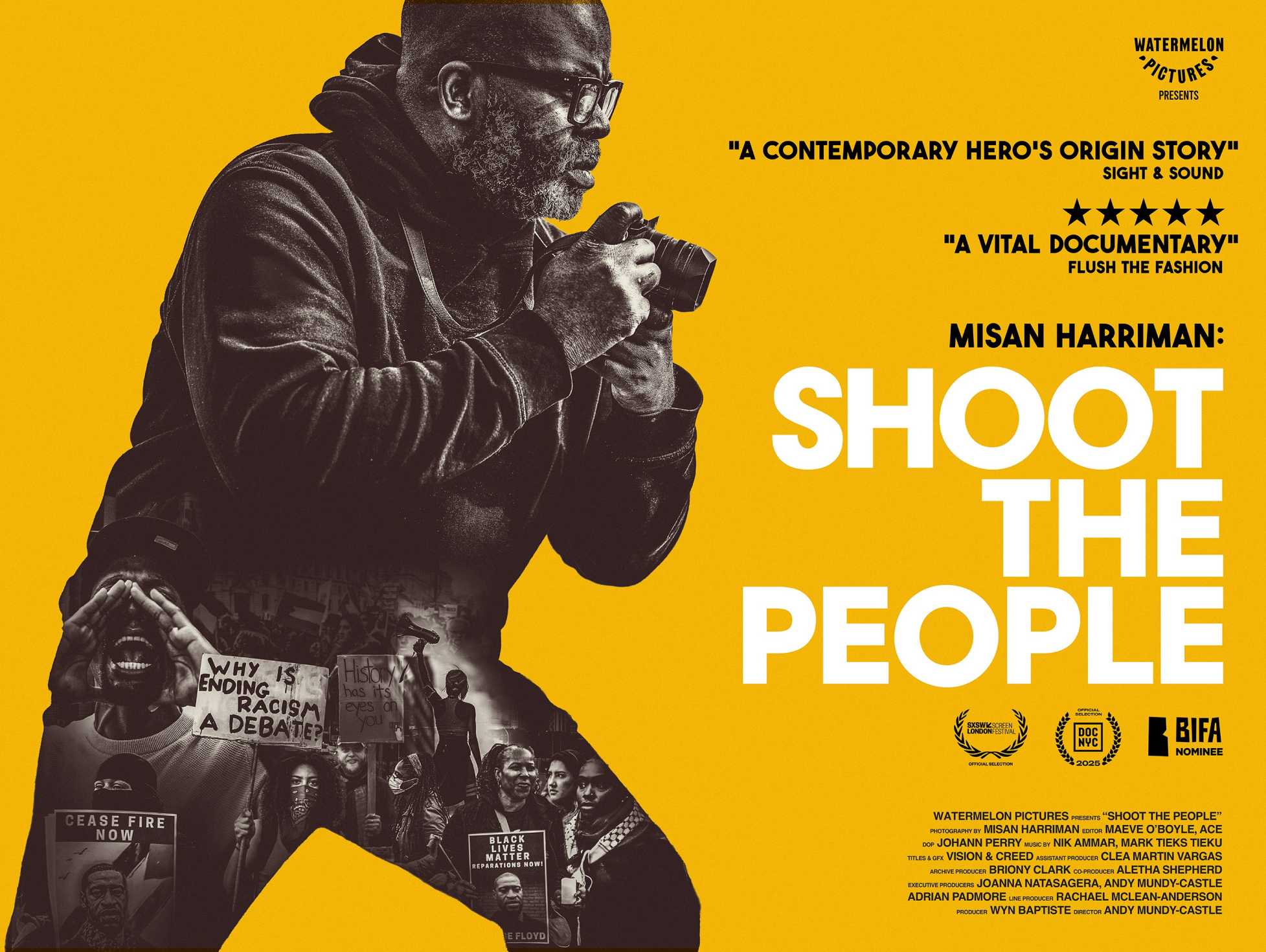
Shoot the People follows Misan Harriman as he travels across continents, witnessing protest movements and documenting activists in their fight for social change.
By Vivian Nneka Nwajiaku
In 2020, when the world was shaken by the murder of George Floyd by a Minneapolis police officer and protesters flooded the streets in multiple countries, a black-and-white image of a young woman holding a homemade placard reading “Why is Ending Racism a Debate?” went viral, shared by many influential figures, including Martin Luther King III, the son of Martin Luther King Jr.
The photograph was taken by Misan Harriman, a Nigerian-born British social activist and self-taught photographer who picked up a camera in his forties, stepping away from a life in finance. The famous photograph brought him virality and threw him into the spotlight at a time when he was still in the process of redefining his life. Harriman is the subject of Shoot the People (2025), a UK-produced documentary portrait directed by Nigerian-British filmmaker Andy Mundy-Castle, whose 2023 documentary, White Nanny Black Child, won the 2024 BAFTA TV Award for Best Specialist Factual.
Shoot the People follows Misan Harriman as he travels across continents, witnessing protest movements and documenting activists in their fight for social change. The clue is in the documentary’s title, a double entendre that represents both the literal act of taking photographic shots of people, and the often violent state response to activists and protesters.
The film’s thesis is communicated in two statements, one in a post-title card reflection by Harriman himself, and the second imposed on black just before the end credits. “You can travel the world with this thing and just bear witness,” Harriman says early in the documentary, looking in admiration at his camera. And the late South African photographer and anti-apartheid freedom fighter Peter Magubane is quoted as parting words: “A struggle without documentation is no struggle at all.”
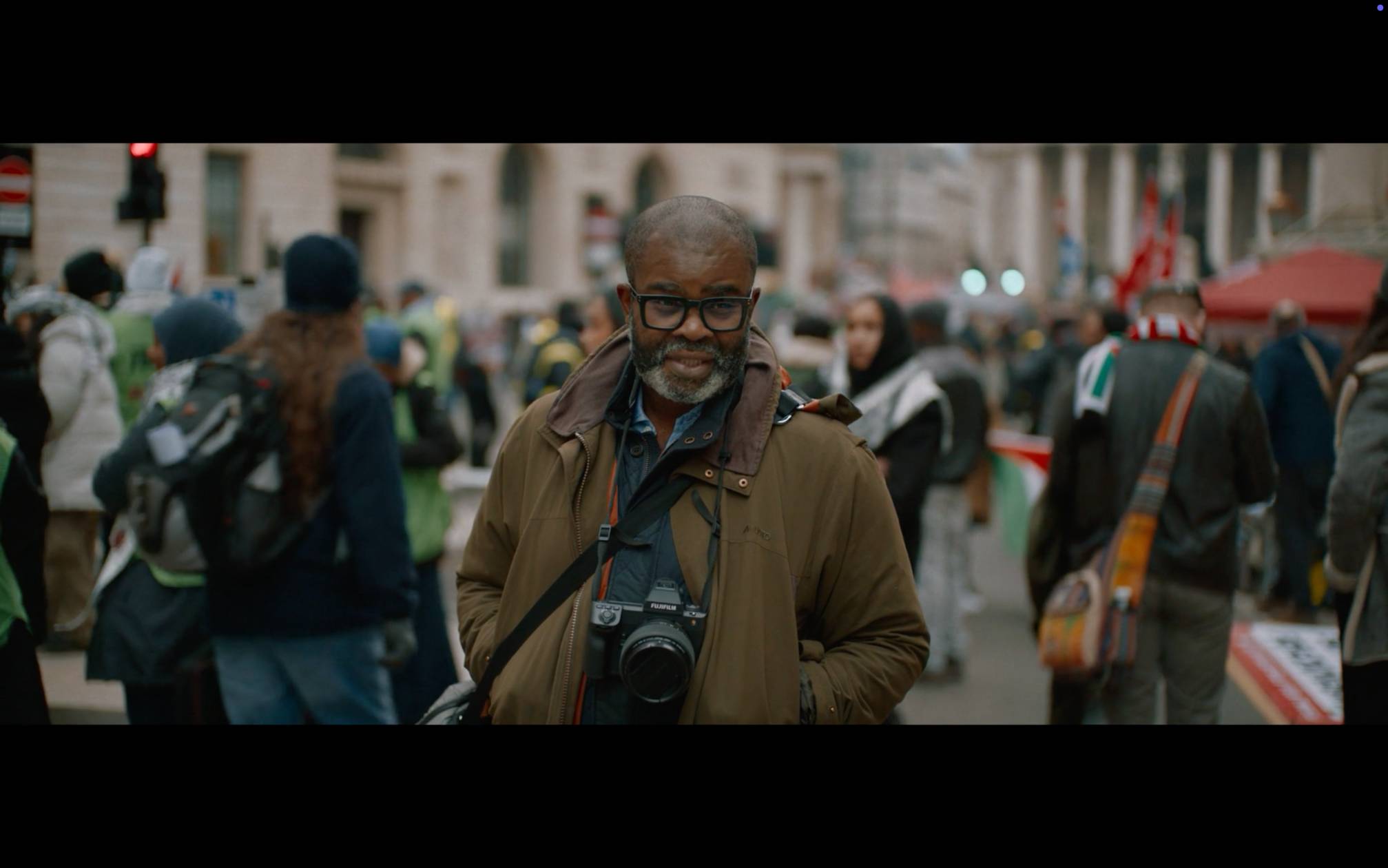
And so, through Harriman, Shoot the People attempts to witness and document the struggle, primarily using photographs taken by Harriman alongside archival footage, news reports, pictures by other photographers—including Peter Magubane—and videos recorded live by Mundy-Castle’s team. And while the editing choices can be heavy-handed, the documentary benefits from a mix of colour and monochrome, and of live coverage and social media posts, ensuring that it sometimes records a vibrant world and, at other times, becomes an archive.
Shoot the People moves from large-scale protests such as the Black Lives Matter movement and pro-Palestinian demonstrations in the United Kingdom and the United States, to smaller protests like the pro-Palestine protest in South Africa’s University of Johannesburg, and a recent post-apartheid protest by fifty pensioners demanding reparations for apartheid-era injustices. Even beyond the present, Harriman and Mundy-Castle travel back in time to revisit historical protests and struggles, from the anti-apartheid protests in South Africa to segregation-era demonstrations in the US, capturing moments from both pro-segregation groups and the Civil Rights Movement.
But what do protest movements truly achieve if people are still demanding the same basic human rights? In one scene about twenty minutes in, Harriman ponders this question. But several times across its runtime, Shoot the People attempts to provide answers, with different degrees of success. In the process, we hear the voices of offscreen journalists, academics, and activists. And Harriman conducts a few interviews, including with Martin Luther King III, American congresswoman Rep. Ilhan Omar, and former president of the Minneapolis NAACP, Lesley Redmond.
But the most interesting, without a doubt, turns out to be Harriman’s conversation with David Meyer-Gollan, Peter Magubane’s friend and spokesperson. Here, Shoot the People takes a detour into what could be described as a mini-documentary on Peter Magubane, as Meyer-Gollan speaks to the freedom fighter’s life and times, and the documentary re-platforms the evocative photographs that once exposed to the world the horrors of the apartheid system.
Still, Shoot the People is as much a film about documenting activism as it is about Harriman, who executive-produces alongside Mundy-Castle. Harriman has made a name as a celebrity photographer, becoming the first black man in British Vogue’s 104-year history to shoot a cover for the magazine—the “Activism Now” edition. He won an NAACP Image Award and was nominated for an Academy Award for his 2023 short film, The After. And he is the outgoing chair of the Southbank Centre, the United Kingdom’s largest arts centre, a position he has held since 2021.
But he is also a controversial figure. He has come under fire for his criticisms of Israel and his commentary on the war in Gaza, recently being accused of antisemitism. And his critics often emphasise his privilege as the son of Chief Hope Harriman, a billionaire businessman and politician from Delta State, Nigeria.

Shoot the People is very much aware of this privilege, but it is also interested in how privilege can be used to aid and amplify the voices of others. In a daring but honest sequence, Mundy-Castle juxtaposes clips from the Academy Awards, which Harriman attends as a nominee, with videos of the protests unfolding just outside the venue as well as clips from violence and protests far away from Hollywood. In that sequence and the scenes that follow, Harriman visibly struggles with walking a tightrope between his privilege and his activism.
The documentary remains conscious of its subject limitations. Harriman himself seems to understand that activism is a journey, not a destination. This, the documentary suggests, the world can hold him to—his commitment to long-term social activism and the documentation of the struggle, but also his acknowledgement that his worldview will continue to evolve.
Runtime: 95 minutes
*Shoot the People will open in US theatres from 19th June 2026 and UK and Irish cinemas from 10th July 2026. It had its world premiere at SXSW London 2025 before screening at DOC NYC in the same year and was nominated for Breakthrough Producer at the 2025 British Independent Film Awards. Watermelon Pictures handles worldwide sales and distribution.
Vivian Nneka Nwajiaku is a writer and film critic writing from Lagos. She has a master’s degree in law but spends most of her time consuming, studying and discussing film and TV. She’s particularly concerned about what art has to say about society’s relationship with women. Connect with her on X @Nneka_Viv