



If the Caine Prize can circulate its shortlist across all regions of Africa, it can circulate its thematic imagination with the same generosity, sabbaticalising gynocentric literature and its integers, be it ever so slight.
By Felix Eshiet
I
The year Zimbabwean writer NoViolet Bulawayo won the Caine Prize for her story Hitting Budapest was the same year Nigerian critic Ikhide R. Ikheloa said her writing “insists on sniffing around Africa’s sewers”. Albeit dubbed an “irrelevant critic” for an approach to criticism Nigerian post-colonial dramatist and theatre critic Femi Osofisan would call “complacently placid prescriptive [doom-crier] criticism that diverts attention away from the wound to the bandage that encloses it”, Ikheloa, as far as my literary-critical nous accommodates, most likely wasn’t needling the Southern African writer. He was indicting the entire 2011 Caine Prize shortlist. He said of the stories, to be uniquely wretched, lazy, predictable…a riot of exhausted clichés…a humourless, tasteless canvas of shiftless Stepin Fetchit suffering, celebrating orthodoxy and mediocrity with a monotonous misery brazen enough to overwhelm readers.
Scathingly blunt as he aimed for the prize and its establishment, Ikheloa’s central argument remained that since Africa was, at the time, “witnessing a renaissance in literature” due to African writers “not being self-consciously burdened by the need to tell a certain story,” the most reasonable explanation for the [new] culture of shortlisting mostly stories “stuck in a fog of stereotypes” would be that the Caine Prize, meant to celebrate “Africa writing”, is instead “breeding writers willing to stereotype Africa for glory.” Writers fidgety of writing outside the box of orthodoxy but are, instead, united by a narrowness of range and shallowness of depth that steroids them into “viewing Africa through a very narrow prism, all in a bid to win a prize.”
Twelve years after Ikheloa’s essay, contemporary Nigerian editor and poet-critic, Ernest Jesuyemi, in Small Bills, would claim that despite having done so for twenty years, the Caine Prize had long stopped limelighting new African writers. “It is time for the Prize to not think of itself as supporting, but as appreciating the best coming out of the continent”.
Outside the prize’s fast-depleting quota in the discovery of new African literary voices, the nexus between Ikheloa’s and Ernest’s essays is the confirmation of Caine’s non-repentance from stereotyping African fiction which, I contend, accounts for its perpetual misrepresentation of the continent’s weakest fiction as a summation of its best and strongest: the critical alchemy of cloaking institutional aesthetics in the garb of sophistry.
On the 2023 shortlist, Ernest borrowed Lesley Nneka Arimah’s phrasing to sum the entire shortlist into stories on “what the world does to daughters”, and nearly half a decade since, sadly, the Caine Prize is yet to beat the allegation or has it?
If we assume that I am the blinkered doctrinaire crusader here, the naive contemporary facsimile of the younger Dr. Felix Emeka Okeke-Ezigbo as trounced in Femi Osofisan’s 1987 Enter the Carthaginian Critic…? finding fault lines where there is none, that, perhaps, then makes close-readingly fucking with the 2026 shortlist the only way to find out.
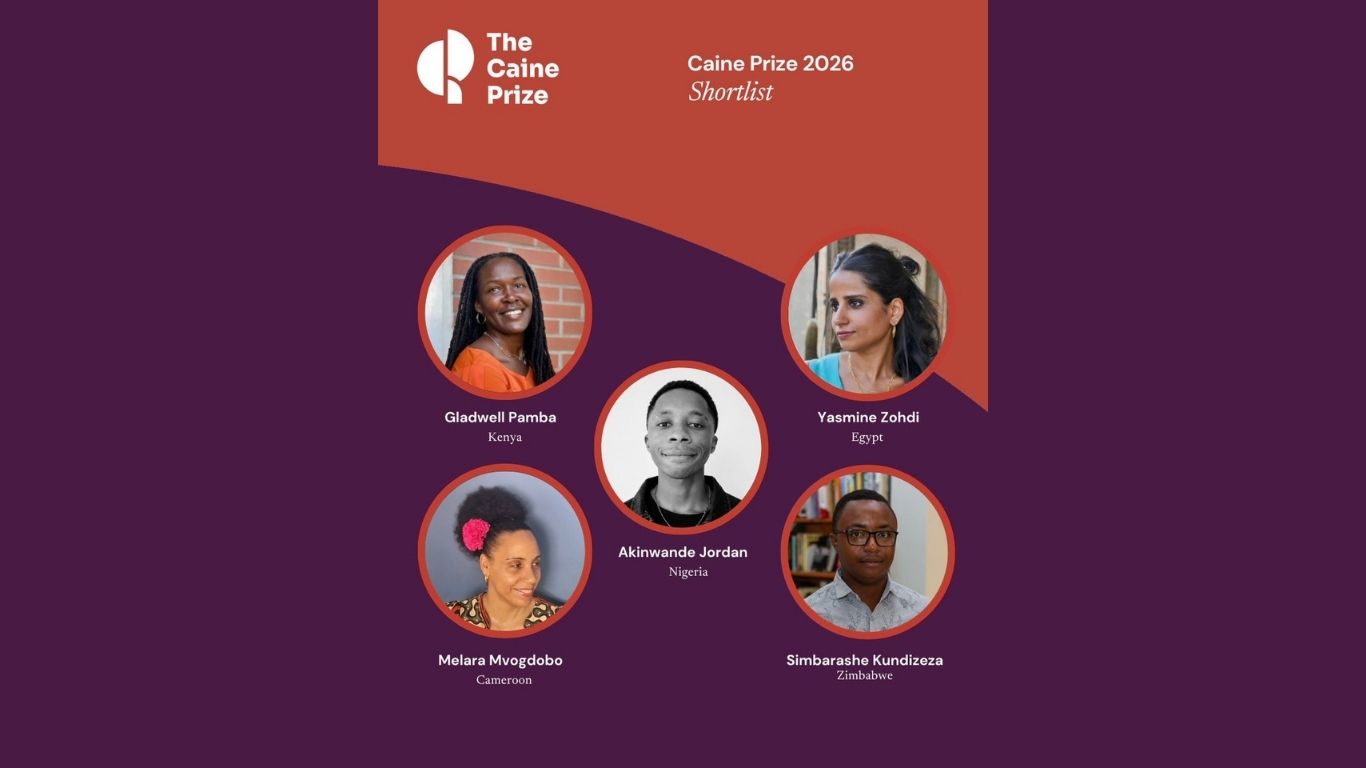
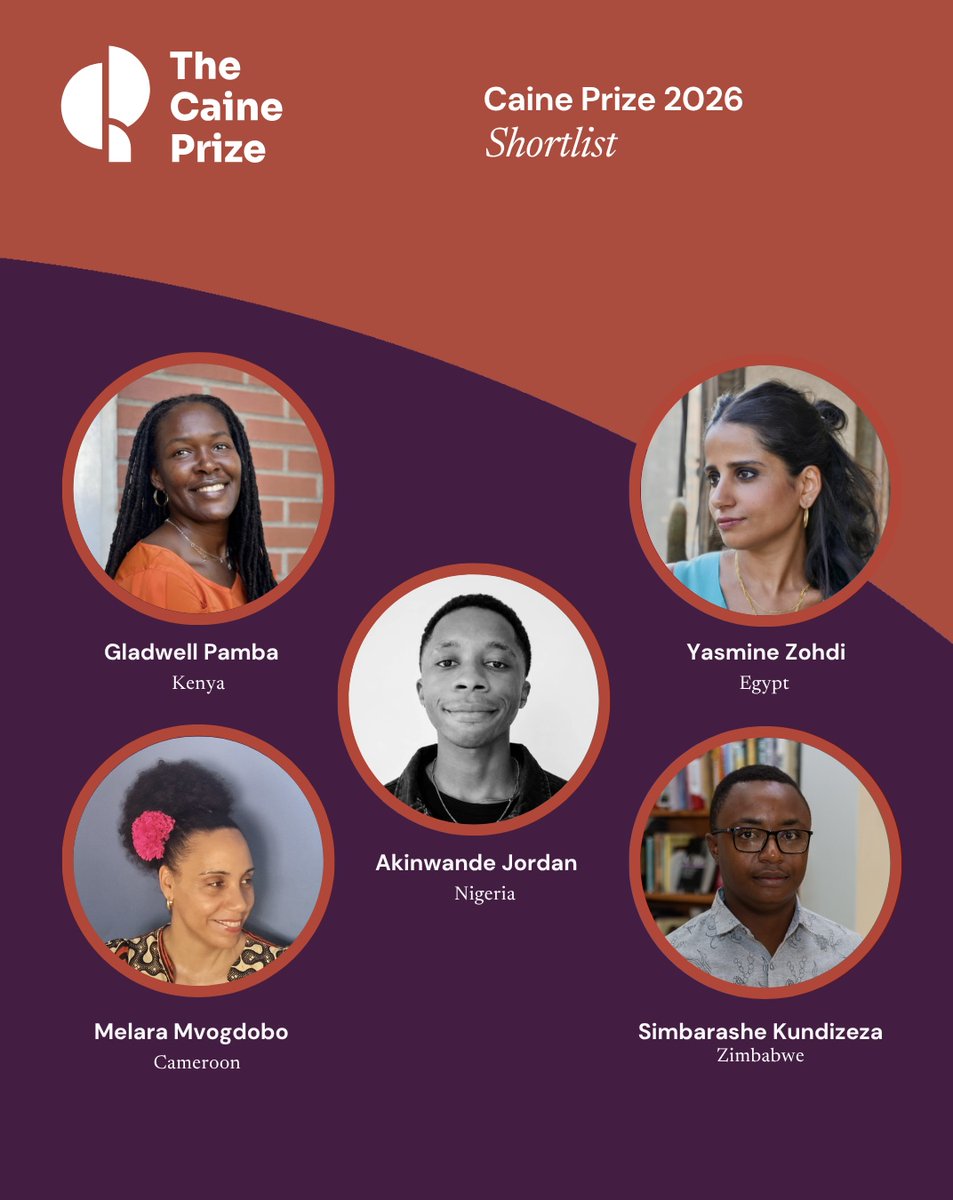
For the first time, the Caine Prize shortlist covers all five regions of Africa. Yasmine Zohdi of Egypt represents North Africa with “The Absence of Stains”; Simbarashe Steyn Kundizeza of Zimbabwe represents Southern Africa with “The Blue Fighter”, while Melara Mvogdobo of Cameroon registers Central Africa with “Dieu Merci”. Kenya’s Gladwell Pamba ballots East Africa, and Nigeria’s Akinwande Jordan, West Africa, for “The Last Shop” and “So Long Now It’s Starting To Look Like Eternity”, respectively. This edition, truly, collects Africa’s fiction.
Marriage, in most of Africa, among other things, is a condition for full personhood. Less for the African man, even more so for the African woman. Four of the five stories in this year’s Caine Prize shortlist furnish their central tension around marriage, and two of the four indict and proselytise the failures of the African patriarchy.
The faux exception, the fifth story, Yasmine Zohdi’s “The Absence of Stains”, published by Nigeria’s The Republic and edited by the 2019 Booker Prize finalist, Chigozie Obioma, is fulcrumed by courtship, a foreplay to marriage, written in quite the stylistic restraint that rehashes the intergenerational reproduction of gendered normativity through maternal authority archetypical of the Caine Prize’s archive since its inception in 2000.
If within us, the culture, in this age of coddling (the italics are Carl Terver’s), still exists a modicum of self-reflexivity — an art-specific psycho-cognitive phenomenon seemingly rare if not non-existent since the dereliction of literary criticism in African literature — then it’d be a cinch to admit that the ubiquity of a dissenting critical logic discredits not its critical value when its agitations are critically legible.
Consider this: it has been twenty-six years, and fifteen years after Ikhide R. Ikheloa’s critical qualms in “The 2011 Caine Prize: How Not to Write About Africa”, and seven years since Nneka Lesley Arimah overextended Caine’s normative social order trope when she won the 2019 edition with “Skinned” — a dystopian short story where girls are banned from wearing clothing from age fifteen till they secure themselves husbands — and still, the Caine Prize champions gynocentric literature.
Calling a spade a spade and not a big spoon, the proof is in the pudding; the Caine Prize is not yet finished, nor seems willing to be done and over with recycling themes of womanhood, antipatriarchy and marriage and to that very effect, the Bola Mosuro-led judging panel propulsively dedicates the 2026 prize cycle to “what the world does” to women in marriage.
In well-modulated prose, Yasmine Zohdi attempts literary realism in The Absence of Stains and misses less often than she hits. A political scientist by training, the Cairo-based Egyptian writer, translator and editor holds an MFA in Fiction from Sarah Lawrence College, New York and happens to keep a perdurable grip on controlled language, one not so common with MFA-prose (which, in my critical assessment, her story fits into), visceral enough to bleed into her nonfiction and some of her translations like The Birth of the Spirit, an excerpt translation of Sudanese novelist Sarah Al-Jack’s sophomore novel, The Mites (2018), written originally in Arabic (Al-Sous /السوس / العثة).
“The day after their first time, Tariq covered his mattress with old newspapers and plastic bags, securing them in place beneath the same blue sheets they’d made love on the previous afternoon. Mariam realized that when she fell onto the bed as they kissed and felt the rustling beneath her. He said she hadn’t bled the day before, so he hadn’t known what to expect today, and he didn’t want to risk ruining the new mattress he’d just bought from IKEA—“The Absence of Stains”, Yasmine Zohdi.
The short story, set in a suburb somewhere in Egypt, the outskirts of Cairo, maybe, follows Mariam, a young Egyptian woman, and her many life puzzles; the primary being her relationship with Tariq, a man she cannot afford to tell her mother about without leaving out their intimacy. What they have going on, Mariam and Tariq, is a socio-conscious romantic relationship joined at the hip by religious and academic clocks; Tariq is fun to love, but Mariam has limited time to love him as much as she could muster before jetting out to New York for her master’s program.
Because this partly reads like an Adichie-ish shot at true African pronatalism, Yasmine’s story gets its conflict from the protagonist, Mariam, reneging on gendered social clock pressure, the older women in her life playing the villain. The story uses character-as-symbols and confronts just about enough symbols to go round: Dina, Mariam’s cousin, squares in on the politics of marriageability; Tariq, a crusader for sexual autonomy and Mariam herself, manifesting the moral consciousness that fuels her double standards; she loves Tariq enough to open up to her mother about dating him, but at the same time, remains morally and religiously cautious enough to keep her sex life with him a secret.
Mariam’s mother, Hanaa and her aunt, Aunt Hala, co-play the social order normators who both insist that Mariam find a spouse while still in Nigeria, as they are too impatient to wait until she “comes back, then meet someone, then get engaged” and afraid of “having one foot in the grave” before dancing at her wedding or watching her “fall for some blond bimbo” and bring him home to them.
And that, Dina, on the other end, after confirming not being raped during a sexual assault episode, submits to a virginity test just so they’d be sure her marriageability status is unsoiled. Its strongest strength is the fluid language of its prose; this is a story whose craft is considerably subtler than its argument and whose best moments occur when it trusts the material world, rather than the narrator, to make its argument.
I think it was American editor Richard Ford, who edited volume 1 (1992) and volume 2 (2007) of The Granta Book of the American Short Story, who said that among other things, the prime quality of a great short story is the ability to demonstrate an awareness of their own existence as artifice and make one hold the fact of their artifice pleasurably in one’s mind while they muscle one around where they want one to go and still seem somehow as plausible as one’s own life.
He’d go on to say “I like stories that understand that they are husbanding my precious attention and need therefore to give me back something important…stories that are up to telling me directly something important about life, something that I did not know and in language I can understand and that gives me pleasure when I learn it”.
Especially for its originality, which is superior to everything on the shortlist bar Melara Mvogdobo’s “Dieu Merci”, Ford’s polemic is obvious in Gladwell Pamba’s “The Last Shop”. It is a story predicated on first risking its extinction by “being small”, yet suppressing one’s native resistance and authoritatively subordinating one to its formal requirements, “authorising one’s every responses”. The story—originally published in “Let Us Conspire and Other Stories”, a short story anthology edited by Kenyan writer and editor, Billy Kahora, with the contributors said to collectively speak on the “marginal identities of female emancipation and autonomy”—is the foremost and only tragic lodestar against female insubordination in the shortlist.
It traces the story of Madame Supreme, a facially deformed sculptor-cum-ex-convict coffin-maker in a rural Kenyan town, Bukembe and her platonic relationship with an unnamed schoolboy with a stuttering disorder. The central arc is the boy, scene after scene, getting to know why— aside from her deformed face making mothers around threaten their rambunctious children with being eaten by her—Madame Supreme is ostracised by the townsfolk.
With a far superior use of sensory, image-heavy prose across the shortlist, Pamba comments on shared solitude and artistry as these two things umbili-cords her main characters: the boy is ridiculed by his peers for his speech impairment yet finds non-masquerading succour in ‘senseless doodling’ while Madame Supreme, on the contrary, resorts to coffin-making instead of sculpting for after she served jail time for killing a man who killed her child, coffin-making seemed more exciting than “masonry, tailoring or cookery”, a deflective response, obviously. It is a workmanlike tragedy, this story. Madame Supreme ends up dying, lying still in a “Lucky Dube” coffin the same day the boy jets out to her house to tell her “Jesus can forgive her sins”, but is met with a small crowd calling the dead coffin-maker everything she never was.
“Madam Supreme said she didn’t sell children’s coffins.
The woman threw herself on the ground, wailing hard, her skirt absorbing the brown of dust. Couldn’t Madam Supreme just make one by evening? She begged” — “The Last Shop”, Gladwell Pamba.
Despite the foregoing, “The Last Shop”, fluid as the near-miss execution of the first-person child POV is, is sabotaged by plodding. For a story with fairly functional symbolic undertones of art and disability-induced stigmatisation, the employment of a Chekhov’s gun may have heavily lifted the plot, stacking the deck in favour of its pacing, yet fifty-nine pages into the sixty-two-page story, nothing hints of its central conflict, hence killing and burying its narrative momentum. There too is the inequilibrium between narration and explicit philosophical commentary for a story narrated by a boy. Somewhere along the middle of the story, the boy says:
“There was a shelf on one side of the wall with sculptures. One was a three-headed weaver bird, all the beaks reaching for an invisible grain. For some reason it brought up a memory of how we scrambled at the water point every time Nzoia Water Company disconnected our supply. The older boys always pushed us out of the queue and fetched their water first. These three beaks, unlike us, had the same fighting chance; none was stronger than the other.”
And perhaps, the most obvious distracting philosophical commentary comes in here:
“I stared at my earlier paintings that she’d hung on her wall. They looked better than I remembered. Next to them were her coffin charts: rectangular-topped, sealed off with no provision for viewing; glass-topped coffins that allowed for viewing without opening; dome-shaped lids; black coffins with golden handles; coffee-brown coffins; white coffins; dark-brown coffins and cheap-looking flat-topped coffins. She also hung newspaper cut-outs of coffins bearing the remains of famous people: Kijana Wamalwa, Lucky Dube, Princess Diana, Mighty King Kong, Brenda Fassie. Brenda Fassie! How her death had held our house hostage for days! My father stood in the living room, blocking everyone’s view of the TV as he stared at the breaking news of her death. My mother mumbling, ‘Nyasaye, you have plucked out the very best.’ That evening, the ugali had remained untouched. The days after her death, nobody talked about anything else or played any music except Brenda Fassie’s.”
Maybe a plot hole, maybe not, but the man Madame Supreme murdered, who was he?
Kirkus Reviews said of English writer, Claire King’s debut novel, The Night Rainbow (2013) to be “hampered by a limited perspective, though well-written and sometimes quite moving”, but in one of her interviews, Claire, on “child narrator POV”, said something incisive. “One thing I find liberating about writing from a child’s viewpoint is the obligation to remain neutral and without judgement.” She’d go on to add, “children don’t usually have a tub to thump or social criticisms to make. They are generally very matter of fact, and see things quite simply. Which means that regardless of your own opinions as the author, you have to leave the space wide open for the reader to decide what is right and what is wrong”.
Pamba may have achieved this to a fault in “The Last Shop”, and if one struggles to see how Claire’s polemic here works outside the shortlist, one could turn to E.C. Osondu’s “Waiting” or NoViolet Bulawayo’s “Hitting Budapest”, all Caine Prize-winning short stories (2009 & 2013) with exemplary deployment of the child narrator POV.
Simbarashe Steyn Kundizeza tells “The Blue Fighter”, a pedestrian plot, in serviceable, if not, middling aphoristic prose that somehow manoeuvres a decent narrative pull, but in a child narrator POV that not only emotionally over-signposts but struggles to attain naturalness.
“There was a silver tilapia with a torn fin that he called Chikondi; a convict cichlid he nicknamed Mambo for the way it chased the others, and a shy sharptooth catfish named Tariro that only came out at night” — “The Blue Fighter”, Simbarashe Steyn Kundizeza.
In the story, Tinashe, the child narrator, gives an account of how his family’s economic status goes from silk to rags due to his father’s obsession with building aquariums for luxury fish. The aquariums need constant electricity for lighting and to power their filters, and since the fish “feed on imported flakes that cost more than their weekly groceries”, he sucks the family’s income dry while tending to this obsession.
It is a linear plot with a predictable denouement and little to no surprise. Because Tinashe’s mother steps in, earns subsistently from tailoring and eventually sells off the aquariums, leaving just the blue fighter the story takes its title from, the reversal-of-fortune narrative directly indicts patriarchy, reneging on headship as a man’s default role in the African family. Prose and language-wise, it is the least contender for the $10,000 and would certainly do better as a story written in the intended child POV and not an authorial voice disguising as one.
“So it came to pass that Malcolm the Congolese flew from Kinshasa to Yaoundé and became my groom. My saviour from la misère du Camer. A gift from my mother, delivered straight to the door. Perhaps as compensation for leaving us children behind in Cameroon and failing to be in touch for many years?” — “Dieu Merci”, Melara Mvogdobo”
Melara Mvogdobo in “Dieu Merci” leans on a sham marriage of convenience to indict patriarchy as well. It is the most original plot on the shortlist. In 2025, her second novel Grossmütter was nominated for the Swiss Book Prize, albeit the Swiss-Cameroonian writer is better known for her debut novel, “Von den fünf Schwestern, die auszogen, ihren Vater zu ermorden” (2013) (translated in English as “Of the Five Sisters Who Set Out to Murder Their Father”).
Her prose is minimalistic yet experimental. Slightly humorous, properly uncanny. Written in a fragmented, staccato prose style, using short paragraphs and sentence fragments that mimic a lengthy prose poem, a difficult read for a lazy reader, the story follows a Cameroonian woman in Switzerland whose marriage to Malcolm, a Congolese man, is bought by her mother to secure her residence permit: immigration fraud.
When the payments sustaining the arrangement stop, she deliberately becomes pregnant, believing the child will protect her from divorce and deportation, and although it does, it doesn’t help her fend for the family whenever her husband’s always-struggling business plummets again, nor when her bluebottle phone rings unendingly from calls that all culminate in black tax.
The ultimate plot reveal is her double-life as a dominatrix at a club of which she goes under the disguise of visiting her sister in Geneva. If only the execution didn’t keep getting in its way, becoming more melodramatic than showing psychological depth, all with an ending manufactured less for the plot and more for shock, this would be a finely wrought piece of fiction. All the same, it is, for me, the strongest contender for the prize.
II
Contemporary Nigerian critic Carl Terver may have contended with the quintessence of non-patronising criticism in O, Griefa— speaking particularly to contemporaneity—when he decried “criticism is essential to art… if bad writing emerges, it shall be pointed out… if one doesn’t have the stomach for it, leave art to artists, or form niches where to rub each other’s backs and praise kitsch.”
Padding Carl’s polemic as it applies here, it suffices, I believe, to say that reading Akinwande Jordan’s “So Long Now It’s Starting To Look Like Eternity” more closely is borne partly of parochial bias; an intent to approach the work with a countryman-like even-handed microscopy that would not shout over it or drown it out with my personal theatrics but that’d listen for its inflections, subtle or not.
American critic James Wood, speaking on language, said in “How Fiction Works”, “there’s a way in which even complex prose is quite simple— because of that mathematical finality by which a perfect sentence cannot admit of an infinite number of variations, cannot be extended without aesthetic blight: its perfection is the solution to its own puzzle; it could not be done better.” In “So Long Now It’s Starting To Look Like Eternity”, Jordan weaves a simple, complex prose. It is, to me, a conceptual motif-driven essayistic cerebral realist prose with a third-person psychological mode.

The linear plot, following the marriage of two academics, Prof. Adeyemi and his wife Ngozi, a professor of literature, both lecturing at the University of Lagos, is, however, weakened by its very strength: the free indirect discourse sourced from Prof. Adeyemi’s mathematical and analytical consciousness and then there is the overdone extended semantic patterning, which, upon a closer disquisition, shows that the story survives more on a system of stacked metaphors and less on language, at least, in the functional sense of it.
“He dried the last plate. A white plate with a blue pattern around the rim. They had bought these plates at a market in Ibadan six years ago, haggling with the seller, feeling like they were participating in something authentic, something that connected them to the place they lived. Now they were just plates. Objects that held food—Akinwande Jordan, “So Long Now It’s Starting To Look Like Eternity”
To encroach further while shedding every ounce of personal animus and disparaging controversialist impulse, I’d first engage the creative throttle and make a clean breast of this review: laid as bare as possible, one reason I do not expect this review or its prime undertakings to attain critical acuity is the presence of judgement errors, the sole distinction being that they would not come from me alone. Mine, if at all incriminating, may owe to what Achebe calls “cocksureness” in “Thoughts on the African Novel,” or T.S. Eliot’s “dogmatisation of youth” and “braggadocio of a mild-mannered man behind a typewriter” in “Criticising the Critic”—charges I lose the agency to make against myself, leaving me, gnashingly, to hold on to what I can: the judgement error of Jordan’s third-person narrator.
Now, in a story where the lean characterisation protagonises Prof. Adeyemi, a punctilious character obsessing over a metaphor misuse more than he is concerned about his wife’s infidelity, there too is a well-meaning defamiliarisation through analytical overattention that ends up leaving the story’s metaphors insipid, especially upon being alternatively repeated. This, perhaps, explains the spatial inconsistency and few yet disturbing cases of semantic incoherence in the plot. One, I posit, enabled the shoehorning of sentences the story could have existed just fine without. Sentences like:
“(a). Moons were cold and distant. Ngozi’s eyes were neither of these things. They were brown and direct, and had a way of looking at you that made you feel like you were being calculated, assessed, and found either adequate or wanting, depending on the day and the light, and her mood and factors he had never been able to graph successfully.”
Or…
“(b). He closed the laptop. The screen went black (does the screen go black because it does go black whenever the laptop is closed or because Prof. Adeyemi actually sees it go black despite no longer being able to see the laptop’s screen since it’s closed?). The email vanished but continued to exist somewhere in digital space, in server farms in distant countries, replicated endlessly across backup systems. This was the nature of electronic communication. Nothing ever truly disappeared. It only migrated to new locations, became invisible but permanent, like trauma or debt (are debt and trauma invisibly permanent?)”
Repetition in prose is a fine narrative flex, even finer in poetry where it attains near-absolute naturalness. It builds on cadence and pads rhythm, not forgetting narrative parallelism. In A Tale of Two Cities (1859), Charles Dickens opened with a fine anaphora, “it was the best of times, it was the worst of times” that sings. Truly, there is no foolery in Naira Stories editors praising “So Long Now It’s Starting To Look Like Eternity” for wielding a unique poetic language, except that the story’s most prominent appropriation of poetic convention is its repetition, in a narrative sense, not symbolic (on that, Jordan comes undone). This poetic repetition, Jordan wields it, especially initially, with grace, and it works until it starts to fray at the edges:
- This was correct/ This was completely correct.
- Adeyemi understood this/ He understood it more clearly now.
- She was standing in the doorway/ She did this now. Stood in doorways…
- The soup was good/ It was always good.
- Failures of logic/failures of expression…
- Numbers were reliable/Numbers didn’t betray you.
Then somewhere in-between, they become triadic repetitions:
- This was their routine/ It had been their routine for years/ Routines were important.
- …they felt like lies. Not complete lies. Partial lies.
As much as the story thrives on these modulating poetic repetitions, the prose overreaches just as the philosophisation of the plot with Prof. Adeyemi’s lexicon-bearing academic consciousness became a surfeit of worn-out symbolisms where further usage only but compounded their on-the-nose-ness.
On “Truth” and “Convention” James Wood also said “convention itself, like metaphor, is not dead; but it’s always dying. So the artist is always trying to outwit it. But in outwitting it, the artist is always establishing another dying convention.”
With its idealistic consciousness, Jordan’s prose is ambitious and close-grained, seconded by none on the shortlist. The strongest version of this story, I believe, would trust multi-character images (a bit of Ngozi’s internal focalisation wouldn’t have hurt, would it?) and the readers’ meaning-making ability more, cut some of the explanatory repetition, and sync the execution with the ambitiousness of the high-church prose. Published originally in “A House That’s Not A Home”, an anthology edited by Nigerian editors Haliru Ali Musa and Kingsley Alumona, this story is a decent rep of the state of Nigerian fiction or is it not?
III
That the thematic convergence, stock symbolisms, of these stories makes the shortlist feel less like five isolated selections than five variations of a singular trope, perhaps, broaches that it is here the Caine Prize’s much-vaunted continental breadth begins to sit uneasily beside its mediocritic confirmity-induced thematic narrowness. For a competition that has managed, this year’s cycle, to circulate its shortlist across North, South, Central, East and West Africa, the imagination of Africa represented by the stories remains disproportionately concentrated around womanhood, marriage, patriarchy and the varying domestic negotiations produced by this coterie of hackneyed themes.

There is, as absolute as possible, nothing inherently deficient about gynocentric literature and, for the avoidance of being misquoted, which is very much likely, I’d, pop and plainly extrapolate, that the call here, however, is not to exclude stories about women or patriarchy, but to tone down letting those subjects become the default thematic preoccupations through which African social complexity is repeatedly interpreted in future cycles of the Caine Prize.
In an unthemed contest, when five of five shortlisted stories organise their principal tensions around a specific theme, of marriage and the recognisably adjacent critiques of patriarchal authority in this case, the question ceases to be whether these subjects are necessarily serviceable and becomes whether the prize is beginning to mistake the recurrence of a social concern for the discovery of new fictional peripeteia.
Ikhide Ikheloa’s old anxiety about what gets repeatedly legible as representative African writing therefore remains relevant—regardless of how vehement that is for factions of the culture still straitjacketing the critic for his seeming judgy censorship—even when the politics had long carthasized, and the writing has become more unorthodox and largely contemporary.
A continental prize should, at the least, be capable of holding, in knitted parallels ideally, contradictions: stories about marriage alongside stories about war, labour, technology, class, ecological collapse, migration, faith, crime, political violence, masculinity, disability, ageing or the banal absurdities of contemporary African life—an ambition it has braved before—because no matter how and where one scrutinises it from, the African everydayness is everything but minimalistic.
If the Caine Prize can circulate its shortlist across all regions of Africa, it can circulate its thematic imagination with the same generosity, sabbaticalising gynocentric literature and its integers, be it ever so slight. This year’s shortlist is good precisely because its individual stories are doing different things with that preoccupation.
Like Ernest said in his dissenting crusade for a much-needed renewal, the baby steps towards walking the talk—assuming there is or ever would be any talk—and towards Caine’s true representation of the best of African fiction would be awarding the 2013 prize to what he considered the strongest representation of African writing: a story whose “lucid, delicate, and firm” prose “investigates and searches the reader…prodding and implicating him with its complicit language.”
Caine, in a surprising turn, would eventually actualise his prediction when Mame Bougouma Diene and Woppa Diallo’s “A Soul of Small Places” was announced the winner months later. I posit that Mvogdobo and Pamba, especially, demonstrate how much can still be extracted from singular stock material when plot and form possess sufficient individuality.
Ultimately, to pad my point, a prize of Caine’s timbre ought to want more than a strong collection of variations on one subject and everything it spectrums. It ought to want collision. It ought to want surprise. And above all, it ought to leave us with the sense that African fiction is panoramic.
With perhaps a selection bias they hope passes as a stroke of luck, this year’s Caine Prize judging panel may have just served us a fine shortlist with every story bearing a chink in its armour, but since the business of prose lies ultimately in language and voice and in Caine’s tradition, a strong fervour for originality of plot, voice and style, the jostle for the $10,000 at the award ceremony in London come October, may just be between Melara Mvogdobo “Dieu Merci” and Gladwell Pamba’s “The Last Shop”.
Felix Eshiet is a Nigerian writer and Efik-Ibibio poet. His work appears in Only Poems, Madrid Review, Prairie Schooner, Efiko, Lolwe, Chestnut Review, Porter House Review, Palette Poetry, 20.35 Africa. A recipient of the Brigitte Poirson Literature Prize in Poetry, he’s a 2025 Obsidian Foundation fellow.