


A Mama Deola Wedding Story pretends to be a film for two hours while remaining, in every structural and creative sense, a skit.
By Joseph Jonathan
There is a particular kind of creative failure that announces itself before it has properly begun. Not in the way that bad films sometimes reveal their badness through a clumsy opening scene or a miscalculated tonal choice, but in the more fundamental way of a work that has not yet understood what it is trying to be. A Mama Deola Wedding Story, the debut production from streaming platform Kava and the feature-film producing debut of Folagade Banks, announces its failure in its very first line.
Before the story has opened its mouth, before a single scene has been established or a single character introduced, Folagade Banks appears on screen as Mama Deola and asks the audience to look beyond his beard as they watch. It is, on its surface, a playful fourth-wall break.
It is, in practice, a confession — the filmmaking equivalent of a comedian explaining a joke before delivering it. If you have to tell your audience what to overlook before you have given them anything to look at, you have already failed at the most elemental obligation of storytelling. You have demonstrated, in a single line, that you know the material cannot carry itself and have decided to manage the audience’s expectations rather than meet them.
The Nigerian skit-to-film pipeline has been one of the more persistent and more persistently disappointing features of contemporary Nollywood’s relationship with digital entertainment culture. The logic is commercially coherent, even if creatively it is almost always catastrophic: a comedian builds an audience around a recurring character, the character accumulates enough recognition to become a brand, and the brand is leveraged into a feature film on the assumption that the existing audience will follow.
What this logic consistently fails to account for is the fundamental difference between what a skit character needs to succeed and what a feature film character needs to survive. A skit character needs a recognisable energy, a reliable catchphrase, a facial expression that communicates a worldview in two seconds, and approximately ninety seconds of chaos before the format releases the audience. A feature film character needs interiority, motivation and the capacity to exist in relationship to other characters in ways that generate genuine dramatic stakes; above all, they require a story large enough to live inside. Mama Deola has the energy. The film has not built her a story large enough to deserve it.
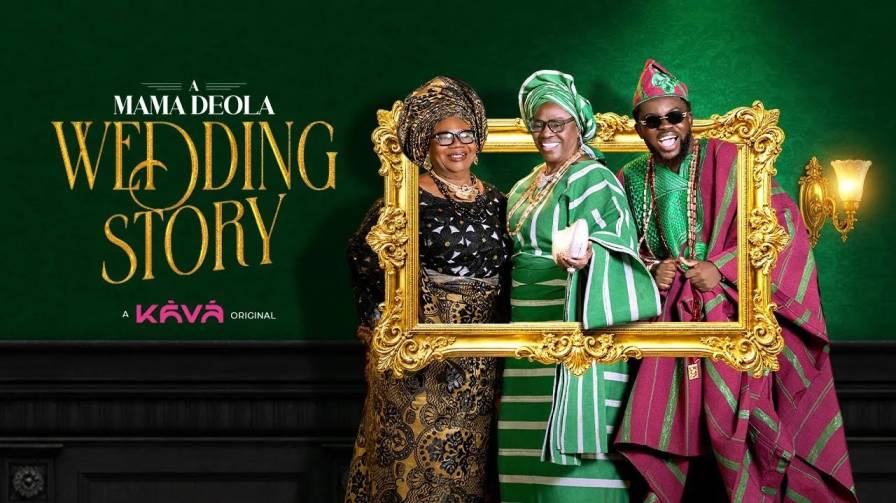
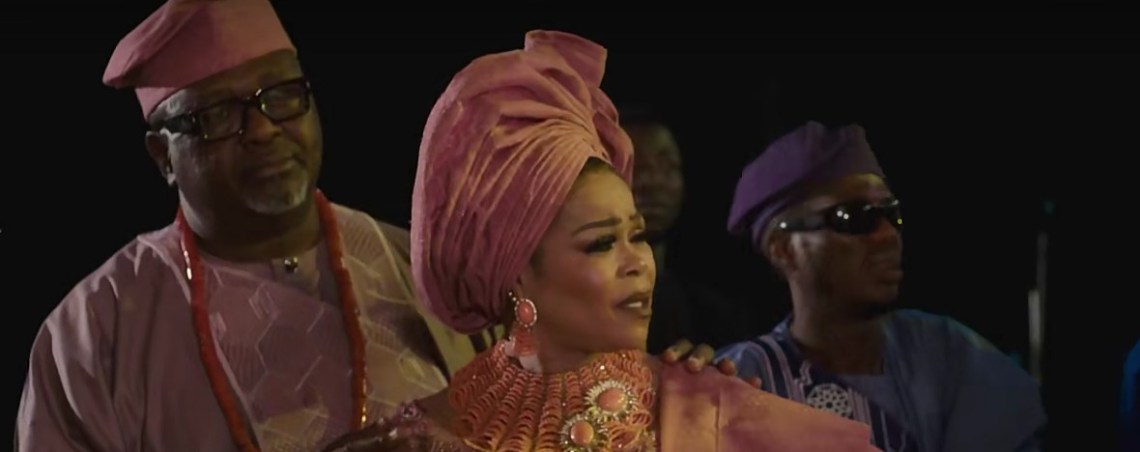
The premise, such as it is, follows Mama Deola’s son Femi (Rotimi Salami) and his fiancée Demilade (Omowunmi Dada) as they attempt to navigate toward marriage against the combined resistance of incompatible family cultures: Femi’s working-class household against Demilade’s high-class mother, Rochelle (Shaffy Bello), whose disdain for everything the Mama Deola household represents she makes no effort to conceal.
This is serviceable territory for a Nigerian wedding comedy. The class friction at the heart of a marriage negotiation, the financial pressure of staging a wedding beyond one’s means, and the social performance that Nigerian weddings demand of everyone involved are real and recognisable tensions with genuine comic and dramatic potential. The film introduces all of them. It develops none of them. It mistakes the act of naming themes for the act of exploring them, and the distance between those two activities is where the film disappears.
The couple at the centre of the story — the people whose marriage is supposedly the reason for everything that happens — generate no emotional investment whatsoever. Femi and Demilade have no discernible chemistry, no established interior life as individuals or as a unit, and no scenes in which their relationship is built sufficiently for the audience to care whether it survives the film’s manufactured obstacles.
When conflict arrives between them, it lands with the dramatic weight of a disagreement between two people you met five minutes ago. The film keeps deferring the honest conversation this couple needs to have and ultimately abandons it in favour of a resolution that has not been earned by anything the preceding scenes have established. You watch it happen without feeling anything, because the film has never given you a reason to feel anything, and a story that cannot make you care about whether two people get married should not be making a film about a wedding.
The supporting complications accumulate with the specific logic of a skit writer who has been told they now have two hours to fill. An ex-girlfriend arrives during a marriage counselling session with a timing so convenient it constitutes its own comedy, though not the kind the film intends.
The loan subplot — Mama Deola borrows ten million naira at a steep interest rate with a repayment deadline that lands on the wedding day — provides the film’s clearest potential source of external tension, and the film promptly neglects it in favour of scenes that stretch past their natural endpoints while contributing nothing to the narrative’s forward momentum. By the time the wedding finally arrives, you have stopped caring about whether anyone gets married and started caring only about whether the film is going to end.
It is worth naming the specific quality of the film’s badness, because not all bad films are bad in the same way. Some films fail because they are poorly executed. Some fail because they are poorly conceived. A Mama Deola Wedding Story fails because it was never properly converted from one form to another. It is a skit that has been inflated to feature length without undergoing the structural transformation that inflation demands. The scenes do not build on each other. The conflicts do not escalate. The characters do not develop.
The film moves from set piece to set piece with the logic of a content calendar rather than a screenplay, each scene existing not because the preceding scene has made it necessary but because somebody needed something to happen next. This is not filmmaking. This is content production dressed in the clothes of filmmaking, and the clothes do not fit.
The direction by Femi Adebayo — a filmmaker whose work in the Yoruba epic tradition has demonstrated genuine formal intelligence — is here operating without the structural support that good directing requires. Direction cannot compensate for a screenplay that has not decided what it is doing, and this screenplay has not decided. The camera records events without particular visual intention.
Scenes that should build to comic or emotional peaks simply end. The pacing has the specific quality of footage that has not been edited so much as arranged, cut together in the order it was shot rather than in the order that would give it dramatic rhythm. There is no sense of a controlling creative vision making decisions about what the audience should feel at any given moment and deploying the film’s formal resources in service of that feeling.


The cast deserves better than this material gives them, and the injustice is particularly visible in Shaffy Bello and Omowunmi Dada. Bello plays Rochelle’s class snobbery with enough specificity to be genuinely amusing in her better scenes — she understands the character’s internal logic even when the script doesn’t — and there are moments where you can see the outlines of a properly written comic antagonist that the screenplay has failed to fully construct.
Dada carries Demilade’s emotional weight with a grounded sincerity that the film repeatedly fails to reward: there is a breakdown scene that, in a better-structured film, would land with real force, but here arrives without sufficient context to generate the response it is reaching for. The supporting ensemble, populated with recognisable Nollywood names, does what recognisable Nollywood names do in films like this: they fill the frame with familiar faces whose presence signals that something important should be happening, even when the screenplay has not provided anything important for them to do.
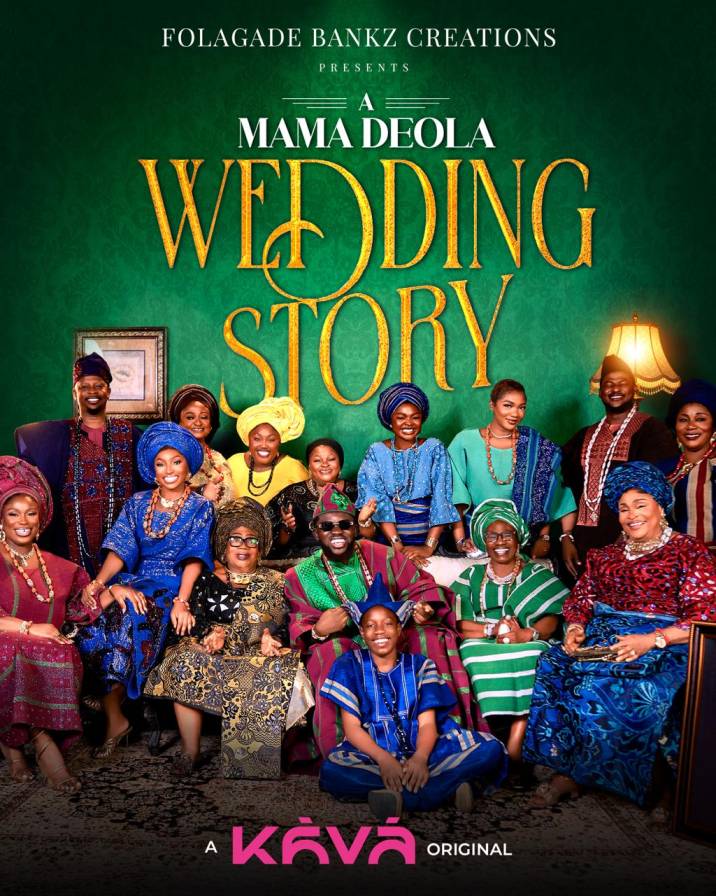
That Kava chose this as its inaugural original production is a curatorial decision that demands scrutiny. A streaming platform’s first original is a declaration. It communicates something about the platform’s editorial identity, about what it believes is worth making and what audience it believes it is serving. The decision to launch with an existing social media IP, built around a pre-existing audience, is commercially cautious in a way that is also creatively timid. It signals a platform that is more interested in importing an audience than in building one through the quality of what it commissions.
If Kava intends to position itself as a serious player in the Nigerian streaming landscape, it needs better decision-makers than everyone responsible for making this film see the light of day, and it needs to understand that a platform’s first original will be remembered long after its second and third, for better or for worse.
Mama Deola, as a social media phenomenon, works because the format that hosts her is honest about what it is. A two-minute skit does not pretend to be a film. It delivers its character in a concentrated dose, generates its comedy from a single situation, and releases the audience before the energy has time to dilute.
A Mama Deola Wedding Story pretends to be a film for two hours while remaining, in every structural and creative sense, a skit. One that didn’t know when to end, made by people who confused the existence of an audience with the existence of a story worth telling them. The character deserved better. The audience deserved better. And Kava, if it has any serious ambitions for the platform it is building, should know better next time.
Rating: 1.3/5
Joseph Jonathan is a historian who seeks to understand how film shapes our cultural identity as a people. He believes that history is more about the future than the past. When he’s not writing about film, you can catch him listening to music or discussing politics. He tweets @Chukwu2big.