

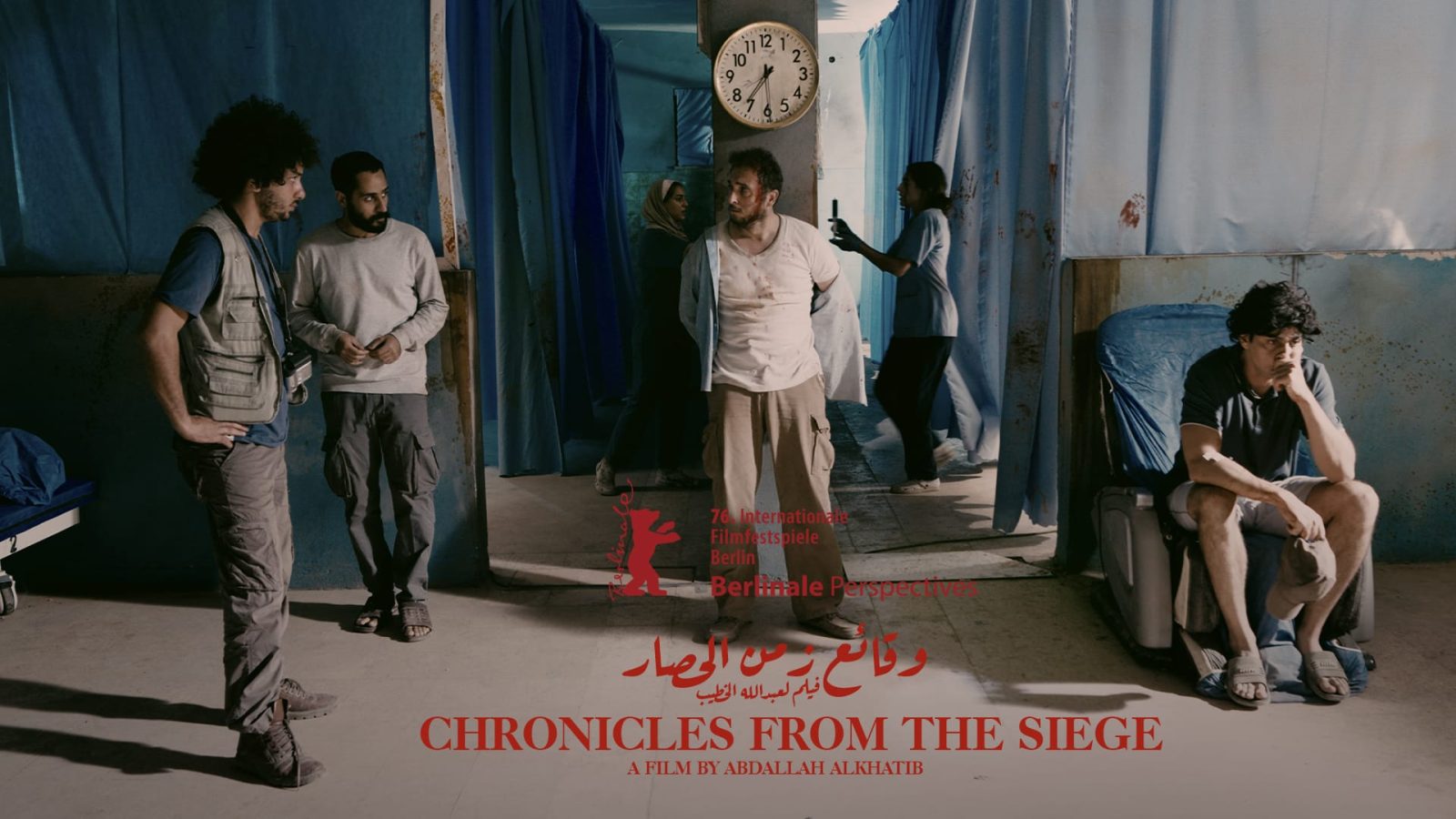

With Chronicles from the Siege, Abdallah Al-Khatib proves that cinema is indeed political and that in the hands of someone who has lived the story he is telling, it can be the most honest language we have.
By Joseph Jonathan
The more visible a crisis becomes, the less visible the people inside it. Numbers accumulate. Positions harden. What gets lost is not merely justice; it is the person. The specific, irreducible, ordinary human being whose life existed before the crisis and deserves to continue after it. Palestinian lives have been processed through the machinery of geopolitical abstraction for so long that the abstraction has become, for many audiences, the reality. It takes an act of deliberate artistic counter-pressure to restore what the machinery has flattened.
Chronicles from the Siege is that act. And it arrives at a moment when what politics is failing to say about Palestine, cinema must. Written and directed by Palestinian-Syrian filmmaker Abdallah Al-Khatib, Chronicles from the Siege won the Best First Feature Award at the Berlinale 2026 before screening at the Melbourne International Film Festival, and is among the most important films made in the last decade. Important is a word that critics deploy too easily, often as a substitute for the more demanding work of explaining why. In this case the explanation is specific: what politics is failing to say about Palestine, this film says. Politics gives us the numbers and statistics. At its worst, it gives us distortion and denial in the form of propaganda.
Chronicles from the Siege gives us something different: ordinary longing. Palestinians want the same things we all want. They want to eat sweet things. They want to party. They want to fall in love and have sex and argue about movies with their friends. It is only circumstance that dictates otherwise, and the circumstance in question is a siege.
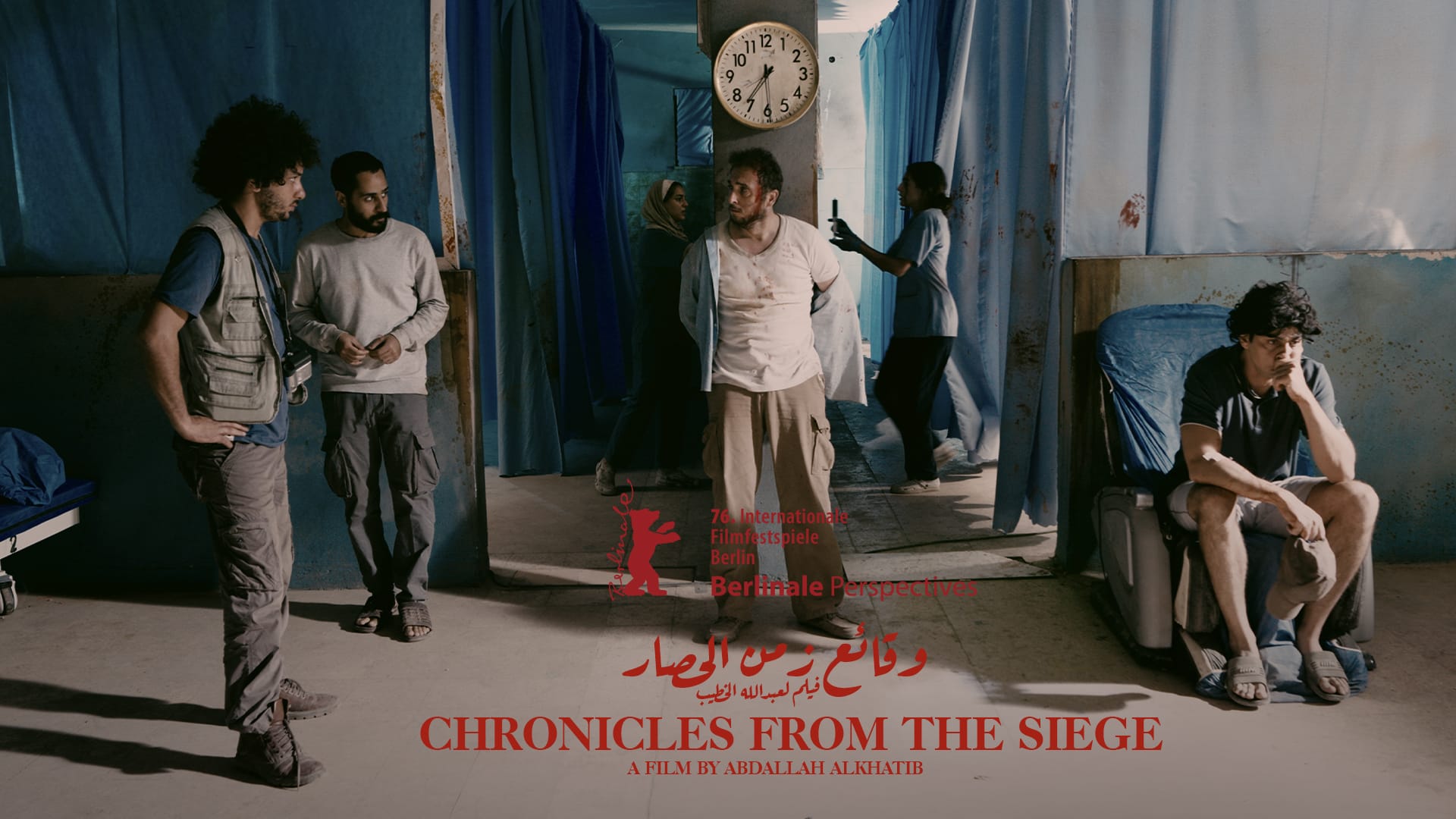
The film is structured as a series of loosely connected vignettes, drawn from Al-Khatib’s own experiences during the Syrian regime’s blockade of the Yarmouk refugee camp in Damascus and from stories gathered from Gaza in recent years. Shot in Algeria and Jordan with a handheld aesthetic that sits in the productive borderland between documentary and fiction, it unfolds in an unnamed city whose identity is unmistakable: Palestinian flags visible in the background, the specific geometry of a people besieged not for the first time and not, the film implies, for the last.
The unnamed city is a formal choice that serves the film’s deepest argument: that what is being depicted here is not one siege but the structure of siege itself, the recurring condition of a people whose dispossession has been organised across generations with such consistency that it has acquired the character of a system.
The film opens with displaced people scrambling for rations thrown from the back of a truck, and it is immediately clear that Al-Khatib is not making a film about heroes or martyrs. He is making a film about hunger. About the specific indignity of needing to fight for food in a place where you were living an ordinary life last year, last month, last week.
The handheld camera — deliberately grainy, deliberately intimate, sharing the aesthetic of the diegetic video camera that appears early in the film — puts the viewer inside this scramble rather than above it, refusing the consoling distance of the observational documentary and insisting instead on a proximity that implicates the audience in what they are watching. You are not watching people suffer. You are standing next to them while they suffer, which is a meaningfully different experience and a meaningfully different ethical position.
From this opening we move through a series of vignettes that are individually vivid and collectively devastating. Arafat, a former video store owner played with quietly extraordinary presence by Nadeem Rimawi, scavenges for food and medicine in near-silence — a scene whose low light and digital noise evoke the specific visual grammar of citizen journalism, of footage recorded not by professionals but by people who happened to have a camera and felt the compulsion to document.
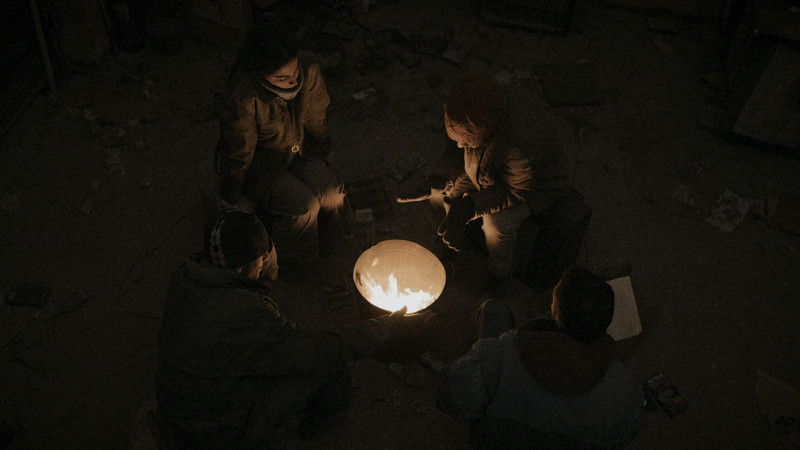
The scene is searingly cinematic despite, or perhaps because of, its aesthetic austerity. Then a group of young friends, taking refuge in Arafat’s empty store, find themselves arguing about cinema the way cinephiles everywhere argue about cinema; with passion, pedantry, and the specific pleasure of being among people who share your obsessions. They talk about films. They trade jokes. They are entirely, recognisably human.
And then they face the question that Al-Khatib has embedded in the scene like a depth charge: whether to burn the videotapes to stay warm. It is, in miniature, the film’s central philosophical inquiry: the question of whether art, including the art we are watching, can ever have material impact on survival, or whether survival will always, in the end, consume the art.
That the characters debate this question with the seriousness it deserves, that they cannot reach an easy answer, that the debate itself is presented as a form of resistance against the dehumanisation the siege is designed to produce is Al-Khatib at his most formally precise. The video store scene is one of the most quietly devastating sequences in recent cinema, and it does not announce itself as such. It simply unfolds, and the devastation accumulates in the viewing.
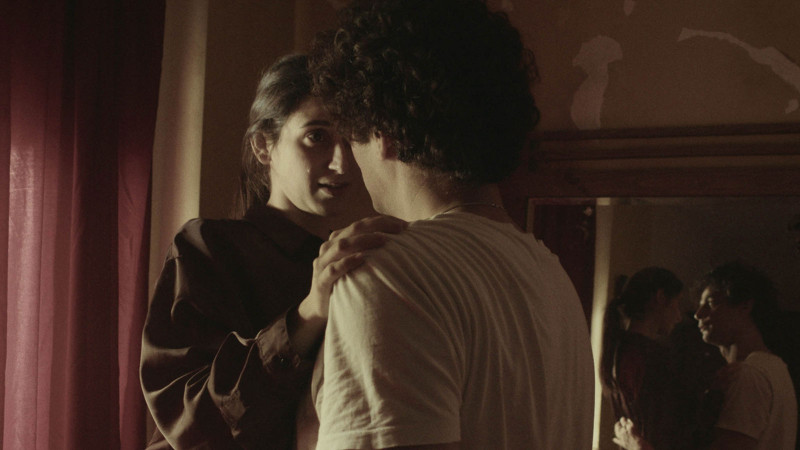
The film’s tonal achievement is its most surprising and most significant. Chronicles from the Siege is, for the majority of its runtime, an intense and often brutal drama. But it is also, at carefully chosen intervals, genuinely funny, and the comedy is not relief from the darkness but an expression of the same humanity that the darkness is trying to extinguish. A sequence involving a fighter and his girlfriend, repeatedly interrupted in their attempt to have sex by the specific inconveniences of living under siege, is simultaneously one of the funniest scenes in the film and one of its most politically resonant. Nobody, to my knowledge, has put a blowjob gone awry at the centre of a film about the ongoing illegal occupation of Palestine before. Al-Khatib has, and the choice is correct, because horniness is political: the desire for intimacy, for pleasure, for the ordinary private experiences that make a life feel like a life rather than a statistic, is precisely what occupation seeks to eliminate, and precisely what these characters refuse to surrender.
The sequence that arrives around the two-thirds mark, when the couple keeps getting interrupted, brings together the film’s tonal range most completely: desperation and desire, comedy and dread, the mundane and the catastrophic occupying the same frame without cancelling each other out. It is the scene that most fully embodies what the film is arguing: that resilience is not the absence of ordinary human need but its insistence. The refusal to stop wanting the things that make life worth living even when everything around you is designed to take those things away.


The film’s formal structure (the semi-anthology format, the loosely connected vignettes) initially resists emotional investment in the way that episodic narratives sometimes do. As soon as you begin to care about one set of characters, the film moves to the next, and the accumulated investment you were building has to be partly rebuilt. This was, for much of my viewing, more a bug than a feature. But the film’s final act, set in a rundown hospital where the majority of the ensemble converges, retroactively justifies the structure. The chaotic nature of the anthology, which seemed like a formal limitation in the earlier sections, reveals itself as the point: under siege, there is never enough time, never enough resources, never enough of anything to allow for the kind of sustained narrative coherence that conventional storytelling provides. The fragmentation is mimetic. It feels like a siege.
The cinematography by Talal Khoury and the sound design by Rana Eid deserve specific acknowledgement. Khoury’s handheld camera achieves the difficult balance of documentary immediacy and cinematic intentionality; the images feel found rather than composed, which is itself a compositional achievement. Rana Eid’s soundscape is perhaps the film’s most politically specific formal decision: the siege is felt rather than seen, heard in the constant ambient threat of shelling, in the walkie-talkie transmissions of the resistance network, in the thunderous interruptions that punctuate even the film’s most comedic moments. There are no checkpoints on screen, no visible military infrastructure. The violence of occupation is rendered instead as sonic weather, the permanent atmospheric condition of a people living inside a system of organised harm.
What is being taken from the Palestinian people, this film insists, is not merely land or infrastructure or life itself. It is what makes life worth living. The argument about which films to burn. The cigarette puff traded for an old refrigerator. The chocolate that has become treasure. The sex that keeps getting interrupted. The video store whose tapes represent not just entertainment but the accumulated evidence that these people had an interior life (a culture, a set of passions, a way of being in the world) before the siege tried to reduce them to their suffering.
Chronicles from the Siege refuses that reduction with every frame. It insists, with the specific insistence of a filmmaker who has lived inside what he is depicting, that these are people whose full humanity existed before the cameras arrived and will continue to exist after they leave. The resilience of the people of Palestine is not merely extraordinary. In this film, it is the light.
With Chronicles from the Siege, Abdallah Al-Khatib proves that cinema is indeed political and that in the hands of someone who has lived the story he is telling, it can be the most honest language we have.
Rating: 4/5
Joseph Jonathan is a historian who seeks to understand how film shapes our cultural identity as a people. He believes that history is more about the future than the past. When he’s not writing about film, you can catch him listening to music or discussing politics. He tweets @Chukwu2big.