

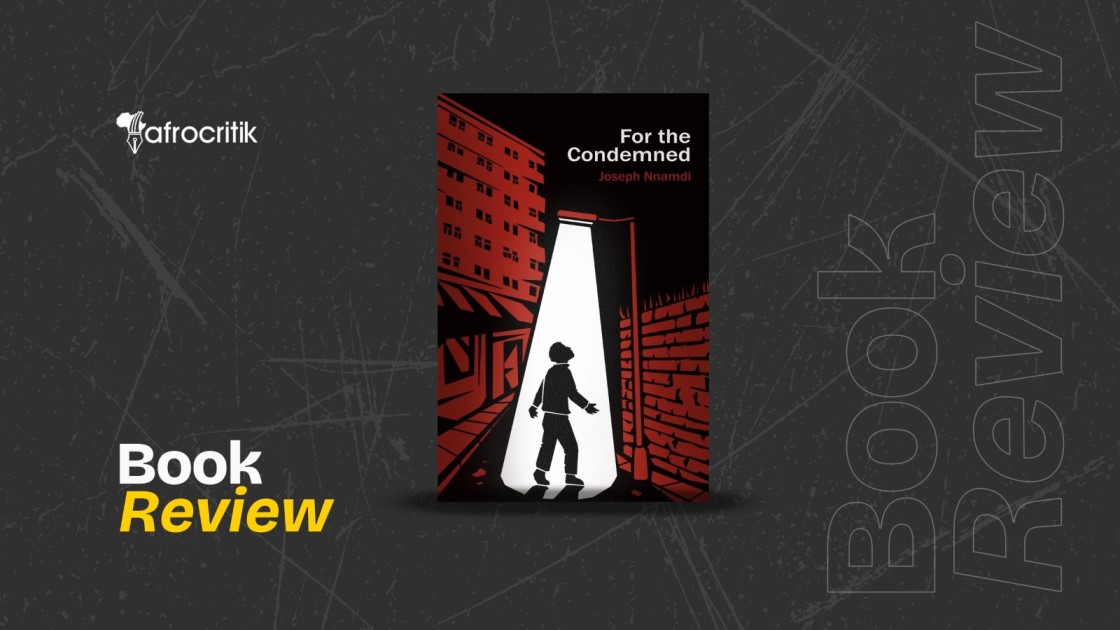

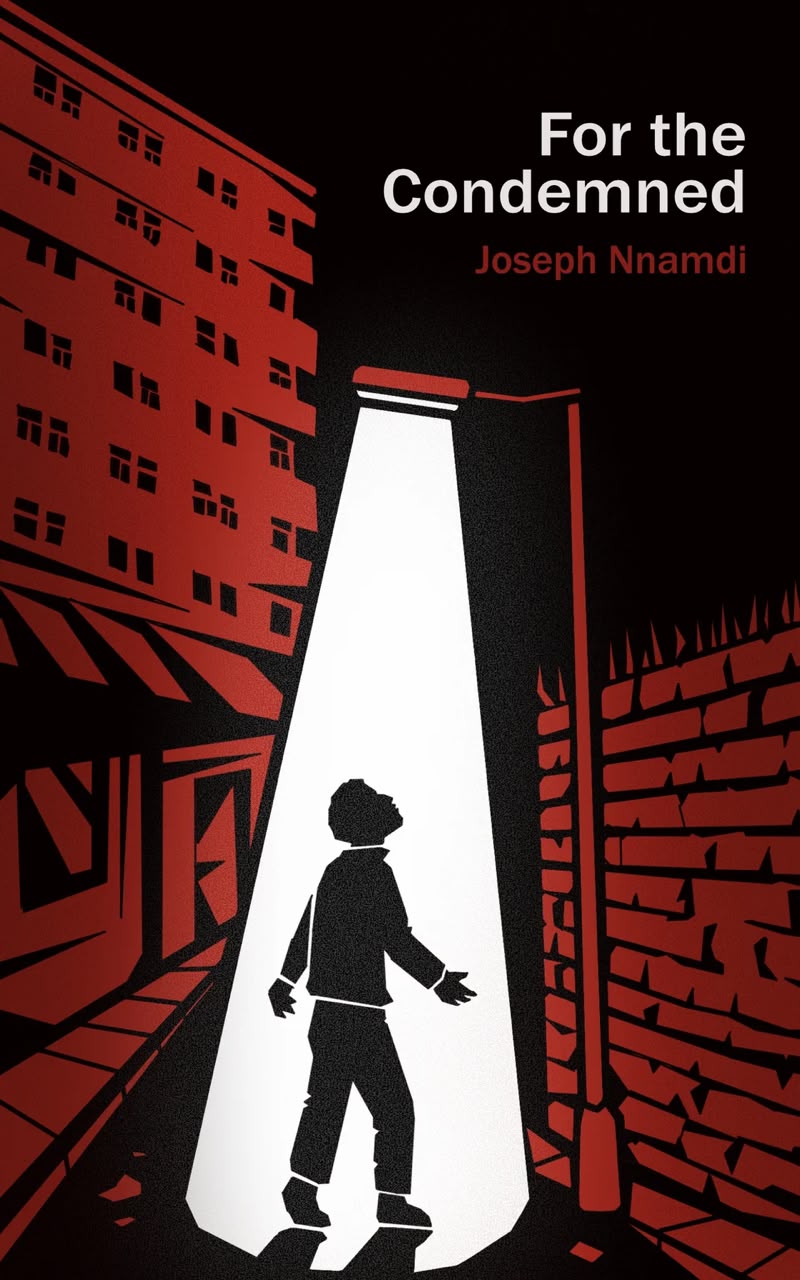
For the Condemned is a form of parable for the good and evil that exist in our world today—how entities take it upon themselves to correct the wrongs of the world, only to inadvertently fall prey to those failings they seek to make right.
By Azubuike Obi
Published by the Roaring Lion Newcastle in June 2026, Joseph Nnamdi’s For the Condemned tells the story of Augustine, a middling trigger-happy policeman who strikes a deal with a supernatural entity after he is thrown in jail on suspicion of a grievous murder.
Augustine, “an unremarkable, light-skinned man who looks perpetually tired”, is a man who is deeply dissatisfied with his life. Orphaned at an early age and raised by an uncle indifferent to his existence, he is married to a woman who outearns his meagre police officer salary, and has fathered two children who see and know his unflattering self, parts of his life he would rather hide—and so, he has lived all of his life feeling inconsequential.
One night while manning a checkpoint, Augustine and his colleague Nicholas accost a young man driving what they describe as the lookalike of a missing vehicle. Talks follow. The young man, Samson, is innocent, as the car is established to belong to his sister. The officers extort money anyway, but Augustine decides that what the young man has offered is not enough. Tensions escalate. Words are thrown. And egos are wounded. A gun, “an extension of himself that gives him power”, is soon deployed in Augustine’s favour.
For anyone familiar with the workings of the Nigerian police, especially given that the scene echoes the motivations of the #EndSARS protests, this is a triggering read. But Nnamdi’s talents are gestured beyond mere arousal of anger or discomfort; he plants his readers into the quotidian life of a police officer, to see the makings of these men who are otherwise known as harbingers of doom—to see that many of them are living with private struggles like all of us, and perhaps in seeing these men, we yet may empathise with them. Isn’t that fiction’s greatest triumph, to live lives we may never get to know, to peer from vantage points otherwise unfamiliar to us?
At work the next day, after Augustine and Nicholas bury the young man and sell off his vehicle, the family comes to lay complaint of a missing person. A witness soon emerges, and Augustine lands in a cell. In there, he is visited by a strange entity, a “very skinny man with a thick afro” and “abnormal, pale-looking skin”. The strange man moves between the boundaries of the living and the dead, working to smooth out the world, to force repentance out of evil doers by making them use their physicality for the sake of a greater good. In a classic move, he offers to make Augustine’s troubles go away, in exchange for three favours. Augustine agrees, and from there the plot begins to move, engaging but never sensational, even when actions may be considered outlandish.
A fantasy thriller, For the Condemned straddles the natural world and the supernatural, with Nnamdi’s hand firm when in the realm he clearly understands and shaky when dealing with the supernatural aspects of the novel. It is as though he forgets the necessity of world-building when venturing into the paranormal, that that plane operates differently, and so, the equation must be set up to be worked out by the metrics of his creation.
For instance, when we meet the strange man on For the Condemned’s opening page, we are told he needs a physical body, yet when he begins to usher tasks to Augustine, there seems to be no need for such a state. In fact, the fear his presence inspires throughout the novel is built singularly on the eeriness of his current form. So what is the need for this body he had hitherto longed for? Who even is he? And what are his motivations for the tasks he requires Augustine to carry out? If we are told he plays God, what liminal space does he preside over, and how does his rule over that jurisdiction affect what he has come to do on earth?

No matter though, it is easy to forgive this novel its misgivings, for they are minuscule, in comparison with its achievements. The narrative is kinetic, and the style is conversational in a way that feels like the story is being told by a friend who has the gift of captivating his audience with a tale. Take, by way of example, this passage: “A mob encircles him, and the scene quickly escalates. A cloud of dust rises with the rowdiness. A few officers are in the commotion, but it is hard to tell who is pacifying and who is instigating. Before Augustine can comprehend anything, he is grabbed and pulled from every angle. The noise and the crowd keep growing. Some hands shove and prod his head, and he feels his uniform tear…”
Or this piece of dialogue from Samson’s mother: “Oga police, but I tell you!!! This man get something to do with why my son no come house? You dey tell me protocol, protocol. See am now! This papa don talk wetin he see, and the devil wan run comot”. So distinct. So thoroughly Nigerian.
In For the Condemned, time and place need not be explicitly mentioned; Nnamdi skilfully embeds distinguishing idiosyncrasies into the narrative and the speech of his characters. From the natural snappiness of the Nigerian Pidgin spoken here, one is able to locate these characters someplace in the South-South part of Nigeria, in Edo or Delta State—many pages later, the setting is confirmed to be Benin.

And for its time period, the narrator simply hints: “One table holds a group of men passionately debating the health of the current president and how his enemies have plans to destroy him because he intends to make the nation great again”. One needs only an average knowledge of Nigeria’s history and political trajectory to understand this.
There’s an implicit context in mind, and a certain level of trust in readers—Nnamdi believes we should get it, and we do. In a time when writers spoon-feed information, watering it down and over-explaining to appeal to a supposed broader audience, it is refreshing to read a novel that seeks to be nothing more than what it is. Nnamdi understands that the local is global.
However, like many plot-driven novels, after the third act, the movements begin to feel artificially engineered, rather than emerging naturally from the story. We find the characters going to places and making visits with frivolous motivations. Only when they get there, when they receive information that features prominently in further scenes, do we see the reason the author had twisted them into making those journeys. For instance, after Augustine nearly finishes his business in town and is about to leave, he goes again to visit Reggae, his boss, to say goodbye—even though he had already said goodbye and it seemed concluded days earlier. Only after he receives the address to Samson’s house, which births a reason for yet another movement, do we see why Nnamdi has made him make the otherwise needless trip.
Taken together, For the Condemned is a form of parable for the good and evil that exists in our world today—how entities take it upon themselves to correct the wrongs of the world, only to inadvertently fall prey to those failings they seek to make right. It is an impressive debut from a writer capable of creating complex characters and engrossing stories.
Azubuike Obi is an Igbo storyteller who believes in the transformative power of language. He won second place in The Republic Student Writing Competition (2025), and was nominated for Chika Unigwe’s Awele Creative Trust Award (2024). His fiction and nonfiction have appeared online and in print in The Republic, The Weganda Review, Naira Stories, Afapinen, Efiko Magazine, and elsewhere. He is a regular contributor at Afrocritik.