

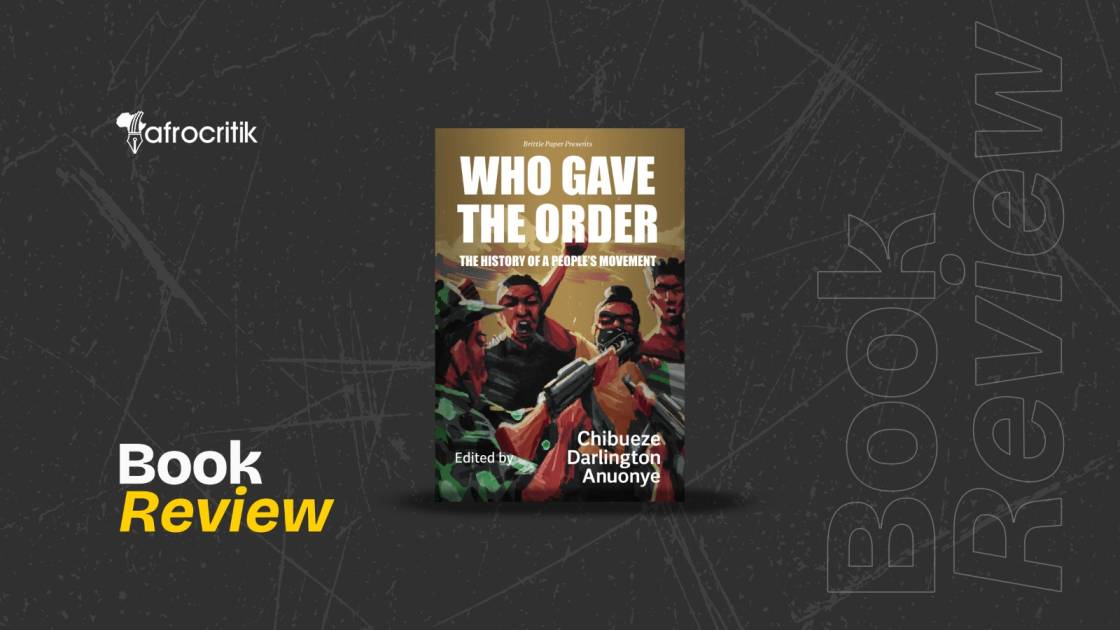

In Who Gave The Order (2025), Chibueze Darlington Anuonye assembles 13 Nigerian writers to bear witness to the events of the protests and the catalyst of the revolution that has characterised the 2020s in Nigeria and christened its youths the Sóró Sóké Generation.
By Azubuike Obi
Around midnight on October 20, 2020, my siblings and I huddled together watching the live stream on DJ Switch’s Instagram Live from our home in Kuje, Abuja. My sister’s hands quaked as she gripped her phone, weeping and muttering prayers that sounded like decades of the rosary. The Live soon disconnected, and we spent the remainder of the night moving from blog to blog, hoping feverishly that the gunshots we heard would not find human bodies. Haunted dreams plagued us that night, and as it seems, all of Nigeria, too.
The gunshots had come amidst chants of Nigeria’s national anthem from Lekki Tollgate, where members of Nigeria’s armed forces had opened fire on civilians who, for the past couple of days, had been protesting and calling for the disbandment of SARS, the Special Anti-Robbery Squad and a general reform of Nigeria’s police force.
It is now six years since that ordeal. The Nigerian government has still not taken responsibility for the lives that were lost on that night. All over the country, police officers continue to man checkpoints and extort money from road users. The country remains fractured. But it is our responsibility as writers, as artists, as thinkers to not forget, to take account of that rupture—and in taking account, try to hack out an understanding of this country that has only taken from us.
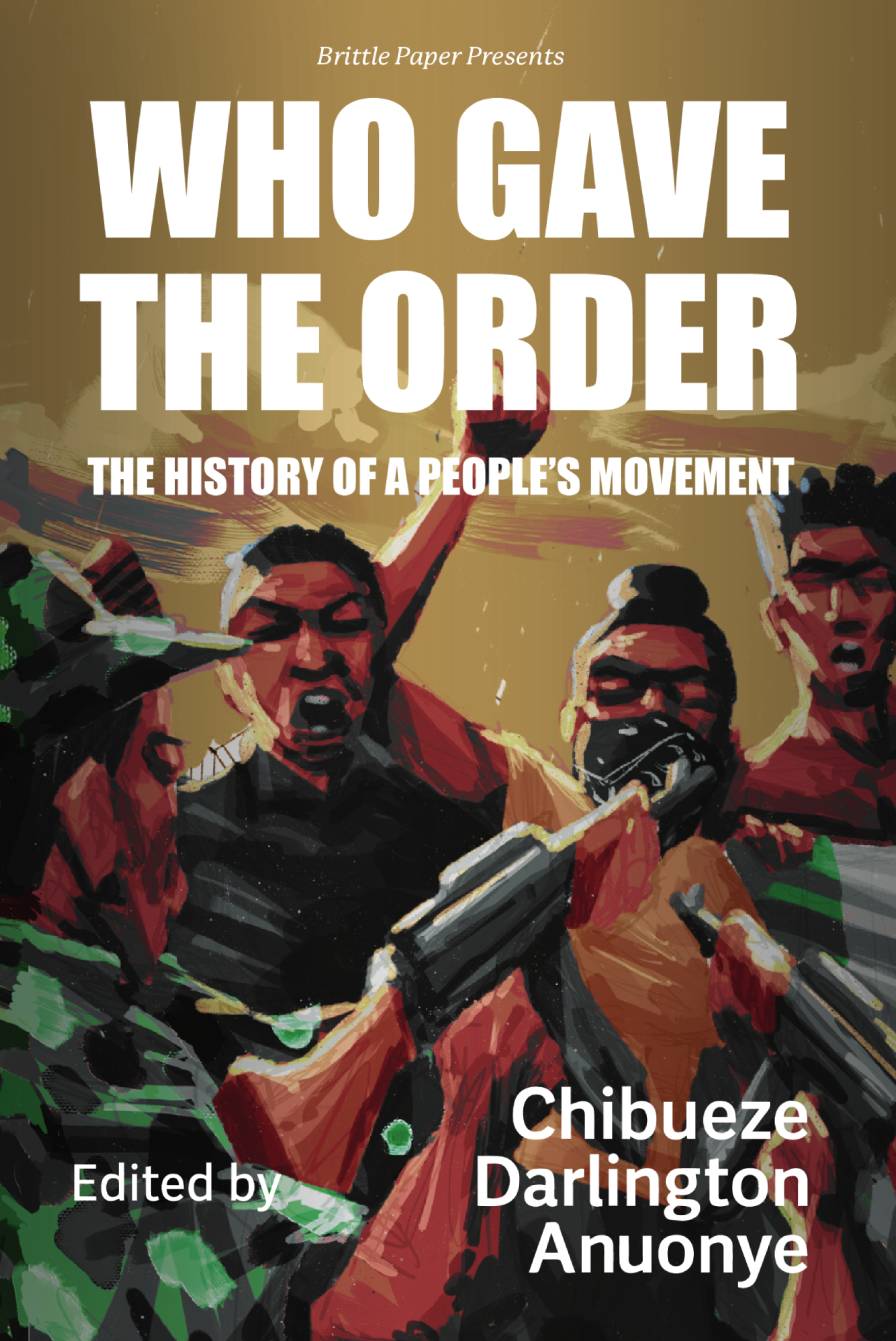
In Who Gave The Order (2025), Chibueze Darlington Anuonye assembles 13 Nigerian writers to bear witness to the event of the protests and catalyst of the revolution that has characterised the 2020s in Nigeria and christened its youths the Sóró Sóké Generation. The writers anthologised here wrestle with questions of self and nationhood, home and belonging, and what happens when Nigerian youths come under a single banner to confront their own country.
In “Come, Let’s Go Home: In Lieu of an Introduction”, Anuonye’s introductory essay, he decries the failure of the Nigerian state in its duty to safeguard the life of its future generation: “Nigeria has often shown itself to be a place of unpredictable violence, a country that kills its own in the month it celebrates its independence from colonial rule.”
In addition, Anuonye examines the role of the African writer in his service as keeper of memories, and what that duty means in the context of the anthology. “What we can do is to turn to those who died and those who are dying”, he writes, to “show them that we have not forgotten why they died, why they are dying, why they are grieving, because their death is our death and their sorrow is also ours.”
With the tone set by Anuonye’s eloquent, angry essay, we are ushered properly into the anthology with Esther Ifesinachi Okonkwo’s stirring tale of young love, with its opening paragraph that is redolent of Adichie at her most observant, but without any of the self-assuredness. Okonkwo’s “Fences” peers into the lives of young men at the dreaded hands of Awkuzu SARS with the story of a former lover whose harrowing ordeal with the officers stole his light from him and made him “intimately familiar with small and big humiliations.”
In a voice subdued by melancholia, Zenas Ubere, in “What You Saw”, observes a quintessential bus ride with all of its accompanying social and political commentary during the heat of the protests. TJ Benson’s “Hashtags” is a comprehensive documentation of the maddening ubiquity of police harassment that spurred the protests.
In every generation, there comes a time when its (young) people stand up to face authority. Very often, the tool that pushes and moves more people to protest grounds reflects the spirit of the age. In 1989, during the Anti-SAP riots, when Nigerians took to the streets to protest the overbearing hardship that Head of State General Ibrahim Babangida and his Structural Adjustment Program (SAP) had heaped on them, it was the newspaper.

In 2020, with the digital revolution already gaining ground, that tool was social media, particularly X (known as Twitter at the time). Contributors Ayomipo Ifenaike and Basit Jamiu—in “Zombies in Lagos” and “Reshaping the Self”, respectively—recount being propelled to participate (virtually and/or physically) because of the digital activism that surged through the platform.
“This Was Supposed to be Different” from Abubakar Adam Ibrahim offers a historical reckoning of the disproportionate use of force on civilians by Nigeria’s armed forces. Ibrahim’s perspective as an older Nigerian brings a clear-eyed view of what many Nigerian elders feel and know intimately about Nigeria’s history with civic demonstrations—and that knowledge is not optimistic about Nigeria’s future and the outcome of a Nigerian revolution.
Ukamaka Olisakwe’s “Happy, Really” is told with novelistic virtuosity and explores her time as a direct sales agent in Abia State during Nigerian banking’s post-capitalisation era. A personal favourite for its astute interrogation of how class affects the relationship Nigerians have with the police, “Happy, Really” is perhaps the most accomplished essay in the collection.
During the protests, queer Nigerians sought to make their own case in conjunction with the movement against police brutality; the nature of oppression they face is peculiar to them. But Nigerians did not agree to make allowances for their cause, and so protesters turned on fellow protesting Nigerians who dared to wave the rainbow flag. It is this oppression within a supposed liberation movement that Mazpa Ejikem ridicules in “Let the Kite Perch”.

An Igbo proverb anchors “Let the Kite Perch”, where Ejikem argues, with a voice crackling with passion, the hypocrisy of the EndSARS movement. “There is something searingly painful about the dishonesty of the EndSARS protest”, he writes. “That such a movement, to which liberation from oppression was central, would involve the direct, open and unbridled oppression of others is the pinnacle of hypocrisy.”
With no less passion than Ejikem’s, Ola Halim sings of a longing in “Bonfires in Sunset Cities”. “Where, in the pages of books chronicling police brutality in Nigeria, would you find at least a sentence addressing the persecution of LGBT+ individuals?” It is this erasure that Anuonye seeks to correct with his inclusion of these two voices. However, his consignment of the essays that deal with the intersection of queerness and the EndSARS movement to the very last pages of the anthology reads like a patronising afterthought. Thankfully, the message endures.
Just as Anuonye mentions in his introduction, the essays we encounter here are all sheathed in memory and remembering. The writers are, however, not only trying to make sense of their realities through memory, but by writing, are producing a collective repository for us all.
Abubakar Ndakotsu in “The Death of Tomorrow” reports directly from the crime scene, at the exact moment when the military arrived and released gunfire. “When officers of the Nigerian military arrived… walking around the tollgate until they had us surrounded”, Ndakotsu narrates. “We thought they were merely monitoring the situation or had been sent to protect us from nefarious elements…We watched them take positions all around the tollgate, cloaked in the shadow of the dying day. We were still chanting and singing when it happened. Gunshots.”
“The Death of Tomorrow” is certainly the heart of the anthology, not only because it bears witness to a monumental time in history, but because its own particular witness bearing completely encapsulates what the anthology set out to do. It is a credit to Anuonye’s curatorial vision that the piece arrives at the centre, arresting readers on their tracks with the intensity of the emotions it elicits.
From Nnamdi Oguike’s “The Police Within Us” and its weary-toned manifesto on the manipulative cruelty of the Nigerian police to Iruoma Chukwuemeka’s superbly braided essay on jungle justice, and then to Anthony Ukwuoma’s tribute to a once vibrant small southeastern town, in Who Gave The Order, editor Chibueze Darlington Anuonye has delivered one of the innumerable offerings of narrative nonfiction: to look at a wound in all of its ugliness and name it what it is.
Azubuike Obi is an Igbo storyteller who believes in the transformative power of language. He won second place in The Republic Student Writing Competition (2025), and was nominated for Chika Unigwe’s Awele Creative Trust Award (2024). His fiction and nonfiction have appeared online and in print in The Republic, The Weganda Review, Naira Stories, Afapinen, Efiko Magazine, and elsewhere. He is a regular contributor at Afrocritik.