

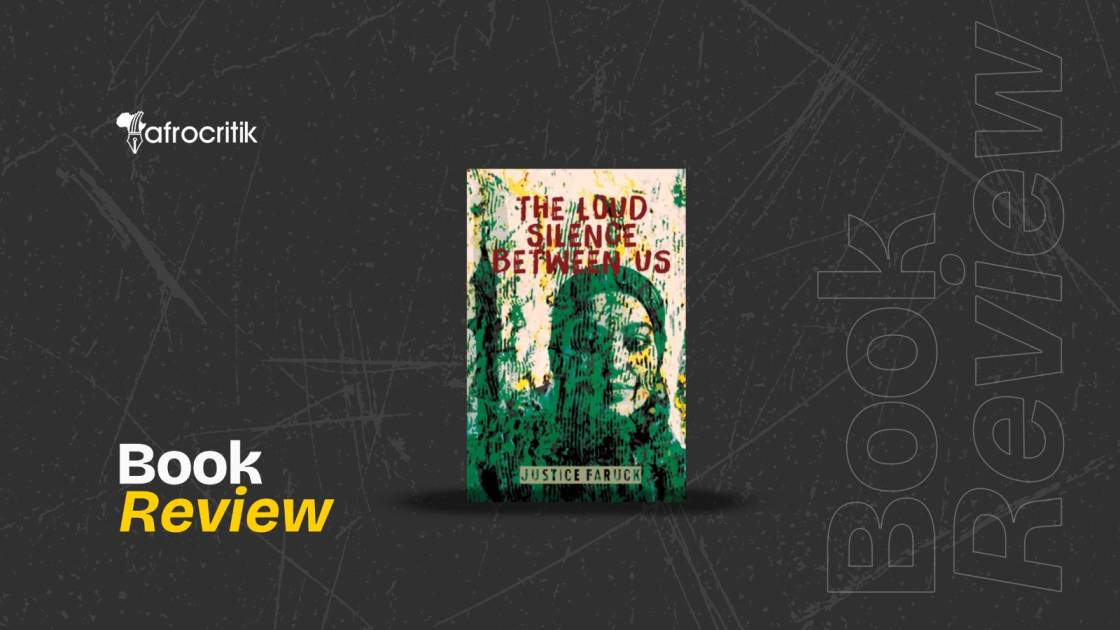

The Loud Silence Between Us could have been an intimate story about a sheltered girl blooming into womanhood and navigating the perils of marriage and culture, but the novel’s gaze stays persistently outward and in motion, losing what could have been an emotionally resonant story.
By Azubuike Obi
The trials and travails of women, how the cultures and religions they belong to subjugate their personhood, and how they begin to come into their own, to stand up and demand better from a world that has continuously taken from them, is a well-threaded path in Nigerian literature. Be they women of the precolonial times, like we find in Flora Nwapa’s Idu (1970); or of the colonial times, as in Elechi Amadi’s The Great Pond (1969); or the post-colonial, as in Ayobami Adebayo’s Stay With Me (2017) or migrating women of growing cosmopolitan concerns like in Buchi Emecheta’s Second Class Citizen (1974).
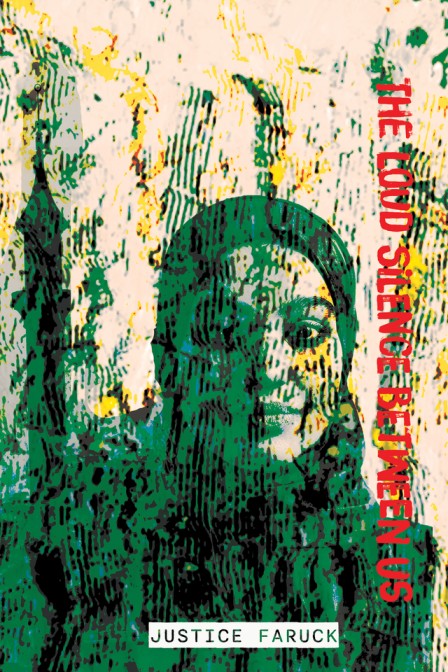
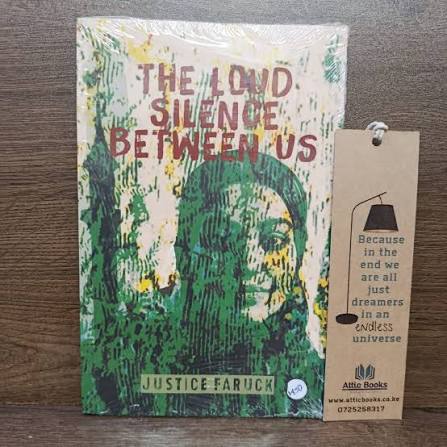
It is to this canon that Justice Faruck arrives with his debut novel, The Loud Silence Between Us (2026), published by Narrative Landscape Press. The novel follows a woman whose “chance encounter” with one man sets her on a journey of discovering and experiencing firsthand the complicated demands her culture and religion make of women.
Na’ima Absulsalam, our protagonist, meets Junaid Idris Bello on her way back from the village river. He comes “barrelling down the narrow path” and crashes into Na’ima and her friends. The attraction is instant for both of them. In subsequent pages, they develop a relationship and eventually marry. Junaid is, however, not who he claims to be. Inconsistencies manifest, and cracks begin to yawn open. Na’ima is then forced to choose between the silence of remaining a subservient, loving wife in a simulacrum of a happy union, or the woman whose voice shatters the fragile hold of tradition.
Combined with its refreshing setting of Hausa land as a site for domestic fiction, away from the oft-seen portraits of the region as a land torn apart by war and insecurity, this is a decent premise; there lies potential for a great story. However, the execution leaves so much more to be desired.
During the course of one’s life journey, there are deeply personal but universally meaningful moments that occur. When captured in literature, these moments heighten interiority and intimacy, such that trust grows between the reader and the character whose story they are witnessing. Take, for example, Mubanga Kalimamukwento’s unflinching detailing of Sali’s pregnancy ordeals in The Shipikisha Club (2026). Faruck, in The Loud Silence Between Us, fails to establish this kinship: intimacy is glossed over; the place of a first love is replaced by rage far too quickly to ring true; pregnancy, childbirth and postpartum recovery are hastily swept past as though they are not real issues.
In essence, the facts are presented, but the emotional truth is lost on the reader; it is as though the reader is merely looking at Na’ima’s world from wound-up car windows, unable to feel and connect with the character whose voice they follow. And this is by no means of their own making, as it is the author who denies his characters their vulnerabilities.
The Loud Silence Between Us could have been an intimate story about a sheltered girl blooming into womanhood and navigating the perils of marriage and culture, but the novel’s gaze is persistently outward and on movement, thereby losing what could have been an emotionally resonant novel.
It is not that it is difficult to begin with the strengths of this novel—because they certainly exist—but that in discussing those strengths we will be beset by some of the many issues that plague this novel. For example, Faruck’s Na’ima has a sense of voice— tentative, uncertain in parts, but one hears it nonetheless.
Take this brief passage, for instance:
“The page loaded. 230. I stared at the number. The screen didn’t blur, but my vision did. The kitchen walls felt closer. I sat down slowly on the floor; wrapper bunched beneath me. It wasn’t terrible. It wasn’t great. But it wasn’t enough. Not for medicine. Not for the dream I had carried like a flame through speechless nights and whispered duas.”

Pay attention to the rhythm. Read aloud if in doubt, for there lurks Na’ima’s voice.
However, as the novel progresses, particularly towards its second half, one realises that Na’ima’s speech pattern of short staccato sentences is hardly distinguishable from that of the other characters. Consider, for example, this, from her lawyer:
“Your Honour, reconciliation was once possible. Not after the bruises. Not after the trauma. My client has submitted sworn affidavits, medical reports… This isn’t a disagreement. It’s damage.” Compare with this from Na’ima’s statement in court: “My name is Na’ima Abdulsalam. I married Junaid Idris Bello thinking he was a blessing. But he turned my body into a battlefield. He betrayed me. He hurt my sisters. He left wounds I cannot erase. I have evidence. But more than that, I have truth. And I will no longer carry that truth in silence.”
Not to mention that it is strange for a wounded woman’s supposedly unrehearsed court statement to sound like a pledge; how different is this piece of dialogue from that of the lawyer?
Faruck has a remarkable management of his narrative. He compresses and moves the story with well-rendered urgency, using foreshadowing and reporting in generous measures. Chapter Four is particularly noteworthy. This, however, means that the novel tells rather than shows its story, thereby losing the ability to linger on moments that may build and sustain emotional resonance.
This is also not to account for the fact that The Loud Silence Between Us is beleaguered by redundant phrasing and terrible punctuation. One wonders if, even though the novel is published by a notable press, it passed through the hands of a competent copyeditor.
One line reads:


“…Mirha blinked curiously, her eyes wide and curious.” Another reads: “These issues weren’t just statistics, they were real.” And another: “All the requirements were clearly listed; acceptance fees, medical examinations, documents to be submitted…”
And yet another:
“The moment we arrived; she was rushed to the emergency ward”.
Punctuations are low-hanging fruits, yes. But inappropriate usage suggests disrespect for your readers. Furthermore, the plotting and characterisation are lacklustre. The characters lack clear motivations for their actions and inactions. One does not need a keen eye to see through the author’s superimposition, his authorial intrusion merging with Na’ima’s narrative voice.
The idea of Junaid is that of a powerful man whose money and power are unable to save him when a calculated wife (Na’ima grew up sheltered, spent holidays in an idyllic village and married while in nursing school – what has honed this instinct?) and a terrific lawyer refuse to partake in the culture of silence any longer.
In execution, Junaid is a young man starting a family in Abuja just before COVID hits. He lands a job right after NYSC, one that places him in a position where he is able to spend lavishly on family trips and other luxuries that characterise a comfortable middle-class life. What is it he does, the reader never finds out. Is he a womaniser, a rapist or a pedophile? Or all three? How do these identities converge in the life of this young man? Who really is he? Even the author seems uncertain.
The economic and interpersonal implications of COVID-19 are well-documented online and in the media. In the novel, the disease arrives just as the young couple begin to settle into their new life, at a crucial point, certainly, yet the impact, if any, is left unexamined—as though the characters are disengaged from the larger context of their world.
In his pallid attempt to chronicle one woman’s defiance, if there is one thing Faruck gets right, it is his documentation of the ordinary lives of the Hausa. Parts of the novel set in the countryside are written with tenderness and an eye suffused with longing. The people’s speech is peppered with Hausa phrases and sentences. The sound and smell of koko and kosai tarries. So does that of Awara, Yaji and Kulikuli. Just like food, greeting and other aspects of culture are re-enacted, too. This is precisely why The Loud Silence Between Us is a readable novel despite its pedestrian storytelling and atrocious punctuation.
Azubuike Obi is an Igbo storyteller who believes in the transformative power of language. He won second place in The Republic Student Writing Competition (2025), and was nominated for Chika Unigwe’s Awele Creative Trust Award (2024). His fiction and nonfiction have appeared online and in print in The Republic, The Weganda Review, Naira Stories, Afapinen, Efiko Magazine, and elsewhere. He is a regular contributor at Afrocritik.