
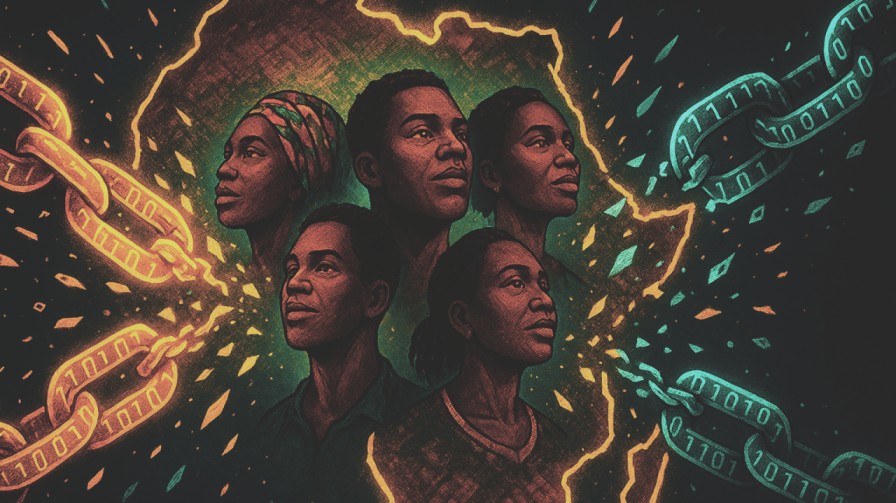

When we hold the results of technological systems as absolute, systems that were not built to adequately cater to certain linguistic idiosyncrasies, who exactly are we raging against?
By Azubuike Obi
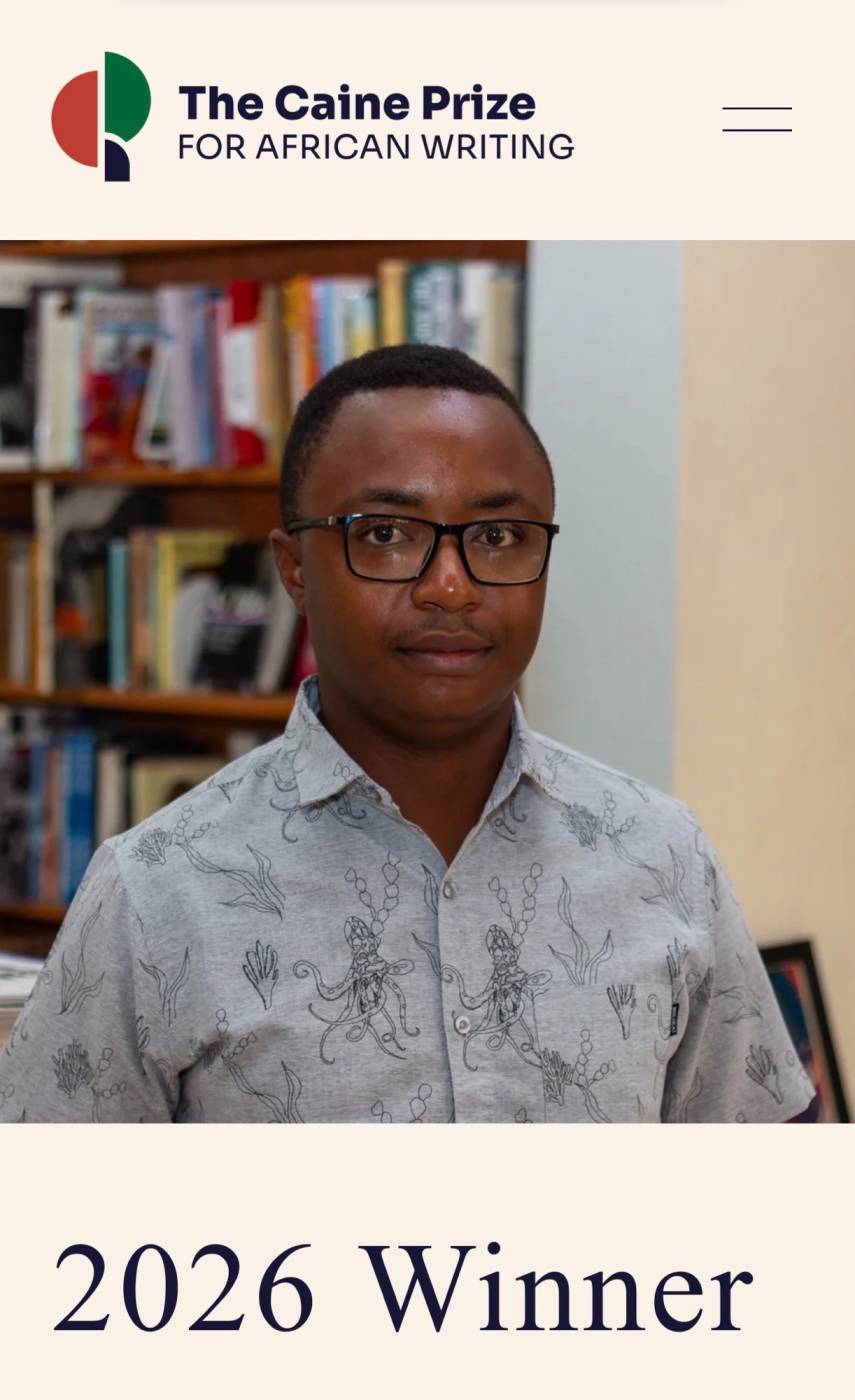
When “The Blue Fighter” appeared in an issue of The Shallow Tales Review in June 2025, Simbarashe Steyn Kundizeza did not envision that it would be nominated or shortlisted for the Caine Prize for African Writing, or that days into winning the largest prize for a single short story in Africa, he would be entangled in a mash of AI allegations over the authorship of his story.
The story began at the 2025 edition of the LOATAD Black Atlantic Residency in Ghana, where Kundizeza encountered a piece of poetry from a member of his cohort, vangile gantsho. The poem would move him, and over the days that followed, he developed a story that drew significantly from his family’s private struggles. In that same month of May, he sent the story to The Shallow Tales Review, a magazine curated and edited by Nzube Nlebedim, another member of the cohort at the Library of Africa and The African Diaspora.
On October 6, in London, it was announced as the winner of the Caine Prize.
Stories and the Principles of Nkali
Less than a week after the story was announced as the winner of the prize, an article was published in The Atlantic by Vauhini Vara, a Canadian-American novelist and journalist, where she admitted to running Kundizeza’s story, along with all 25 stories that have previously won the Caine Prize, through Pangram, “a type of neural network called a classifier model… [that] reads a segment of writing and – using an enormous set of learned patterns – estimates whether it is AI-generated.”
But this is not Vara’s first rodeo. Earlier this year, in May, after allegations against Trinidadian writer Jamir Nazir—who was announced winner of the Commonwealth Short Story Prize for the Caribbean region—surfaced, Vara asked Jenna Russell, a research scientist at Pangram, “to run stories from the past 15 years of the Commonwealth Short Story Prize through the platform”.
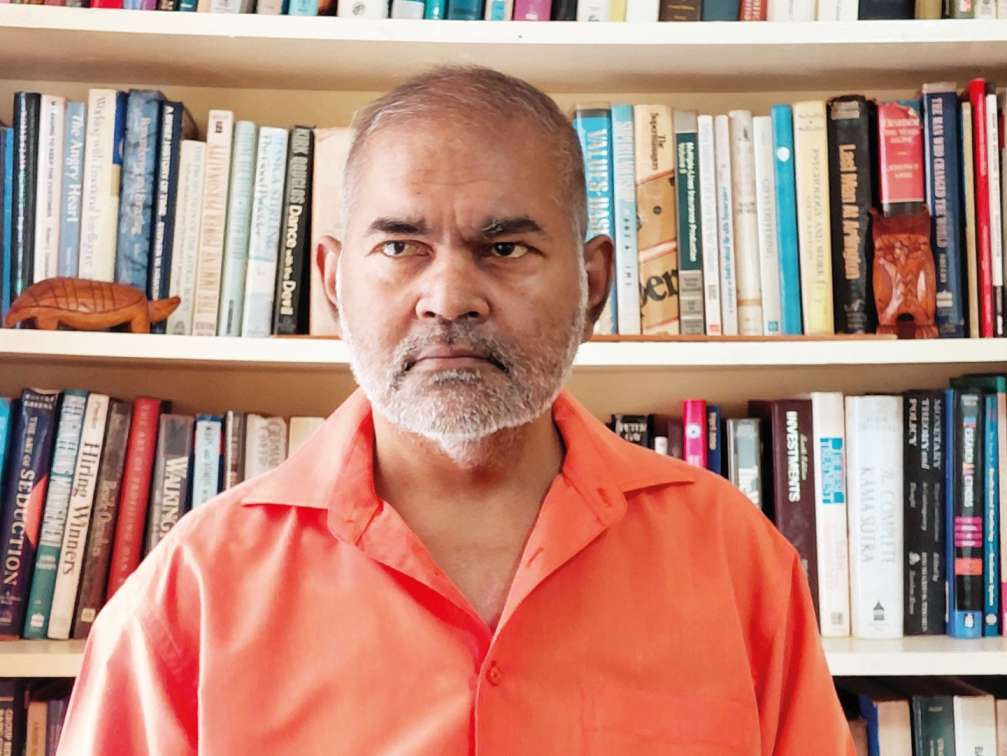
Nowhere in the essay—or in the one that followed, where she admitted to running all 25 stories that have won the Caine Prize— did she confirm receiving permission from the authors or their publishers.
Why, one might wonder. Could it be that this is no more than a question of power? Who has the power to determine whose work was created with aid from Artificial Intelligence, and how are consequences navigated? What would have changed, both in seeking permission and in flatly stating that one had run another’s intellectual property through a software that admits to using Artificial Intelligence for “processing data, writing code, running experiments, and evaluating results,” if the owners were not, in the words of Vauhuni Vara, non-white and non-American?
In an email response to Afrocritik after being asked about the ethics of running copyrighted material through Pangram without express permission of the writers or their publishers, Vara clarified that Pangram is in fact not a Large Language Model (LLM), that “it uses a classification model (rather than a generative model like an LLM), which works differently, by classifying content — in this case, as AI, human, or AI-assisted… Pangram doesn’t train its model on content people check, nor does it sell or share it to third parties for marketing.”
This is also the position Pangram holds on its website, and Vara believes them. We are all expected to because we must assume honesty on the part of the owners of Big Tech, even if no external body has investigated to ascertain the veracity of their stance. Yet, this courtesy is not extended to the African writer, who, for some strange reason, if capable of producing award-winning writing, must be guilty of something—if not good-old plagiarism, then AI assistance.
Jamir Nazir denied the allegations of having created his story with Artificial Intelligence. The Commonwealth Foundation conducted its own private investigation, confirmed this and awarded Nazir the overall prize in June. The Atlantic did not apologise or take down Vara’s article. Simbarashe Kundizezi’s agents confirmed to Vara that he wrote the story, offering to produce the evidence needed. Yet the article, with all of its unfounded claims, went up, simply because Pangram deemed it to have been created by Artificial Intelligence.
Pangram is said to achieve “the highest accuracy on the AI-text detection task while maintaining a false positive rate of 0.0041% (roughly 1 in 24,000)”. To address concerns about English from non-native speakers, the Pangram team “evaluate[d] Pangram 4’s false positive rate on several public corpora of non-native English text”, and found that “Pangram 4 has a single raw false positive out of 24,586 samples”. Remarkable.

However, what is left unsaid is that none of “the public corpora on non-native English text” were from an African indigenous language. This is no surprise; presently, no indigenous African language is part of the top 35 languages used on the internet. What Pangram’s exclusion means is that were Pangram ever developed to become 100 percent accurate, writing from those whose mother tongue is an African language may fall through the cracks, and the writers scapegoated because the machine that plays detective over their creative and artistic productions was not built with an understanding of the nuances of their language. Pangram’s team did not respond to an emailed inquiry on this.
In many ways, this plays into a form of digital neo-colonialism. The researcher Abeba Birhane identifies it as “the desire to dominate, monitor, and influence social, political, and cultural discourse through the control of core communication and infrastructure mediums”. She goes further to distinguish it from colonialism as we know it: “While traditional colonialism is often spearheaded by political and government forces, digital colonialism is driven by corporate tech monopolies—both of which are in search of wealth accumulation”.
Kundizeza is Zimbabwean; his story is set in Zimbabwe and populated by characters who presumably do not have English as their native language. Why then has the provenance of this story been decided by a technology that was not built to cater to the subtleties of the people whose story it tells?
In her famous Ted X speech, the Nigerian writer Chimamanda Ngozi Adichie explained that stories are about the principles of nkali. “How they are told, who tells them, when they are told, how many stories are told—all really dependent on power”. Hence, it is important that we interrogate the structures behind the stories we tell and the people whose voices we inadvertently suppress in our decision to tell certain stories the way we have chosen to.
When we hold the results of technological systems as absolute, systems that were not built to adequately cater to certain linguistic idiosyncrasies, who exactly are we raging against? It is pertinent that we think about the people whom we dispossess of their own agency and stories in our beholden desperation to carve an understanding of the times through algorithmic constructions.
Has Race Got Anything To Do With It?
In 2024, anti-D.E.I. laws swept through the United States, prohibiting activities and trainings that were conducted “in reference to race, colour, ethnicity, gender identity, or sexual orientation.”
When the Diversity, Equity and Inclusion (D.E.I.) initiative was being terminated at the University of Texas, it was said that the ban did not apply to “academic course instruction and scholarly research”. Yet, professor Aquasia Shaw, who taught courses at the “intersection of sociology, sports and cultural studies in the Department of Kinesiology and Health Education at the University of Texas at Austin”, did not have her contract renewed. She told Associated Press that “[she] was under the impression that teaching and research was protected so … I am trying to grapple with the idea and in denial that this can’t be the reason I was targeted”. Professor Shaw was the only person of colour in her department, and when she reached out to employees from other universities who had been let go, she learned that most of them were from minority groups.
The greatest tragedy of America’s current state regarding “diversity” is the floodgate of racially-motivated attacks it opened on already-vulnerable minorities—the target it lunged at their backs. Its ripple effects are arguably the reason an American critic refuses to apply her intellect to justify the reasons she thinks a prize-winning story from an African writer is “bad”.
It Is a Witch-hunt. And It Is About Race
To dismiss race as a motivation is to falsely believe that the matter is simply about literary merit and an attempt to hold good literature to standards; to dismiss race as motivation is to not take cognisance of the political underpinnings that characterise much of what goes on in our world today. If the disturbing pattern of recent AI allegations with actual repercussions tells us anything, it is that we cannot dismiss the social and political weight of skin hue when it concerns who the media has taken as its latest object of scorn, and from where those allegations have been marshalled out.
In July 2026, a self-proclaimed “race-realist” Nathan Cofnas took to Substack and alleged, with the aid of a plagiarism detector, that the doctoral work of Jason Arday contained heavily plagiarised material. Cofnas had, in 2024, been relieved of his position as a research associate at Emmanuel College, Cambridge, after a blog post where he wrote that, in a world run on merit, “Blacks would disappear from almost all high-profile positions outside of sports and entertainment”. Arday, from his account, had lived an extraordinary life: diagnosed with Autism at three, could not speak until eleven and could only read and write at eighteen, with the help of devoted teachers; he went on to get a PhD, and in 2023, at 37, was appointed professor of sociology in education at the University of Cambridge. Consequently, he became the youngest Black person to receive a professorship in the university’s history. Trailing Cofnas’ allegations, Arday was labelled a “plagiarist and fabulist”, and the media tore deep into him. As Lauren Jackson writes in The New Yorker, “Arday was not greeted as a risible scammer endemic to the times”, even though fabulist stories of this nature are not new. For some reason, his case needed a bloodbath. He soon resigned from Cambridge, and on August 14 was found dead in South London.
The month after Arday’s death, in September, Haitian-Canadian author Thélyson Orélien had his book, C’était ça ou mourir—It Was Either That Or Die— (2026), pulled from the Prix Goncourt Prize after a spate of accusations followed the announcement of the novel’s inclusion in the prestigious prize’s longlist. Before the longlist announcement, the novel had received rave reviews and critical acclaim, and had won the Fnac prize for best novel. The allegation emerged from an anonymous account on X (formerly Twitter). Samuel Fitoussi, a columnist at Le Figaro, a conservative daily newspaper, later revealed himself as the hand behind the account. Fitoussi had run chapters of the novel through Pangram and was assured of the tool’s discoveries. To further complicate matters, some of Orélien’s past work was accused of plagiarism. He denied the AI allegations. The Prix Goncourt dropped the novel anyway, riding on the wave of what that singular accusation spawned.
But this is nothing new. Since the emergence of written African literature, the African writer has held the role of interpreter and exotic other. If he is incomprehensible to a Western audience, like we see in Amos Tutuola’s case, then he is a true African; if he is eloquent, and through his own invention, has written a work that could be deemed modernist, then he must be read as anthropology, saddled with the task of explaining the primitive man.
Today, time and recognised literary lineage notwithstanding, the African writer’s work arrives cloaked in the garb of suspicion and doubt. God help him if his artistic preoccupations veer off pre-conceived notions of what African lives look like. And even when they toe the expected path, but by some stroke of mastery and luck, that work is deemed best of anything, he must also prove, by whatever arbitrary standards, that he is capable of what he has produced, else he be burnt at the stake.
“Doubt has a genealogy, especially when it falls on Black writers”, journalists June Loper and Harrison Stetler write. They go on to recount the tale of the writer whom Mohammad Mbougar Sarr’s The Most Secret Memory of Men (2021, translated 2024) fictionalises: “In 1968, Yambo Ouologuem became the first Black African writer to win the Prix Renaudot, for Le devoir de violence (The Duty of Violence), before he too faced a smear campaign accusing him of plagiarism… The Malian writer, then in his late 20s, never regained his place in francophone literature. In its nearly 125-year existence, the annual Prix Goncourt has been awarded to only four Black authors”. Sarr’s The Most Secret Memory of Men received the prize in 2021.
The Goncourt Academy, the institution responsible for administering the prize, said its withdrawal of Orélien’s novel from the longlist was “driven by the desire to preserve the integrity of the Goncourt prize and the academy itself, whose central role is to promote and honour literature written by women and men”. This is also despite the fact that, according to a report in The Guardian, “French media outlets have found other AI detection programmes that identified It Was That or Die as very probably written by a human”. The writer with pigmented skin arrives guilty, and is afforded no avenue through which they may speak their truth and have that truth accepted. One accusation is all it takes. One.
The Miseducation of AI Witch-hunters
In Vauhini Vara’s “Yet Another Literary Prize Winner Seems to Be AI”, she recounts being “struck by the proliferation of language that is common in AI-produced writing: the not x, but y sentence constructions; the glut of metaphors; the platitudinous aphorisms.” Each and every one of these so-called tells, Jerry Falade—a Nigerian writer whose $2 million book deal was snatched in July after allegations of AI assistance surfaced—has deconstructed in his witty, moving account of that tragedy, showing how these same tells were also called out in his work, but are all representative of his Yoruba heritage and upbringing; a reality he sought to reconstruct in his novel, but upon whose back the allegations were being ferried. “As a Yorùbá writer telling a voice-driven thriller”, Falade writes, “it felt natural that the rhythms, sarcasm, humour, and narrative techniques of my culture would shape the novel’s voice. That Yorùbá-inflected voice was one of the qualities every publisher I spoke with praised… Why should I suppress the rhythms and rhetorical devices I grew up hearing now that a machine has learned to imitate them?”
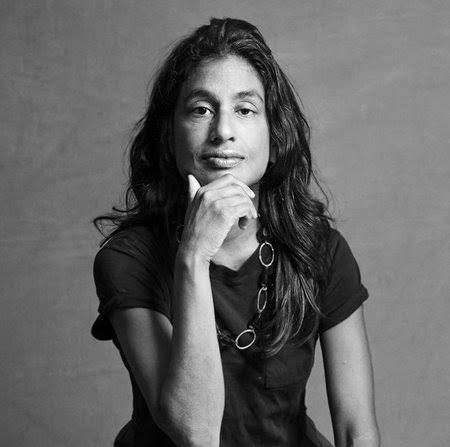
“What I also noticed, more disturbingly, was the presence of stereotypes about African life common among outsiders”, Vara continues in her essay. But stereotypes are stereotypes for a reason; for many families in Zimbabwe the atmosphere Kundizeza’s story evokes is their reality. Is it then a crime that Kundizeza has not invented a different world, that he has chronicled the truth of a people he knows, however clichéd the interior of those lives may seem to a Western audience?
This is, however, an indictment of African leaders, because is it not a failure of leadership, seeing that not many things have changed in the texture of poverty much of the continent continues to live in?
In its technical report on Pangram 4, the Pangram team admit that Pangram’s estimates are “statistical” and that both false positives and false negatives do occur. Yet, Vara has not given Kundizezi the benefit of the doubt nor ample opportunity to prove her wrong. The literary community is a small one, and a writer’s credibility and positioning hinge on small, minuscule things, such that a piece like this, written and published hastily in what can only be interpreted as bad conscience, in a publication famed in recent times for its “reactionary centrist politics”, has the capacity to effectively end a career that has only just begun. It is also notable that this is the first time, in the Caine Prize’s 26-year-old history, that The Atlantic has covered it, not minding that some of the “world’s most celebrated authors” have won it, or that last year, NoViolet Bulawayo, whom Vara’s essay names, won the Best of Caine Award for a short story that became a Booker Prize shortlisted novel.


Given the aforementioned size of the literary community, a writer’s reputation thrives on small networks of reliability. Very often, accusations of this nature become what bellies an otherwise burgeoning career, regardless of the veracity of the claims raised. Even in situations where the writer may very well be guilty, redemption is denied them, as suspicions become besmirched on anything that bears their name.
For writers of colour, whose stories are seen not only as emblems of their names, but as representatives of a people, these accusations have twofold consequences: first for them, and then for the people with whom they share a race. This is precisely why Bridgette James’ unfounded allegations against a young Nigerian poet in March were dangerous, and why Vauhni Vara’s are, too. That it comes from people whom one may consider their own makes it all even more insidious.
Much Ado About AI Writing
“It is soulless writing. There’s a repetitiveness to the sentences; it is marked by an unvaried rhythm,” Chideraa Ike-Akaenyi says during an interview with Afrocritik, when I asked about how she recognises possible AI-assisted work from what comes into the slush pile at AFREADA, the African literary magazine where she works as an editor.
Still, it is undeniable that the technology is getting better. With time and perhaps some skill on the part of the dubious writer, AI-assisted work may acquire that “soul” that has long proved elusive. Is the problem then AI and the greyness of the morality surrounding its use, or is the work just bad? What happens when one reads a piece of work they do not know has been generated by Artificial Intelligence and do, in fact, enjoy said work? A New Yorker article found that creative writing graduate students were sometimes unable to accurately tell human writing from writing that has been modelled and recreated by AI. So what gives? Might we come to a juncture where we are able to accept the changes that the emergence of AI is bringing to literature and how we consume it? What moral and ethical landmines bedevil this path, for readers and writers alike?
“I think all critics are going to have to be more vigilant. We need to let our readers know when our instinct screams AI. We need to pay attention when an author puts out multiple books in a year, writing suspiciously fast. And we absolutely need to own up to our mistakes when we’re fooled”, writes the critic Rachel Meghan in an essay where she backtracks after a novel she read twice, enjoyed and championed was reported to have been written with AI.
But are screaming instincts enough? Literary critic Chimezie Chika told Afrocritik that “the only veritable instinct a critic should have now is how to identify literary quality. The critic can show us carefully, through the principles of good writing, why a piece of writing is good or bad.”
The Way Forward
On Monday, 24 hours after Vara’s Atlantic essay went live, the Caine Prize released a statement where it seems to have put their prize winner on trial with vague claims of “taking a human-centred approach” in their investigation. Kundizeza has also released a statement where he unequivocally denies the involvement of AI at any stage of writing and developing the story. The African literary community have rallied around him in their support, calling Caine’s statement “weak” and “spineless” as the tone lays bare Caine’s unpreparedness to deal with the issue with a hand that acknowledges the political weight of the allegations, or to offer the story its panel of judges awarded the kind of confidence and support that affirms its legitimacy.
So much remains uncertain as it concerns detecting AI use in creative writing. “It is not possible to determine AI use via AI detectors, despite the Pangram propaganda,” Chika told Afrocritik. “They are all fallible”. Vara, in her email to Afrocritik, suggests “training people in identifying AI text by eye.” But that also has its own landmines. For one, many of these “tells” are stylistic devices writers have used long before Silicon Valley existed.
In addition, every reader approaches a text with their own bias, so illegibility could easily be mistaken for AI. However, I suppose that will lead to novel inventions in the form. For now, though, it is a rat race, and as winner of the 2020 Commonwealth Short Story Prize (Africa Region), Innocent Ilo proclaims, a game “of Find the Imposter, where everyone is both player and umpire”.
For the African writer, “what can save us is relentless organising”, the poet Romeo Oriogun writes on X. “And this does not mean we have to condone cheaters. What it means is that we have to protect ourselves when we know that those coming for us are not seeking genuine answers”.
Hereafter, magazines and prize administrators must be more forward-thinking and proactive in how they relate to and deal with AI allegations; for the writers whom they prop up, they must provide unflinching support that leaves no room for doubts on the writer’s credibility. They owe their writers “a duty of care,” Ike-Akaenyi said.
In “Algorithmic Colonization of Africa”, researcher Abeba Birhane offers some instructive thoughts: “The continent would do well to adopt a dose of critical appraisal when regulating, deploying, and reporting AI. This requires challenging the mindset that portrays AI with god-like power and as something that exists and learns independent of those that create it. People create, control, and are responsible for any system. For the most part, such people consist of a homogeneous group of predominantly white, middle-class males from the Global North. Like any other tool, AI is one that reflects human inconsistencies, limitations, biases, and the political and emotional desires of the individuals behind it and the social and cultural ecologies that embed it—a mirror that reflects how society operates: unjust and prejudiced against some individuals and communities.”
The emergence of generative AI leaves us with more questions than it does answers. Questions that may be answered, in part, when African tech entrepreneurs, with substantial support from their various governments, rise up and move to the forefront of AI developments. It is disappointing that a continent touted as the future owns less than 300, about 2.35 per cent, of over 12,000 data centres worldwide. If we must be part of what is no longer a quiet revolution, we must take centre stage, not only to understand the developments involved in Artificial Intelligence as they occur, but to be part of the team driving and influencing those changes and ensuring that voices and stories from the continent are being told as they should.
In many ways, this is asking technological companies to create and garner profits for solving a problem they invented, not to mention the devastation that increased developments will wreak on the natural world. Whatever the case may be, it is literature and the people forging it that suffer.
Azubuike Obi is an Igbo storyteller who believes in the transformative power of language. He won second place in The Republic Student Writing Competition (2025), and was nominated for Chika Unigwe’s Awele Creative Trust Award (2024). His fiction and nonfiction have appeared online and in print in The Republic, The Weganda Review, Naira Stories, Afapinen, Efiko Magazine, and elsewhere. He is a regular contributor at Afrocritik.
Cover photo credit: LinkedIn