

African films shared in the spotlight with wins at the 83rd Venice International Film Festival (Venice 2026), which ran from 2nd to 12th September, 2026.
By Adedamola Jones Adedayo
African films shared in the spotlight with wins at the 83rd Venice International Film Festival, which ran from 2nd to 12th September, 2026.
In the main event, Cameroonian filmmaker Auguste Bernard Kouemo Yanghu’s House of the Wind (La Maison du Wind), a co-production involving Cameroon, France, Belgium, Benin, Saudi Arabia and Qatar, won the “Luigi De Laurentiis” (Lion of the Future) Venice Award for a Debut Film. The award was given by a jury composed of Carolina Cavalli, Akinola Davies Jr., and Ted Hope.
Filmmakers from Algeria, DR Congo, Ethiopia, Morocco and Tunisia also received accolades at Final Cut in Venice, an out-of-competition initiative organised as part of the Venice Production Bridge and intended to support projects from Africa and the Arab world in post-production.
Algerian filmmaker Sofia Djama received support for A Quarter to Thursday, a France, Belgium, and Algerian co-production, from Paris-based Titra Film. The support covers colour grading, DCP mastering, platform file creation, and French and English subtitling. The project also received a $5,000 award from El Gouna Film Festival for an Arab project, along with an invitation to the CineGouna industry platform.
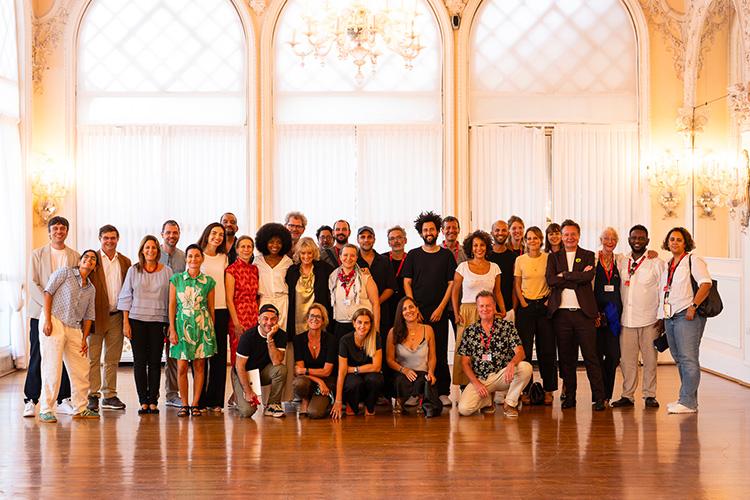
Congolese filmmaker Machérie Ekwa Bahango won the La Biennale di Venezia Prize (€10,000) for Best Film in post-production for Madi Makambu (DR Congo, France, Belgium). Madi Makambu also received support from Oticons, which offers film music services valued at up to €10,000; MAD Solutions, which offers a minimum guarantee of $10,000 for a feature-length fiction film, or $3,000 in worldwide marketing, advertising, and distribution support for a feature-length documentary; Mnemonica, which provides full access to its secure, cloud-based platform for managing, preserving, sharing, and distributing the winning film’s digital assets, valued at up to €10,000; and the Red Sea Fund of the Red Sea Film Foundation, which offers €5,000.

Similarly, Ethiopian filmmaker Abraham Gezahagne’s Mehal Sefari, a co-production involving Ethiopia, Canada, Germany, the Netherlands, Norway and Saudi Arabia, won the “Coup de Cœur de la Cinémathèque Afrique” Prize offered by Paris-based Cinémathèque Afrique of the Institut Français, which grants five-year non-commercial and non-exclusive broadcasting rights valued between €4,000 and €6,000. The project additionally won €2,500 from Festival International du Film de Fribourg for DCP production.
Moroccan filmmaker Alaa Eddine Aljem’s Eldorado, the Taste of the South, a co-production involving Morocco, France, Italy and Norway, received €5,000 from Organisation Internationale de la Francophonie (OIF) as a refund for post-production services.
Tunisian filmmaker Youssef Chebbi’s Plague (Balaa), a co-production involving Tunisia, France, Qatar, Saudi Arabia and Slovenia, also got €15,000 from Rome-based Laser Film for colour correction services, and €2,500 from The Festival International du Film d’Amiens towards DCP production.