

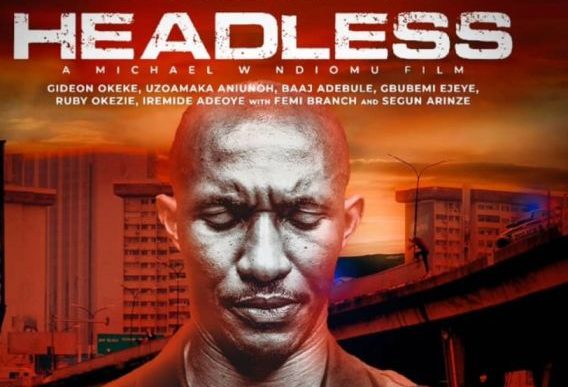


Headless is not the film it could have been. But it is a film that knows what it wants to say, and there is value in that, even when the saying falls short of the vision.
By Joseph Jonathan
In the last week of March 2026, nearly three weeks after Headless was released in Nigerian cinemas, I spent the better part of an afternoon trying to find a showtime for it in Abuja. The film was not sold out. It was simply not showing or barely showing, squeezed into the margins of a release calendar that makes room most readily for what it already knows will perform. I eventually found one. I watched it, largely alone. And sitting in that near-empty hall, I thought about Erastus Okpanachi, the film’s fictional Nollywood producer who spends the entirety of Headless trying to get past exactly this kind of door. There is an uncomfortable symmetry in a film about institutional gatekeeping that cannot itself escape the gate.
This is not a small irony. Nigerian cinema has long operated by an unwritten logic of preselection — a circular economy of familiarity in which films earn screens because they have popular faces, and these faces are created by the films that earned screens before. These faces could either be the producers or actors in the film. Headless has none of them, at least not in that conventional sense.
And in a cinema culture still largely transactional — where audiences often attend not to watch a film but to watch a person — this absence is its own kind of argument. Michael Ndiomu, making his feature directorial debut, seems to understand this. The question is whether understanding a problem and dramatising it effectively are the same thing. Here, they are not always.
Headless is, at its premise, a crime thriller: Erastus (Gideon Okeke), a struggling filmmaker from Enugu who has made his career on YouTube’s informal economy, arrives in Lagos seeking the credibility of the big screen and finds himself instead implicated in the murder of an actress named Omolara (Ruby Okezie).
But Ndiomu is less interested in whether Erastus did it than in why the machine so readily believes he could have — why a man without industry status, without a distributor, without the right contacts, becomes the most convenient suspect. The plot is scaffolding. What Ndiomu is really building is something closer to an indictment: of the film industry, yes, but also of the political and bureaucratic structures that mirror it, that run on the same currencies of access, proximity, and the quiet violence of being overlooked.
West African storytelling has always understood the relationship between the individual and the institution in almost cosmic terms. From the Yoruba concept of ajogun — the forces that obstruct destiny — to the Igbo understanding of chi, the personal spirit that either aligns with or wars against the universe, there is a deep cultural tradition of framing personal struggle as something larger than the individual.
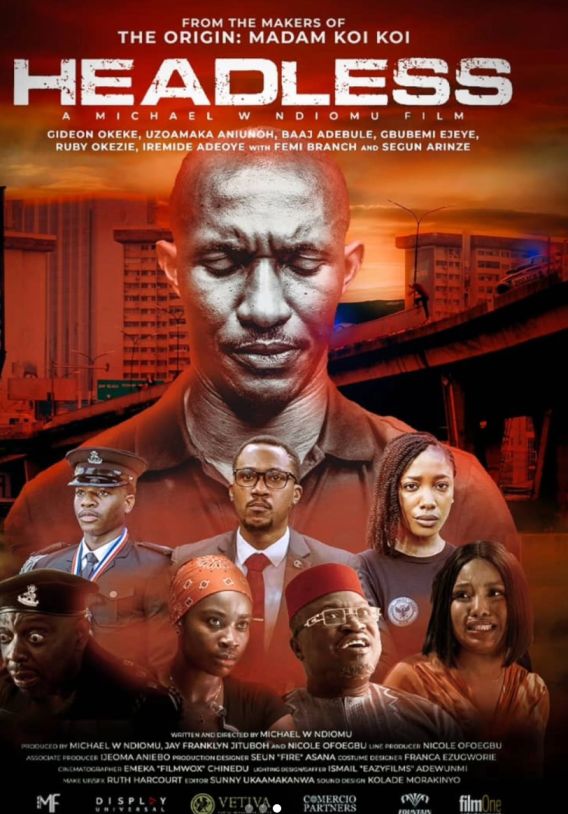
Nollywood itself emerged partly from this cosmological inheritance: early home-video films were obsessed with fate, with the unseen hands that elevate or destroy, with the moral logic beneath social outcomes. Headless updates this tradition into the secular language of institutional critique, but the emotional architecture is recognisable. Erastus is not just a man accused of murder. He is a man whose destiny has been held hostage by systems designed to ignore him.
Okeke’s performance is the film’s most contested element, and the controversy is at least partially fair. He plays Erastus in a register that sits somewhere between comic anxiety and genuine desperation, relying heavily on accent and physical volatility to locate the character’s cultural specificity. There are moments when this works; when the comedy and the fear are so close together they become indistinguishable, which is often what actual distress looks like.
There are other moments when the performance tips into something more pantomimic, when the mannerisms outstay their emotional purpose, and the character begins to feel performed rather than inhabited. Crucially, this never feels like a limitation of Okeke’s ability. It feels like a limitation of consistency; of a performance that found its key and then played it too loudly in rooms that called for something quieter.
What holds the film together far more reliably is Uzoamaka Power as Inspector Gofwan. This is a performance of extraordinary stillness. Where Erastus moves, stumbles, and code-switches — between English and Pidgin and Igbo, between formality and vulnerability and instinct — Gofwan watches. She is the film’s steadiest intelligence, and Power plays her with the kind of authority that does not announce itself. Gofwan is young, institutionally pressured, surrounded by complicit superiors, and persistently underestimated. She wins not through moral purity but through a patient, calculated engagement with the corrupt architecture around her. In a different film, she would be the protagonist. In this one, she functions as its conscience, and the film is better for trusting her with that role.
Nigerian cinema has often struggled with its female characters in ways that reflect rather than critique the culture it emerges from. The woman who enables and the woman who redeems tend to occupy opposite poles, and the space between them — where actual complexity lives — frequently goes undramatised. Headless is caught in this tension.
Omolara, the murdered actress, exists almost entirely through male memory: she appears in flashbacks framed by the perspectives of the men she entangled or was used by. She is objectified within the narrative world of the film and, to varying degrees, within the film’s own visual grammar.
Ndiomu seems aware of the problem — there are gestures toward critique, moments where the camera seems to register the indignity of Omolara’s position — but awareness does not always translate into redress. The character who dies to set the story in motion is a pattern as old as cinema itself, and Headless does not yet have the formal vocabulary to escape it, even as it tries.
The film’s political landscape is populated by figures familiar to anyone who has followed Nigerian public life with even passing attention: the senator who runs an organ-harvesting operation behind the facade of a legitimate business; the senior officer who protects the wrong people and sacrifices the right ones; the lawyer who weaponises documentation as personal revenge.
These are not characters, precisely, they are structural positions. Ndiomu is making a point about how corruption replicates itself across institutions, how the same logic that governs Nollywood’s gatekeeping operates in politics, in law enforcement, in medicine. The point is valid. But there is a risk, in rendering evil this schematically, of making it feel distant. The most disturbing corruption in Nigerian public life is not cartoonish. It is banal. It wears familiar faces. It takes its children to school and goes to church. When the film’s villains are as recognisably archetypal as these, the critique stops just short of landing where it should hurt.
The screenplay’s finest achievement is also its most formally precise: the interrogation scene that opens the film’s second act. Here, language becomes the true battleground. Gofwan holds the institutional ground of English, procedural and composed. Erastus slips between registers — formal English when he needs to assert dignity, Pidgin when he wants to deflect into familiarity, Igbo when he is finally, involuntarily honest.

It is a masterclass in what language actually does: not just communicate information, but manage exposure, negotiate power, perform belonging. That Nigeria is a country of hundreds of languages compressed into a few official registers, where code-switching is survival, gives the scene a cultural resonance that goes well beyond the plot mechanics it is serving. Ndiomu shoots it with a restless, rotating camera that refuses to settle — a formally intelligent choice that mirrors the impossibility of stable ground beneath Erastusʼ feet. It is the film’s best ten minutes.
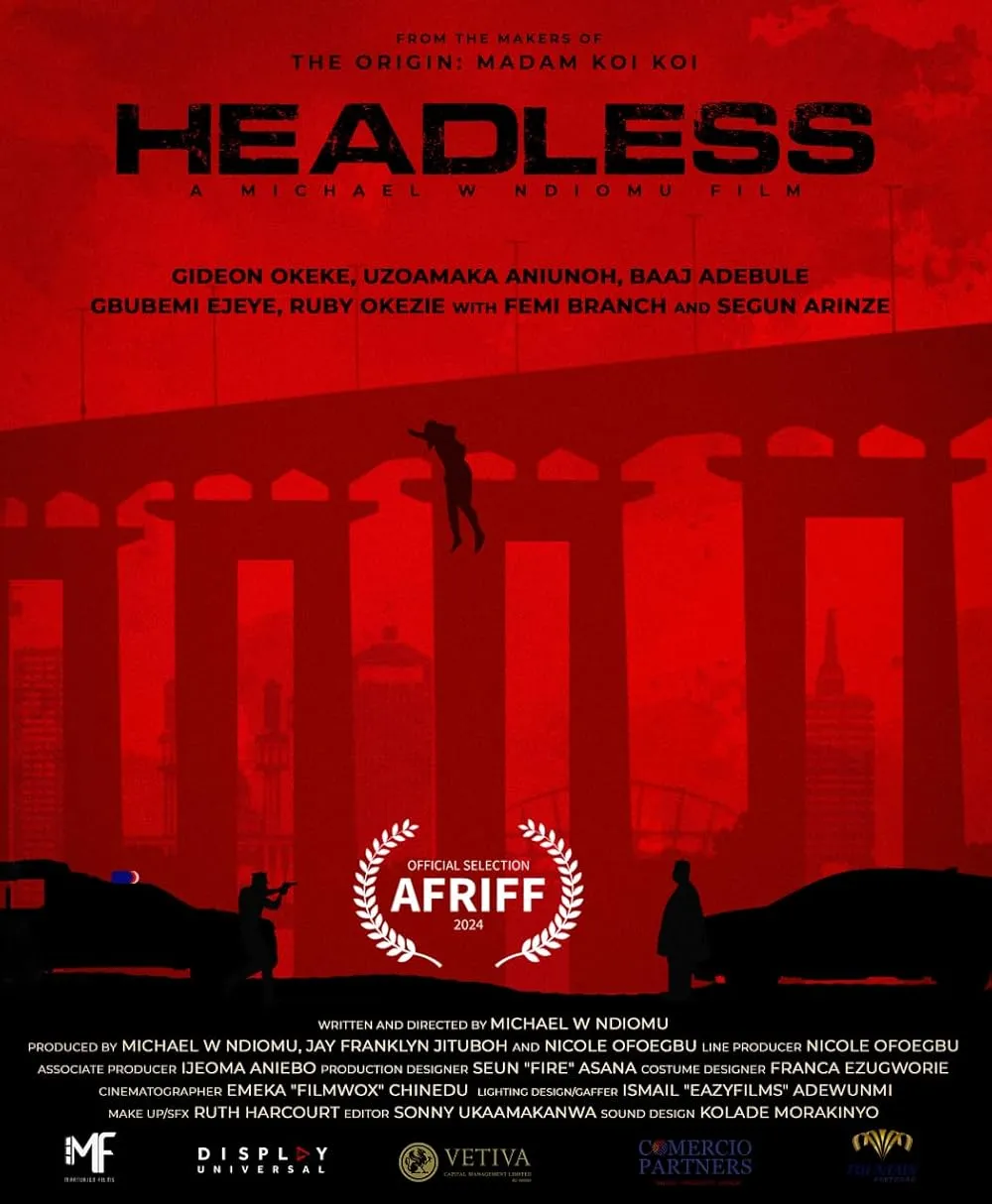
That this scene arrives early, and that nothing in the remainder quite matches it, is the film’s central structural problem. Headless peaks before it should. The third act abandons the disciplined ambiguity of its opening in favour of explanation; characters articulate what could have been dramatised, flashbacks correct gaps that better construction would have avoided, and a story that trusted its audience stops trusting itself. The resolution arrives with the mechanical completeness of a case file rather than the emotional weight of a lived experience. All the threads are tied. Nothing particularly lingers.
This is, perhaps, the difference between a film that critiques a system and a film that has escaped it. Ndiomu’s indictment of Nollywood’s economy of access is real and worth making. But the film that makes it is still subject to the habits that the economy produces: the pressure toward clarity over ambiguity, toward resolution over resonance, toward giving the audience everything they need to leave feeling satisfied rather than disturbed. The best films about broken systems — think of Memories of Underdevelopment (1968), or Touki Bouki (1973) — leave their audiences in a state of productive discomfort. Headless lets you off too easily.
And yet the final image earns something. Erastus, at the end of everything, is on set, directing a film. The industry that nearly destroyed him is still there. The systemic problems have not been resolved by Gofwan’s supposed victories — they have simply been temporarily disrupted. But the filmmaker continues.
This is, for anyone who knows what it costs to make films in Nigeria — the financing negotiations, the distribution battles, the showtime searches, the near-empty halls — a genuinely moving statement. Not triumphant. Not naive. Just honest about what persistence looks like in a context designed to exhaust it. Ndiomu, whose own film took the better part of two years to move from a festival premiere to a cinema release, has lived this. It shows.
Headless is not the film it could have been. But it is a film that knows what it wants to say, and there is value in that, even when the saying falls short of the vision. It arrives asking real questions about who Nigerian cinema is built for, whose labour sustains it, and who bears the cost of a system that rewards familiarity over quality. That I had to fight to find a screen showing it — in the very city it was available in, in its own opening weeks — suggests the questions are not abstract. They are operational. They are the air the film breathes. Erastus would understand.
Rating: 2.5/5
Joseph Jonathan is a historian who seeks to understand how film shapes our cultural identity as a people. He believes that history is more about the future than the past. When he’s not writing about film, you can catch him listening to music or discussing politics. He tweets @Chukwu2big