

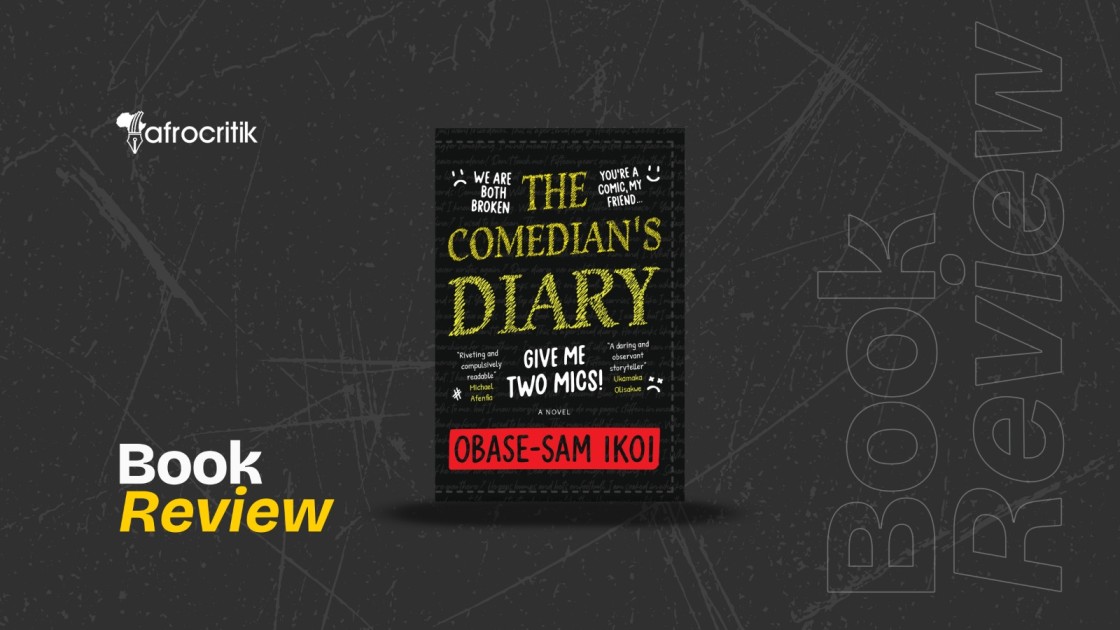

The Comedian’s Diary is a sobering portrait of the capability of community in the face of one man’s underemployment and addiction.
By Azubuike Obi
“It begins on a blistering afternoon, the air thick with heat. A man in a white cotton shirt halts in front of my shelf”. Thus opens Obase-Sam Ikoi’s debut novel, The Comedian’s Diary, published by the Lagos-based indie publisher, Masobe Books, in January 2026.
This man, we will come to learn, is Oga Simon, a somewhat middle-aged man driven to a life of despair as he struggles with addiction after he is made redundant from his professional job as an accountant. The story is told through a rather inventive perspective — that of a notepad. In its opening chapter, Oga Simon buys the notepad from a bookstore, and we see the entirety of the events the novel covers through the vantage point of the notepad, following the story as the notepad acquires immense significance for Oga Simon and his burgeoning career as a stand-up comedian.
After the loss of his job, he acquires another job as a security officer at a bakery, and on this job, he begins to pursue his talent as a comedian at a local comedy club. In addition to Oga Simon’s life, Ikoi imbues the narrative with the history of the notepad, specifically that of its time at the bookstore, telling a rather underexplored story of the small acts of violence that happen in unexpected spaces. In the parts of the novel where the narrator recollects, the novel is at its wisest, aphorisms speaking truth every so often.
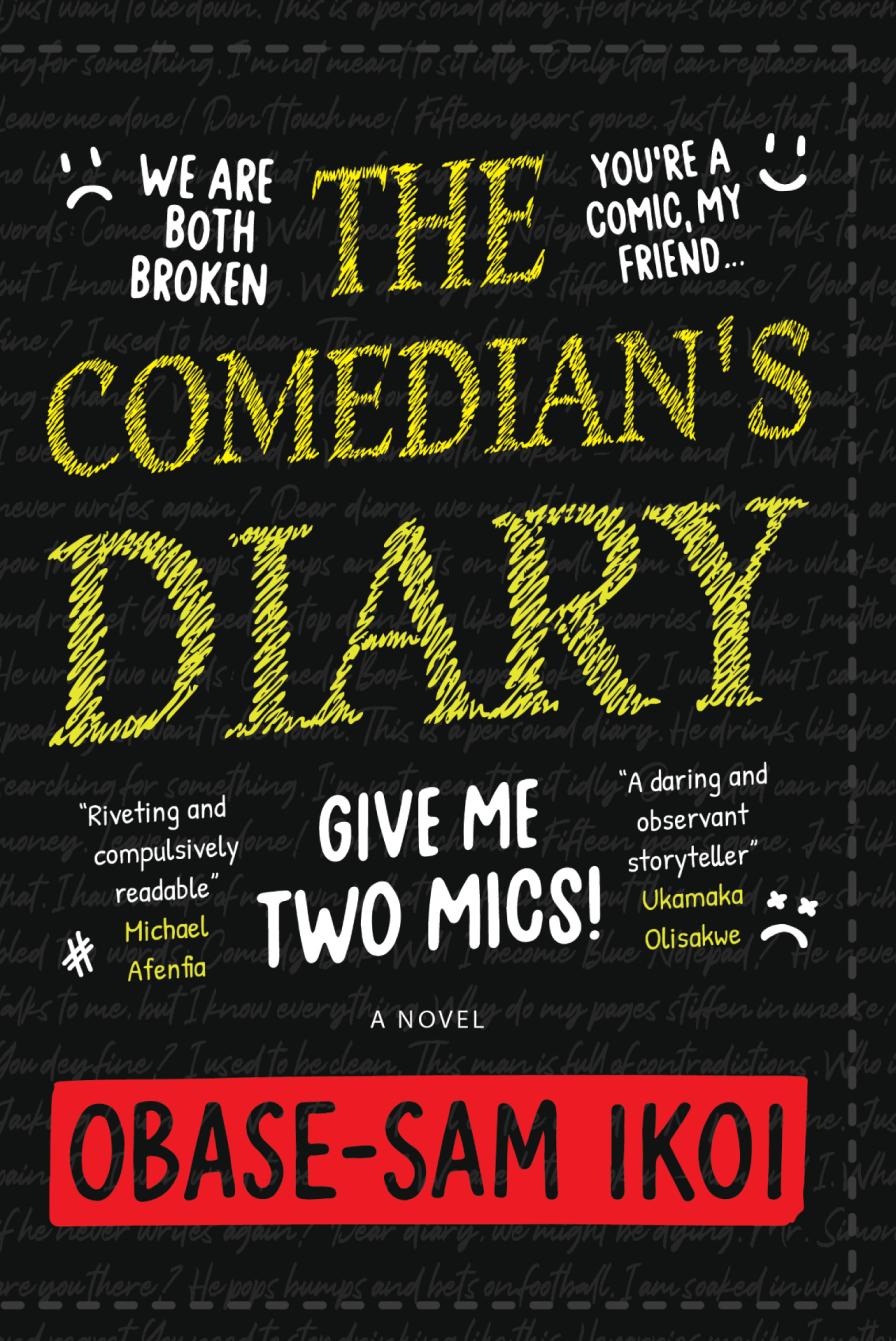
One of the best things about The Comedian’s Diary is that it is keenly aware of the insufficiency of its POV: “My accounts of Oga Simon’s life are dictated by the limited view I have of him and his world,” the narrator reflects. “I can only report what I see, a perspective confined to my position.”
The notepad’s account of Oga Simon’s life, in acknowledging its inadequacy, goes on to show the far-reaching impact of addiction, not just on one man’s life but on the boomerang effect it has on others around him. So much so that it is deeply felt by something as seemingly ordinary as a notepad: “…despite my keen observations, I often misjudge his situation. I fail to understand the weight of his reality, the full toll it takes on him, and ultimately, on me. How could I have known that my fragile pages would suffer the same fate as his troubled mind?”
In addition to Oga Simon and his notepad, the novel offers a diverse array of personalities through the stock characters of its primary setting, 25 Baptist Way. We meet Sista Philo, a candid, prayerful enigma of a woman; Esther, kind and generous, who harbours feelings for Oga Simon; Mummy Esther, Esther’s sagely mother; and Emma, Oga Simon’s neighbour and a shrewd taxi driver.
Consequently, through the setting and its adoption of stock characters, The Comedian’s Diary operates within a fascinating binarism that, though reflective of a facet of Nigerian society, is altogether underwhelming. The men are providers and ego merchants, quick to engage in brawls and pick up crowbars in defence of their dignity. The women, on the other hand, are reduced to maternal figures, mummified, so to speak, in their primary roles as caregivers, with barely any more complexity afforded them in their relationship to Oga Simon.
During one of Oga Simon’s drunken episodes, the narrator limns about Esther’s relationship to the novel’s protagonist: “He is like a child, cared for with a tenderness he has never known. She feeds him, watches over him, and becomes his primary caregiver. In the quiet of the night, when no one else is around, he even seeks comfort in her, suckling from her breast.”
If, in previous chapters, we have learned how much Oga Simon is cared for by those around him, how much does this, this domestication and objectification of a young woman serve the narrative? Need he be infantilised in this manner?


This does not, however, take away from the fact that in The Comedian’s Diary, Ikoi tells a reflective, deeply human story. One of the hallmarks of good novels is their ability to question and to penetrate the heart of what it means to be human, what it means to live and struggle and strive to keep one’s head above water. In Ikoi’s strikingly observant chronicling of the trajectory of Oga Simon’s life, there is so much of this to pick out, little nuggets of wisdom splattered across several chapters.
Even before there is an explicit mention of the place setting in Ikoi’s The Comedian’s Diary, some of the linguistic choices he makes accentuate and reflect the story’s sense of place. We encounter Nigerianisms that mirror the speech patterns of a people, such as “Mista Simon”, “Sista Philo”, “Missis Janny”, “Okafor notices this and might have briefly thought that Oga Simon’s brain had a loose screw,” to mention but a few. This is reminiscent of what is obtainable in Michael Chiedoziem Chukwudera’s Loss is an Aftertaste of Memories (2024), where we encounter “giraffing”, “one-two, one-two”, wrong use of the phrase “used to” in poor and lower-middle-class Nigerian households, etc.
Ikoi is unafraid to tackle hard subjects, and he makes the novel all the more compelling by infusing it with a fresh, utterly inventive narrative device. He further employs humour to deliver an urgent, timeless message on the many forms addiction can take and what it means to attempt to rescue one who may not always be willing to be saved.
The Comedian’s Diary is a sobering portrait of the capability of community in the face of one man’s underemployment and addiction. It is a first novel from a young writer who is capable of taking risks and challenging traditional forms of the novel. If not for its form, then for the candour with which it approaches its subject matter, this novel will endure.
Azubuike Obi is an Igbo storyteller who believes in the transformative power of language. His fiction and nonfiction have appeared online and in print in The Republic, Efiko Magazine, Afapinen, Afrocritik, Naira Stories, and elsewhere. He was nominated for Chika Unigwe’s Awele Creative Trust Award and H.G Wells Short Story Competition in 2024, and is currently pursuing a Bachelor’s degree in English Language and Literature.