

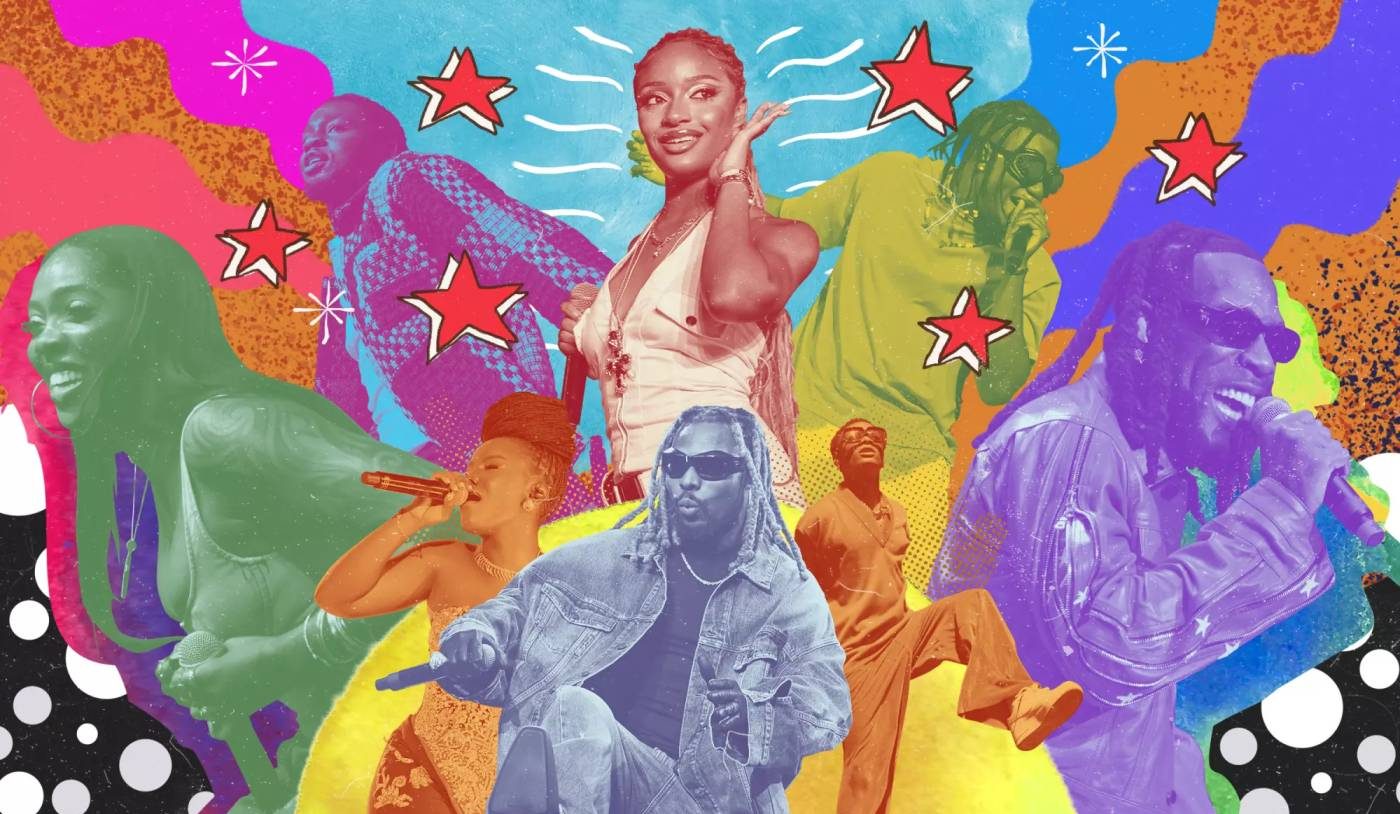

Afrobeats’ current condition reflects the tensions inherent in global success. As a sound, it continues to thrive. As a system, it faces questions of coherence, ownership, and meaning. Treating Afrobeats as a genre alone obscures these dynamics. Approaching it as a cultural system brings them into focus.
By Yinoluwa Olowofoyeku
Afrobeats as a Cultural System
Afrobeats now exist in a condition of full arrival. By the end of 2025, it has moved beyond emergence, contestation, or marginality and settled into global familiarity. It circulates across continents with ease, embedded in the machinery of playlists, festivals, brand partnerships, and pop crossover, functioning as a dependable marker of contemporary African popular music. Its rhythmic signatures are widely legible, its aesthetics instantly recognisable, and its presence no longer requires translation. This level of global permeation represents a significant cultural achievement. It also signals a moment that demands closer examination.
Part of that examination requires clarity about what is meant by Afrobeats. The term itself has never been fixed. While initially associated with a cluster of Nigerian pop sounds that gained continental momentum in the late 2000s and early 2010s, it now operates in global markets as a broad umbrella for a range of contemporary African popular expressions.
Ghanaian Highlife-inflected Pop, South African crossover acts adjacent to Amapiano, and diasporic hybrids are routinely folded into the Afrobeats label in international circulation. This elasticity has amplified its reach, but it has also blurred its contours. Technically, a genre implies a relatively stable set of stylistic characteristics and formal conventions that allow works to be grouped within a coherent artistic category.
Afrobeats in its present configuration exceeds that definition. What binds its various strands is not strict sonic uniformity, but shared circulation pathways, branding logics, and global expectation. It is for this reason that Afrobeats resists being approached simply as a genre. It functions more accurately as a cultural system, shaped by the interaction of sound, circulation, economics, institutions, and demand.
The pressures acting on it are therefore not primarily questions of talent or popularity, but of alignment. The sound continues to travel efficiently, but the meanings it carries increasingly thin out as it moves. What once thrived on locality, friction, and informal experimentation now operates within incentive structures that reward smoothness, familiarity, and export-ready legibility.
Optimisation and the Export Template
This produces a quiet but consequential tension at the centre of Afrobeats’ current configuration. As Afrobeats become increasingly ubiquitous, its symbolic weight begins to diffuse. Global success incentivises recognisability over specificity, encouraging production choices that prioritise immediate legibility within playlist ecosystems.
The result is a growing emphasis on mid-tempo accessibility, familiar rhythmic structures, and melodic restraint, all of which facilitate frictionless consumption but reduce the sound’s capacity to surprise or provoke. Records engineered for global circulation often feel interchangeable, not because they lack craft, but because they are designed to fit seamlessly into a standardised listening environment.
Mid-tempo crossover records such as Ayra Starr’s “Commas”, Fireboy DML’s “Yawa”, and Khaid’s “Jolie” exemplify this export-ready template. Built around restrained percussion, streamlined arrangement, and immediately legible melodic hooks, these songs are engineered for cross-market compatibility and playlist longevity. Their success underscores how optimisation for global scale can narrow the margins of sonic volatility, even when the individual records remain polished and effective within their intended lane.

A more expansive illustration of this dynamic is found in the meteoric global rise of South African artiste, Tyla. Her breakout success with “Water” and subsequent crossover positioning placed her at the forefront of what many international audiences understand as Afrobeats’ contemporary face. Sonically, her music blends Amapiano’s rhythmic swing with Pop polish, R&B tonality, and Afrobeats-adjacent percussion in a form frequently described as “popiano”.
Yet, Tyla herself has resisted narrow classification, framing her sound in broader pop terms rather than situating it strictly within the Afrobeats label. This divergence between external categorisation and self-definition is instructive. While global markets and award institutions often fold her into Afrobeats branding, her own articulation of genre identity gestures toward something more hybrid and expansive.
The tension becomes even more revealing when viewed through domestic listening patterns. Spotify’s 2025 Wrapped data for South Africa shows Kabza De Small once again dominating local streams, underscoring Amapiano’s entrenched domestic centrality. Tyla’s global stature, by contrast, does not translate into equivalent dominance within her home streaming ecosystem.
The contrast is not an indictment of her artistry, but a reflection of structural dynamics. It suggests that what travels most efficiently under the Afrobeats umbrella internationally does not always mirror the sounds most deeply embedded within local cultural consumption.

This condition does not signal creative decline so much as diminishing cultural returns. Afrobeats continues to function effectively as an export, but its ability to carry distinct cultural narratives weakens as it becomes ever more optimised for scale. In this sense, saturation does not erase Afrobeats’ presence, but it softens its contours, making it increasingly difficult for individual records to register as culturally urgent rather than merely successful.
Seen this way, the central issue surrounding Afrobeats is not whether it has peaked, nor whether it has been diluted, but how it is being held together as it continues to expand. Its long-term relevance appears less dependent on further reach than on a recalibration of meaning, structure, and intention.
As with other globally circulating sounds that have passed through similar phases of saturation, the durability of Afrobeats now rests on its ability to sustain regional specificity and cultural coherence while operating at scale. The question is no longer how far the sound can travel, but how clearly it can define itself while doing so.
Inward Derivation and the Innovation Bottleneck
Afrobeats has always been structurally derivative, drawing energy from its ability to absorb and reconfigure influences across geography and genre. This openness has historically been one of its defining strengths, allowing it to evolve through dialogue with hip-hop, R&B, dancehall, and other diasporic forms. In its current phase, however, derivation increasingly turns inward, resulting in a cycle of self-referential repetition rather than outward expansion.
Across much of the 2023 to 2025 period, dominant production patterns consolidate around a narrow set of tempos, drum textures, and arrangement structures. Percussion-forward intros, predictable drop points, and chorus-led songwriting become default rather than strategic choices. The widespread absorption of Amapiano elements illustrates this shift clearly.
What begins as a productive cross-regional exchange, visible in the early run of Asake’s Mr. Money With The Vibe and subsequent hits like “Terminator”, gradually flattens into a surface-level borrowing of log drums and rhythmic feel, often detached from the structural and cultural logic that originally animated the South African sound.

Interestingly enough, the beginnings of this adoption were initially seen as an innovative and emergent sonic fusion, regularly dubbed “Afropiano”. It incensed a wave of intentional fusion experiments by heavyweight producers such as Ozedikus, which led to unique spins like Ojapiano, which infused traditional Igbo Oja instrumentation with Amapiano sensibilities.
However, by 2024 and 2025, the Amapiano imprint had flattened to become a stylistic shortcut across multiple mid-tier releases, rather than a generative site of innovation. This is evident in the recent mass adoption of log drums and Amapiano snares in what would now be termed run-of-the-mill Afrobeats, Street-Hop, Afro-Adura, and the likes.
This inward looping does not preclude moments of disruption. Rema’s HEIS stands out as a deliberate refusal of optimisation, leaning into abrasive textures, irregular pacing, and tonal unpredictability that disrupt playlist smoothness.
Similarly, emerging sonic architects such as Mavo and Zaylevelten introduce production palettes that feel less beholden to established Afrobeats templates, experimenting with alternative drum programming, distortion, and grungy mood construction that resist easy categorisation.
It remains to be seen how durable their influence will be, but their presence underscores an important reality: innovation continues to surface. What has shifted is not the capacity for experimentation, but the systemic conditions under which experimentation is rewarded or marginalised.
The dominant ecosystem continues to privilege familiarity, reinforcing a feedback loop in which new releases echo established templates rather than generating new tensions. There is a possibility for new directions to be starved in favour of more palatable, easily packaged exports, especially where that novelty lacks financial backing and media machinery.
From Sonic Volatility to Global Abstraction
Sonic repetition matters not only at the level of aesthetics, but at the level of meaning. When rhythmic and melodic structures stabilise too completely, they lose their capacity to carry narrative weight. Early Afrobeats thrived on a sense of informal volatility, where shifts in rhythm, language, and delivery reflected the social and cultural pressures of their moment.
Records such as Olamide’s “Durosoke”, Timaya’s dancehall-inflected “Bum Bum”, and the rhythmically unconventional “Samba” by Sarz and Wizkid operated without apparent concern for fitting into a unified sonic framework. They were mainstream hits, yet they foregrounded individuality, indigenous cadence, and percussive idiosyncrasy over polish or cross-market smoothing.
This is not to suggest that generic formulas did not exist in that era. They always have. What differed was the weight placed on uniqueness. The industry did not yet feel compelled to engineer songs toward a specific export-ready template. There was less of a commercial product quality to the thinking around structure and sound design, and more tolerance for volatility as a driver of success. As repetition sets in, sound becomes atmosphere rather than statement, and music risks functioning as background rather than cultural expression.
This erosion does not occur suddenly. It accumulates gradually, as familiar structures displace exploratory ones. Over time, the sound’s ability to register as socially or culturally situated weakens, making it more susceptible to abstraction and repurposing elsewhere.

As Afrobeats circulates beyond its points of origin, it increasingly functions as a transferable and flexible sonic toolkit rather than a culturally anchored sound. Its rhythmic patterns, tempos, and melodic sensibilities are adopted across regions and genres, often without reference to the histories or social contexts that shaped them. This process is not inherently problematic. Cultural exchange has always been central to popular music. The issue arises when sound travels faster than narrative.
By 2025, Afrobeats rhythms appear frequently in Latin Pop, global R&B, and mainstream crossover records, integrated seamlessly into local scenes. Collaborations such as Rema’s remix of “Calm Down” with Selena Gomez opened new corridors of exchange, so artistes across Colombia and Puerto Rico began incorporating Afrobeats-inflected percussion into reggaetón and Latin R&B frameworks.
Strong examples include “Quilo” by Dawer x Damper, “Mi Reina” by Hamilton and Nanpa Basico, as well as Kapo’s “Ohnana”, which has garnered over 90M views on YouTube. In many cases, these adaptations foreground groove and texture while sidelining lineage and authorship. Afrobeats becomes a stylistic option rather than a situated cultural expression, deployable without requiring engagement with its origins.
This shift alters the balance of influence and authority. While Afrobeats’ sonic vocabulary expands its global footprint, its narrative control diminishes. The sound gains reach but loses density, circulating widely while carrying increasingly generalised meaning.
Misdiagnosing the Moment
Within this context, a noticeable turn toward indigenous Nigerian musical forms emerges as a counter-current. Adekunle Gold’s Fuji foregrounds Yoruba oral traditions and percussion structures, drawing directly from the genre that shaped his formative listening. Wizard Chan’s “Boma Nime” similarly channels riverine spiritual textures and Ijaw linguistic presence into contemporary production. These gestures signal an awareness of Afrobeats’ drift toward abstraction and a desire to re-anchor the sound in specific cultural logics.
Yet, these efforts remain largely peripheral to Afrobeats’ dominant pathways. While they introduce valuable sonic texture and cultural grounding, they rarely reshape the core production and distribution systems that govern the genre. Indigenous elements often function as aesthetic accents rather than structural foundations, incorporated selectively without reorganising the underlying logic of circulation.

The autochthonous turn thus operates more as an indicator than a solution. It reveals dissatisfaction with the prevailing model, but without sufficient institutional support, it risks being absorbed as another stylistic layer rather than catalysing systemic change.
As Afrobeats navigates this phase, several dominant responses misidentify the nature of the challenge. One such response centres on gatekeeping, framing global adoption as a threat that must be resisted. Periodic waves of online discourse, particularly on X and Instagram, have seen calls to “protect” or “gatekeep” Afrobeats whenever non-African artistes adopt its rhythmic structures or branding, especially during moments of heightened Latino crossover visibility.
These debates often trend briefly, positioning sonic borrowing as cultural encroachment. Yet the focus frequently rests on who is allowed to use Afrobeats aesthetics, rather than on who controls the structures that govern credit, compensation, publishing rights, and long-term narrative ownership. In doing so, the conversation risks mistaking symbolic policing for structural reform.
Another misdiagnosis treats genre elasticity as evolution. As Afrobeats stretches to encompass an ever-widening range of sounds, its identity risks becoming diffused. Flexibility, once a strength, begins to obscure coherence, making it difficult to articulate what Afrobeats represents beyond a general sense of vibe or mood.


Finally, shifts toward slower tempos and mood-driven records are sometimes framed as reinvention, when they more accurately reflect listener fatigue with high-energy repetition.
The global resonance of Omah Lay’s emotionally subdued catalogue, particularly records such as “Soso” and “Understand”, alongside the international breakout success of Libianca’s “People”, illustrates how introspection, vulnerability, and restrained production have increasingly displaced exuberance as Afrobeats’ most exportable register.
These records centre atmosphere, emotional confession, and sparse rhythmic framing rather than percussive intensity or dancefloor propulsion. Without bigger structural change, however, this tonal pivot risks functioning as a surface-level adaptation rather than a substantive reorientation of the system itself.
Reorientation and Strategic Recalibration
Afrobeats is not alone in facing the pressures of saturation and global diffusion. Other genres offer instructive examples of how similar moments have been navigated. Hip-hop sustains vitality through regional fragmentation, from Atlanta’s trap lineage to the UK drill movement, allowing local scenes to set the narratives and redefine the sound continuously.
Reggaetón maintains coherence by retaining Spanish as its primary linguistic vehicle even at peak global visibility, ensuring cultural rootedness even amid massive crossover moments like “Despacito”, or more recently, Bad Bunny’s Super Bowl Half-Time Show. K-pop demonstrates the value of institutional coherence.
Companies such as HYBE and SM Entertainment do not simply manage artistes; they operate vertically integrated systems that combine long-term artiste training, synchronised branding, global distribution networks, and tightly controlled narrative ecosystems through dedicated fan platforms and multimedia expansion.
This coordination ensures that as K-pop scales internationally, ownership, storytelling, and economic leverage remain centralised rather than diffused. Dancehall, by contrast, illustrates the risks of insufficient structural protection. During the mid-2010s, dancehall rhythms and patois-inflected cadences heavily influenced global pop through records such as Rihanna’s “Work” and Drake’s “Controlla,” yet the widespread sonic adoption did not translate into equivalent institutional strengthening or sustained economic leverage for Jamaican originators.
Across these cases, longevity emerges not from endless expansion, but from strengthened internal logic. Genres that endure do so by clarifying identity, reinforcing structure, and managing diffusion intentionally.
The conditions surrounding Afrobeats point toward the need for reorientation rather than reinvention. Streaming platforms have seen sustained growth in mood-based playlists over genre-based ones, while global chart data across pop and R&B reflect a gradual drift toward slower BPMs and emotionally subdued production in the post-EDM era.
On short-form platforms such as TikTok, resonance often hinges less on dance intensity and more on lyrical relatability and atmospheric texture, rewarding songs that evoke feeling rather than spectacle. This broader tempo and mood recalibration positions Afrobeats within a global environment that is receptive to nuance, provided that nuance is rooted in coherent cultural identity rather than surface adjustment. Afrobeats are well-positioned to respond, but only if regional specificity is treated as an asset rather than an obstacle.
This does not require retreat from global circulation. It requires a recalibration of priorities, where indigenous structures inform production at a foundational level, where language operates as a worldview rather than an ornament, and where projects are shaped by narrative intent rather than playlist optimisation.
This orientation is already visible in pockets of the ecosystem: in the continued vitality of Lagos Street-Hop scenes that prioritise vernacular immediacy over global smoothing, in the faith-tinged textures of Afro-Adura records that merge gospel cadence with street percussion, and in the way artistes emerging from Port Harcourt increasingly foreground the city itself as narrative anchor, wearing regional identity as both badge and backdrop.

Much like Chicago rappers embed neighbourhood codes into delivery, or South African township culture animates the genres that arise from it, Port Harcourt artistes often allow the city’s social texture, slang, and lived experience to shape lyrical perspective and tonal atmosphere.
A parallel clarity can be observed in contemporary Ghanaian Highlife-Pop, where artistes continue to draw directly from Highlife’s melodic inheritance and Twi lyricism without flattening those elements into generic global pop templates. Even as Ghanaian records circulate internationally under the Afrobeats umbrella, their structural allegiance to highlife traditions preserves a distinct sonic lineage.
These sub-scenes do not dominate the charts, but they demonstrate that regional grounding and sonic coherence remain viable pathways rather than nostalgic gestures. Such an approach emphasises coherence over scale, allowing global relevance to emerge from clarity rather than compromise.
Afrobeats’ current condition reflects the tensions inherent in global success. As a sound, it continues to thrive. As a system, it faces questions of coherence, ownership, and meaning. Treating Afrobeats as a genre alone obscures these dynamics. Approaching it as a cultural system brings them into focus.
What is at stake is not whether Afrobeats can continue to travel, but whether it can do so without losing the structures that give it shape. Its long-term durability depends less on expansion than on definition. In a moment where the sound is heard everywhere, the challenge is to ensure that it still knows where it is coming from and what it is carrying with it as it moves forward.
*This essay, among other cultural essays, is published in The Afrocritik Report 2025. Download the report here.
Yinoluwa “Yinoluu” Olowofoyeku is a pioneering music producer who contributed to the foundation of the Alté movement. An avid multi-hyphenate artist and creative, his work across various media is available on all platforms.
Cover photo credit: LA Times