



4 Da Streets! highlights the curatorial strengths of Uncle Waffles and Royal MusiQ, who successfully bring together a wide range of artistes, styles, and energies under a singular and clearly defined sonic vision.
By Yinoluwa Olowofoyeku
Few figures have experienced a rise within South African dance music as explosive and culturally visible as Uncle Waffles. Born Lungelihle Zwane in Eswatini, the DJ and producer emerged into global consciousness through a viral performance clip soundtracked by Young Stunna’s “Adiwele,” a moment that rapidly transformed her from rising selector into one of the defining public faces of Amapiano’s international expansion.
What followed was not a fleeting internet moment but the steady construction of a genuine musical career, with projects like Red Dragon (2022) and Asylum (2023), alongside high-profile performances across Africa, Europe, and the United States, helping establish her as a prominent cultural figure within the genre’s worldwide ascent.
At the same time, Royal MusiQ has steadily emerged as one of Amapiano’s increasingly respected younger producers, building a reputation within the scene through his involvement in groove-heavy, log drum-driven productions and collaborations across South Africa’s rapidly evolving dance music ecosystem. Though less globally visible than Uncle Waffles, Royal MusiQ’s growing presence within producer circles reflects the wider generational wave of young sonic architects continuing to push Amapiano’s sound forward from within its home environment.
That context frames the arrival of 4 Da Streets!, a joint project that immediately positions itself within the communal, dancefloor-centered ethos from which Amapiano culture emerged. The title itself evokes a grounding in township energy, street culture, and the everyday environments that continue to shape the genre’s sonic identity even amid its globalization.
Released at a time when Amapiano occupies an increasingly dominant place in global dance conversations, the project arrives as another entry in the broader movement of collaborative works that define the genre’s ecosystem, where DJs, producers, vocalists, and performers regularly merge creative worlds to build immersive rhythmic experiences.
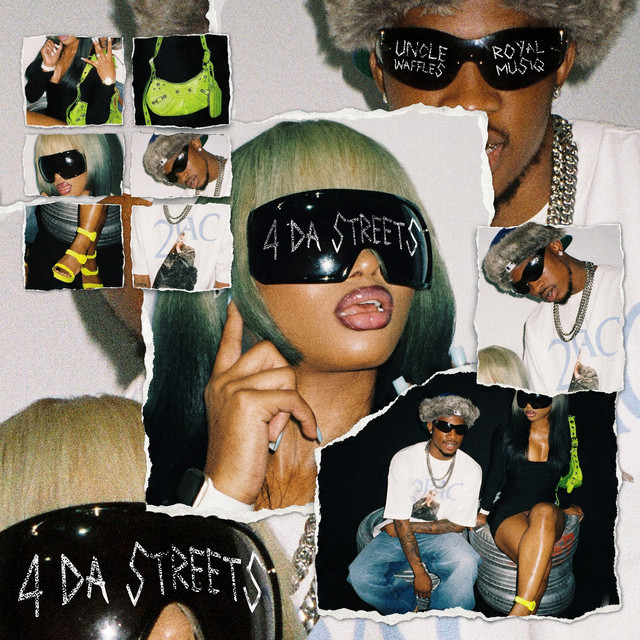
For Uncle Waffles, 4 Da Streets! continues her transition from viral phenomenon into a more established musical figure navigating longevity and artistic identity within the genre, while for Royal MusiQ it represents another major collaborative step within a rapidly growing production career. Together, the project enters the wider Amapiano landscape carrying the weight of both artistes’ rising profiles and the broader expectations surrounding one of African music’s most internationally visible genres.
Opening 4 Da Streets! with “Too Cool”, Uncle Waffles and Royal MusiQ waste little time establishing the raw street-centered energy that defines the project’s sonic identity. Featuring Shoes Meister, the track immediately throws the listener into a dense rhythmic environment powered by pounding kicks, bongos, metallic shaker textures, rolling percussion patterns, and layers of ear candy effects that constantly move around the stereo field.
Wailing siren sounds and grunted male vocal chants inject tension and urgency into the atmosphere before incessant sharp snare hits and rounded log drums arrive alongside deep 808 sub bass, creating a groove that feels simultaneously chaotic and tightly controlled. Melodic considerations remain secondary to rhythm and pulse, with synth stab accents appearing more as punctuation than emotional centerpiece, allowing the groove itself to dominate the experience. As an opener, “Too Cool” functions effectively as a mission statement for 4 Da Streets!, immediately immersing the listener in gritty dancefloor energy while capturing the communal, high-intensity atmosphere the project aims to sustain.
That rhythmic emphasis continues on “Kwela”, though the approach becomes more hypnotic and groove-focused. Incessant shakers, subtle snare hits, and four-beat percussion pulses establish a tightly wound rhythmic framework while growling synth basses and sweeping synth effects create movement beneath the surface. The vocal approach leans heavily into half-rapped cadences and chant-like repetition, with layered backing vocals and trance-like melodic fragments helping deepen the immersive atmosphere as the instrumental evolves.
Once the rolling log drums arrive beneath the verses, the song locks firmly into its syncopated pocket, prioritizing groove and danceability over melodic complexity. The vocal performances themselves are playful and witty, delivered with constantly shifting cadences and tonal variations that keep the energy lively even within the song’s repetitive rhythmic structure. Instrumental breaks strip the arrangement back to its skeletal percussion before the groove crashes back in again, making “Kwela” feel particularly designed for dance routines and crowd movement rather than emotional melodic payoff.
On “Cn I See U”, the project briefly pivots toward Gqom territory, enlisting BXKS and BarbieSZN for one of the tape’s most aggressively energetic moments. The production is anchored by pounding Gqom kick patterns and booming 808s, while a rich synth bassline provides the primary melodic thrust beneath popping sound effects and swirling transition textures. Both ladies attack the beat with sharp braggadocious bars delivered through rapid-fire cadences and layered vocal effects, her performance riding the pounding percussion with a sense of controlled aggression.
As the song progresses, claps and shakers creep into the mix while sweeping effects and rhythmic switch-ups help delineate the various segments of the track. The repeated “Can I see you?” refrain acts as a simple but effective hook, periodically resetting the tension before the instrumental surges back into full force. The result is a track built almost entirely around pulse, momentum, and physical energy, balancing raw dancefloor intensity with tightly delivered rap performances.
With “Woza Kim’”, 4 Da Streets! returns more firmly to straightforward Amapiano structure, though subtle Jersey club and house influences creep into the edges of the production. Heavy percussion arrangements, four-to-the-floor kicks, rattling shakers, and gated risers establish the rhythmic backbone while minor synth chords and improvised electric piano trills add flashes of melodic color. Joined by Djy Vino, CowBoii, and Xduppy, the song keeps its focus squarely on gritty vocal delivery and rolling drum momentum rather than large melodic evolution.

Piano stabs remain sparse throughout much of the track, functioning more as rhythmic accents than harmonic centerpieces, while the instrumental continuously layers new percussive details, particularly rich syncopated snare patterns that give the groove additional movement. Though the song does not dramatically evolve structurally, that relative steadiness works in its favor, allowing the drums, vocal energy, and rhythmic interplay to remain the true focal point.
Shoes Meister returns on “Imission”, this time surrounded by a wider cast of collaborators on one of the project’s more playfully arranged records. The production feels particularly detailed here, built around four-to-the-floor kicks enhanced by foley-inspired percussion textures and a wide assortment of ear candy effects that constantly animate the mix. Soft sultry female vocal passages drift across tambourine shakes and gated synth textures, creating an atmospheric melodic bed before conservative log drums begin gradually thickening the arrangement.
Gritty male rap deliveries sit comfortably over playful sampled-vocal arpeggios, while the instrumental itself evolves noticeably from section to section, frequently dropping drums out entirely for softer vocal breaks before rebuilding tension again. The transitions are especially effective, with synth runs and melodic flourishes guiding the listener between sparse moments and fuller rhythmic crescendos. This constant shifting gives “Imission” a slightly more cinematic quality compared to some of the more loop-oriented tracks earlier on 4 Da Streets!.
Closing the project is “Brazilian Funk,” a track whose title initially suggests a full pivot into baile funk territory before cleverly revealing itself as something more hybridized. The song begins within familiar Amapiano territory through rattling shakers, layered percussion, synth chords, sparkling keys, and a humming synth bassline, but gradually introduces Brazilian funk influences through vocal percussion patterns inspired by the genre’s iconic mouth-drum cadences, “doom cha cha doom cha cha doom doom cha cha doom cha cha.”
Rather than directly abandoning Amapiano, the production cleverly mirrors those rhythmic vocal patterns through rolling log drums, booming 808 bass, layered snares, sizzling hi-hats, and buzzing synth runs, allowing both genres to coexist within the same rhythmic framework. Vocal stabs, shouted interjections, and constantly shifting percussive textures keep the energy elevated throughout, turning the song into one final burst of gritty dancefloor adrenaline.
As a closer, “Brazilian Funk” encapsulates much of what 4 Da Streets! prioritises across its runtime: rhythm, groove, movement, experimentation within familiar frameworks, and above all an unwavering commitment to energetic communal dance music.
The title 4 Da Streets! leaves very little ambiguity about the project’s intentions. Rather than leaning into the smoother, cleaner, more pop-oriented direction that portions of Amapiano have increasingly drifted toward as the genre globalises, Uncle Waffles and Royal MusiQ dedicate this project firmly to the pulse, grit, drive, and communal street energy that helped propel Amapiano to its current heights in the first place. The project feels deeply rooted in those origins, not merely aesthetically but structurally, with nearly every creative decision made in service of rhythm, momentum, and physical movement.
4 Da Streets! fully encapsulates that dedication through its execution, delivering a listening experience that constantly prioritizes groove and atmosphere over crossover polish or melodic excess. The production is unquestionably the beating heart of the project. Across the tape, melodic presence remains secondary to drums, syncopation, bass movement, and rhythmic layering, with the producers displaying an impressive understanding of how to sustain energy through percussion alone.

Even when stylistic detours emerge, whether through the Gqom pulse of “Cn I See U” or the hybridised genre interplay of “Brazilian Funk,” the central focus on drive and groove never wavers. Melodic elements certainly exist, but they are typically sparse and purposeful, often reduced to simple synth stabs, singular chord progressions, subtle keys, or basslines that merely reinforce the rhythmic foundation without overcrowding it.


Sampled vocals, sound effects, foley textures, chants, and vocal snippets are also woven directly into the rhythmic architecture of the songs, functioning less as decoration and more as integral percussive components. Tying all of this together is sharp engineering that manages to balance an overwhelming number of layers, textures, and moving elements without losing the rawness or physicality the project depends upon.
Vocals throughout 4 Da Streets! operate largely in support of that production-first philosophy. Traditional singing rarely takes center stage, instead giving way to gritty rap deliveries, chant-like refrains, swagger-heavy vocal performances, and rhythmic cadences designed to amplify the energy already established by the instrumentals. Whether it is the playful confidence of the women on “Cn I See U,” the rough-edged male rap performances scattered across the tape, or the witty cadence switches and streetwise bravado embedded throughout the verses, every vocal contribution feels aligned with the project’s larger commitment to pulse, movement, and dancefloor connection.
More than anything, the project highlights the curatorial strengths of Uncle Waffles and Royal MusiQ, who successfully bring together a wide range of artistes, styles, and energies under a singular and clearly defined sonic vision. Despite the different collaborators and stylistic influences appearing across the runtime, 4 Da Streets! maintains remarkable thematic cohesion, constantly returning to its core identity as a tribute to street-rooted dance culture and rhythmic immersion.
The result is a strong and highly intentional listening experience that feels tailor-made for communal spaces, dance routines, loud speakers, and crowded dancefloors. From international festival stages back to the streets and sonic environments that shaped her rise, Uncle Waffles continues to demonstrate impressive versatility and cultural awareness, while Royal MusiQ further establishes himself as an increasingly important contributor within the genre’s evolving ecosystem. Together, they deliver a project that fully understands its audience and purpose, and the streets will almost certainly embrace it accordingly.
Lyricism – 1.4
Tracklisting – 1.5
Sound Engineering – 1.6
Vocalisation – 1.3
Listening Experience – 1.5
Rating – 7.3/10
Yinoluwa “Yinoluu” Olowofoyeku is a multi-disciplinary artist and creative who finds expression in various media. His music can be found across all platforms and he welcomes interaction on his social media @Yinoluu.