




What Dear Ajayi needs is a screenplay as disciplined as its images, one willing to stay with its characters long enough to discover who they are beyond the suffering they endure.
By Joseph Jonathan
In Buchi Emecheta’s The Joys of Motherhood, Nnu Ego gives everything to her children, trusting that her sacrifices will be repaid in old age, only to die alone by the roadside. The novel’s title is its bitterest joke: it describes a social arrangement in which sacrifice is treated as a pension scheme, and women are expected to finance it with their lives.
Damilola Orimogunje’s Dear Ajayi, set in late-1990s Ibadan, arrives at a similarly uncomfortable ledger. With public institutions offering little security for the sick and elderly, the family becomes the hospital, pension and care home. Within that arrangement, the responsibility often falls disproportionately on women.
Dear Ajayi is Damilola Orimogunje’s sophomore feature, following his 2020 debut, For Maria Ebun Pataki. While both films are concerned with the pressures of family and the difficult realities of womanhood, Dear Ajayi expands its concerns into questions of ageing, caregiving and the unequal distribution of familial responsibility.
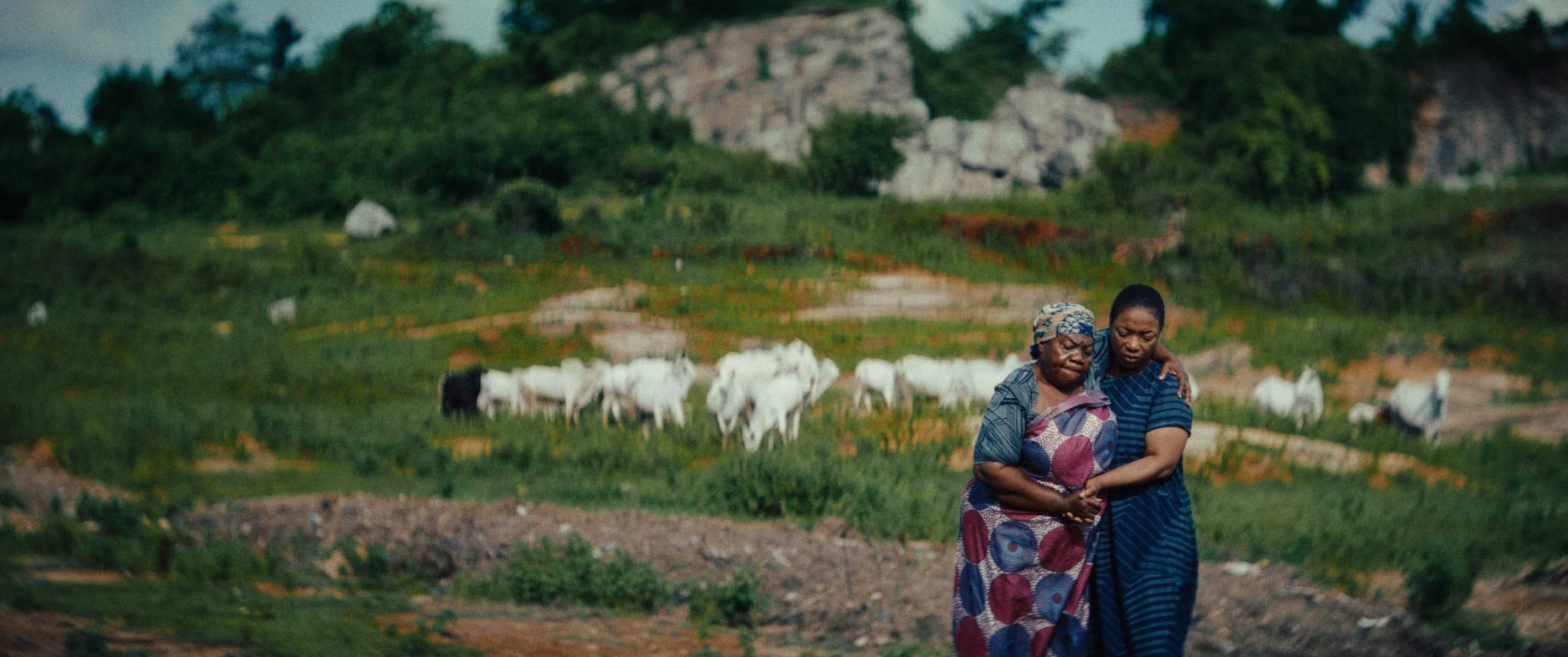
When their mother’s deteriorating health brings two estranged sisters, Ade (Bimbo Akintola) and Titi (Tosin Adeyemi), back under one roof, the film begins to examine what each woman has made of her life. Ade is a nurse, a devout Christian, a wife and mother, and the financial and emotional backbone of her household. Her painter husband, Michael (William Benson), struggles to make a living from his work, leaving her to shoulder responsibilities that extend beyond her immediate family. Titi, meanwhile, is a singer who has chosen to pursue her ambitions rather than settle into the domestic respectability expected of her. Their differences are considerable, but neither woman appears to have found the freedom she imagined. Their mother’s illness forces them into proximity, though it does little to resolve the grievances that have accumulated between them.

What Dear Ajayi understands particularly well is that caring for an ageing parent is not simply an emotional obligation. It requires money, time, physical labour and difficult negotiations over who is responsible for what. These demands become especially punishing in a society where economic instability limits people’s capacity to provide for themselves, let alone relatives with complex care needs.
Set against Nigeria’s transition from military rule towards civilian government, the film’s domestic struggles echo a country attempting to move forward without having resolved the conditions that keep its citizens vulnerable. Radio broadcasts about economic reforms and political developments provide a quiet reminder that national transitions do not necessarily translate into improvements in people’s everyday lives. For Ade, the demands of survival remain immediate and personal.
Akintola gives the film its most compelling performance. Her Ade is a woman whose composure conceals an enormous accumulation of fatigue. She speaks with restraint, measures her responses and often seems to retreat into herself rather than articulate what she needs. Yet Akintola makes these silences remarkably expressive.
There is frustration, affection, disappointment and exhaustion in the smallest shifts in her face. Her performance captures the particular loneliness of being indispensable to everyone but rarely having anyone available to take care of you. It is a captivating piece of work, and the film’s failure to explore Ade’s interior life more thoroughly makes it all the more frustrating. We see how much she carries, but rarely get enough time to understand what carrying it has done to her.
Adeyemi is equally impressive, though in a markedly different register. Her Titi is expressive, restless and fiercely attached to the possibility of a life beyond the expectations of her family. She brings an infectious energy to the character’s musical ambitions, but also conveys the vulnerability beneath her determination. When she sings, the film briefly seems to release some of the emotional pressure it has been accumulating.
Her performance makes Titi’s desire for independence feel tangible, even as the world around her repeatedly complicates that pursuit. William Benson also deserves recognition as Michael, whose inability to translate artistic ambition into financial security gradually affects his sense of worth and his relationships with those around him. Benson plays this frustration with a quietness that avoids turning the character into a caricature of the unsuccessful male provider. Together, the three performances give the film an emotional credibility that its screenplay does not always sustain.
Orimogunje’s command of the visual language is another of the film’s considerable strengths. KC Obiajulu’s cinematography is beautifully considered, with compositions that give the domestic spaces a distinct emotional character. The lighting and colour grading establish the period without making the film feel overly dependent on nostalgia. The moonlit sequences are particularly striking, their compositions and interplay of light creating images that linger long after the scenes have passed.

Ré Olunuga’s score and the music performed within the story complement this visual atmosphere, giving the film a melancholy that feels rooted in its characters’ circumstances. There is a remarkable amount of technical assurance here. At times, the images communicate feelings that the screenplay has not quite found the language to express.
But Dear Ajayi is ultimately a film about two sisters, and this is where its ambitions begin to falter. Their relationship should be the emotional centre around which the other conflicts revolve. Instead, the screenplay increasingly directs its attention towards the men in their lives and a succession of distressing developments.
We learn about the pressures surrounding the sisters, but spend comparatively little time examining their relationship with each other or how their mother’s illness reshapes it. The film has an interesting tension between two women who have made different choices under similarly restrictive circumstances, yet it rarely allows that tension to develop into the searching examination of sisterhood it promises.
The structure compounds this problem. Several events seem to happen without producing meaningful consequences for the characters or their relationships. Remarks, decisions and encounters that could have opened up deeper conversations are quickly abandoned as the story moves towards its next development.

For a film of this length, you often wished Orimogunje had trimmed some of the plot and spent more time with the moments that mattered. A tighter narrative, or one more willing to linger on the sisters’ disagreements and private conversations, might have given the emotional developments greater weight.
This becomes particularly noticeable when the film turns towards its darker material. Titi’s vulnerability to abuse, and the victim-blaming that often follows such experiences while perpetrators escape accountability, are important subjects. But as the narrative accumulates more distressing events, the movement from one grim episode to another becomes increasingly disorienting.
The film seems to mistake emotional intensity for emotional depth, as though making its characters endure more suffering will automatically make their stories more affecting. At some point, the question of poverty porn becomes difficult to ignore. The problem is not that the film depicts hardship, but that it sometimes appears more interested in displaying its consequences than in examining the people living through them. Misery is not the same as depth. A film should be devastating because it understands its characters, not simply because it finds increasingly painful ways to hurt them.
The ending is where this imbalance becomes most frustrating. The performances, music and cinematography have been building towards an emotional destination, but the narrative does not quite arrive there. What could have been a deeply affecting conclusion instead feels like the culmination of a story that has gradually lost sight of its most interesting relationships.
Still, Dear Ajayi has a great deal going for it. It is a technically accomplished drama with two exceptional central performances and a thoughtful understanding of the material conditions that shape familial responsibility. More than anything, it is a sobering reminder that for many African women, dreams come with a considerable price, often compounded by the collision between filial piety, gender expectations and economic precarity.
The freedom to pursue a life of one’s own is rarely straightforward when so many other lives depend on you. Orimogunje clearly has the eye, the ear and the actors. What Dear Ajayi needs is a screenplay as disciplined as its images, one willing to stay with its characters long enough to discover who they are beyond the suffering they endure.
Rating: 3.2/5
* Dear Ajayi premiered at the 2026 Venice Film Festival in the Giornate degli Autori (Venice Days) section, where it won the Premio Enrico Fulchignoni and the Premio Bisato d’Oro for Best Cast and Performances, before screening at Film Africa 2026.
Joseph Jonathan is a historian who seeks to understand how film shapes our cultural identity as a people. He believes that history is more about the future than the past. When he’s not writing about film, you can catch him listening to music or discussing politics. He tweets @Chukwu2big.