



In Central Hotel, Ehikhamenor spends more time on the demographic that most represents the vast majority of the Nigerian experience: the poor.
By Chimezie Chika
Renowned Nigerian artist and writer, Victor Ehikhamenor, has long comfortably bestridden the creative disciplines of visual arts and literature (although one could argue that he has been far more successful with the former). His exploits in visual art need not be reproduced here; only to say that Ehikhamenor is one of the few contemporary Nigerian artists who sit on a pedestal of achievement and respect.
Yet both art and literature have enjoyed a certain fealty in the man’s creative engagements. I was a hungry recent secondary school graduate stabbing at grandiose dreams of writing on Facebook, when Ehikhamenor’s book, Excuse Me! (2012), a collection of humorous essays about being Nigerian, began to make the rounds. It remains his most well-known book to date. Prior to this, his first book, a rather obscure collection of poems titled Sordid Rituals, had been published in 2002.
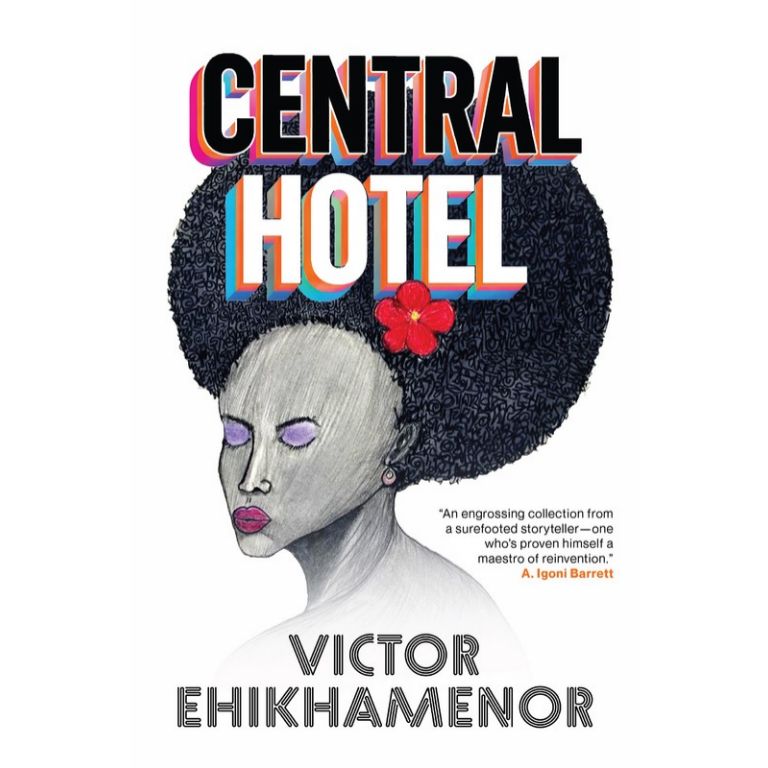
Central Hotel (2026), his first full book of fiction, comes with glowing recommendations from some of Nigeria’s well-known writers, including A. Igoni Barrett, E.C. Osondu, and Sarah Ladipo Manyika. It is a collection of 11 short stories set across Nigeria, Europe and the United States. The book brims with all kinds of stories about familiar Nigerian experiences. Love. Immigration. Slum life. Human trafficking. Sexuality. The stories are written in a range of POVs—third person, omniscient, first person, and second person singular—and show Ehikhamenor’s range and ability.
The first story, “I Put a Spell on You”, is a run-of-the-mill romance in Washington DC, between an incognito Bini prince and a Muslim woman named Halimat from the Democratic Republic of Congo. Not realising that the romance was doomed from the start, the desperate Halimat falls for Idaikin’s careful wooing, only to realise later that tales of ancestral ties and the rules of royal lineages can tear her dreams apart. The sex scene in this story is ridiculous.
The second story, “You Smell Like Kerosene”, is a forgettable, meaningless tale (again set in the United States) of a day in the life of a Nigerian man whose wife earns more than he does. The story is his first-person musing around that condition. He thinks himself the sacrificial lamb for the good of his little son. Amidst all this, his wife disdains him and appears to no longer believe in the union. A summary of this story, as it is, would always be better than the story itself.
The longest story in the collection, “Madam”, though wobbled in its first quarter, is the first palatable story in the collection. It is a story of human trafficking in Benin City, a city that became legendary as the headquarters of crime rings trafficking and coercing girls into prostitution and slavery in Europe, particularly Italy and Belgium (Chika Unigwe’s Nigeria Prize for Literature-winning novel, On Black Sisters’ Street, is about this). In “Madam”, a young girl, Itohan, is tricked into the same problem by the psychiatric hospital nurse who treated her father.
After the death of her parents, this influential nurse, Madam Comfort Uselu, promises to send the naive Itohan to Italy to study nursing. From this point, the girl’s life went downhill. She is raped by one of Madam Comfort’s ring members, a man named Prince, who then takes her to Europe on fake papers, abandons her at the airport immigration and then miraculously rescues her from a prison in Lampedusa into a place in Venice that houses the ring’s sex work slaves. A story as moving as it is shocking, crime litters every juncture in it. It is a shocking reminder of the crimes being committed around us by a greedy, depraved few.
In “Waiting for the Bulldozers”, a beachside slum is earmarked for demolition by the government in preparation for the development of prime real estate. The first-person narrator documents the helplessness of him and his community in the face of higher powers. The community is full of poor, destitute, disabled, and hopeless people who cannot even help themselves.
The story also provides acute insight: such a community is not a place where protest can happen because, as the narrator points out, more time is spent praying against the demolition than actually protesting. It is a brutal portrait of a country filled with people who have surrendered their fate and revolutionary will to poverty, national betrayal, and the dampening pacifism of the Christian religion. This story is particularly topical when one considers what is currently going on in Lagos with the Makoko demolitions, which itself isn’t the first time such acts are being committed against helpless people without adequate compensation.
The titular story, “Central Hotel”, one of the book’s most accomplished, is the story of two friends, Vindo and Pako, who nurse dreams of “becoming men” by breaking their virginity in a well-known hotel. Ehikhamenor’s gifts as a storyteller are on full display here. His particular strengths: the pinpoint capturing of teenage and youthful exuberance comes alive, and Vindo and Pako go about planning their escapade. But when the day arrives, and the friends find themselves at the hotel, Vindo comes face to face with the shock of a lifetime regarding an aunt who has been his greatest cheerleader.
The most moving and fully realised story in the book is perhaps “Passport to Heaven”. It is the story of Oselumen, a graduate who gets the coveted American visa (tourist visa, by the way) after spending eight years trying. In Oselumen’s mind, America is heaven, and so he considers the visa a ticket to heaven.
With the help of friends and acquaintances, he gathers his flight ticket and arrives in America and experiences a rude but necessary reality check. His first problem becomes solving his persona non grata status so he can work. He rejects a business marriage to a plus-sized drug addict in a seedy neighbourhood in Maryland because he cannot countenance granting her the initial sexual favours she is demanding, and his problems only compound from there. The story is a good illustration of the decorated mirage that many Nigerians and Africans still fall for when it comes to Japa.
The other side of the immigration tale is not one of a rude awakening such as Oselumen’s, but one of freedom to be, as many LGBT Nigerians are aware. This is why the story, “A Picture from Ireland”, can be read as a kind of companion piece to “Passport to Heaven”. This story is told from the point of view of a teenage boy who helps his grandmother read and write letters to her son in Ireland. The boy’s uncle, who was the village catechist, had left Nigeria with a young Irish priest many years before. In the intervening years, his mother fixates on him coming back to their village, Uwessan, to marry a girl until the day a letter and a photograph arrive.
Many of the stories in Central Hotel, as the title would imply, cover a sleazy and glitzy life, peopled with sex workers, poor dreamers, exploiters, and all kinds of low-lifers in a way that makes one think of Meja Mwangi’s Going Down River Road. But more than anything, the stories in Central Hotel are mainly about ordinary Nigerians pursuing their self-curated dreams—aspirations that are often motivated or hindered by political dysfunctions or socio-cultural conditions.


It is always refreshing to read something other than middle-class Nigerian life, which is the subject that seems to occupy many of our writers working today. In Central Hotel, Ehikhamenor spends more time on the demographic that most represents the vast majority of the Nigerian experience: the poor. We see the differences in their stories as well as their similarities, all distilled through the perspectives of protagonists presented as Edo people.
This is heightened by the fact that some of the stories are vaguely connected through characters, themes, and places, allowing us to have a sense of a much more expansive experience than singular stories can offer. The one reservation I have about them is the bloated, unwieldy writing that one sometimes finds in the book. Ehikhamenor’s prose can be overwrought and simile-laden. For this reason, the first two stories are unfortunate.
It might come to a point at times where one may begin to find the drawings at the beginning and end of each story more fascinating than the writing. The drawings often capture almost literally—with certain abstract flourishes—the themes and subjects of the stories they complement. One of the most fascinating begins “A Picture from Ireland”.
Illustrations of congregants crowded around a church spire. On the far left and right are: an owl, a woman and a young boy in school uniform clutching a letter, a hut with macabre masks and the likeness of a man with a plate of cowries. The centre of the illustration is dominated by a white catholic priest and a black clergyman, who appears to be resting his head on the former’s shoulders.
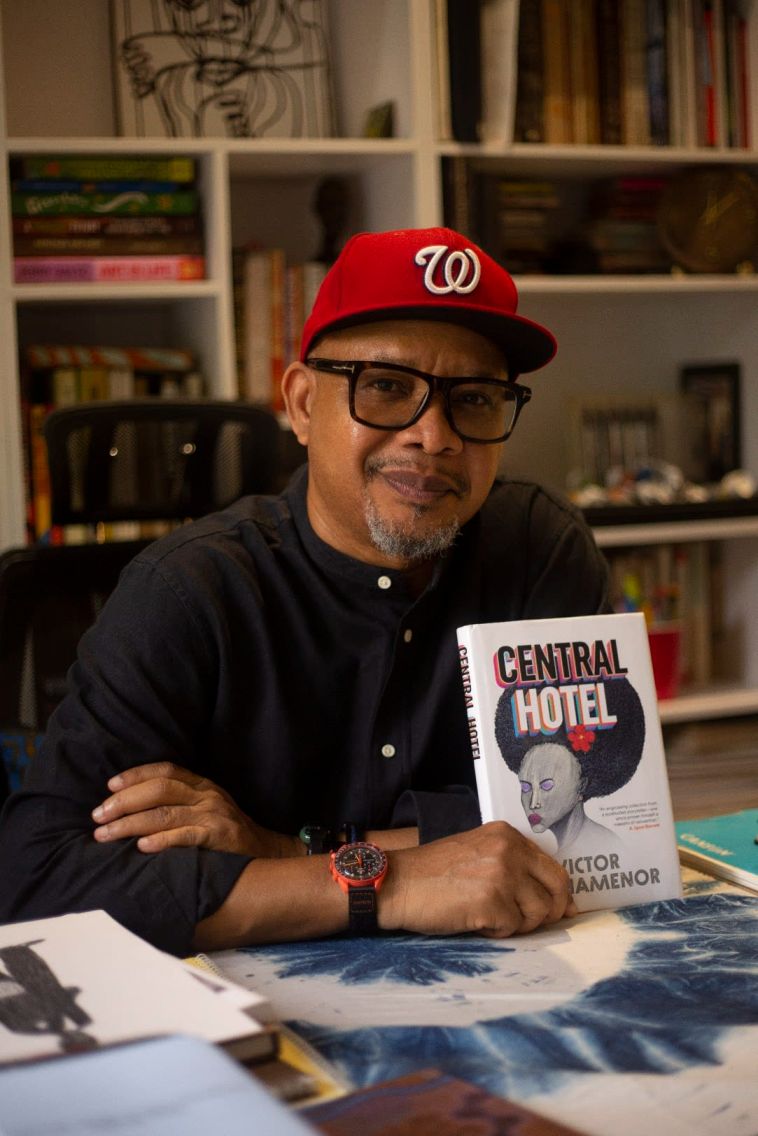
The illustrations make Central Hotel a signature artist’s book. One could say that Ehikhamenor’s two major creative orientations come together here. Illustrating books is not new to him, having made the cover illustration of this present book and that of many books in the past, including those of Chimamanda Ngozi Adichie, Helon Habila, and reissues of Buchi Emecheta’s works.
There is also nothing new in literature about this combination of visual art and fiction in a book by a single author; we have even seen this a few times in Nigerian fiction, particularly with acclaimed writer and photographer Teju Cole, whose first book, Everyday is for the Thief (2007), also contains both fiction and photographs.
In Central Hotel, what works is not only the art, but also Ehikhamenor’s ability to tell the Nigerian experience, show that experience, and mostly keep our attention, one way or another, while at it.
Chimezie Chika is a senior staff writer at Afrocritik. His short stories and essays have appeared in or forthcoming from, amongst other places, The Iowa Review, Dappled Things, Channel Magazine, Terrain.org, Lolwe, Isele Magazine, Efiko Magazine. He is the fiction editor of Ngiga Review. His interests range from culture, history, to art, literature, and the environment. You can find him on X @chimeziechika1