

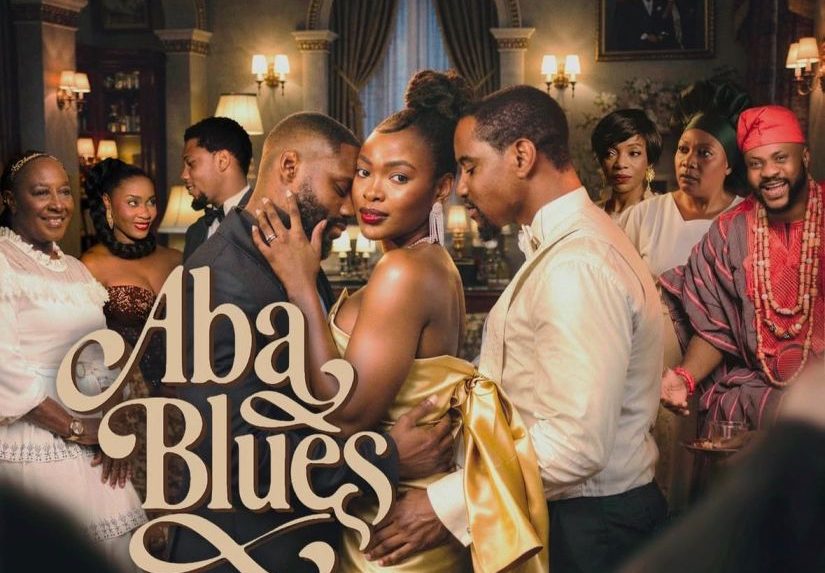

In Aba Blues, writer-director Jack’enneth Opukeme attempts to reach for morally grey complexities within a colourfully textured cultural world set in the titular Eastern Nigerian city of Aba.
By Vivian Nneka Nwajiaku
Few mainstream Nollywood directors ever bother with fashioning a truly distinct style for themselves. This, at the very least, makes Aba Blues (2026) an interesting watch. In Aba Blues, as in Farmer’s Bride (2024) before it, writer-director Jack’enneth Opukeme attempts to reach for morally grey complexities within a colourfully-textured cultural world, set this time in the titular Eastern Nigerian city of Aba in an uncertain time period.
The film stars Angel Anosike as Amara, a newlywed tailor who has to make a choice between Uzor (Prince Nelson Enwerem), the struggling but doting man she just married, and her first love, Dirim (Jide Kene Achufusi), who has just returned to Aba, hoping to reconcile years after abandoning her in a vulnerable state.
The choice seems obvious to Amara’s sassy best friend, Alero (Toni Tones), her religious fanatic mother (Eucharia Anunobi), and even her barely confident husband, Uzor. But for Amara, it opens old wounds that have never fully healed, raising questions about the conditions of love and triggering a complex and overwhelming tussle between old dreams and current reality, between unresolved connections and future paths.
It’s not the most inventive premise, but it is undeniably elevated by Opukeme’s standout style, one that is quite atypical in Nollywood. In Farmer’s Bride, but even more so in Aba Blues, Opukeme’s insistence on imperfect characters, especially with female characters, contrasts compellingly with his signature style—otherworldly, yet warm and pristine visual aesthetics.
And yet, this signature is still so far off from being sharpened to precision that what could be truly unconventional ends up fitting right into Nollywood convention, mirroring the industry’s obsession with style and aesthetics over narrative coherence or situational context. The film is burdened with dialogue that is so deliberately flowery and theatrical that even the actors can’t figure out how to deliver them. And despite the visually interesting production design, Aba Blues has no sense of place or time.
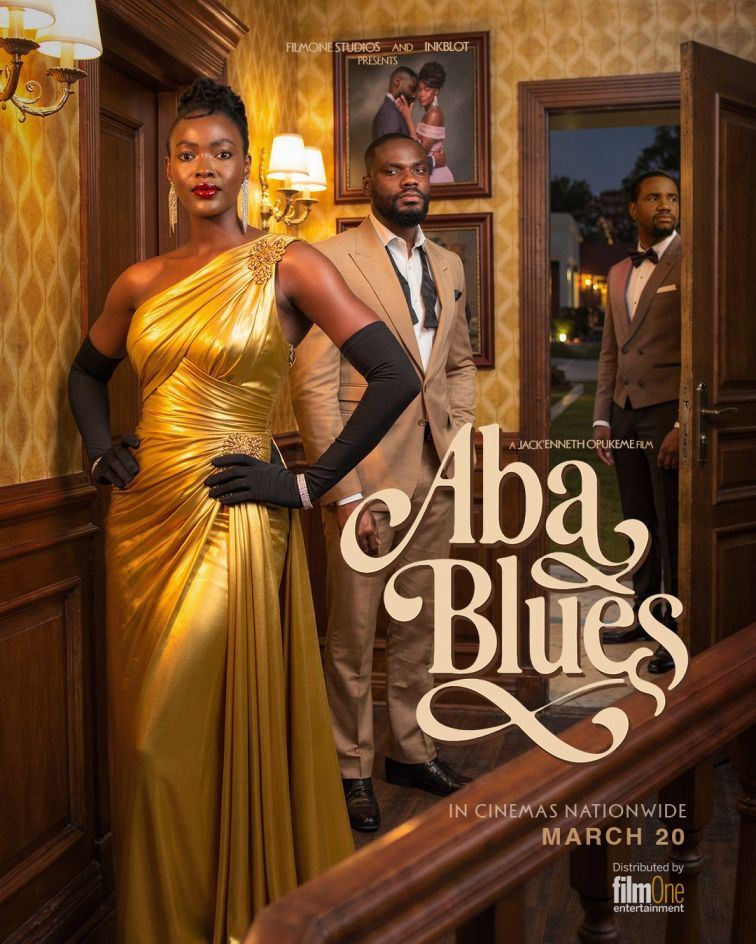
It’s merely the first quarter of the year, and Nollywood already has two period romance dramas without the language or environment of the period properly incorporated into the story. To attempt an extensive dive into this film’s struggles as a period piece would be to rehash points already made only about a month ago in my review of Kayode Kasum’s Valentine box office hit, Love and New Notes (2026). Suffice to say that if you took this film out of its supposed time period and placed it in contemporary times while retaining the director’s signature, not much would change beyond the version of naira notes brandished onscreen.
It is tempting to defend the lack of grounding in realism as understandable in a film with production that carries an otherworldly air. But that does not exactly succeed when the narrative itself is supposedly grounded in realism. Besides, that defence would bring Aba Blues within the realm of another Kasum film, Tarella: Princess of the Nile (2023). Tarella’s otherworldly vision did not succeed because there was no real worldbuilding. Aba Blues suffers a similar fate: there is no substantial worldbuilding to suggest an alternate reality.
Even worse, it would barely make a dent if this film were set somewhere that is not Aba, and it is somewhat curious that the film would be titled after a city that it only pays lip service to. At best, it offers culturally performative plot points with negligible impact on the plot. This, too, fits into familiar Nollywood tendencies, with Aba Blues joining a growing list of romance-centred films named after vibrant cities that are ultimately substantially absent from the films in ways that actually matter.
Lagos has been the usual suspect, from Jade Osiberu’s Christmas in Lagos (where Anosike played the love interest of the male lead) in 2024, to Chinaza Onuzo’s A Lagos Love Story (unsurprisingly cut from the same Inkblot cloth that produced Aba Blues) in 2025. The 2026 edition, at least, steps out of the Lagos bubble, even thematically—there’s a scene that plays on the Lagos versus Aba fashion design rivalry—but it proves even less interested in its setting than its predecessors.
Yet, Aba Blues is arguably a more pleasant romance drama than the others. At the minimum, it does feature romance. It may be corny, and one half of the triangle does not successfully get you to root for them, but it does not forget that its love-triangle lead characters are in a love triangle.
Sure, it helps that they are all already in love when we meet them, but it at least has that going for it. Plus, its female lead really is the complicated character that her creator imagines her to be. Pity that the film stumbles in exploring the complexities around the triangle, the people, and the relationships in the film.
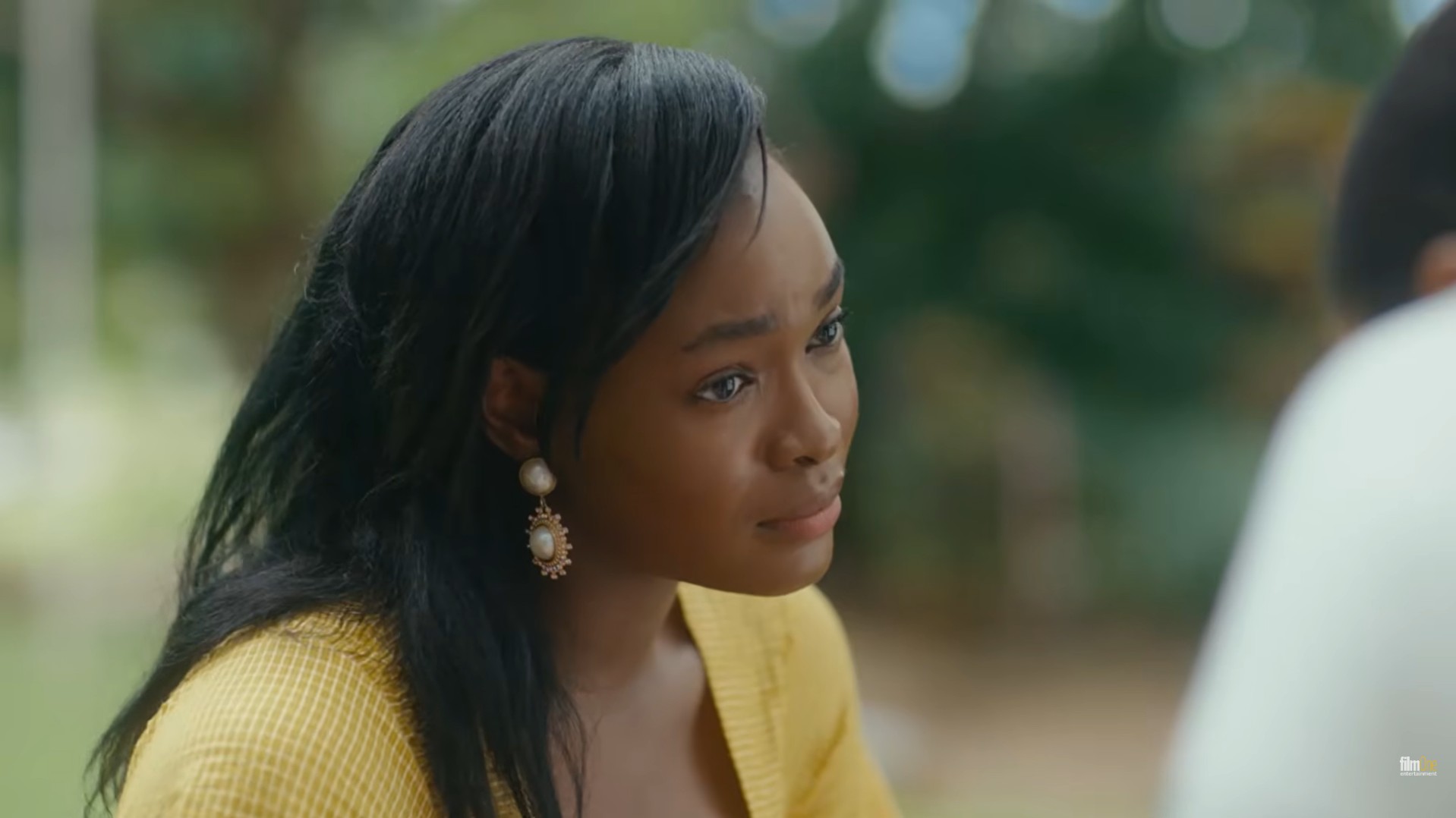
Aba Blues loses its grip on its characters’ arcs, resulting in strenuous manipulations by the screenplay that defy the path that the plot has been treading. It goes back to the Nollywood storytelling problem of an inability to keep the core of the story in sight while developing the characters and confronting the conflict.
When the moment of reckoning comes, and Amara finally has to make her choice, it lands without emotional honesty, like a decision imposed on her by the storyteller rather than one earned by the narrative. It delivers neither certainty nor finality, and the moral consequences of her decision are overshadowed by the nagging sense that it is not truly her decision.
Still, it’s near-impossible not to enjoy the messy, soapy ride that Aba Blues takes you on in its bid to reach that flawed resolution, even when the film attempts to reflect on fundamental questions of human behaviour and relationships. It is as hilarious as it is eyeroll-inducing when Amara and Dirim have that passionate confrontation that sounds like a wannabe cross between a Taylor Swift lyric and a Queen Charlotte scene. Or when Dirim’s mother (Bimbo Akintola) moves from a menacing “Leave my son alone!” to a cheery “Good chat!”
How can you not cackle when Amara’s caricature of a mother announces that darkness has a stench, right after a nerve-wracking fight that reveals deep-seated familial trauma? Or when Uzor argues with his best friend Lota (Chuks Joseph) over the politics of accents—which is an interesting conversation that almost seems like justification for the inconsistent and exaggerated accents in the film—just after Lota teases him with the sore truth that his wife chose him because Dirim, the man she wanted, was unavailable. Or every time Amara’s friend Alero has something scandalous to say about anybody.


Not even commentary on delicate social issues is handled with decided sensitivity. One domestic violence side plot involving a minor character ends in the conclusion that it is the woman, not the man, who is the prize, which somehow leads the film’s leading woman to a decision that is fundamentally opposed to the point the film seems interested in making with that forced and disturbing side plot.
There are not a lot of solid performances in Aba Blues, and to be fair, even more experienced actors might be limited by the material. The writing is too heavy-handed for Anosike’s best efforts at a measured delivery. Uzor’s inherent sympatheticness (and good looks) props up his character, and there’s a particularly sentimental scene where he painfully admits to Amara that she is breaking his heart, but Enwerem still has some skill honing to do in transitioning from media personality to actor. On Achufusi’s part, he can’t quite decide what persona to stick with, but how could he? The screenplay isn’t sure, either.
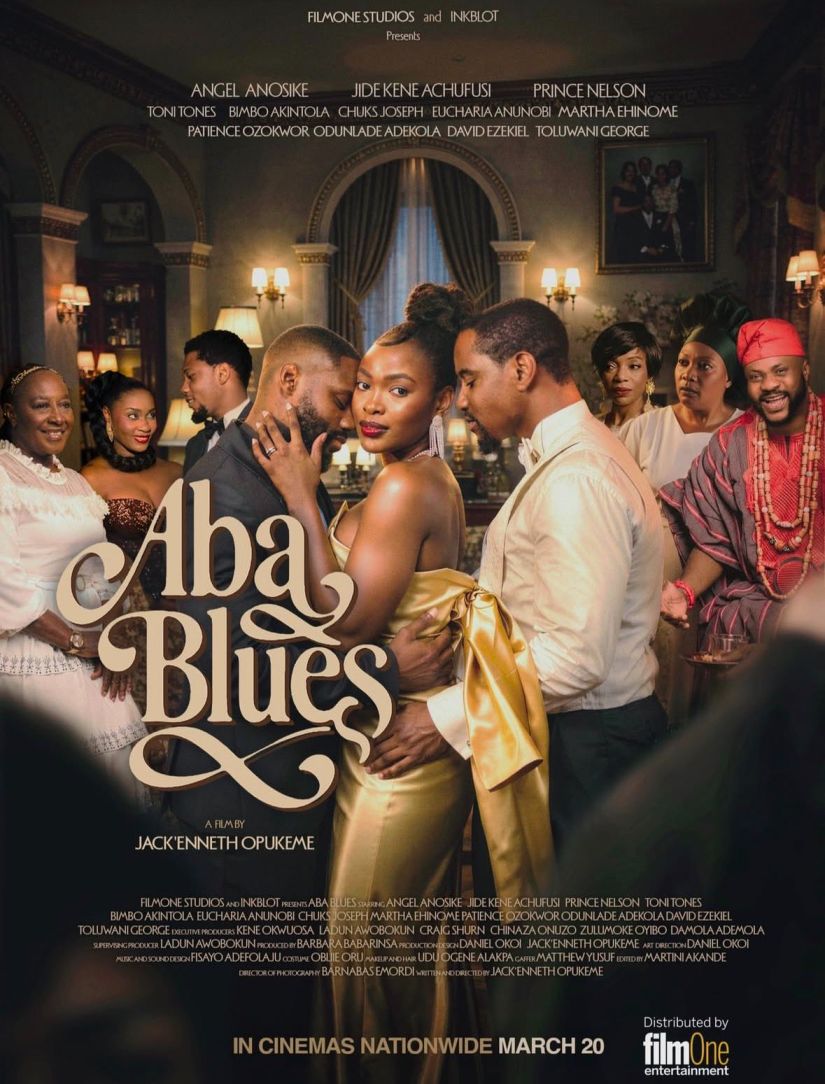
Other than Anunobi, who overperforms an already overwritten character, the supporting cast has a better lot. Tones and Joseph are enjoyable, and it is such a pleasure to see the talented David Ezekiel on the big screen, although in a minor role as Mezu, Amara’s apprentice, who faces mockery for learning tailoring as a man. It is indeed a loss that Mezu and the other supporting characters don’t get the benefit of a deeper dive; they are sometimes more interesting than the back-and-forth exploration of the love triangle that ultimately arrives at a manipulated resolution.
Opukeme has produced more work as a writer, from the more popular Battle on Buka Street (2022) and Adire (2023) to lesser-known movies like Onyeegwu (2023) and All’s Fair in Love (2024). But it’d be interesting to see more from him as a writer-director, to see how he refines the style he established with Farmer’s Bride and Aba Blues, one that distinguishes his work from that of his peers.
Perhaps, he will swap out the time and place obscurity for a more precise setting while retaining the alternate-world texture that both complements the colourfulness of his characters and contrasts with their imperfections. Bonus points if the plotting and character development are done with more prowess.
Rating: 2.3/5
*Aba Blues premiered in Nigerian cinemas on 20th March 2026.
Vivian Nneka Nwajiaku is a writer and film critic writing from Lagos. She has a master’s degree in law but spends most of her time consuming, studying and discussing film and TV. She’s particularly concerned about what art has to say about society’s relationship with women. Connect with her on X @Nneka_Viv