

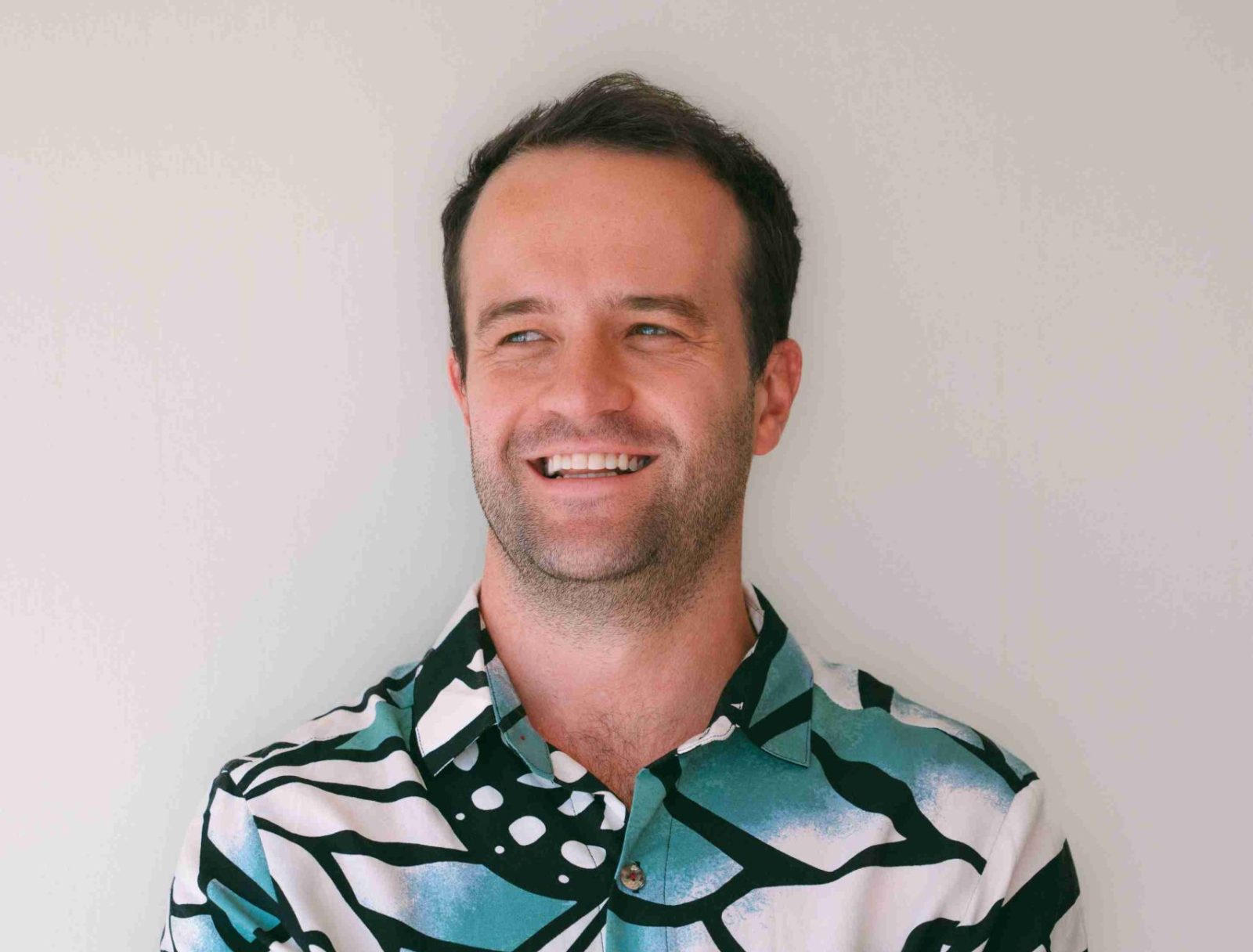

“I believe that we are shaped by our circumstances, but I also believe that we are responsible for our circumstances. So, in a way, I think social critique and empathy can only be balanced if a narrative is propelled by characters who are both victims and perpetrators.” — Dian Weys
By Vivian Nneka Nwajiaku
Capitalism remains a major preoccupation of global cinema, serving as a bottomless well of critical stories about the exploitation of the vulnerable, the entrenchment of unhealthy competition, and the ever-widening gap between the rich and the poor.
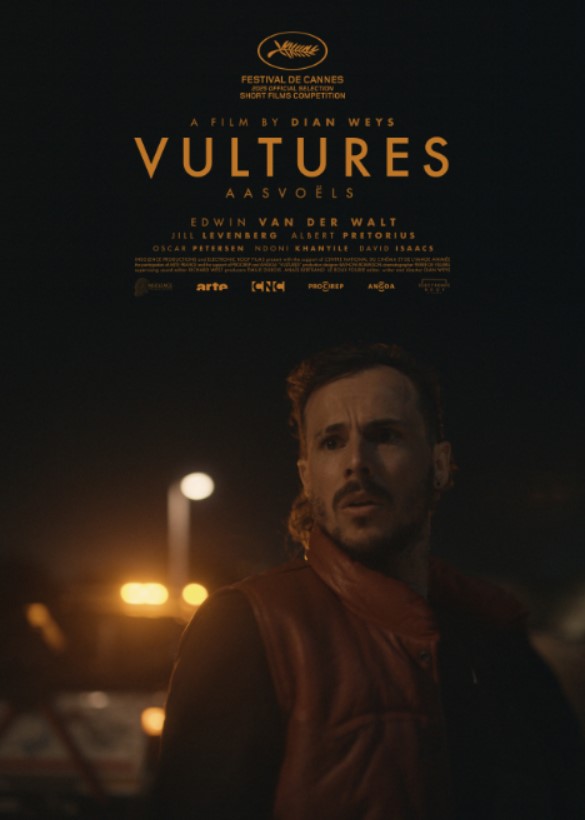
Joining that canon is the aptly titled short film Vultures, a South Africa-France co-production that premiered in competition at the 2025 Cannes Film Festival, where it won the Unifrance Short Film Grand Prix. The film went on to win the Jury Prizes for Best Film and Best Cinematography at the 2025 Bucharest Short Film Festival, as well as the Jury Award for Best Short Film at the 2025 Philadelphia Film Festival, and has continued its festival run into 2026, with notable screenings at the Clermont-Ferrand International Short Film Festival and the recently concluded Tribeca Festival.
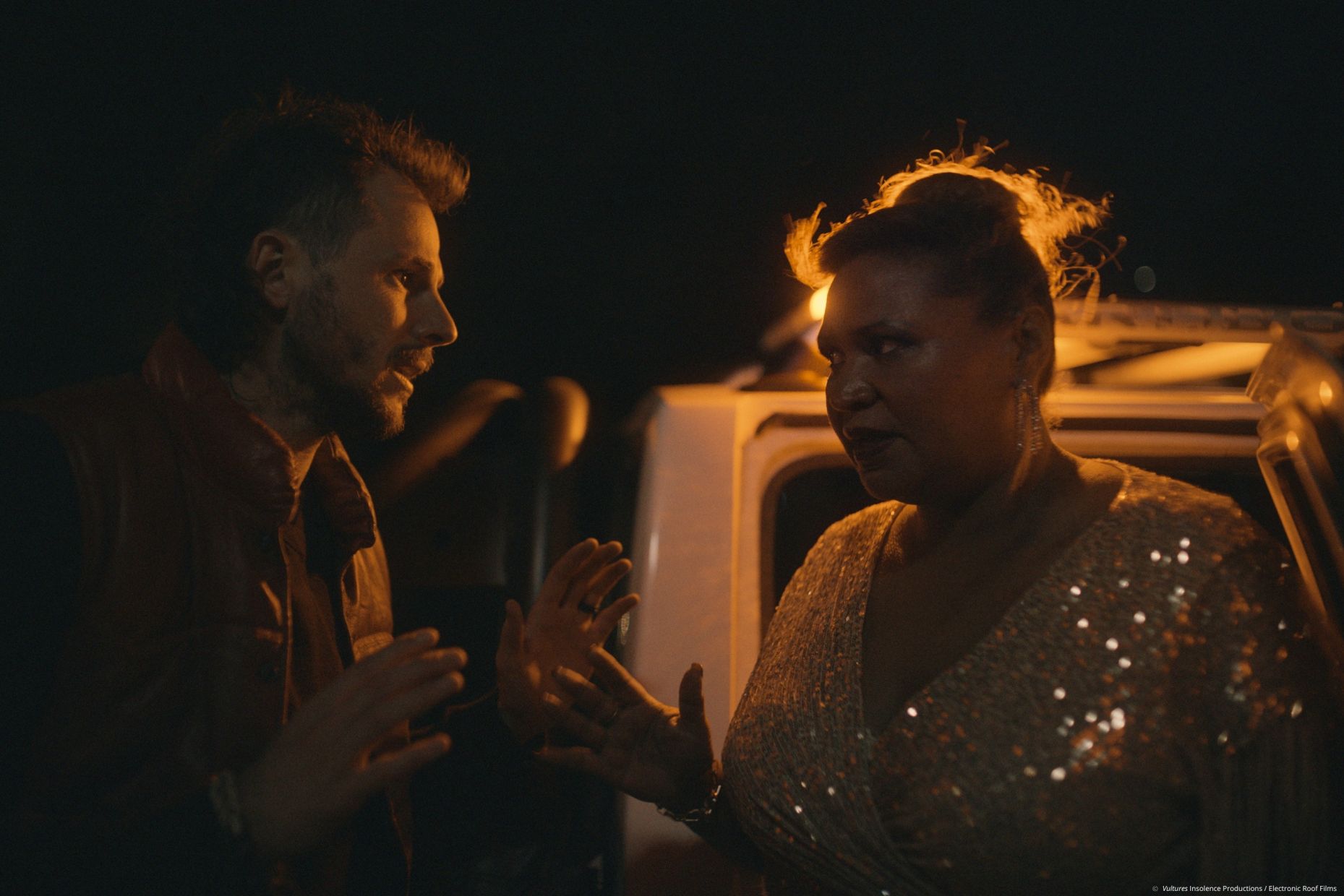
Written and directed by South African filmmaker Dian Weys (Versnel (2017); Bergie (2022)), Vultures follows a hot-headed tow truck driver (played by Edwin van der Walt) during the volatile aftermath of a fatal car crash as the situation spirals out of control. Through a profession that provides an essential service but is commonly associated with ambulance-chasing, Weys explores the predatory tendencies that emerge within capitalist systems and the moral dilemmas they create.
Films that critique capitalism often rely on allegory or metaphor, but Vultures is strikingly literal in its depiction of exploitation, competition, and territorialism. Yet, its characters and events are also a microcosm of much larger societal and economic issues. And though the title seems to invite an immediate moral judgment, Weys presents the characters as people who are driven by desperation, make questionable decisions because of their economic and social realities, and struggle with the choices they feel compelled to make.
Vultures tells a story that is very contained in scope. But the film is also contained in the sense that it is remarkably restrained and controlled while maintaining a strong sense of tension. Under Weys’ direction, the cinematography by Pierre de Villiers deftly captures the urgency and frenetic energy of the crash aftermath, with framing, camera movements, and the choreography of the performances all contributing to a taut and immersive but uneasy atmosphere.
In this exclusive interview with Afrocritik, Dian Weys discusses Vultures, reflecting on capitalism, moral responsibility in the aftermath of violence, his approach to making audiences feel like witnesses, and the progress of his upcoming feature.
Vultures has enjoyed success on the international festival circuit, from Cannes to Tribeca. What has that success and recognition meant to you, both personally and professionally?
Vultures’ selection in Cannes has completely changed my life, both personally and professionally. With the support of my wonderful producers, Anaïs Bertrand, Emilie Dubois, and Le Roux Fourie, the success of this film has enabled me to continue writing and making films, which I think is what every filmmaker wants!
As the writer-director, was the story inspired by a specific incident you witnessed or learned about? What sparked the idea for the film?
I’m very interested in stories that take place after violence and focus on the actions and responsibilities of those involved in its aftermath. So, while I wanted to explore the dynamics after a car accident, the short film is also inspired by what I’ve witnessed myself. I’ve been in two car accidents and in both cases tow-truck drivers appeared out of nowhere and vied for my patronage.
Even though this sounds predatory, we have to keep in mind that South Africa has a 33% unemployment rate. As such, a lot of people are forced to find alternative ways to make a living and care for their families. Together with the fact that we have one of the highest motor vehicle accident rates in the world, it is thus very common to see tow-truck drivers waiting next to South African roads and highways.
Tow truck drivers also occupy quite a complicated space, because even though their livelihood depends on the misfortune of others, they are usually the first to offer assistance at truly horrifying scenes; they dispatch ambulances, inform law enforcement, keep the area safe, and, most importantly, assist and support the victims. For example, one of the tow-truck drivers I spoke to told me how he once arrived just in time to pull a child from a burning vehicle. The job therefore requires a certain fearlessness and resilience.
Why was it important for you to approach the film’s themes in such a grounded and direct way?
I think that in many privileged societies, the dehumanisation of cannibal capitalism requires metaphor, because its effects are not always visible or obvious. But in third-world countries, the consequences are often very literal and direct.
Everything in Vultures is based on research, interviews and my post-accident experiences. I also went on ride-alongs with tow truck drivers. It was thus important for me to simply describe how these situations play out. In doing so, however, the film became a metaphor for how most of us are encouraged to live in our free-market economies, that is, to compete and to transact. One’s need becomes another’s gain.
To what extent did you intend it as a commentary on contemporary South African society and broader global societies in general?
At the start of the writing process, I considered the scene of the car accident as a metaphor for post-Apartheid South Africa. The national government has seriously failed our people, corruption has had a devastating effect, and the divide between the rich minority and poor majority has deepened immensely. So, like the characters in the short film, most South Africans are simply trying to survive. But I think this speaks to our global, neo-liberal societies as well. Our relationships are becoming increasingly transactional, and we are constantly competing for scarce resources.
How do you balance social critique with empathy for characters whose choices are shaped by their circumstances and the need for survival?
I think most people have experienced the difficulty of being economically vulnerable—it is a major driving force in the world today. Yet, if we are honest, we can also detect within ourselves a drive for self-preservation. So, even though the short film describes an extreme situation, I think anyone in a similar position would be tempted to make the same questionable choices.
But I think your question raises a deeper point about lived experience. I believe that we are shaped by our circumstances, but I also believe that we are responsible for our circumstances. So, in a way, I think social critique and empathy can only be balanced if a narrative is propelled by characters who are both victims and perpetrators. Because then it becomes a question of implication. How are you going to act? What is your response to all of this? And while it makes for quite uncomfortable viewing, I think it’s closer to our experience than the “either/or” dichotomy that characterises most political discourse.

Why, then, did you choose such a definitive title instead of one that leaves more room for ambiguity?
In South Africa, “Vultures” is a well-known nickname for tow truck drivers. Yet, the reality of the job is much more complicated than merely swooping down and snatching leftover scraps. The characters’ actions complicate the title, and it thereby becomes a question for the audience. And I don’t think the title only applies to the tow truck drivers!
What were the key creative and technical decisions that helped you achieve the film’s tense and immersive effect?
I place certain restrictions on my filmmaking style. The film must be set in real time; it must be shot in a series of long takes; the camera must try to keep up with the main character; and the sound design must encourage the audience’s imagination. My aim with these restrictions is to make the audience feel like witnesses.
Many films give us the idea that the world can be perceived and experienced from countless angles and across various timespans. I reject this generic point-of-view. Witnesses are bound to their bodies; we experience the world from a position limited in time and space. To be a witness is therefore very different from being a spectator, an observer, or even a voyeur, because you are called to a response; that is, to testify, to take responsibility, to reconsider your place in the world.
What conversations are you hoping the film sparks about these kinds of professions and about the way society responds to moments of crisis and vulnerability?
I hope the audience will interrogate the type of society that transforms first-response vocations into profit-driven professions. It doesn’t just happen in a vacuum. Why do we regard profit and gain above service and self-sacrifice? I think, to truly respond to the needs of others, we need to be willing to put ourselves on the line.
You’re currently working towards your debut feature, Bergies, which you developed as part of the Pop Up Film Residency Focus CoPro 2025. How is the project progressing, and are there thematic or stylistic connections between the upcoming feature and Vultures?
Progress is slow, but sure! I was lucky to have been selected for La Résidence du Festival de Cannes to continue working on the project. The name has since changed to Bastion, and it tells the story of a law enforcement officer who has to lead the court-ordered eviction of fifty unhoused people living in tents next to Cape Town’s old colonial castle. With this film, I also want to give the audience the experience of witnessing, so the film will again be set in real time, will be shot in a similar style, and will deal with the same themes as Vultures.
Vivian Nneka Nwajiaku is a writer, film critic, TV lover, and occasional storyteller writing from Lagos. She has a master’s degree in law but spends most of her time watching, reading about and discussing films and TV shows. She’s particularly concerned about what art has to say about society’s relationship with women. Connect with her on X @Nneka_V