


As an adaptation, The Man Died works because it appropriately combines references and contexts from Soyinka’s work with the requirements of cinematic storytelling.
By Adedamola Jones Adedayo
In 1967, during the early months of the Nigerian Civil War, Nobel Laureate, Wole Soyinka, was arrested and imprisoned by the Federal Military Government under General Yakubu Gowon. At the time, Soyinka was already gaining momentum as an internationally recognised poet and playwright, with titles such as The Lion and the Jewel (1963), A Dance of the Forests (1963) and The Trials of Brother Jero (1963) to his name.
Attempting to salvage a country on the brink of full-scale hostilities, Soyinka secretly visited the leader of the seceding faction, Lieutenant Colonel Chukwuemeka Odumegwu Ojukwu, in Enugu. When he returned from Biafra, he learnt that the Federal Government was searching for him and went into hiding.
He was subsequently captured and detained without proper trial for more than two years, including several months in solitary confinement in Kaduna Prison. His prison experiences form the basis of The Man Died, a memoir Soyinka wrote and published in 1972. A literary and political testimony set against the backdrop of Nigeria’s early post-independence troubles, Soyinka’s work combines personal experience with a critical evaluation of the nexus between politics and the human condition in his society.
Five decades later, this memoir is the source material for Awam Amkpa’s film adaptation of the same title. Stoic, direct, and visually refreshing, with a cut-to-the-chase sensibility, Amkpa’s The Man Died (2024) re-animates Soyinka’s prison saga with feature-length precision.
Produced by Femi Odugbemi under the aegis of Zuri24 Media Limited, the historical drama film stars Wale Ojo as Wole Soyinka, the celebrated literary figure whose interference in the escalating crisis and advocacy for peace put him at loggerheads with the authorities, leading to his unlawful detention.
Following its 2024 premiere in Lagos, the film has embarked on a global screening circuit, showing at local festivals such as the Africa International Film Festival (AFRIFF) and the 2025 Zuma International Film Festival (ZIFF), as well as international festivals including the Pan African Film Festival (PAFF), before its recent release on Prime Video this year.
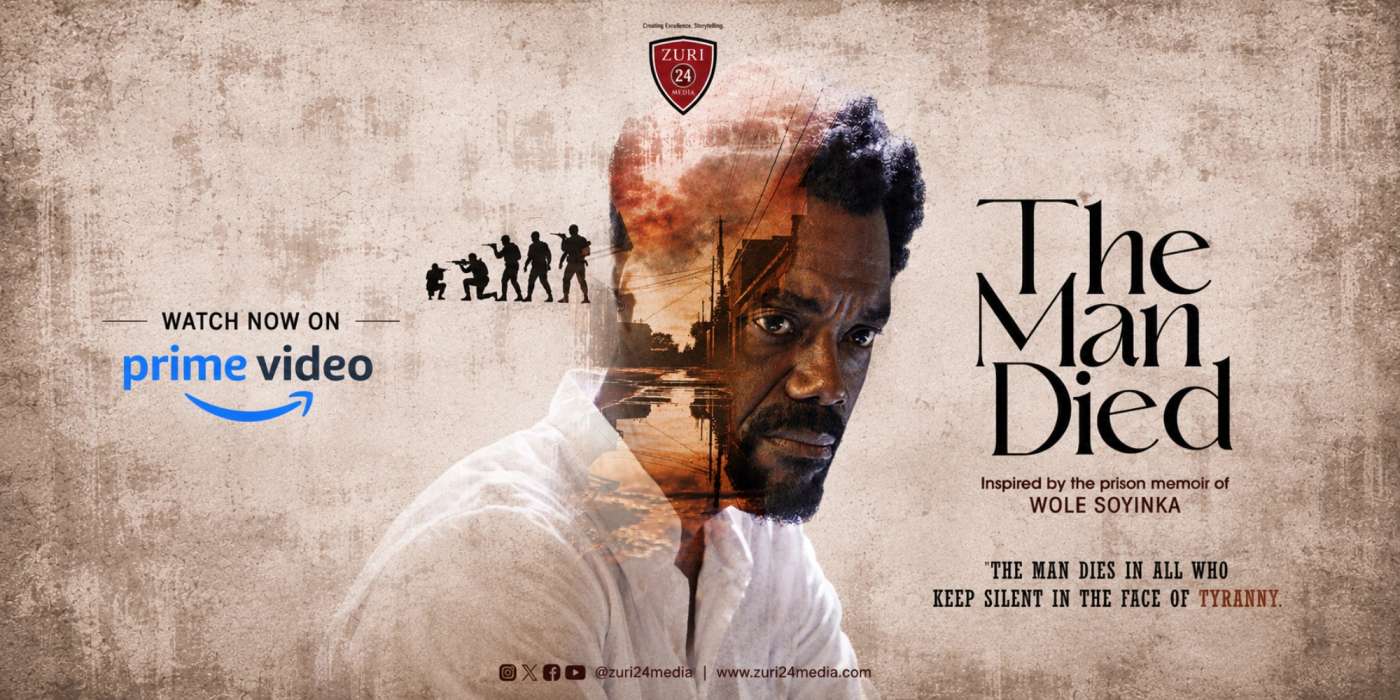
The Man Died focuses on its protagonist’s sociopolitical and psychological struggles, exploring his quest to preserve his intellectual freedom and humanity while confronting state-sponsored suppression and the politics of war. Devoted to the book’s philosophical and political atmosphere, Amkpa’s adaptation moves away from the front lines to show what happens behind the scenes, particularly among political actors and activists during an outbreak of war.
Soyinka, here, is the centre of attention. He occupies the nucleus of the narrative, functioning as the strong-willed protagonist. He endangers his life as he is said to spearhead a movement committed to ensuring that the war does not continue, a movement we never really see take shape on screen. He refuses to yield to the intimidation and threats of liquidation employed by the state through henchmen like Yisa, played by Sam Dede.
In depicting the protagonist, Wale Ojo pays homage to the literary juggernaut himself, who would go on to become the first African recipient of the Nobel Prize in Literature in 1986. The actor approaches the character with measured intensity, firmness of thought, contemplativeness, eloquence and quiet charisma. There is also an attempt to infuse the character with a playful, romantic charm, particularly through his flirtations with his sweetheart, Laide (Christina Oshunniyi), though this is largely subdued by the character’s overriding intellectualisation.
With film adaptations, there is the fundamental concern of freedom, arising from the question of how much is allowable in the adoption and transference of ideas from the source text to the new, cinematic form. The tendency for flexibility with adaptations comes from the belief that structural differences exist in the very nature of a film and the written text from which it is adapted.
Such an understanding informs how Amkpa’s The Man Died approaches Soyinka’s memoir, with the filmmaker having to leave out chunks of the textual material or re-order the plot for clarity and precision on screen. Amkpa omits much of the philosophical overflow and the random, personalised outpourings documented in Soyinka’s book, while keeping the characters compact and easily identifiable.
For instance, while the film features only a character named Yisa, it merges two separate figures from the memoir, Yisa Adejo and Mallam D., into a single character, combining Yisa Adejo’s authority and brutality with Mallam D.’s role as Soyinka’s interrogator. The conversation with the terrifying-looking questioner takes a less profound direction in the film than it does in the memoir.

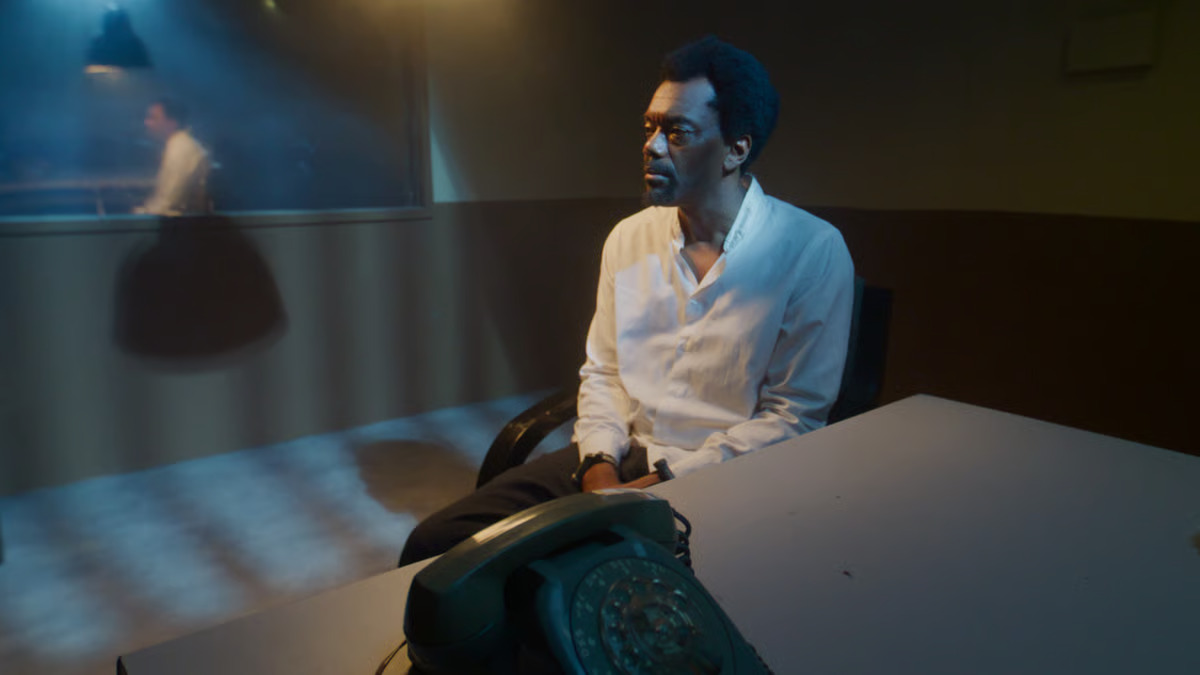
Film adaptations can deny audiences the pleasure of experiencing the unfiltered and unadulterated originality preserved in the source text. However, this inherent limitation is often compensated for by the visual possibilities of cinema, including cinematography, lighting, production design, costume design and visual effects, which make the work more sensually engaging, regardless of whatever compromises may have been made to the original work.
Amkpa’s film is set in 1967, with scenes capturing both Western and Eastern Nigeria, as well as costume and production design tailored to reflect the lifestyle and social realities of the period. Occasionally, the film employs flashbacks to solidify its bandwidth, including one set two years earlier, when Soyinka intervenes in a radio broadcast calling on Ladoke Akintola, the newly elected Premier of the Western Region, to forfeit office amidst the region’s electoral crisis.
As an adaptation, The Man Died works because it appropriately combines references and contexts from Soyinka’s work with the requirements of cinematic storytelling, translating its introspective and literary qualities into a visual narrative grounded in the historical and political realities that shaped the author’s experience.
The screenplay, credited to Bode Asiyanbi, often relies on acrolectal English, emulating the book’s elite conversational and narrative atmosphere. Yet, this is done with restraint, ensuring that the film does not reproduce the full extent of the ornate imagery and elaborate language of its source material. Prioritising inventiveness over blind, obsequious textual faithfulness, the adaptation distils Soyinka’s dense prose into accessible dialogue in a way that both preserves the thematic spirit of the text and equips the film with an identity of its own.
Dramatising events surrounding the persecution of one of Africa’s most important literary figures, The Man Died comes off as a visual translation that validates the purport of the 1972 book and further immortalises Soyinka’s enduring resistance to political repression and intellectual convictions. In the same breath, the film positions itself as a reminder of the power of cinema as a tool for concretising literature, corroborating history and preserving legacy.
Adedamola Jones Adedayo is a film journalist and critic with special interest in African cinema. Through writing and audiovisual mediums, he creates conversations around cinema in Africa and the Diaspora. You can find him on Instagram @jonesthegoodboy and X on AdedamolaAdeda4.