


Book influencers have ushered in a new age of reading, and their arrival is certainly not peculiar to the Nigerian market. Globally, they have changed how marketing happens in literature.
By Azubuike Obi
In recent years, it has become common practice for readers to not only track their reading habits, but to make end-of-year posts on social media to celebrate having reached their goals, or groan about the year being more hectic than they had hoped and falling off. I have come to look forward to them, these year-end pronouncements of I read 50 books! I read 100 books!—to compare my notes and take down new recommendations. But why do we do this? Could it be that we have become more concerned with quantifying experiences, with being seen as partakers of experiences, instead of simply being livers and inhabitants of those experiences?
I first came across one of such pronouncements in 2022. I had been thumbing through George Orwell’s 1984 (1949) for the last three months, consuming so much Twitter that I only returned to Orwell’s dystopian world silken in guilt. The post was from a young woman, Ezioma Kalu, sitting at a small table heaped with books, a luminous smile stretched across her face, grandly announcing that she had 100 books that year.
In the years that followed, this genre of posts has become a staple on social media, most of them coming from young people who have built and carved out a niche for themselves as “book influencers”.
The Curious Arrival of Book Influencers
Book influencers are readers who, in one way or another, found themselves sharing their current reads and offering tailored recommendations on social media. In Nigeria, most of them kicked off in 2020, when COVID-19 cleaved the world into small isolated corners and human beings took to digital spaces to seek new forms of community and intimacy. Uchenna Nnabugwu, otherwise known as “favouriteIgboboy”, who has a combined following of 11,000 and has been sharing book-related content since 2018, told me that “COVID led to an influx of people in the space”. They quickly gained currency; followers sought their recommendations, and authors, a great many of them independently published, sent out books to them, hunting for the eyeballs a feature could get them.
For many of these influencers, this became an alternative career path, though most of them continued to hold full-time jobs: Nnabugwu currently holds two; Zainab Sidiq, who goes by “SacchieReads” on her socials, doubles as a data analyst; Kalu herself is an associate producer at a media firm. In countries where book influencers have better-defined influence and significant market stake, the niche has indeed become its own full-time job, with influencers going on sponsored brand trips and featuring in promotions for luxury brands. In Nigeria, however, the business operates informally, thriving on networks of trust and a shared love for stories.
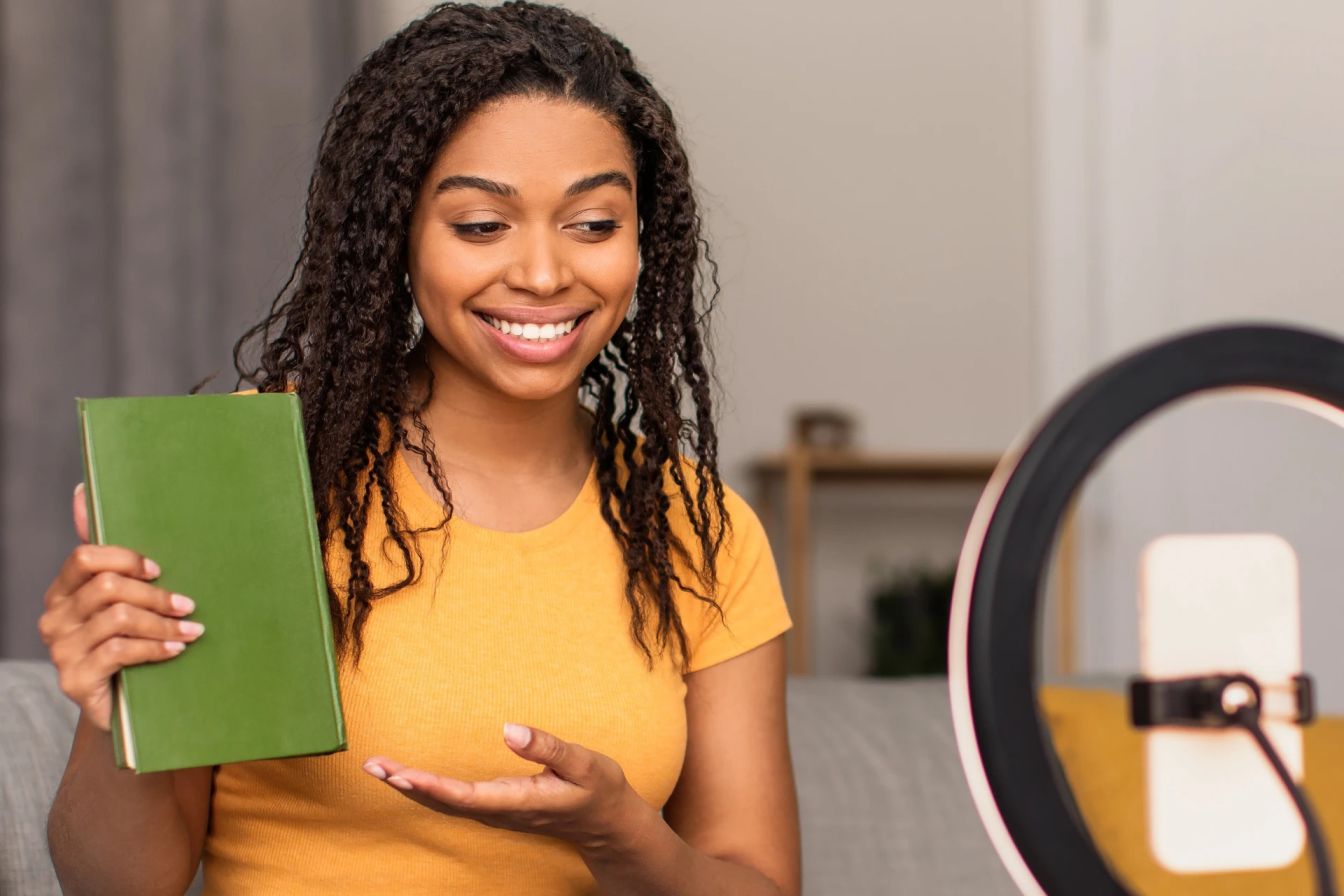
As aforementioned, it was self-published authors who first sought after book influencers, but today, in a time when newspapers are cutting back on weekly book columns and home-based prizes have all but dried up, one could argue that the majority of marketing in Nigerian literature, particularly that of home-based publishers, rests on the back of these influencers. Take, for example, Fatima Bala’s breakout novel Broken (2023), which became something of a sensation after it was republished by Masobe Books. It is true the novel’s exploration of the tension between love and cultural obligations resonated with many, but before it reached those hands, it had to be ordained by the voices of BookTok. Creator Ikegod Chielo’s video on the novel raked in about 200,000 views on Instagram and TikTok and by the end of the year, Bala’s novel ranked seventh on the Rovingheights bestseller list, moving up to third in 2025. Bala is still riding that remarkable wave, and her new collection is certain to make the list by year-end.
What this means is that in a world of depleted attention spans and preference for short-form video content, influencers have managed to leverage that to expand the reading public. In Nigeria, their followership has grown, and their influence has become perceptible. Hence, money has entered the conversation—influencers have come to an understanding of the power they wield, with some charging as high as 40,000 naira per novel for a multi-platform review.
Things are changing. And fast. If formerly, influencers were happy to simply receive free copies, now they have become selective with the gigs they take on, choosing only books they are likely to enjoy and using a rate card to limit the number of people they work with. “There are so many good books out there, and a price tag will reduce or filter the number of books I get,” Nnabugwu told me, explaining the need for payment with the labour of the technicalities of content creation: “People make it look like ‘oh, is it not just to put your camera?’ But I bet you it is not just to put your camera… There’s a whole lot of transition, there’s a whole lot of changing clothes. There are different things involved in it”. Sacchie, who has a combined following of 4,000, echoed his thoughts during our call: “Content creation as a whole is a very hard thing… For the book community, it is even harder. For a video book review, I have to spend hours, if not days, reading a book, and then I have to fit all my emotions and feelings into a video that is not too long”. With the added challenges creating in Nigeria presents, it can all be rather daunting.
The necessity of payment has, however, presented a peculiar challenge: how do influencers remain true to the work they do while being beholden to their masters? In my conversation with book influencers, it was clear that this is still new terrain, so they avoid the problem entirely by issuing refunds when they learn that a book is so bad they don’t have any angle from which they can speak or recommend it to their audience; other times, when they have serviceable books, they creatively capitalise on their strengths in their videos. Trust is fragile, and in the world of book influencing, it is paramount.
The New Age of Reading
Book influencers have ushered in a new age of reading, and their arrival is certainly not peculiar to the Nigerian market. Globally, they have changed how marketing happens in literature. “Since around 2020, the literary precinct of the social-media platform TikTok seems to have usurped older marketing and publicity strategies as a primary driver of sales,” writes the New Yorker critic Katy Waldman. Word-of-mouth remains one of the most successful ways of marketing; when it then comes from trusted lips with thousands of convertible followers: gold. “They offer a human-based, quasi-critical recommendation portal for fans and genre devotees to connect, commiserate, and promote their favo[u]rite work,” the writer Brady Brickner-Wood explains why videos from book influencers have become a powerful and efficient marketing technique in his essay, “The Rise of the As Seen on TikTok Sticker”
Take the success of these novels for better illustration of the power of BookTok: I Who Have Never Known Men (1995), from the Belgian writer Jacqueline Harpman, found a new life, thanks to BookTok, and sold over 800,000 copies in North America. In 2023, Rebecca Yarros’s Fourth Wing became a runaway success because the hands of influencers on BookTok deemed it worthy—it sat on the New York Times bestseller list for 18 weeks, selling over 3 million copies worldwide. A sequel followed soon after, capitalising on the success of the first novel and moving over 500,000 copies on its publication day. A third novel has since followed, and a TV show has been optioned—offshoots of a singular BookTok success.
In Nigeria, however, the data is harder to track as much of what goes on in Nigerian publishing is kept within the ledgers of publishers and their partner bookstores. Nonetheless, the impact of these creators is felt: Rosemary Okafor has become one of the most recognisable names in Nigerian indie publishing. Adesuwa O’man Nwokedi, another romance author and BookTok favourite, who is popular for offering free e-copies of her novels via a newsletter, landed five of her novels on the RovingHeights bestseller list in 2025.
It may seem as though literary fiction, the genre that houses what is regarded as serious writing worldwide, suffers as what we encounter in the colourful, vibrant talking head videos on Bookstagram and BookTok are works of genre fiction such as romance, thrillers and crime fiction, but it is important to note that literary fiction has only ever performed well amongst a subset of readers. Many adults who read for pleasure and have no literary or academic background often tilt towards non-fiction, genre and popular fiction—what influencers promote is only a reflection of the consumption pattern of their audience. “Nigerians are very interesting people in terms of the content they consume”, Nnabugwu noted. “The only way to get attention [in an oversaturated market] is when you use eye-catching and [provocative] titles… The literary culture is a struggling scene. And these types of titles drive more readers”.
Literary critic Akumbu Uche told me during our call that the heavy promotion of genre fiction and the entire literary influencing culture can be understood as a form of “pushback” against the literary establishment and publishing industry. “Originally, a lot of the people who used to publish literary fiction in Nigeria tended to publish people who were already known and celebrated abroad… And then they [the publishers] were more traditional-leaning: they’d send books to newspapers to review these books, to have these conversations with them. However, the people who started patronising or encouraging the book influencers tended to be the independent publishers—the authors who are self-published”.
In addition, a number of the audience who pay attention to book influencers are people who are trying to get back into reading, who are looking to escape reality, to be thrilled and to fuel their own delusions in an increasingly inhospitable country. For these readers, genre fiction, with its fluffy, sweeping romantic characters, its predictable tropes, its outlandish plotlines, its heart-racing thrill, is one of the reasons they come to books as adults. “These are books that people love, books that people don’t feel ‘oh, I need to have gone to school to decode this, I don’t need to have an MFA to appreciate what this person is writing,” Uche told me. “ This is not to say that literary fiction discriminates among readers, but there is that perception”.
To reflect this, there has been an explosion of acquisitions and publications of popular and genre fiction, particularly romance, from publishers like Masobe Books. In the past year, we have witnessed titles such as British Natasha and the Ashawo Doctor (2026), Lagos Sugar Baby (2026), and the forthcoming Sin and Salvation (2027). Even authors who were previously self-publishing have been snagged up by publishers like TBLNG Press and Masobe Books who are eager to tap into the market. Some of these authors include Okafor and O’man Nwokedi.
Although the data from OCMxRovingHeights lists show that Nigerians are still reading literary fiction, that space still exists for people who are looking for “serious fiction”, there is something to be said for what these recent publications say about our literary health as a people. Is there a cause for alarm? How much romance, some of them teetering on explicit pornography, can we consume?
Last year, a young woman announced that she had read 120 books, with a picture of her standing close to her pile, triumph plastered on her face. A quick zoom of the picture showed that many of the titles contained heavily pornographic material. The judgement did not take long to arrive: of course she read over 100 books. It is all porn, after all. Many defended her: why would anyone judge the other’s reading choice? In a time of dwindling attention spans, is it not enough that one is simply reading?
“This person is celebrating their love of reading. They are not claiming to be a literary scholar or an academic”, Uche told me. “They are just saying I read X number of books, and these are the books I read. And those are the books they read. So one may differ from them on a matter of taste and on a matter of interest, but so far as submitting a list of the books they read goes, that is accurate”.

The writer and editor Chinonso Nzeh adds that, “Reading SMUT is progress, because I think that reading of any kind is important. But I also think that it is important that we do not stop there; rather, it should be a stepping stone towards reading that is not merely a gratification of self”.
That day in 2022, I wondered if one woman could complete 100 books in a single year; how could I, who had been a promising student of literature, who, in Onitsha in the early 2010s, used up snack money to buy two-in-one story books and copies of what is now known as Onitsha market literature, continue to waddle through one in the last three months?
The answer hovered before me. I did not acknowledge it or speak of it, for doing so would be agreeing that I had spent most of the year ceaselessly scrolling through the void, caught up by an algorithm designed to keep me in the loop. That windy December, I drank up Orwell, terrified that my life would not assume meaning if I did not return to reading. It became a resolution for the coming year. And I have not stopped reading.
Has Reading Become a Performance?
Yes, Kalu’s post brought me back to reading, but does it answer why readers keep and publicise these numbers? The critic Akumbu Uche, who maintains a consistent yearly list, told me her act of record-keeping started as a way to celebrate her joy of reading after rediscovering it. I keep one for self-serving reasons: to pat myself on the back and to take note of any slacking, and as I have discovered over time, to note my interests and habits. In addition, I make judgments of my months or years by the number of books read. For example, in June, I read 11 books because I was taking care of a sick relative in the hospital and had some free time; in September, I read four because I was juggling two jobs; on average, in regular months, like in March or July, I read eight books. This list and the data it provides enable me to understand myself and my time in ways only a personal journal can approximate.
Readers publicise these numbers for a cocktail of reasons: performance, dopamine, virtue-signalling, and good old encouragement for readers and non-readers alike. In a 2025 essay, Brady Brickner-Wood offers: “Performative reading has emerged as a suspicious activity not because reading books is suspect but because being beheld reading a book is understood to be yet another way for one to market himself, to portray to the world that he is indeed deeper and more expansive”.
In conjunction, we are a generation obsessed with numbers and what they say about us. We celebrate social media followers as though they were real and not 1,000 strangers with unprecedented access to our thoughts and lives. We celebrate 10,000 likes because if that many hands tap at the like button, then surely we are doing something right. For content creators, it has become a source of righteous anger when posts don’t “perform well”—that is, when not-enough eyeballs are on parts of the interior makeup of their lives. Authenticity has become a selling point. Creators are called brave and rewarded with engagement when they share otherwise intimate parts of themselves with an audience that, like scavengers, is always ready to take.
Readers, too, have carved a niche out for themselves in the creator economy. With the emergence of BookTok and Bookstagram, readers want to keep their audience abreast of what is happening in their reading lives, to show the audience they have garnered just how seriously they take this hobby. Nzeh thinks it is “a form of braggadocio,” the act of publishing lists. Nonetheless, he queries, if people can brag about a job, about money, about many other frivolous and responsible things, then why not about reading? Nnabugwu, who read 147 books in 2024 and 180 in 2025, shares the same sentiment, adding that he finds it“encouraging that there are people who still read”.
Aside from the dopamine hit of adding one more number to a growing list, readers too want to celebrate, to signal just how much they are reading, how much better they are spending their time. This is a virtuous undertaking in many ways, but virtuous for whom? Whatever does finishing 80 books do for world hunger or poverty? Has the price of garri changed because of your reading?
But reading was never meant to change the world; its function has always been to change the reader’s world. To challenge their assumptions about the world, to reinforce and to give language to positions they already hold, to expand their minds and their perceptions of the world. To see that their struggles are not so esoteric. “Literature is an education of the heart”, Nzeh told me during our call, his voice shimmering with a kind of bursting joy. “We read to enlarge our hearts and our imaginations.” And we share, I believe, to show others that they are not alone, that a life of the mind is a worthy undertaking.
Azubuike Obi is an Igbo storyteller who believes in the transformative power of language. He won second place in The Republic Student Writing Competition (2025), and was nominated for Chika Unigwe’s Awele Creative Trust Award (2024). His fiction and nonfiction have appeared online and in print in The Republic, The Weganda Review, Naira Stories, Afapinen, Efiko Magazine, and elsewhere. He is a regular contributor at Afrocritik.