


What 180 needed was a screenplay willing to sit with its characters long enough to understand them…
By Joseph Jonathan
“Before you embark on a journey of revenge, dig two graves.” This quote, or more precisely a warning, attributed to Confucius, has survived centuries because it understands something that revenge narratives consistently forget: that the person who sets out to destroy another is already, in the act of setting out, destroying themselves.
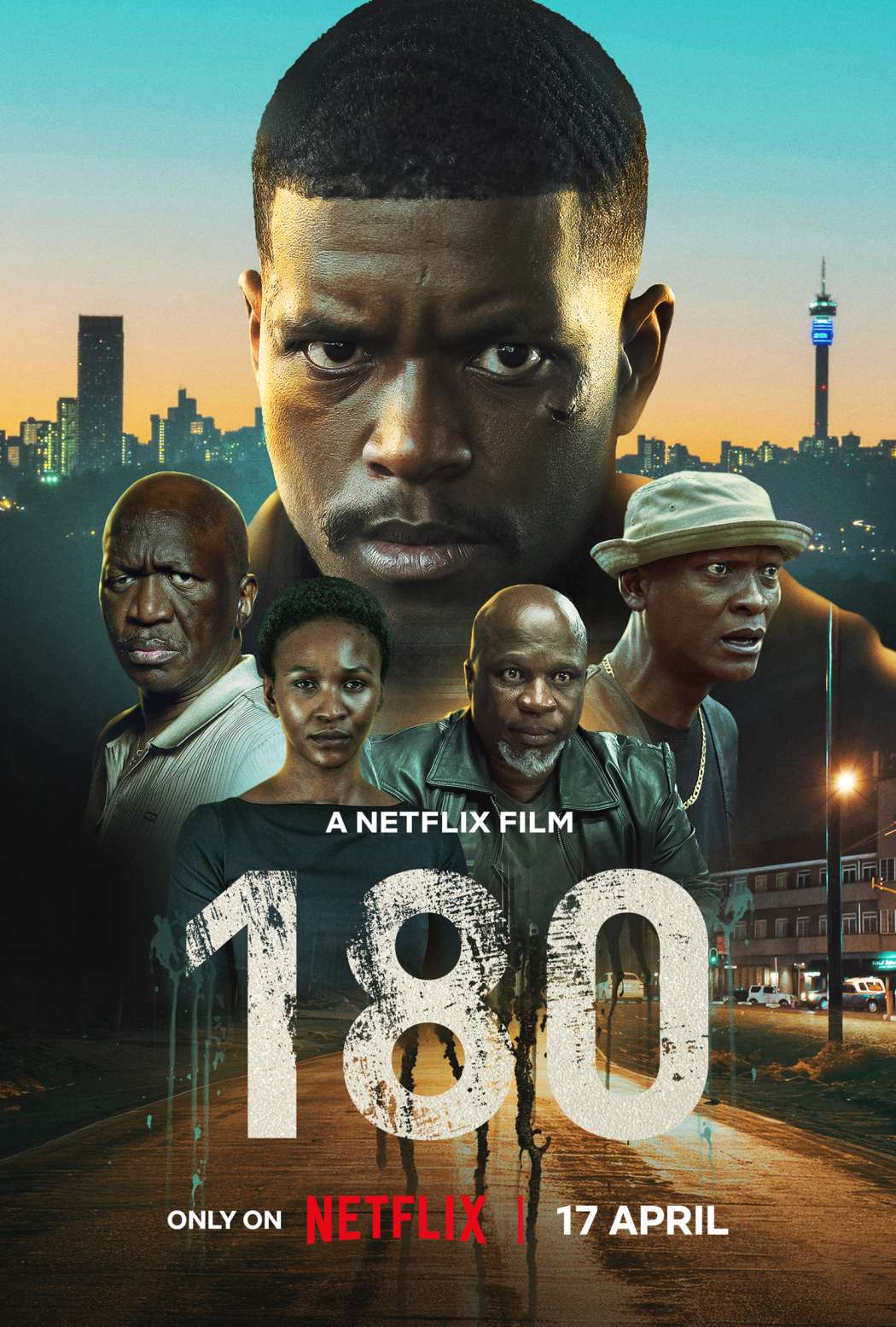
The best revenge films understand this. They are less interested in whether the protagonist gets their target than in what the pursuit costs them, what it hollows out, what it makes them capable of. Death Wish (1974), Prisoners (2013), Oldboy (2003), Blue Ruin (2013) are films that take the Confucian warning seriously, that make the second grave visible and terrifying long before the first one is filled. South African director Alex Yazbek’s 180, now streaming on Netflix, announces its interest in this tradition and then, with frustrating consistency, retreats from its demands.
The setup is elemental: Zak Sigcawu (Prince Grootboom), an ordinary man in an ordinary South African city, has a road altercation with gangsters. What begins as the kind of confrontation that urban life in any major African city manufactures daily (the compressed tension of shared roads, the toxic masculinity that makes backing down feel like self-erasure) escalates with a speed that the film presents as believable but does not earn. A gun appears. Zak’s young son Mandla is shot. And from this rupture, the story descends, or attempts to descend, into the moral abyss that the revenge genre has mapped so many times and in so many registers that a filmmaker entering it now must either find something genuinely new to say or execute the familiar with exceptional precision. 180 does neither.
South African cinema has, at its best, understood that the country’s specific history of racialised violence, economic dispossession, and institutional failure gives the revenge narrative a particular charge. When a Black South African man finds that the justice system will not protect him or his family, his turn toward vigilantism carries a historical weight that American or European versions of the same story cannot replicate.
The failure of the state in post-apartheid South Africa — the gap between constitutional promise and lived reality, between the rainbow nation’s rhetoric and the township’s daily arithmetic of survival — is the real antagonist of any honest film made in that context. Yazbek, who also wrote the screenplay, seems to sense this. There are gestures toward it: Zak’s medical aid being cut off while his son fights for his life in intensive care, the bureaucratic machinery grinding slowly while the family’s crisis accelerates, the police proving unreliable at the identity parade when Zak cannot confidently finger the shooter.
These are the film’s most resonant moments, the places where 180 briefly becomes something closer to social commentary than genre exercise. The system that leaves Zak with no options is more frightening than any gangster, and in those scenes, you can see the outline of a better film: one in which the real subject is not whether Zak gets his revenge but how a society produces the conditions in which revenge becomes the only legible language of justice.
But that film keeps slipping away, replaced by a version that trusts plot over character, incident over interiority. The fundamental problem with 180 is that Zak never feels like the author of his own story. He floats through events rather than driving them, reacting to an escalating series of circumstances without the internal coherence that would make his reactions meaningful.
We are told, implicitly, that Zak is a good man pushed beyond endurance. But the screenplay does not do the slower, more demanding work of establishing who he is before he is broken: what he values, how he moves through the world, what specifically he stands to lose beyond the immediately obvious. Without that foundation, his transformation from ordinary man to reluctant vigilante has no emotional architecture. He is not descending. He is simply moving from scene to scene.
This problem is compounded by the fact that Zak is, to put it plainly, not good at what he turns to. He is hot-headed, clumsy, and consistently makes decisions that should, by any reasonable narrative logic, get him killed. His hotheadedness is what triggers the original confrontation, what transforms a road argument into a shooting. Later, his hotheadedness gets his brother killed. When he turns vigilante, his ineptitude is so thoroughgoing that his survival begins to feel less like dramatic tension and more like authorial mercy — the screenplay protecting its protagonist from the consequences of his own stupidity because the story needs him to reach the ending. A blindfolded man, hands bound, escaping and evading bullets at close range in darkness — this is not gritty realism. This is the kind of narrative convenience that breaks the illusion a film has spent its entire runtime constructing. Once you notice the strings, you cannot stop seeing them.
The screenplay’s unevenness extends to its peripheral architecture. A call centre agent is introduced and then effectively abandoned, a character who gestures toward connection with the main narrative and never arrives there. The school bullying subplot that touches on Zak’s domestic life before the tragedy, the vehicle licence department confrontation that plays like an attempt to establish Zak’s relationship with bureaucratic frustration; these scenes feel less like deliberate world-building than like material from an earlier, more expansive draft that survived the edit without surviving the integration. A film about cycles of violence and institutional failure in urban South Africa has every reason to spend time in these spaces. 180 spends time in them without making the time count.
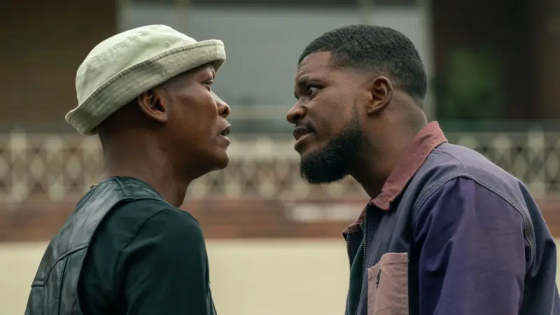
Where the film finds genuine, unforced life is in its supporting cast or rather, in one member of it specifically. Kabelo Thai, as Karwas the taxi driver, brings to his scenes precisely the quality that the film’s protagonist so conspicuously lacks: moral complexity rendered without announcement.
Karwas works for the gang responsible for Zak’s ordeal (he was the driver in the crash that set everything in motion), and Thai plays him as a man living inside the specific torment of indirect culpability, the guilt of someone who did not pull the trigger but cannot fully separate himself from the hand that did. It is a beautifully calibrated performance. When Karwas is arrested and asks the police how the boy is doing, and later, upon release, asks the same question of the very gang he refuses to betray, Thai communicates something the film’s screenplay cannot quite articulate elsewhere: that people are capable of genuine remorse and genuine cowardice simultaneously, that guilt and self-preservation do not cancel each other out but coexist in uncomfortable, very human proportion. He will not give up the gang. He also cannot stop asking about the child.
Thai holds both truths in the same body without resolving them, and in doing so produces the film’s most honest portrait of how ordinary people are folded into violence, not as villains, not as heroes, but as frightened participants whose consciences arrive too late to change anything. Noxolo Dlamini, as Zak’s wife, Portia, handles the grief of a mother watching her child fight for his life with an adequacy that serves the film’s emotional needs without quite transcending them. Hers is the performance of a role that the screenplay needed to develop more fully. The script uses Portia’s grief as emotional evidence of the tragedy’s stakes without ever fully inhabiting her perspective or investigating what this crisis does to her specifically.
Prince Grootboom is, by consensus and by evident effort, the film’s centrepiece, and the performance has real moments. The teetering between restraint and fury is genuinely there, and there are scenes where Grootboom finds the specific texture of a frightened man trying to perform a resolve he does not fully feel. But a strong performance cannot substitute for a well-written character, and Grootboom is ultimately defeated by the screenplay’s failure to give Zak consistent internal logic.
The character’s motivations shift not because characters change and grow but because the plot requires them to. We are never quite sure what Zak believes, what line he will and will not cross, what he is actually trying to achieve beyond the immediate.


In Prisoners, Hugh Jackman’s Keller Dover is terrifying precisely because his internal logic is so rigidly consistent: he is a man who has organised his entire identity around preparation and protection, and the film systematically dismantles his belief that such organisation can hold the world’s chaos at bay. Zak has no equivalent internal architecture. He is not a man whose worldview is being destroyed by events. He is a man who events are happening to.
What redeems 180 aesthetically, and redeems it substantially, is Yazbek’s direction at the level of the image. The cinematography is genuinely accomplished with tight framing that keeps the viewer in Zak’s compressed, claustrophobic perceptual world; shadows are deployed not decoratively but psychologically; the visual texture of South Africa’s urban geography is captured with an eye that understands how environment shapes character.
Yazbek makes the film look as cinematic as its streaming context allows, and there are moments where the composition alone generates the dread that the screenplay is working too hard to manufacture through incident. This is a director who knows how to use a camera, whose visual intelligence is evident in nearly every frame. The tragedy is that this intelligence is in service of a screenplay that does not match it. It is basically a beautiful coat on a body that has not been fully assembled.

The revenge film as a genre has always been, beneath its violence, a philosophical argument about the limits of institutions and the temptations of self-help justice. At its most honest, it is not a fantasy of empowerment but a warning: the Confucian graves made visible, the second burial always arriving.
180 is named, presumably, for the degree of turn: the reversal that violence initiates, the way a single moment can rotate a life into an unrecognisable orientation. It is a sharp title for a film that understands the concept intellectually but struggles to dramatise it with the depth it deserves. Zak turns 180 degrees, yes. But we never quite feel what he was facing before he turned, and so the new direction carries less weight than it should.
South Africa has the material for devastating cinema about the ordinary man’s relationship to violence, justice, and a state that has not kept its promises. 180 has the look. It has, in Grootboom and Thai, the performances. What it needed was a screenplay willing to sit with its characters long enough to understand them, to build Zak from the inside out rather than from incident to incident, to make his journey feel inevitable rather than convenient, to trust that the second grave is more frightening than the first, and to show us both.
Rating: 2/5
Joseph Jonathan is a historian who seeks to understand how film shapes our cultural identity as a people. He believes that history is more about the future than the past. When he’s not writing about film, you can catch him listening to music or discussing politics. He tweets @Chukwu2big