


Anyone who knows the significance of masquerades in Igboland knows that it is an esoteric affair at its core, reserved only for the fully initiated. The rules of masquerade cults are fierce and secret.
By Chimezie Chika
I
When I learnt that the theme of this year’s Enugu Photo Fest was “initiation”, I could not help but wonder what that would mean for us at this time. What or whose initiation? Or why initiation at all? Why not, say, induction, or awakening? What of such galvanising words as would directly or indirectly speak to the pressing themes of our present political dilemmas?
But initiation, this powerful symbol and practice of transformation or becoming, according to the curatorial statement, “marks the movement from one stage of life to another: from childhood to adulthood, from outsider to member, from observer to participant.” Knowing the forms initiation can embody brings us to the truth that we are constantly being initiated into things throughout our lives—by social, cultural, or personal forces. One line of the statement provides immense illumination for most of the works under exhibition at the Festival: it is that initiation in Igbo culture has never been merely symbolic. One can stretch this to cover most African cultures, where the symbolic represents existence.
In his famed work, Flash of the Spirit: African and Afro-American Art and Philosophy, Robert Farris Thompson writes that “Yoruba art returns to the idea of heaven to mankind wherever the ancient ideal attitudes are genuinely manifested.” The ancient ideal attitudes, in his reckoning, are codified ritual practices of Yoruba religion built around the Orishas; they are life itself as we know it, not just symbols. He suggests further that in the physical and spiritual nature of this practice, we find a “metaphoric capture of the moral potentiality inherent in certain powers of the natural world—thunder, oceans, herbs, and stones—and a demonstration that creative persons have shaped certain images, pillars of lateritic clay, implements of iron, metal fans, brooms decorated with leather and cowrie-shell embroidery, so that they illumine the world with intuitions of the power to make right things come to pass.”
This is not mere observation, for such persons so endowed with the spiritual creativity he describes will have passed through a thorough initiation into a sacred caucus of the religion, its symbols, their meanings, and a higher understanding of their representations and manifestations.
At the Enugu Photo Fest, one of the photo exhibitions titled “Sacred Spaces” by Coltan Kubiangha captures the venerated sites and symbols of supreme ritual knowledge and cultural memory in Yoruba spirituality. In the seven images here, we are shown scenes from the Osun-Osogbo Sacred Grove. The place, which has been a UNESCO World Heritage site since 2005, is a four-centuries-old monument to the Yoruba water and fertility goddess Osun, whose name is also given to the river that runs through the Osogbo forest and much of eastern Yorubaland.
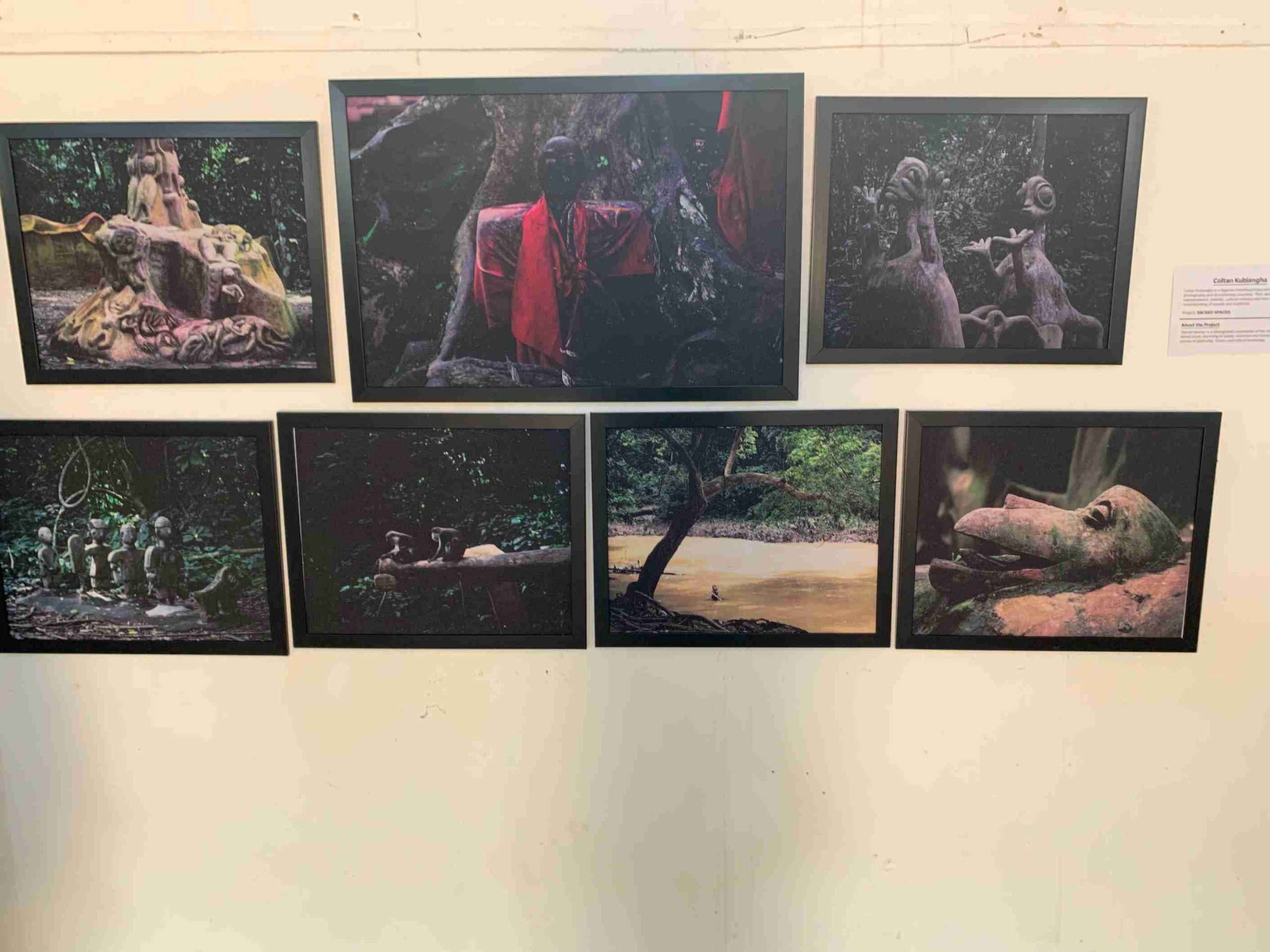
The Osun-Osogbo Grove notably has over forty shrines, sculptures, and artworks, some of which, beginning in the middle of the last century, were revitalised and instated by Susanne Wenger’s New Sacred Art movement, which included artists such as Adebisi Akanji, Rabiu Anesu, Kasali Akangbe Ogun, Buraimoh Badamosi, and others. Kubiangha does well to capture the aura of immanent spirituality in the place, the calmness that pervades the grove—more or less what Thompson calls the characteristic coolness (silence and tranquillity which embody seriousness and high-mindedness) associated with ritualised aspects of the culture. Kubiangha shows us the coalescing of these in her exhibition.
The central piece captures a dark sculpture positioned at the base of a huge tree, garbed in a red ritual wrapper with telltale signs of blood sacrifices on it. That we do not see much else apart from tiny lichens and the boulder of the tree trunk points to the deliberate isolation of the deity, and therefore its importance. Other pictures follow all kinds of isolated iconography.
In one of the most interesting, we are staring at a section of the muddy river: tree trunks and the green forest foliage embracing most of the frame; yet out there, not exactly in the middle of the river, is a tiny sculpture—one could even swear that it has the likeness of a toddler—sitting all alone in the river, a stained piece of white cloth around its lower half, waiting for the rescue or obeisance of the worshippers.
Another interesting one is the supine skull of an ape, its stone mouth wide open, showing the tongue. In another, a populated wood sculpture contains all kinds of distorted icons bunched together in a kind of flow state. Other small figures are caught in a procession, bearing certain significant objects. It’s as if each section of iconography in the Grove re-enacts the pilgrimage of its devotees.
The Grove is no stranger to strangeness or stillness. Its forested and well-watered expanse houses over 400 tree species and a notable population of fauna. In short, Kubiangha does well to capture two monkeys (or, unclearly, drills) sitting atop a part of one of the massive sculptures. This image is, more than anything, a reminder that the natural and native customs of environmental preservation and eco-consciousness in Africa are often connected to its sacred entities, practices, and values.
Many indigenous African spiritualities are built around the immanent ecology. And yet when we contrast Kubiangha’s presentation with that of Obidience Agu, another photographer in the Enugu Photo Fest exhibition who showcased photographs of the Osun-Osogbo Sacred Grove, we begin to see signs of environmental degradation amidst spiritual devotion.
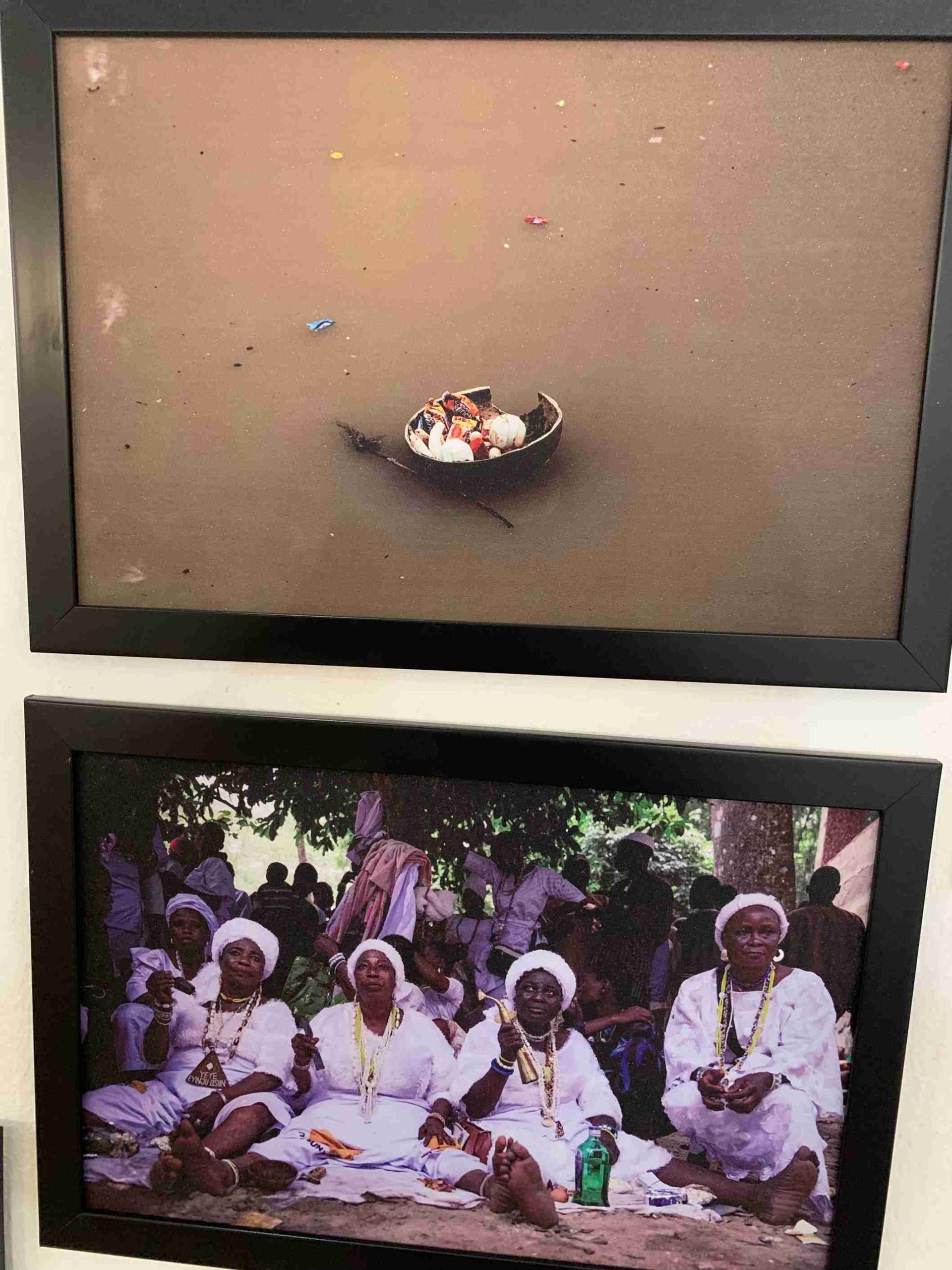
Agu’s project, “Omi Osun: The Calling”, highlights his storytelling approach to photography. His series follows the Omi Osun festival (which happens every August) as a rite of initiation: from the preparation of the Arugba to the procession from palace to river. Each photograph here shows devotees participating in rituals of spiritual belonging and inheritance. In one of the photos, a group of priestesses in white (white is usually the colour worn around water deities to show purity) are preparing sacrifices to the river.
In another, other priestesses sitting side by side are caught in supplicatory poses, amulets around their necks. One picture shows a sacrifice of “sweet things” floating on the river (we can make out wraps of biscuits, pieces of what looks like banana, and oranges on the plate). Around it, floating on the water, are bits of plastic wrap. Images of a woman standing on a riverside boulder to fetch water from the river, a woman offering prayers in an isolated section of the river, and a woman’s hands bathing the head of a bent person show all kinds of ritual rites. But one wonders if these devotees ever think about the environmental consequences of plastic in a venerated entity such as Osun.
Could the photographer have paid more attention to this side of the narrative? Especially now that reports of the river’s contamination through residues of artisanal gold-mining in its headwaters are emerging. No matter what value we bestow on our natural environment through religion, the truth remains that the nature of that value will be questioned if the esteem with which it is held does not extend to the preservation of the environment’s pristine nature.
This has long been one of the dilemmas of indigenous African religions and spirituality (it is particularly a major problem in modern Odinani practice): the burden of cleanliness and enforceable ecological integrity in a consumerist modern world that produces a dispiriting amount of non-biodegradable waste. If we are creating objects of veneration that our natural environment cannot digest, then we must rethink how we worship our deities, or we might end up with a problem similar to that of the Hindu and the Ganga.
II
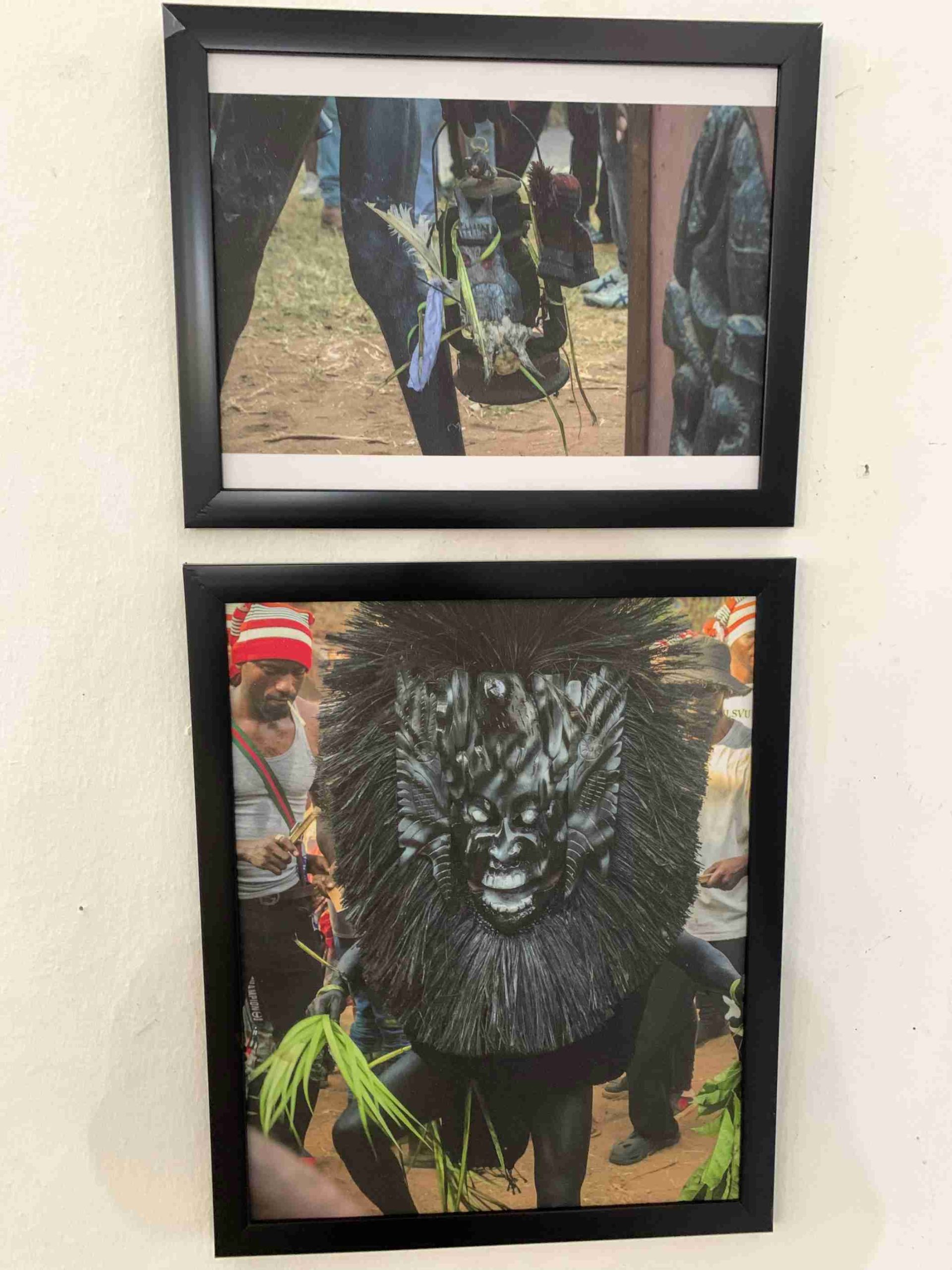
Two of the exhibiting photographers, Young Chimezirim Charles and Johnpeters Anyanwu, focused their work on the Mmanwu (masquerade) ritual in Igboland. Charles’s presentation consists of just two photographs capturing the Ekpe Festival in the Umuahia community of Ohuhu. The centrepiece of the first photograph is the image of a most terrifyingly macabre mask, the likes of which can only be seen with legendary grotesque masquerades such as Agaba and Ulaga. Made from ferociously crafted raffia and wood, the masquerade is also carrying highly ritualised flora such as young palm fronds and ogirishi leaves. The other image captures the legs of another masquerade carrier. But here we do not see his torso; what is captured at the centre of the frame is his hand holding a ritual hurricane lantern, decorated with an okpu agụ, palm fronds, white cloth pieces, amulets, a figurine, and a bird feather. The sight of these two images does not necessarily give us the sense of unity and peace which the Ekpe festival is supposed to evoke. Its ancestral significance rather tells on us with a sense of the esoteric, of a knowledge far beyond our understanding as outsiders.
Anyone who knows the significance of masquerades in Igboland knows that it is an esoteric affair at its core, reserved only for the fully initiated. The rules of masquerade cults are fierce and secret. They embody respect as manifestations of the Igbo ancestors in different communities. I have written zealously on this site about this understanding of mmanwu as the celebration of our departed ancestors.
That understanding will allow us to see clearly Anyanwu’s documentary project titled “Mmanwu”, after masquerades. To grasp this understanding, we must return to the idea that initiation in Igbo culture is not merely symbolic. By the same token, Mmanwu is not merely a symbolic affair; it is a vital part of our spiritual and cultural life. It is a carrier of our stories. The photographs here capture different masquerades with sheer aesthetic fidelity. Many of the masquerades (such as Okpaka Mmanwu) possess striking beauty, as such representations of spirits can be; others are incredibly fierce and forbidding.
Anyanwu did not fail to show us at least one image that apes the idea of initiation and the significant cultural symbolism they evoke within Mmanwu masquerade rituals and festivals. In the photo, the scene is a marketplace. And there is a procession of initiates or spirits in white or red wrappers, most wearing grotesque skull masks, bodies painted with nzu chalk, hands bearing ritual and musical objects. Even as we feel as though we are being given a peek into another world, of something ancient or sequestered away from modernity, we see two viewers, voyeurs like us, watching and striding alongside the spirits.
III
The intrusion of modernity into ancient ways of living and being remains a pivotal subject at this time. The most literal documentation of this in the Enugu Photo Fest is the exhibition by Sulaiman Abdullahi Danladi, whose project, “Life Between Movement and Memory”, explores how Fulani communities of Gishiri Ruga are coming to terms with maintaining their traditional ways of life in a rapidly developing city. The picturesque photographs here belie one of the major problems of urbanisation: loss of tradition. The photos here show striking contrasts between modernity and tradition.
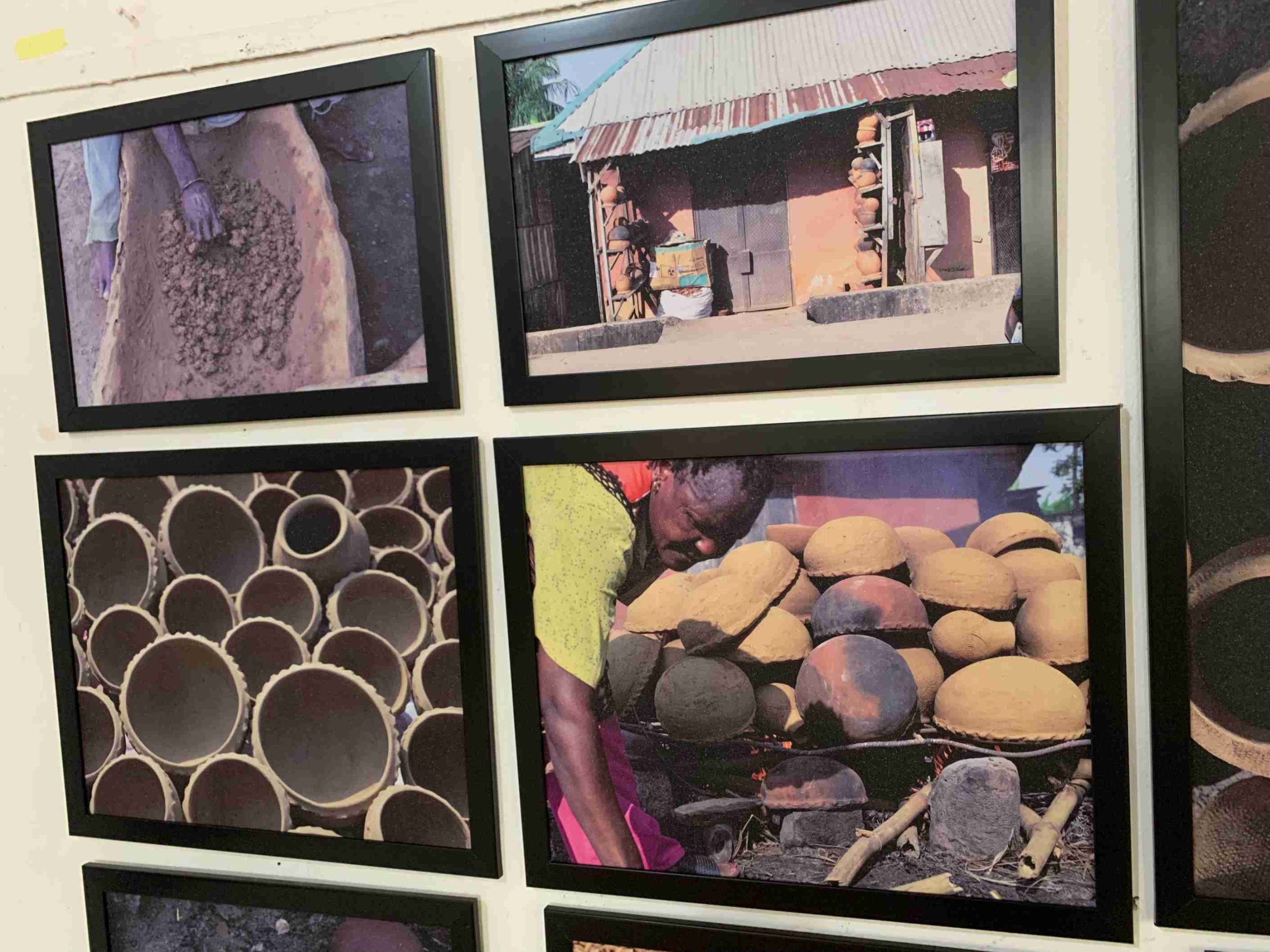
In one of the most affecting of these, a mud thatch-roofed house with stacks of firewood on either side of it looks forlorn against the shadow of three or four massive modern white houses, with Almaco windows, AC units, and electricity lines visible on them. On the other hand, there is Chidera Sam-Eze’s ongoing documentary project, “The Potters of Ishiagu”. Ishiagu is a community in Ebonyi State whose pottery rituals, passed down through generations, have long sustained the community’s sense of identity. Of course, the larger picture of the unequal struggle between such artisanal craftspeople and the mass products of big conglomerates cannot be overlooked.


Other projects capture the failures of modernity in certain locations where culture and tradition are affected by the collateral damage of climate change. This is the focus of Garba Bakura’s long-term project, “In Search of a Drop”. It documents how climate change is affecting the daily lives of communities in Yobe State, Northeastern Nigeria, where water remains a contested and contestable resource. According to the artist statement, “the project explores the human cost of environmental degradation and asks what ecological justice means for people whose lives are being reshaped by a crisis they did little to create.”
It can be hard to believe the photographs that follow were taken in the same country I live in. One can palpably feel the struggle for water in this semi-arid landscape: whether it is malnourished cattle drinking dirty water from a concrete trough, a group of people fetching water in greasy jerrycans from a borehole pump, or the picture of a derelict water pipe that must have gone into disuse years ago. The pipe is broken, long-abandoned, disconnected, and sits rusting in the dry Sahelian earth.
IV
It all brings us back to the vitality of water to our physical and spiritual well-being. It is curious that we in Africa have understood, if not made the most of the latter. Yet, as to the former, our governments have failed in their fundamental duty to make water abundant and accessible. The paradox of our existence is that we both respect and disrespect the life-giving resource we call water; an extension of that paradox (perhaps a reason for our failure) is that water is also the most abundant physical resource on earth. We derive supreme spiritual authority from it, but also treat it with such cavalier neglect as can only be given to things of little or no importance.
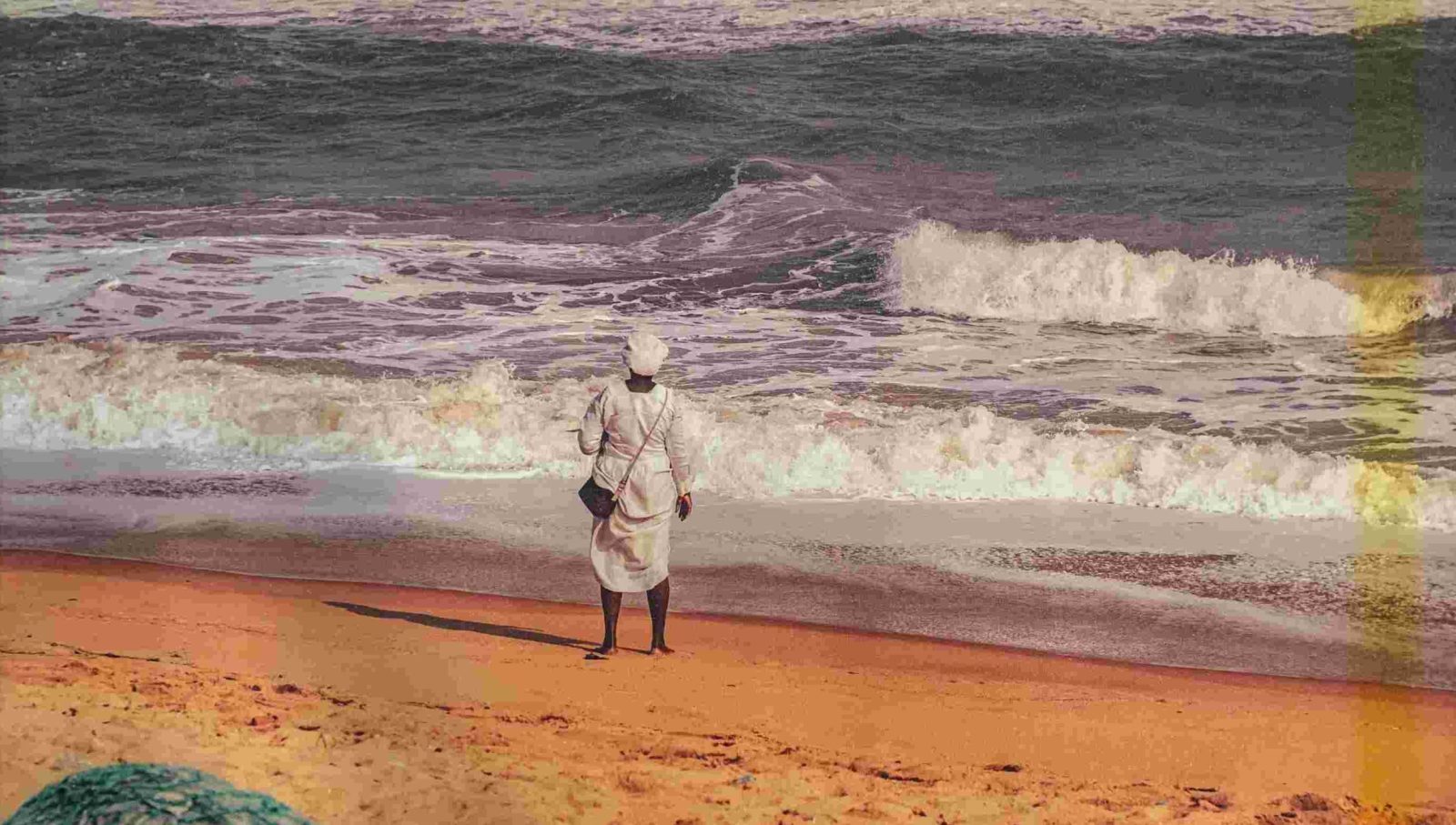
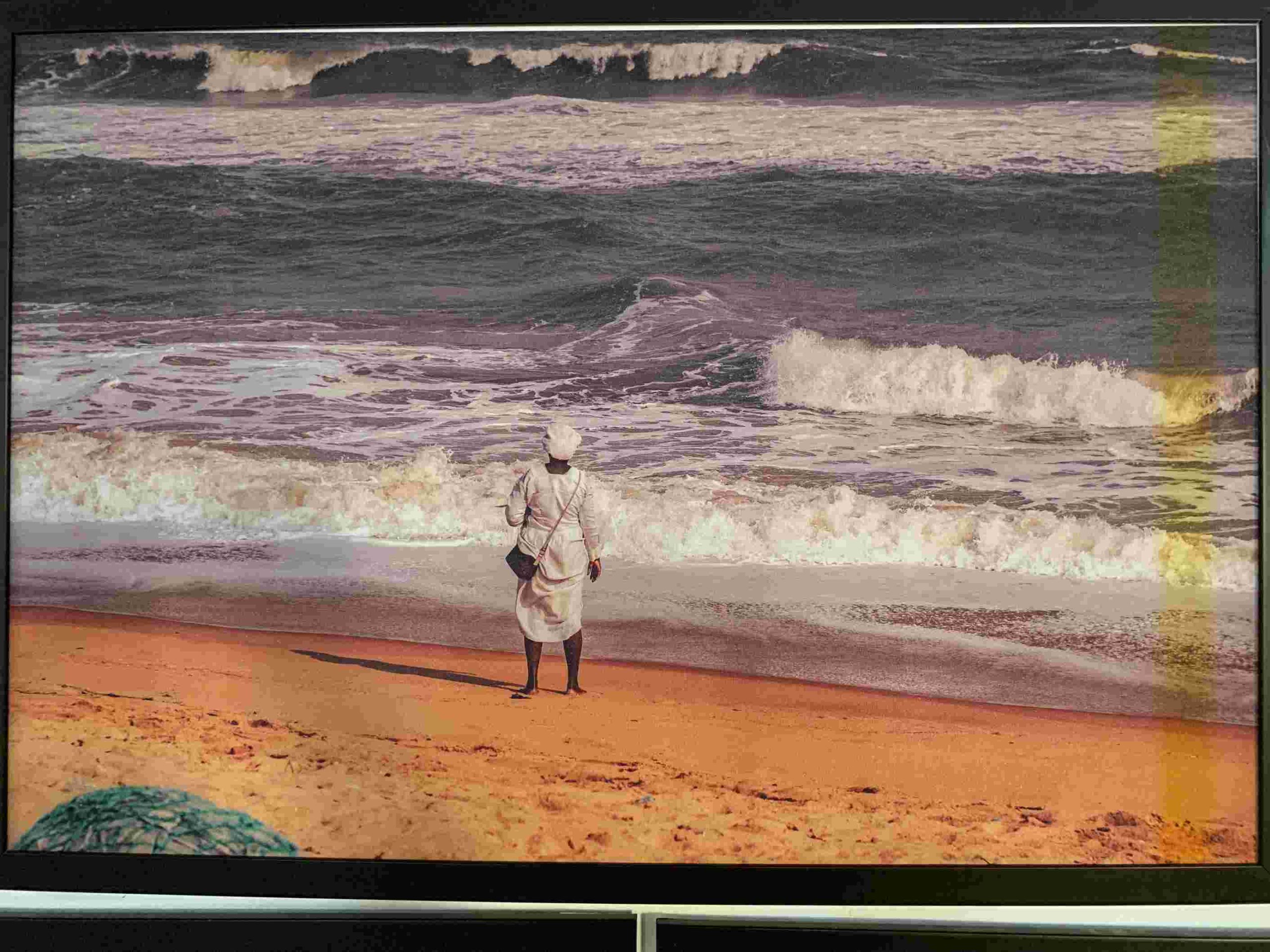
And we maintain that our spirits and physical well-being must be quickened by these waters. We fasten onto them, as the lone woman worshipping on the beach in Caleb Ishaya Oseshi’s project, “The Shores Remember”, a documentation of the relationship between the people of the coastal communities in Badagry and the Atlantic Ocean.
I am looking at that woman, clad in the habitual white gown and headgear of water spirit worshippers. She is standing there before the frothing waves of the ocean, a bag slung across her shoulders. And despite the undulating riot of those waves, we can be sure that she is not afraid. Not her nor the man in another photo, similarly clad in white, who has come to pray with a baby-carrying woman. Other photographs in this display are snapshots of fishermen mending nets. One is a hand drawing thread through the net; the other is feet coiling rope. And it is all happening before the restless waves.
Whether praying or preparing to go fishing—these people have profound reverence for the ocean and its deity, Yemoja. Yemoja, being one of the most powerful orishas in the Yoruba pantheon, is regarded as the mother of all orishas. Thompson, referring to the art surrounding Yemoja and other water goddesses, talks about “the use of a round fan as an emblem embodying the coolness and command of these spirits of the water”. He would also later admit that the idea of coolness does not capture the character of water deities, pointing to their propensity towards vengeance, doom, and danger. But he also spends time describing the beauty, thoughtfulness, and mythical force imbued in the design of Yemoja’s sacramentals.
The items and objects we create to bridge our interaction with the spirits may be one of the things the shore remembers—it will remember all our activities of course—but also they are one of the things our bodies would remember as well. Arinze Okafor’s “Lines and Body” spiritualises the body with paintings of uli and nsibidi symbols. The young woman here is shown in different poses and angles with a body almost completely covered in these inscriptions. She appears to me like the medium of a water spirit, an ogbanje or any of the legion of watery minions associated with Osun or Yemoja—the very apparition that evokes urban myths of mammy water in river- or sea-side cities and towns.
The same spirit of mediumship and spirit possession is what one sees in Bello Benjamin’s literally titled project, “Initiation”. In each of the seven pictures he showcases, we see different rites of passage; whether through the route of indigenous religions, through the Christian religion, or through personal metamorphosis.
In one photo, a young man with a body almost completely chalked is carrying things on his head. The picture is a curious mix of monochrome and colour, and as he stares at us through the chill borders of the frame, we may begin to feel drawn into the liminal correspondence between any kind of religious rites and an inward retreat into channelling the body’s own forces. At that point, initiation will be a personal journey, will still be a connection to one’s origins, but never a performance for these performative times.
And so the safest initiation is of the self—the self that is conscious of the environment and our duty to it. And may we all come to that point of awakening where we can begin to understand this.
Chimezie Chika is a senior staff writer at Afrocritik. His short stories and essays have appeared in or forthcoming from, amongst other places, The Iowa Review, Dappled Things, Channel Magazine, Terrain.org, Lolwe, Isele Magazine, Efiko Magazine. He is the fiction editor of Ngiga Review. His interests range from culture, history, to art, literature, and the environment. You can find him on X @chimeziechika1