

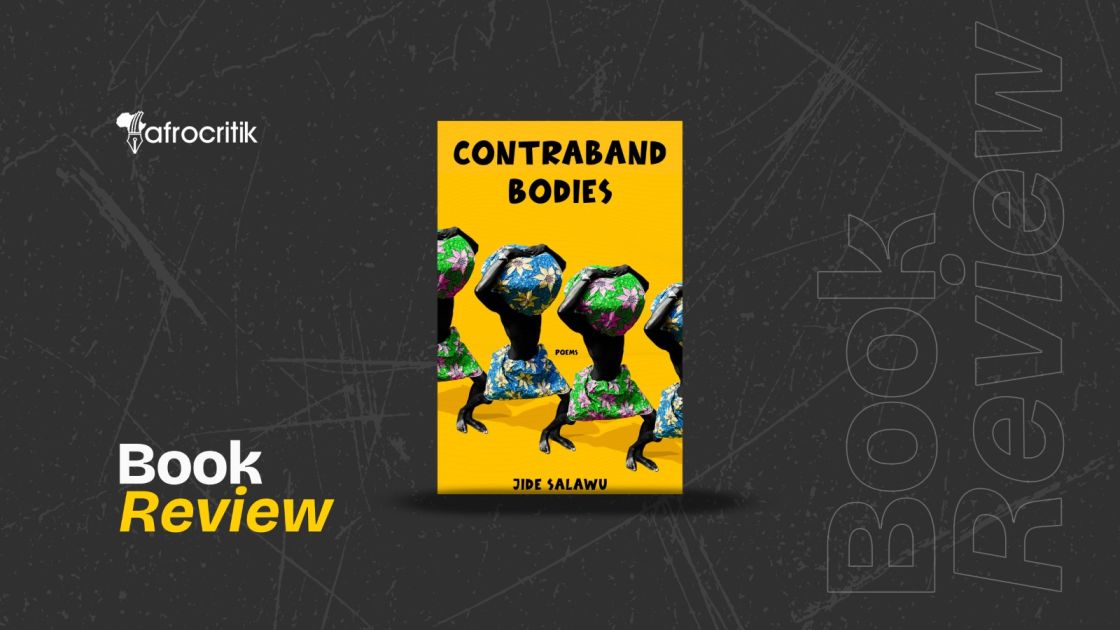

Contraband Bodies challenges us to think about exile: that there is not much dignity in it, either within the places of origin or in exile itself.
By Chimezie Chika
In Jide Salawu’s splendidly titled debut collection of poems, Contraband Bodies, you might catch yourself forcefully imagining hordes of bodies moving in one clouded mass (“a cartographer talk say his country na sufferhead and maps the sea as an alternative bridge”), the destination being anywhere other than their places of origin, across the Atlantic from Africa.
Although these migrations are not limited to echoes of the transatlantic or trans-Saharan human trafficking (“Newark is the harbour of Atlantic dreams/where boats of the past dock with the present”), we are aware that they are no less devastating. It is this devastation—of what could be but cannot be, of entire fugitive lives “made of running”—that Salawu attempts to inscribe.
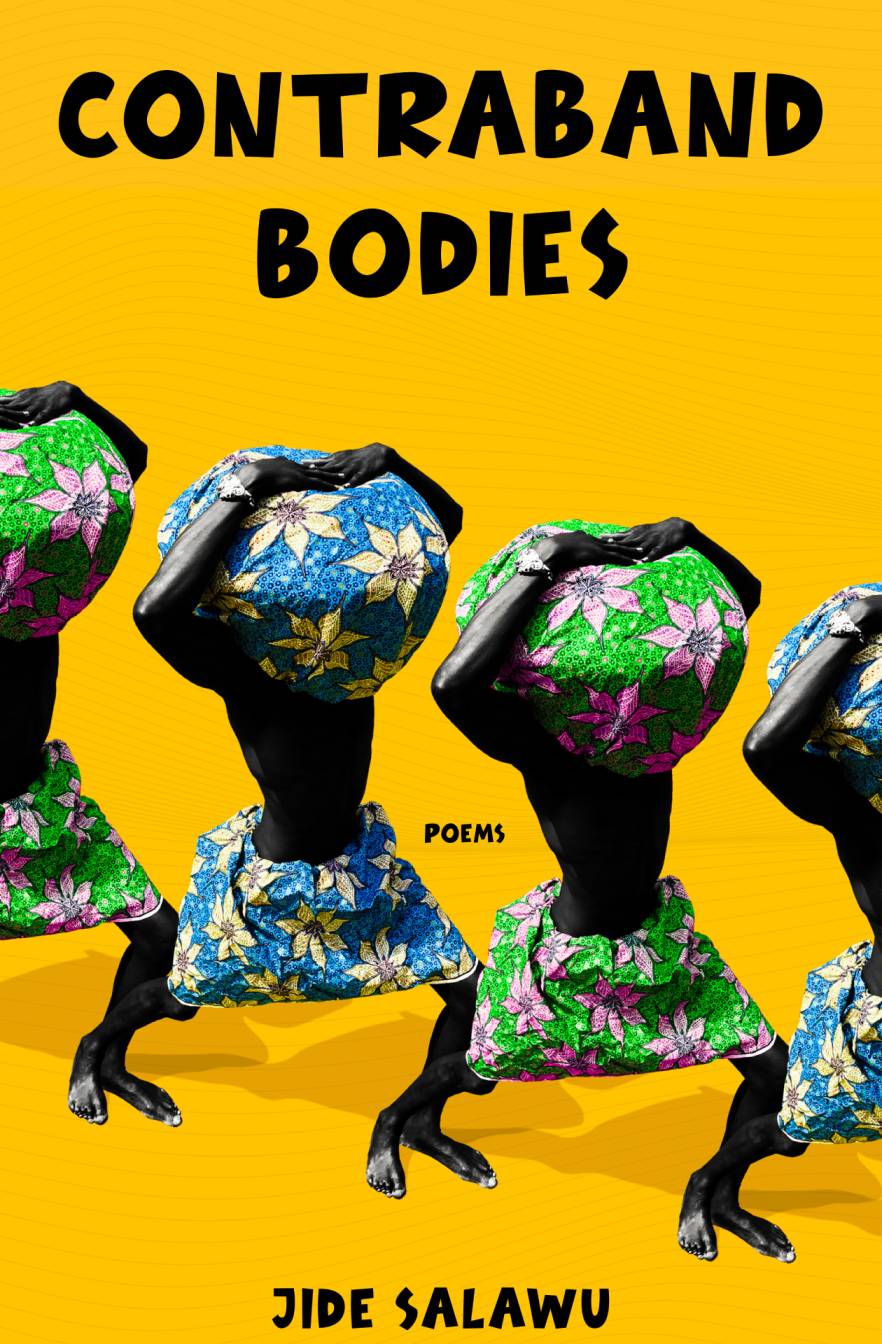
In Contraband Bodies, Salawu makes us see clearly that the poetry of bodies is the poetry of exile. As has become evident in contemporary poetry of exile, traces of the reasoning that even the journey to exile is itself a kind of condemnation are everywhere. Salawu offers it up well in the last line of the poem, “A Cartographer Maps His Way out of His Country”: “exile is also a famished road even when you survive sea”.
If this reasoning functions as colonial gutting, this is what the poet writes in “48 Nightmares Later”:
In the beginning was the sea,
and the bandits of empire arriving at the shores
Before Lagos was called to bow
for the crown under a sky of smog.
If the reasoning is contemporary “Sea Stories”, we will find a lot of it flammable:
… hundreds are wading
through the butane eye of the Mediterranean
flailing in the brine.
…
rushing out of a country’s flame.
And of course the idea is that the journey is so arduous, insufferable, coming with so many baggages, that surviving the journey becomes another exile of its own kind.
Choice can be read in many of these lines. The poet suggests a kind of consciousness in which “choice” as a valid reason for the journey of exile is ever-evolving. While the slave trades of the past were choiceless for the African victims, today this choice thing is more complicated. If there is even some agency with that choice, many have arrived at it from being hounded by hardship and dysfunctional or war-torn homes. The poem, “Sufferhead”, exemplifies this pattern in the collection, framed as a prayer:
God, do not make me a beast of burden
for this land, its broken door,
and fractured fiber of its roads.
…
I leave home with my anger
on my back like a hunch
…
On every road I have drifted,
I hear the voices of the dead
and contraband bodies waiting for dawn.

Home here is a metaphor sitting either in plain view or just between the interstices of the poet’s melancholia. One prose-poem, “The Family House”, in this vein jumps out. Here the poet revisits and reimagines his natal home. What could have gone wrong with his memories of the place? He tells us: “Standing at the front of the house, I smell like a loss.” Loss here is many things: it is family, dreams, an undivided nationality, a non-dislocated identity. We are feeling emotions we have been searching for all over with the poet.
Considering all these, the African exile understands that exile is a kind of permanent condition. Many homes these days may function for, and as a result of, exile. “I am in the story,” Salawu muses in the end, “where my father says all gratitude belongs to the road”. Some of this last consideration is also in a poem like “Memorandum of Understanding for the Travelling African”.
Contraband Bodies is not limited by geography. In these poems, we move across the Americas, across Africa and parts of Europe. And in these places, we are given the understanding, sometimes vaguely, that Africans are the contrabands. Every African understands the horrors of visa applications and other related immigration blues. The African immigrants can be many things: unwelcome bodies, bodies that feel strange, bodies that feel lost, bodies that are longing, bodies that do not belong, bodies of ennui—they are all contraband bodies.
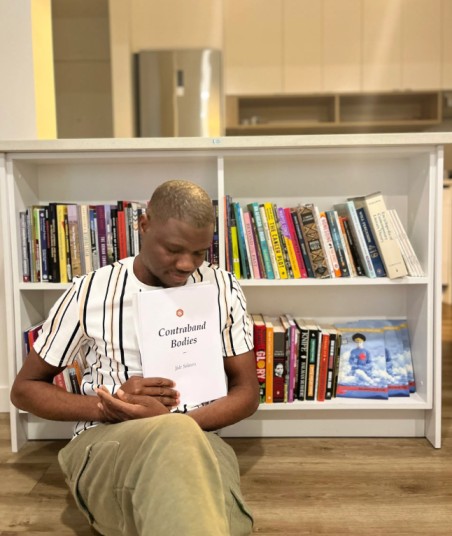
The best poems here, often familial or autobiographical, encapsulate something about the tragedy of moving bodies, either those leaving in life or leaving in death. Like in a “Lament of Leaving” where moving away from family is a devastating exercise in the loss of love (“Every morning, I sacrificed to the worms/because I speak no language of the grave.”). Or like in “The Uplanders” (“what makes the sea salty is the migrant’s sweat”)
But is Nigerian literature new to the poetry of bodies? Of course not. And while we do not expect poetry on this theme to end anytime soon, we want poets to bring singular insight, a certain strange new wisdom, to the subject.
If one looks at poets who have done this successfully as a yardstick, this collection does not, on the whole, give us the consistent emotional pull of an Adeoba or the narrative poignancy of an Oriogun. It does, however, offer what one may call individuated clarities, and that resides wholly in experience. The best poems conflate the symbols of memory, home, and the sea; some of the others contain execrable lines.
Perhaps the culprit is that Salawu may have spread some of his thoughts a little too thin. As a result, some of the earlier poems in the collection feel superfluous. Or perhaps it is the lack of rhythm, the sense of a running inner song, that gives this sense that something is missing.
Yet, these will not detract from what Contraband Bodies challenges us to think about exile: that there is not much dignity in it, either within the places of origin or in exile itself. This is as much a poetry of bodies as it is a poetry of the sea, of lands, and of nameless faces striving for survival in those places.
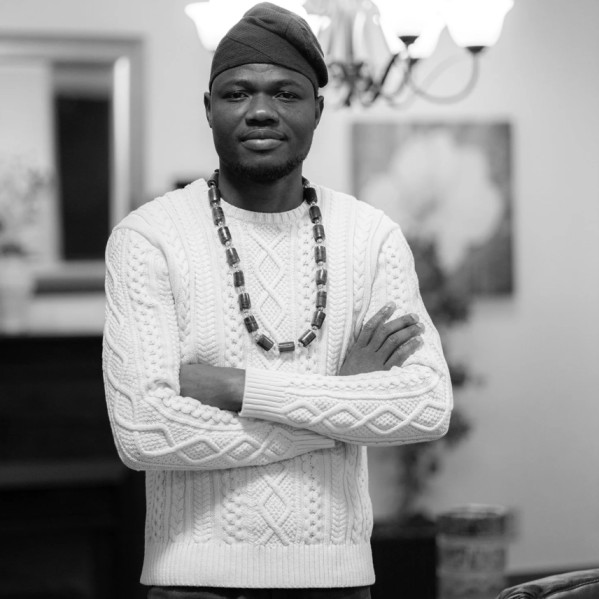
Chimezie Chika is a staff writer at Afrocritik. His short stories and essays have appeared in or forthcoming from, amongst other places, The Iowa Review, Dappled Things, Channel Magazine, Terrain.org, Lolwe, Isele Magazine, Efiko Magazine. He is the fiction editor of Ngiga Review. His interests range from culture, history, to art, literature, and the environment. You can find him on X @chimeziechika1