

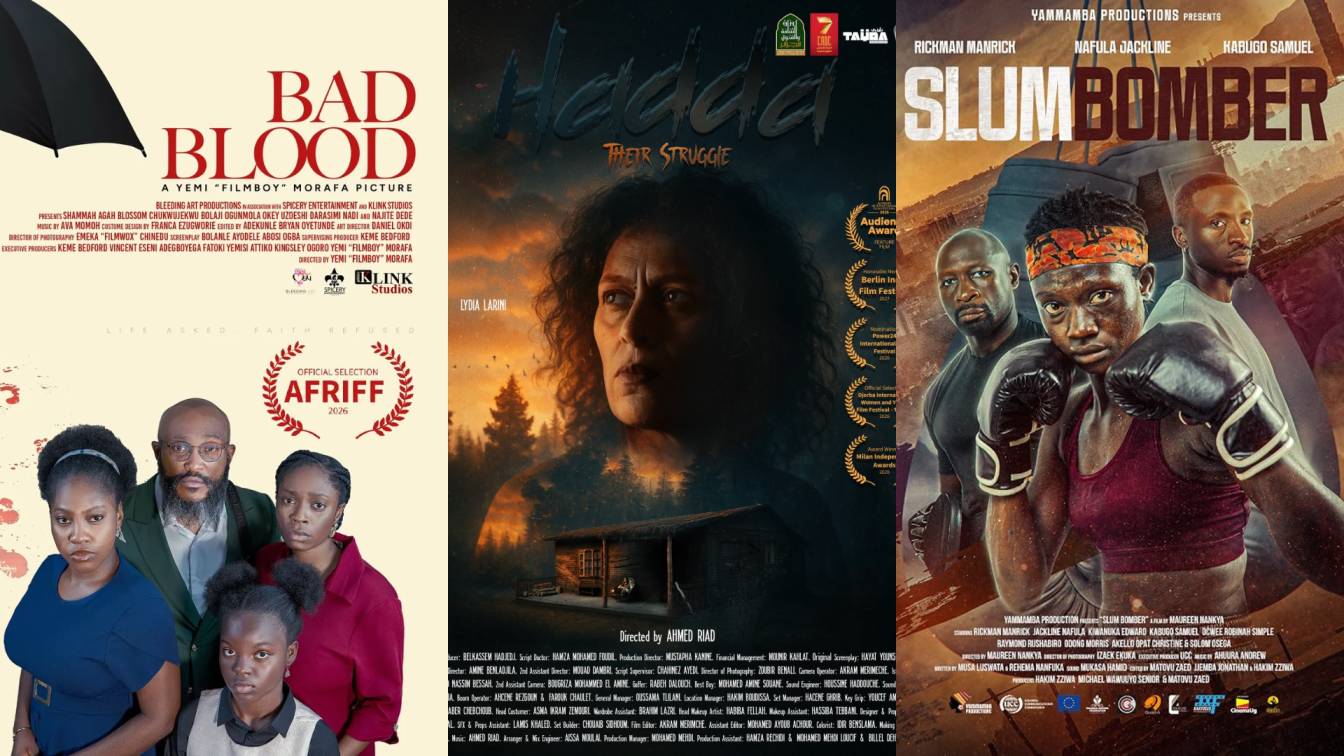

If Slum Bomber and Bad Blood are fun watches, Hadda takes itself very seriously, even at its most comical.
By Vivian Nneka Nwajiaku
One of the pleasures of African festivals, especially the more mainstream-leaning festivals like the Africa International Film Festival (AFRIFF), is that they do not necessarily demand African stories of a particular kind in the way that the world’s most prestigious international festivals do.
Combined with the lower barrier to entry, since African cinema is the point of such festivals rather than a mere interest, the chances of discovering tonally fun and thematically diverse African films are significantly higher, even if such films tend to struggle with execution. At the 15th edition of AFRIFF, Uganda, Nigeria and Algeria provide interesting examples in Slum Bomber, Bad Blood, and Hadda.
Slum Bomber
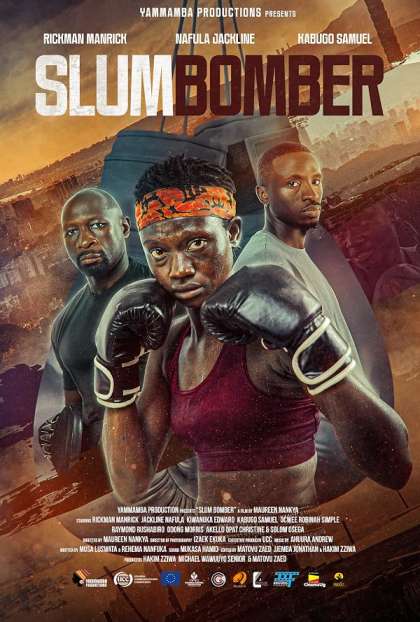
In Maureen Jolly Nankya’s Slum Bomber (2026), a directorial debut that recently earned fourteen nominations at the Africa Movie Academy Awards (AMAA), a young woman named Julie Ayolo (Jackline Nafula) escapes from her small village to Kampala, the Ugandan capital city, where she takes up a job as the help to an elderly woman in the hopes of raising enough money to care for her struggling family back home. It turns out that her employer, the son of the elderly woman, owns a small gym where he coaches at-risk young men in boxing. When Julie learns that women on the national boxing team earn money that would be life-changing for her, a whole new future opens up before her.
On his part, Coach Kabuye (Samuel Kabugo) ordinarily does not train women. Apparently, they meet men, get pregnant, and are unable to focus on the sport. But Julie promises to be different, so he takes her under his wing. Meanwhile, the gym comes under threat of forceful acquisition by a “business tycoon” in collusion with the city council. To keep the gym open, Coach Kabuye has to prove its utility to the government and the public, and Julie suddenly becomes instrumental to saving the gym. But a budding friendship with a sweet-mouthed local footballer literally called Sweetness (Rickman Manrick) threatens Julie’s newfound career path. Could it be that Julie is not much different from the other women?
The journey through the beats of this sports drama is messy and often hectic. The pacing and tone are uneven, with the third act becoming an unintentionally comedic rollercoaster. The stakes, particularly with respect to Julie’s role in preserving the gym, are tenuous, at best. There is a sexual violence scene that is as unnecessary as its damsel-in-distress purpose is outdated. And its apparent women-can-have-it-all messaging is ridiculously impractical.
But Slum Bomber somehow manages to be a vigorously entertaining ride that demands emotional investment, even when the narrative choices are untenable. It helps that several chunks of the film are shot and edited in the manner of credible sports dramas, a characteristic that signals an appreciation for the basic tenets of the genre, even if the narrative itself is very often far from credible.
Slum Bomber is professed (in officially published synopses) to mirror the true-life story of a woman who shaped female boxing in Uganda in the most unexpected way. It would be the most fascinating reality if this truly is the case. But it seems more likely that the art of exaggeration has been wielded to ultra-dramatic effect, with little to no attempt at cinematic restraint. In any case, Slum Bomber is a crowd-pleaser, and that’s not essentially a bad thing for a film to be.
Bad Blood
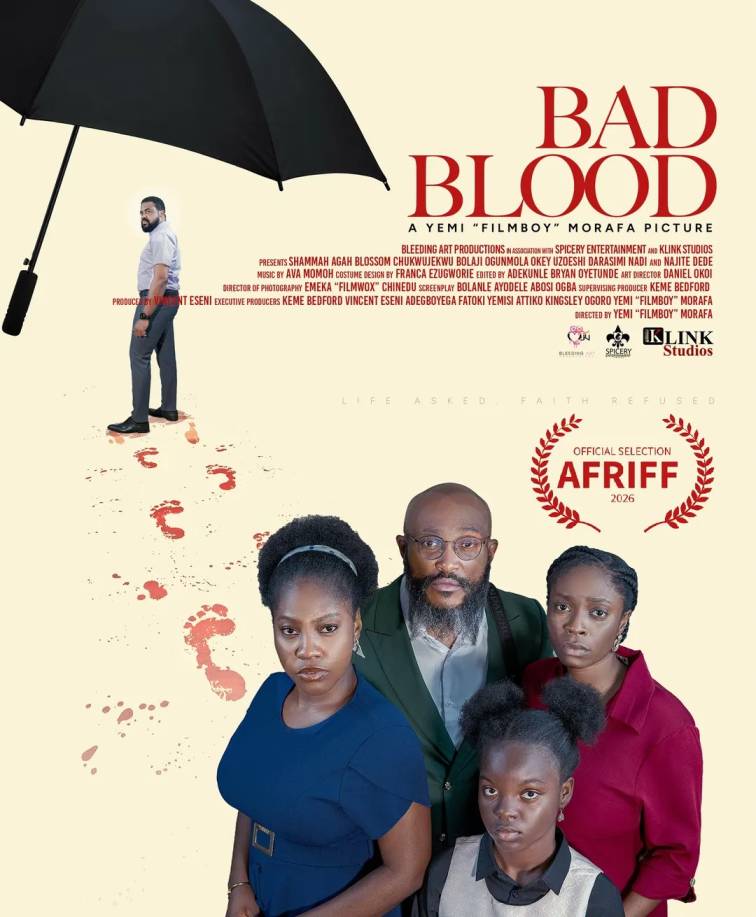
Bad Blood, the latest from Nollywood director Yemi “Filmboy” Morafa (Gingerrr (2025); Mirrors (2026)), is a psychological thriller constructed around religious faith and mental illness. But in true Nollywood fashion, Bad Blood is more interested in the aesthetics and dramatic potential of its chosen concepts and story than in any real consideration of the concepts or story. The film attempts both an exploration of mental health and a critique of religious beliefs, but it never goes beyond making surface judgments against the religious sect whose beliefs it builds its story upon and brandishing mental illness as a convenient shorthand for psychological instability and questionable character decisions.
Starring Bolaji Ogunmola, Blossom Chukwujekwu, Okey Uzoeshi, Shammah Agah, Darasimi Nadi, and Najite Dede, Bad Blood follows two married couples whose faith as Jehovah’s Witnesses is tested when medical emergencies force them to make tough decisions regarding blood transfusion. The filmmakers’ stance on the subject remains obvious and consistent throughout the film, and as if to ensure that the audience does not miss it, they write in grossly inappropriate lines for a medical practitioner within the film to emphasise just how misguided they consider the beliefs to be.
That opinion is very much within the filmmakers’ rights. But the Jehovah’s Witnesses in Bad Blood are characterised as mere archetypes in a way that rarely works outside of satires. The characters sit on either extreme of the divide, as hypocritical but favoured church leaders who secretly disregard the rules or as overly committed converts who abide without question. There is a conflict between their faith and the result of the decisions that they have to make, but they never truly grapple with that conflict as individual persons with internal considerations. Instead, every occasion of conflict is mined for external drama until the film reaches an explosive but roundabout climax where logic fails over and over again in order that spectacle should prevail.


In truth, Bad Blood is quite a fun and entertaining watch, if one does not focus on the details (which unfortunately include yet another unwarranted sexual violence scene). It is too visually manufactured such that it comes off more showy than stylistic, but that does have the effect of heightening the aura of the picture to match with the melodrama unfolding onscreen. And it certainly matters that it is capably performed by its cast, with a particularly spectacular turn from Agah, who plays an eerie character with a clinically diagnosed mental illness, delivering a performance that consistently demands attention, creates suspense, and breathes personality into a character so paper-thin that the audience never does learn her actual medical diagnosis.
Hadda
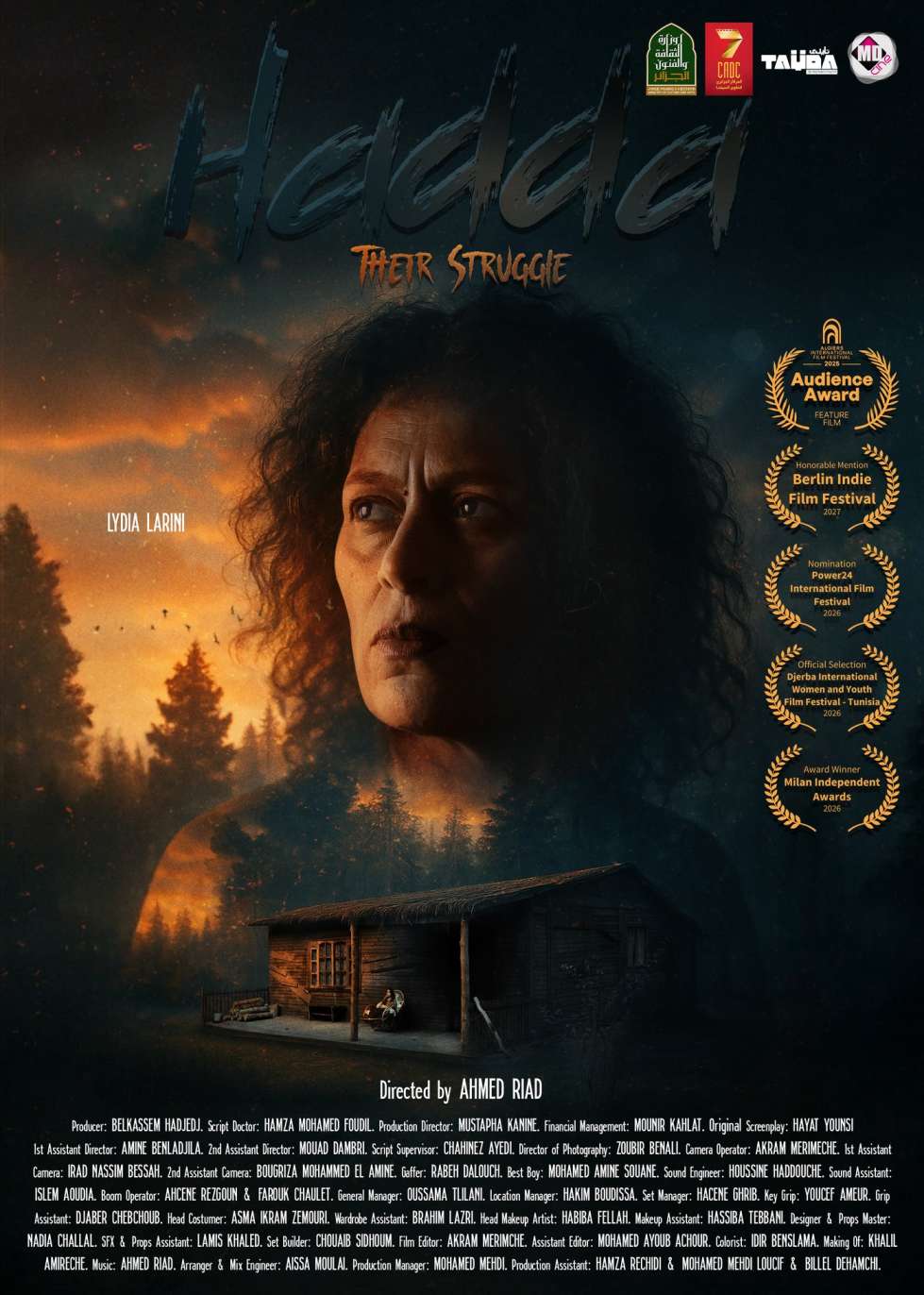
If Slum Bomber and Bad Blood are fun watches, Hadda (2026) takes itself very seriously, even at its most comical. As it should. Riad Ahmed’s feature directorial debut is an Algerian historical drama set during the Algerian War of Independence. Lydia Larini plays the eponymous character, Hadda, a local healer who runs a clandestine medical operation in a cabin in the heart of the mountains, attending to revolutionaries in secret while presenting herself to the French authorities as a regular nurse providing services to ordinary villagers. When an operation sends the French military in search of a rebel fighter around Hadda’s vicinity, a French officer becomes suspicious, and Hadda’s delicate enterprise suddenly comes under threat.
Hadda gets off to a start so slow that even patient audiences would struggle to endure, with much of the film’s first half dedicated to establishing Hadda’s operation and the various moving parts that will eventually come together in the high-stakes second half. But that second half certainly is the thrilling part of this thriller and as fun as an Inglourious Basterds’ derivative could turn out to be. Hadda converts from a serious war drama into a dark comedy war film from the moment the crisis-causing French officer (Abdelhamid Masbah), who is consciously or subconsciously modelled after Christoph Waltz’s Hans Landa, is introduced, and so much of that second half plays like the iconic opener to the beloved Quentin Tarantino film.
That Hadda works in its own right has more to do with the directing than with the writing, which relies too much on borrowed ideas, convenient twists, and a political message of heroism that is powerful at first glance but ultimately registers as counterproductive in the case of the protagonist. At the very least, it is a technically competent film, with solid cinematography and functional scoring, even if the acting performances are not always as reliable.
Vivian Nneka Nwajiaku is a writer and film critic writing from Lagos. She has a master’s degree in law but spends most of her time consuming, studying and discussing film and TV. She’s particularly concerned about what art has to say about society’s relationship with women. Connect with her on X @Nneka_Viv