


At an industry level, addressing the black box requires improvements in data systems, stronger international collaboration between collecting societies, and wider education for artistes and rights holders.
By Deborah Oyedijo
For many artistes, the expectation is straightforward. A song is released, it gains streams, receives radio play, and in some cases travels across borders through global platforms. Over time, that success should translate into royalty payments. Yet for a significant number of musicians, the income that should follow never fully arrives. The music circulates, the money is collected, but somewhere within the system, a portion of that revenue fails to reach the people who created it.
This gap is not always the result of exploitation or deliberate withholding. In many cases, the missing income sits within what the music industry refers to as the black box. This term describes a pool of royalties that have been collected by streaming platforms, distributors, and collective management organisations but cannot be distributed because the rightful owners cannot be properly identified or located. In simple terms, the money exists, but it has no clear destination.
To understand how this happens, it is important to distinguish between the different forms this undistributed income can take. Some royalties are unmatched, meaning that the system has recorded the use of a song but cannot link that usage to any registered rights holder. Others are unclaimed, where the rights holder exists but has not registered the work or their ownership with the relevant organisation. There are also undistributed royalties, which have been collected and are temporarily held while efforts are made to match them to the correct parties. Although these categories differ slightly, they all contribute to the same outcome: revenue generated by music that does not reach the creators entitled to it.

The pathways through which royalties enter the black box are often technical, but they are also common. One of the most frequent causes is incomplete or inconsistent metadata. When a song is uploaded to a streaming platform, it carries identifying information such as the title, songwriter names, producer credits, and unique identifiers. If this information is missing, incorrect, or inconsistent across different platforms and registries, it becomes difficult for collecting societies to match usage data to the correct rights holders. A song may be streamed thousands or even millions of times, but without accurate metadata, the system cannot confidently assign those royalties to anyone.
Registration gaps create a similar problem. An artiste may release a song and distribute it globally through platforms such as Spotify or Apple Music, but only register the work with a local collecting society. If that society does not have strong reciprocal agreements with organisations in other territories, royalties generated from radio play, public performance, or streaming in those regions may not be successfully routed back. In effect, the music travels internationally, while the rights information does not move with the same efficiency.
The absence of standard identifiers further complicates the process. Recordings are typically assigned International Standard Recording Codes (ISRCs), while compositions are linked to International Standard Musical Work Codes (ISWCs). These codes function as reference points within the global royalties system, allowing different organisations to recognise and match works accurately. When songs are released without these identifiers, or when the codes are not properly linked across systems, tracking usage becomes significantly more difficult, increasing the likelihood that royalties will remain unmatched.
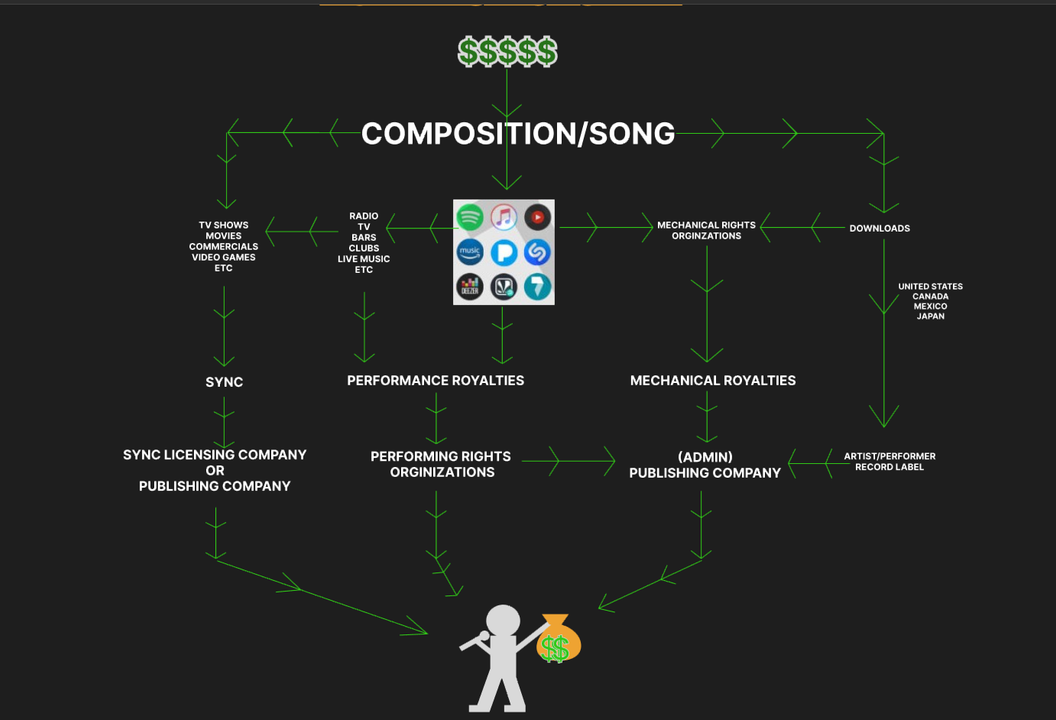
Publishing structures also play a role. Where a song has no registered publisher or administrator responsible for managing the composition, publishing royalties may be collected but left without a clear recipient. This is particularly relevant for independent artistes who handle releases themselves without engaging publishing services. While the music may generate income from multiple sources, the absence of a formal structure to receive and process those royalties can result in portions of that income sitting unclaimed.
For African artistes, these structural issues are often intensified by broader industry conditions. Registration rates with collective management organisations remain relatively low compared to more established markets, and many independent artistes release music without formally affiliating with organisations such as the Copyright Society of Nigeria (COSON) or the Musical Copyright Society of Nigeria (MCSN), limiting their ability to receive certain categories of royalties. At the same time, awareness of key concepts such as metadata management, ISRC and ISWC codes, and publishing administration is still developing across the industry.
Infrastructure gaps also contribute to the problem. While major international societies operate with highly integrated databases and long-standing reciprocal agreements, many African Collective Management Organisations (CMO) are still working to expand their global reach and data capabilities. This creates situations where royalties generated abroad cannot be efficiently matched or transferred back to local rights holders. As African music continues to gain international recognition, these gaps become more visible, as songs generate value in markets where the systems for returning that value are not fully aligned with those at home.


Over time, the royalties that cannot be matched or claimed do not simply remain untouched indefinitely. Collecting societies typically hold these funds for a defined period, often between three to five years, while attempting to identify and locate the correct rights holders. If the money remains unclaimed after this period, it is usually redistributed to registered members based on market share or usage data. In practice, this means that well-documented and high-earning artistes may receive a portion of royalties generated by works whose creators were never properly captured within the system. While this approach allows funds to be allocated rather than left idle, it also reflects a structural imbalance in which those outside the system are effectively excluded from the income they generate.

For individual artistes, reducing exposure to the black box begins with basic but essential steps. Registering with a recognised collective management organisation ensures that performance and related royalties can be collected on their behalf. Obtaining ISRC codes for recordings and ensuring that compositions are assigned ISWC codes improves the traceability of their work across platforms. Maintaining accurate and consistent metadata across all releases helps prevent mismatches that can delay or block payments. Where possible, working with a publisher or publishing administrator with international reach can further strengthen the ability to collect royalties across multiple territories. For artistes whose music circulates globally, it is also important to understand whether their local CMO has reciprocal agreements in the regions where their work is being used.
At an industry level, addressing the black box requires improvements in data systems, stronger international collaboration between collecting societies, and wider education for artistes and rights holders. As more African music enters the global market, the systems that support it must evolve to ensure that value flows back to its creators consistently and transparently.
Ultimately, the black box is not just a technical feature of the music business. It is a structural issue that determines whether revenue generated by a song reaches the people responsible for creating it. For African artistes operating within a rapidly expanding global industry, understanding how this system works is no longer optional. It is a necessary part of ensuring that success in streams, airplay, and international exposure translates into actual, measurable income.
Deborah Oyedijo is a music business writer and entertainment lawyer-in-training with a focus on the African music industry. When she is not writing about music rights and culture, she is watching K-dramas or absorbing yet another documentary. Connect with her on IG and X: ayooyedijo.