

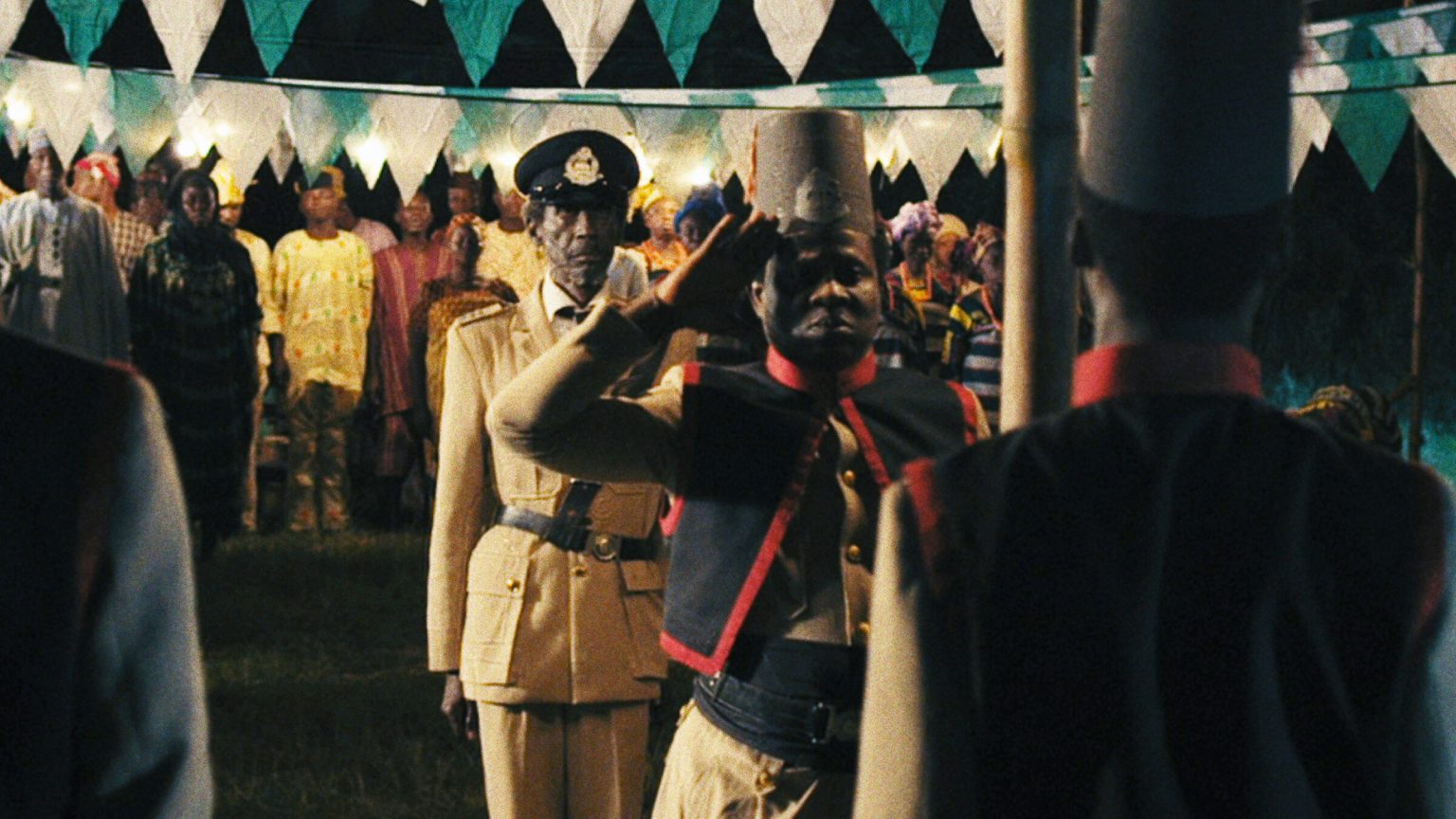

If films are inherently political, if all films have something to say, though they may be unaware or unconscious of their inherent politics, then the critic’s duty remains, difficult as it may have been rendered by the film itself.
By Vivian Nneka Nwajiaku
I. The Politics of Cinema
In a world of magic and speaking animals, a green-skinned young woman enrols at a magical university. She is bullied and mistreated, but she endures, accepting to be tutored by the Dean of Sorcery Studies in hopes of gaining access to the great Wizard. On campus, she discovers that animals are losing their speech. Determined to do right, her first opportunity to fraternise with the Wizard becomes an advocacy project on behalf of the animals. She expects a solution. Instead, she is invited to join a scheme to control and scapegoat the animals. Her refusal sets her against the Wizard and the Dean. She is branded the Wicked Witch and a sworn enemy of the land.
This is the story of Wicked (2024-5), Hollywood’s colourful two-part musical fantasy that primarily presents itself as entertainment. Most audiences, especially those uninterested in politics, would consume Wicked for its entertainment value. Fascism, the “nature versus nurture” debate, power imbalances and social inequalities in daily life, these discourses may not bear heavily on the casual viewer. And yet, American sociopolitical realities and the ideological positions of the filmmakers seep through the screen, intentionally controlling the narrative. The casual viewer, wherever they may be located in the world, might not know it, but they are likely internalising certain political stances propagated via this fantasy world.
“Political”, here, refers not to the strict dictionary definition of “relating to the government” but to the broader socio-cultural interpretation of the term as the exercise of power or, as the British political scientist Andrew Heywood defined it, “the activity through which people make, preserve and amend the general rules under which they live”. In this sense, “the political” encompasses several forms of negotiation for power or control within the various contexts of cultural, socio-economic, and socio-political realities, including the politics of identity, of community, of human emotions and relationships, of class struggles, and of societal systems and power structures.
In this age of social media and the considerable democratisation of access, we have come to discover that the flawed perception held by most of the Global South in favour of the West has been, at least partly, a result of the PR machine that is cinema. The United States, for instance, has historically wielded Hollywood in garnering global respect and consolidating soft power. Hollywood’s reinforcement of American ideological dominance is well documented, from government-sponsored propaganda to independent-minded filmmaking with deliberate socio-political messaging.
Beyond the West, film has played a remarkable role in propagating ideologies. Chinese Kung Fu films, from Drunken Master (1978) to Shaolin Temple (1982), were psychological weapons that shaped national identity and global perception. And even in Nigeria, early Nollywood notably altered the fabric of Nigerian society, for better and for worse. Much of Old Nollywood has been blamed and criticised for the proliferation of societal ills and the deformation of Nigeria’s global image—an extreme example, films such as End of the Wicked (1999) are considered to have influenced the upsurge in the branding of children as witches, a culture which persists today—but their clarity in messaging can scarcely be denied.
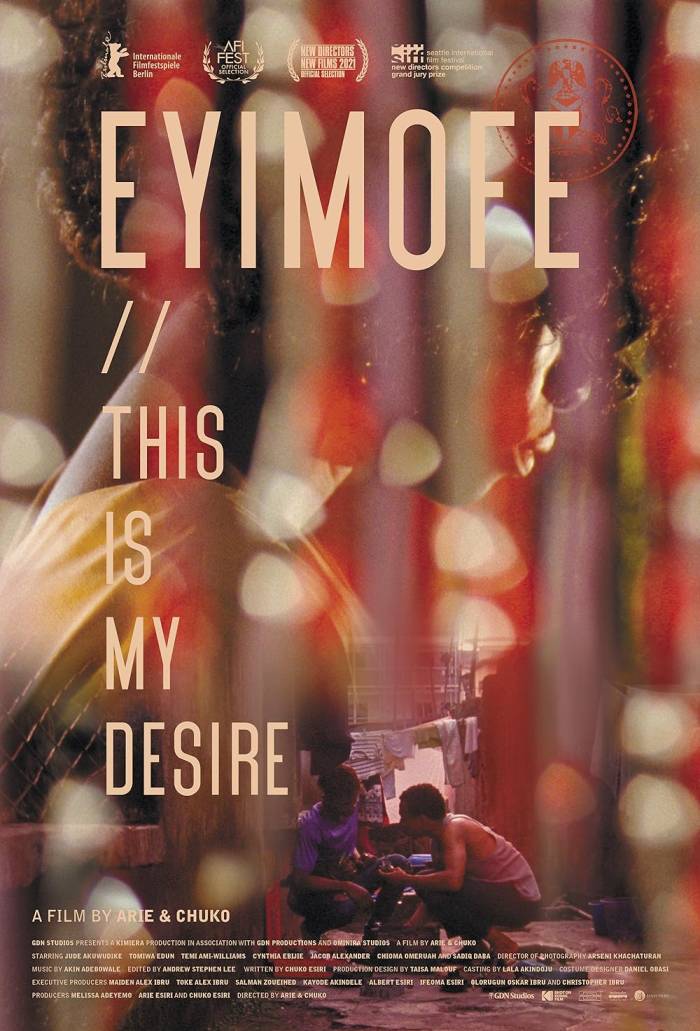
In its present iteration, however, Nollywood hardly seems aware of this power of cinema to shape cultural perception, consciousness and influence. That is not to say that cinema is required to function specifically as a marketing tool or a morality police. After all, many of Nigeria’s finest films, from Tunde Kelani’s classic Saworoide (1999) to Arie and Chuko Esiri’s globally acclaimed Eyimofe: This Is My Desire (2020), have been films that highlight the country’s dysfunction, with the latter, in particular, eschewing moral judgment.
The point is, film is political. A film may clearly address a society’s sociopolitical conditions and contradictions or it may not, but it is inevitably a product of such conditions as well as a cultural repository. One need not study Fredric Jameson on political (un)consciousness, or consume the critical exchange between Cahiers du Cinema and Cinéthique in the 1970s—although these are considered essential reading—to appreciate the politics, conscious or unconscious, of cinema. One need only consider the most entertaining and commercial film they can think of, from Hollywood’s superhero genre to Nollywood’s comedy blockbusters. Banal or brimming with depth, they ultimately reflect, reinforce or challenge societal conditions and worldviews.
As French film critic and theorist Christian Zimmer put it in his 1970 essay titled “All Films Are Political”: “There is no innocent film, we would say, no film without some political incidence.” This is even more so because the medium itself is political, pulling its audience in and making active participants of them. Film gives “the impression of reality” as French film theorist Christian Metz famously described it in his seminal 1968 work, Film Language: A Semiotics of the Cinema. “Films give us the feeling that we are witnessing an almost real spectacle—to a much greater extent… than does a novel, a play, or a figurative painting.”
We may preach eternally about the fiction of film, even in documentary filmmaking, but we will remain unable to deny that the public does not always see the screen. Too many members of the audience are simply unable to divorce film from reality. Even critics, as Zimmer acknowledged, do not always manage to escape the effects of that impression of reality created by a film. This is its very design and, perhaps, its strongest appeal.
So, if films are inherently political, and if they indeed shape public consciousness, then is it not preferable that films be conscious? Surely, such consciousness need not take the form of overtly political themes. But is it not necessary that films have a clarity of essence and a sense of responsibility for their inescapable political implications? And is it not imperative that films be subject to critical engagement and interpretation? What, then, is the essence of criticism if not to interrogate the intersections of culture and politics?
II. The Critic’s Quagmire
In the Nigerian film ecosystem, journalistic assessment has minimal effect on audiences’ filmgoing decisions, a phenomenon which appears to diminish the power of criticism. I argue that this is not the case. Granted, criticising is an element of the critic’s job, despite our insistence on marking distinctions between “criticising” and “critiquing”. Indeed, in Criticism and Politics: A Polemical Introduction, American literary scholar Bruce Robbins gently admits (although with specific reference to literary criticism) that faultfinding is a major component of what critics do. And I concede that it does register as partially futile, at least, if that faultfinding has no effect on the market, since the incentives for correction and improvement are considerably minimised.
Yet, film has established itself as an integral part of culture, and criticism is crucial to culture, not only as a faultfinding affair but also as an analytical and interpretative activity, essentially political in itself. To quote Robbins, in his reflection on the career of Thomas Mann, the German social critic and Nobel Prize in Literature laureate who notably walked back his position on maintaining an apolitical approach to culture, “Culture doesn’t represent only itself, but that it is socially representative, passively displaying truths about its time but also intervening—representing in an active sense—so as to push the social collectivity in a certain direction or directions. If it is indeed representative, it would be the duty of critics to figure out what cultural politics does represent, and how much, and with what effects.”
Accordingly, even in Nigeria, criticism, at the very least, interprets, contextualises, and enlightens. This is an essential duty, considering the political power of cinema, especially in a society desperately in need of a sociopolitical reckoning. But if one has a duty to engage, what does one do when there is nothing coherent to engage with? When the film itself fails to properly engage with its own cultural politics? When the film is itself unaware of or uninterested in its inherent power? When it does not know what it wants to say?
We often frame Nollywood’s filmmaking and storytelling problem as primarily a screenwriting problem. That is indeed a part of the industry’s challenge, but one that arises at a later stage. A more urgent diagnosis, perhaps even more worrisome, may be that Nollywood is largely devoid of thematic direction and intentionality.
In essence, Nollywood has a messaging problem. This challenge is often transcribed as “Nollywood films have nothing to say”, a sentiment that even I may have expressed in the past. However, if it is established that all films are political, it follows that all films have something to say. The question, then, is not whether a film has something to say but what the film has to say. This is Nollywood’s primary difficulty, I contend, where a film often runs into its first trouble.
At this juncture, it is pertinent to note that the term “Nollywood” is used here strictly, referring specifically to mainstream Nigerian cinema. In fact, political consciousness abounds at the other end of Nigerian cinema, independent cinema, typically in overt manners, with stories and themes deliberately sociopolitically or ideologically driven.
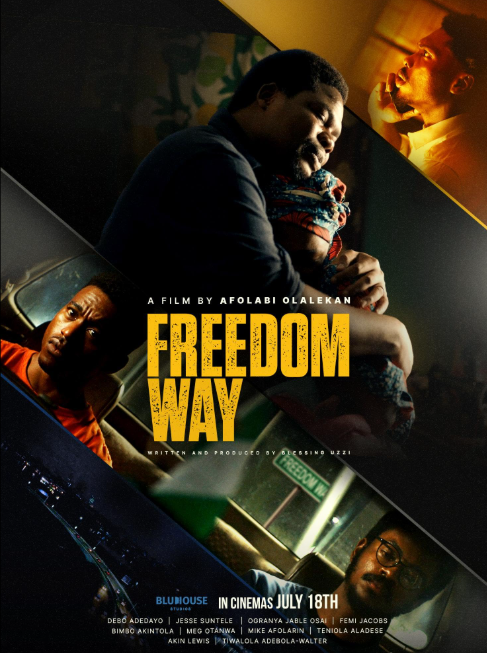
Indie titles like My Father’s Shadow (2025), Freedom Way (2024/5) and When Nigeria Happens (2025) remain overtly conscious of the social conditions that produce them. Beyond the conspicuous approach, as well, Nigerian indie films, especially films which function with an independent mindset rather than merely as a stepping stone to mainstream Nollywood, also tend to appreciate the inherent political character of cinema.
Nollywood, on the other hand, rarely does. Too many films suffer from an entry stage deficiency, as it concerns messaging, hence the recurring complaint in Nigerian film criticism: “This film does not know what it wants to say.”
Often, they meander, skipping between ideas, easily distracted, unable to complete any thought, and incapable of delivering coherence. Consequently, a story of self-discovery ends without self-discovery (Finding Me (2025)). A drama centred on a dysfunctional family grappling with trauma and abuse abandons the trauma and abuse in favour of theatrics (Family Brouhaha (2025)). A crime drama attempting a critique of Nigerian party culture and ethnic tensions takes an unjustified detour into unwarranted marital drama (Owambe Thieves (2025)). And a tourism film meant to challenge negative portrayals of Northern Nigeria becomes a decidedly negative portrayal of Northern Nigeria (Finding Nina (2025)).

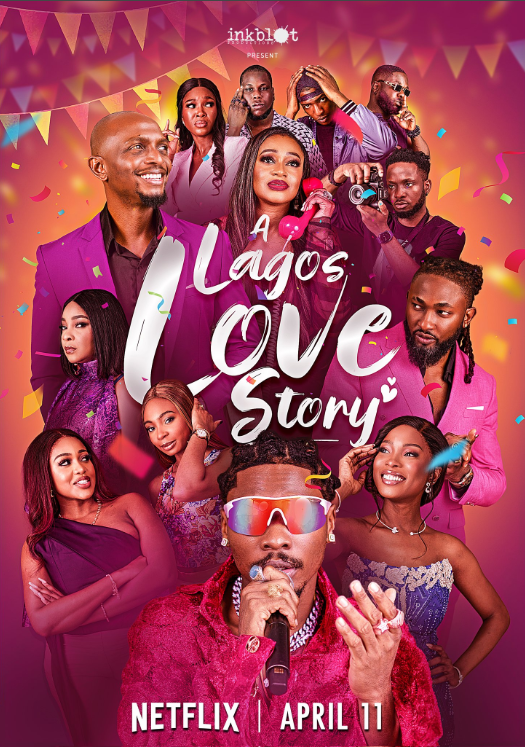
Other times, Nollywood films bury their thematic essence in pursuit of genre expectations. Thus, a psychological thriller built around sexual exploitation does not recognise that it is a film about sexual exploitation (Blackout (2025)). And a romance drama apparently interested in celebrity culture and power dynamics either skirts around the subjects or completely avoids them (A Lagos Love Story (2025)).
The overtly political films do not enjoy exception solely based on the fact of their politics. They, too, tend to fail the entry-stage test, often presenting incoherent ideologies, betraying their lack of appreciation for the implications of their attempted political statements.
Consider The Masked King (2025), a historical drama set in an ancient Efik kingdom. Arriving in a cinematic era of proud historical epics, currently dominated in Nigeria by Yoruba cinema, The Masked King pitches itself as a celebration of Efik history and culture. However, the historical events the film draws from (the customary killing of twins) demand that the film create a balance between adoration and condemnation. The Masked King, unclear on its own core message, ultimately leans towards a generalised demonisation of the local customs and a celebration of colonial religion.
Exceptions exist. Nollywood films like The Fire and the Moth (2025), The Herd (2025), and Radio Voice (2025) have recorded decent success in resolving the entry-stage question of political awareness. Having accomplished this feat, the question that follows is the deftness of the writing and the effectiveness of the message delivery. As that question is beyond the scope of this inquiry, suffice to say that proper execution of the message is a venture of equal importance, and, understandably, a priority of film criticism in Nigerian cinema.

If the vast majority of contemporary Nollywood films struggle to generate thematic relevance, to produce storytelling worthy of meaningful engagement, the implication is that the critic becomes easily manipulated towards the more agitating approach: “film bad / film good”, where good really means technically decent or competent. It is a belittling of the form, both of film and criticism, and a predominant cause of Nollywood fatigue among critics and audiences, especially critics.
Yet, criticism remains a sacred duty. And if films are inherently political, if all films have something to say, though they may be unaware or unconscious of their inherent politics, then the critic’s duty remains, difficult as it may have been rendered by the film itself. The critic must endeavour to rise to the challenge, above “film bad / film good”. The critic cannot afford the hypocrisy of limiting themself to “film bad / film good” while they criticise filmmakers for a similar failure.
Admittedly, we often wrestle with this demand, even more so in the past year. Critical engagement noticeably declined across the board, partly due to exhaustion. We wonder why we must consciously dedicate our faculties to films that exhibit little evidence of equal consciousness. Perhaps, we will always wonder. Nevertheless, we must apply to ourselves the rules we apply to filmmakers: It might be easier said than done, but it must be done properly.
After all, as Christian Metz succinctly noted, “Certainly, the criticism of films—or, better yet, their analysis—is an enterprise of utmost importance: it is the film-makers who create the art of the cinema; it is through reflection on those individual films we have liked (or those we have disliked) that we have gained insights into the art of the film in general”.
*This essay, among other cultural essays, is published in The Afrocritik Report 2025. Download the report here.
Vivian Nneka Nwajiaku is a writer, film critic and Afrocritik ’s Head of Film and TV. She has a master’s degree in law but spends most of her time consuming, studying, and discussing film and TV. She’s particularly concerned about what art has to say about society’s relationship with women.