

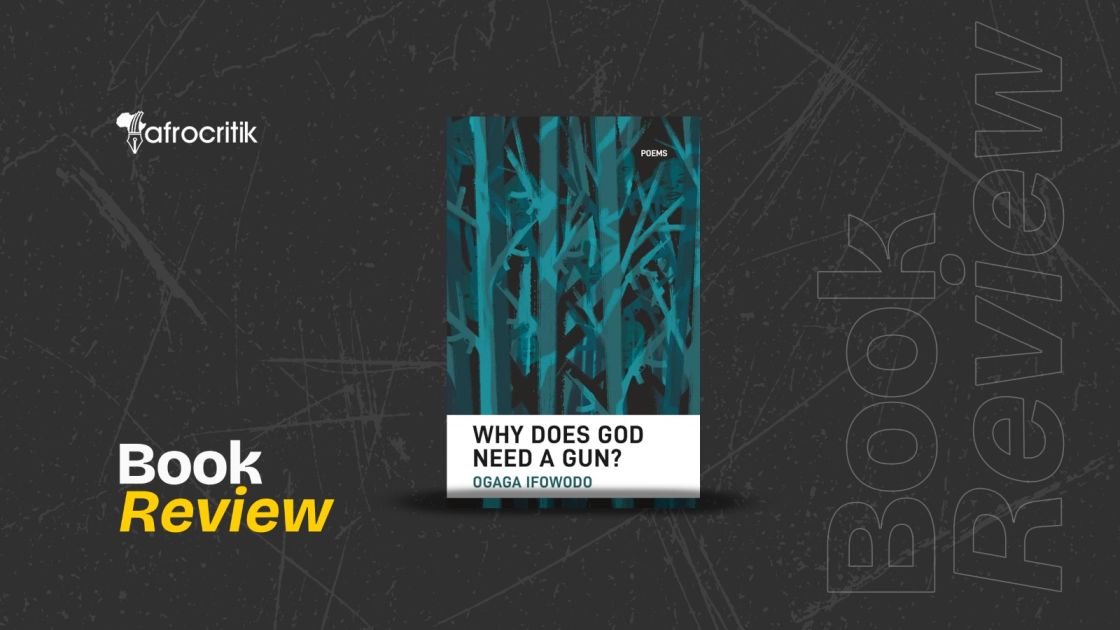

Greatness must surely be in Ogaga Ifowodo’s Why Does God Need A Gun?, for why else would the book make the Nigeria Prize for Literature’s shortlist of three?
By Chimezie Chika
Once upon a time in my fecund imagination, I offered a poor acquaintance I had just made three gift pieces—a pebble, a gold, and a diamond—and asked them to choose one. My acquaintance hastily chose the pebble. Surprised, I asked why. And they said, “Oh it really reminds me of my childhood. I used to pick pebbles by the seashore when I was…” And I shrugged and walked away with the real valuables. Is it possible, though, that the pebble was more valuable to that poor fellow than the gold and diamond? Is it probable that sentimental value is indeed incredibly more valuable than any objects or markers of factual (and actual) value?
Which is why, coming off the thought-provoking introduction to Ogaga Ifowodo’s poetry collection, Why Does God Need a Gun? (2026), which is currently on the shortlist of the 2026 Nigeria Prize for Literature, I went into my reading of the book looking for gems, scouring the pages for poetic expressions of the human condition, and was surprised to find none.
Surely, the incendiary subject of Africa-wide Islamic insurgencies, which we in Nigeria are well-acquainted with via the violent incursions of Boko Haram and ISWAP in the last decade and a half, should provide a moving poetic document. And if it doesn’t, should we, being very accommodating of spirit, redefine poetry to include any longueur versifications of passion and activism?
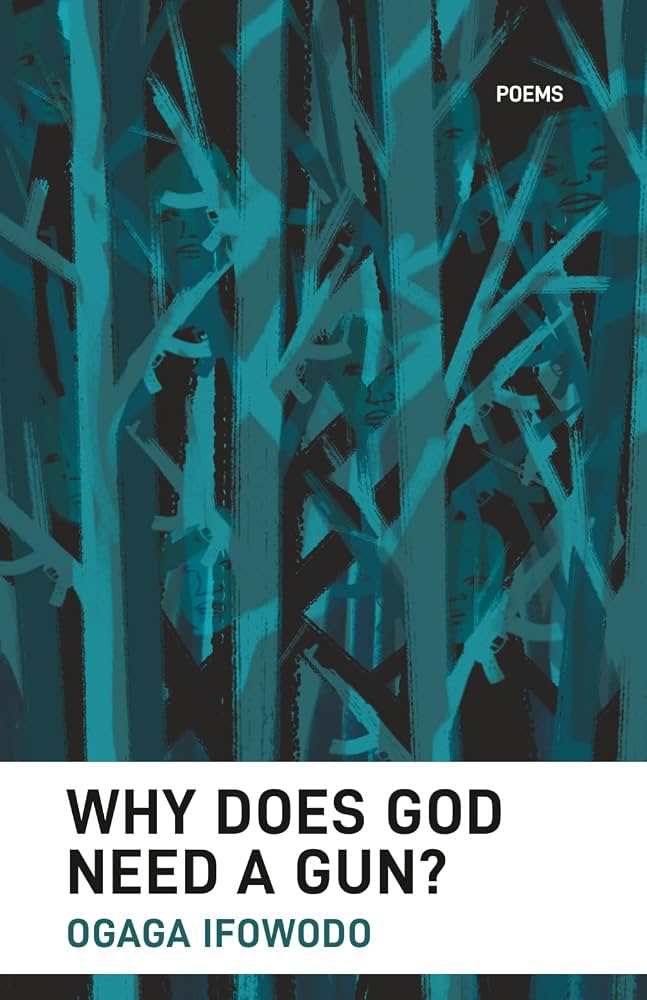
By the time one reads the titular poem, a quarter of the way into Why Does God Need a Gun?, this is what one is wont to think. Does our definition of poetry differ—if this is truly the trouble here—from an unknown definition of it insisted upon by certain other people? Are these lines supposed to count as poetry for merging alliteration and assonance?
As in: “Is breaking hymens and hearts heaven’s harvest?”
Or the opening lines of “A Window in Gaza”:
Which widow’s window keeps still
its wooden frame in a wall wobbling
in holy tremor?…
Could the ultimate diagnosis here be that of a rigid bench littered with hackneyed ideas about an extremely old genre of literature, or is this a simple matter of the absence of vital poetic intelligence beyond any pure-minded desire to document atrocities?
One is constantly struck by the poverty of these lines. Where is rhythm and painstaking diction? Where is real feeling? They are all so scarce here that one must pity any reader’s desire to enjoy poetry.
But is it possible that poetry cannot be enjoyed? Of course enjoyment in poetry is rooted in language and its use, in real feeling. It is possible then that poetry can be unenjoyable because the subject matter wears the clothing of sorrow? One can only say that it is possible that such joylessness is in lines like “I’ve transferred all my fears to him/to flourish in the weeds of his tangled beard”. Or the following mellow drama in the poem, “They Stripped Us of Our Own Clothing”:
‘Leah, don’t be AFRAID,
I’m coming to get YOU!’
Moved again beyond my mother’s arms, echo
of a dream lost in dust clouds, drowned
in the defeating drone of choppers
that bomb treetops and anthills far from us.
And into this rhetoric we must add the long poem, “The Forest is My New School”, with the footnote that if such a poem could be enjoyed, it would be in light of thinking of it as a soliloquy extracted from a play. That context is beyond important; it could be its saving grace.

What if then you decide to search for fresh and surprising metaphors? Would it be too far-fetched, considering the realities of your search, to imagine yourself as one of the human beasts of burden in the atrocious cobalt and coltan mines of Katanga and Eastern DRC? Would the poems, “The Strange Thought that I am in a Safe Place” and “Today, Something Popped Open Inside Me”, suffice to end your sorrows with lines like:
The strange thought that I’m in a safe place!
Where history’s knot
is too well wrought to unloose its riddle.
Or
Today, something popped open inside me
like a flower, maybe a hibiscus, vicious
red, or a black-eyed Susan crying yellow tears
to bear up a grieving heart, guarding…
Do I detect fatigue and weariness? Is the poet now tired of his own lines, but decides to continue to push the verses out of the assembly line? This must all be part of a great arms race of poetry geared towards a destination at Eko Hotel, to which end human factories are all over the place churning out line after line of verses without pausing to think about them.
Where goes good, old taciturn, laconic, terse and reticent economy in these pages? As far as poetry goes, don’t we usually get edified—and gratified—by the much more that is unsaid than by what is? Surely, the impassioned loquacity in all the poems leading up to the tasteless letter titled, “Dear Dad, I Missed You So Much Today I’m Writing a Letter”, and beyond, cannot help our course, or can’t it?
Once in an era, we come across singular promising lines such as:
The bleeding sun slinks to sleep over the hill in “They Had Been Out All Day, Fighting for God”.
There is also the opening of “Grief’s Consolation”, the entirety of “Dying to See His Face”, and “Angel of Hope and the Ticking Clock, Can You See Me?”, which more economy, more thought, and more imagination would have helped.
Even in these tiny sparks, you will lose your way looking for originality; all thanks to the major culprit of this poetry: overwriting. Perhaps it is not so much overwriting as over-trying beyond ability, over-forcing, overstretching, or just outright laxity.
All we know of the cohesiveness of the themes and subject here is what the poet tells us in the intro; beyond that, the poems do not follow a coherent narrative. Each, if it encapsulates a thought or a theme, stands almost entirely on its own, divorced from the ones before and after, and they are clearly not helped by this independence, for the independence is only by accident, and so the poems cannot sing alone or at all, even if we are told that they are supposed to.
Why? Because there is no poetry in these poems, if poetry can indeed be thought of as something more than mere sequenced lines. What will the reaction of a reader be who encounters the poem, “Who is Listening to the Cries of Little Girls?”
Who is listening to the cries of girls
snatched from school and hidden
in a forest haunted by holy hate?
Who is listening for the fading echo
of their hearts heaving with stifled songs
in breasts still forming, weighing the world’s burdens under forced conversion gowns
in whose crude cotton faith blacks out?
Who will listen to the cries of little girls
in a world deafened by guns, bombs, weeping?


Isn’t it all strangely redolent of a middling poetry assignment somewhere within the walls of a classroom?
I suppose there is greatness here somewhere, only that it is so craftily hidden away from dense fellows like me. And yet, greatness must surely be in here, for why else would the book make the Nigeria Prize for Literature’s shortlist of three? What I may advise the likes of me is to avoid this book; avoid the pages of this book, for they may burn you with your own anger at their existence. Which reminds me of the first few lines of another interesting poem here titled, “If this Forest Starts to Burn”:
If the mild morning air catches fire
and this forest starts to burn, lit
by thunderbolt, farmer’s cigarette butt
or holy fury — if this forest starts to burn —
flames leaping and creeping towards us
like a redcarpet coat soaked in petrol…
What does the imagery of the last line—“a redcarpet coat soaked in petrol”—mean?
May I then offer the conclusion that, in Why Does God Need a Gun?, you could toil yourself to rags looking for poetry? And may your god help you if you think there exists a possibility that you may find any poetic gems here.
Chimezie Chika is a staff writer at Afrocritik. His short stories and essays have appeared in or forthcoming from, amongst other places, The Iowa Review, Dappled Things, Channel Magazine, Terrain.org, Lolwe, Isele Magazine, Efiko Magazine. He is the fiction editor of Ngiga Review. His interests range from culture, history, to art, literature, and the environment. You can find him on X @chimeziechika1