


In Her Daughters’ Mother, her debut feature, Chukwu returns to the vulnerabilities and agency of society’s marginalised, this time turning her lens to womanhood, through a woman and her daughters whose lives depend on the favour of men, both born and unborn.
By Vivian Nneka Nwajiaku
Many who have seen the tender but fraught Ti e Nbo (2023), Chinàzaēkpērē Chukwu’s debut short—not counting A Psalm for Abigail (2021), which won her the Best Director award as a student of EbonyLife Creative Academy—would be curious to see what the Nigerian writer-director can do with the time and space that a feature-length affords. The operative word is “many”.
Ti e Nbo is a queer film that explores homophobia in a country where homophobia is rife and public displays of same sex amorous relationships are an imprisonable offence. The five-minute film was a daring move for a new filmmaker introducing herself to a largely conservative country and film industry. Of course, some would be curious. What would she invest in for her first feature? What would a long runtime enable her to explore?
In Her Daughters’ Mother (2026), her debut feature, Chukwu returns to the vulnerabilities and agency of society’s marginalised, this time turning her lens to womanhood, through a woman and her daughters whose lives depend on the favour of men, both born and unborn.
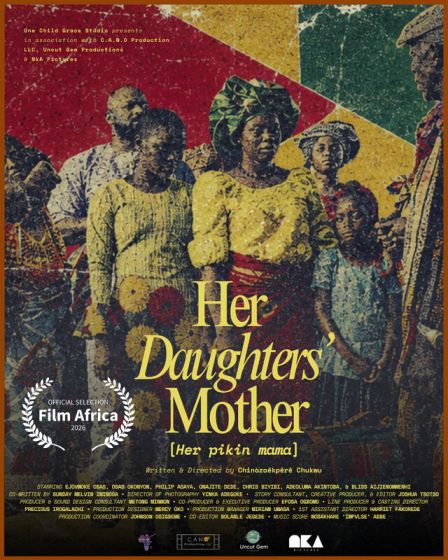
Set in an unspecified time period—presumably pre-2007, given the version of naira notes displayed onscreen and the early 2000s production design—between Benin, Edo State and Warri, Delta State, where a bewilderingly vague public crisis—presumably the 2003 peak of the Warri Crisis—is making parts of the town unlivable, the film follows the private struggles of a family whose survival is tied to a mother’s ability to give birth to a son.
Ejiro, the protagonist, is a woman in her thirties who has already lived with all the labels expected of a woman in a patriarchal society. With no dillydallying, Her Daughters’ Mother introduces her as a sixteen-year-old daughter being married off to an older man by a satisfied father. In the next scene, she is a widow undergoing widowhood rites, including the practice of drinking the water used to clean the corpse of her late husband. And right after the title card, she is a mother returning to her father’s home in Warri with her two daughters, having been thrown out of her marital home for her lack of a male child.
Played by Ejovwoke Obas Olikuntuyi, who finds the balance between the exhaustion of a woman who has led a difficult life and the staunchness of a woman who has mastered the art of making practical decisions within a subservient culture, Ejiro settles into a childhood home that she considers her own, while she makes plans to finally start earning a living to give her daughters the education that she did not receive. But she is quickly reminded that the home really belongs to her father (Chris Biyibi), and he insists on marrying her off again, this time to a more appropriately aged Benin-based widower called Osato (Philip Asaya).
Initially, with the support of her unmarried and childfree aunt, Akpobome (Najite Dede), who once escaped a similar fate, Ejiro refuses. She intends to work for the future of her daughters, one of whom is almost as old as she was when her father first married her off.
Fifteen-year-old Ejiata (a transformed and convincing Osas Okonyon) will be a medical doctor, she says, and nine-year-old Miriodere (newcomer Bliss Ajienomwenhi) will become a lawyer. But when her father leaves her no choice, and with the streets of Warri becoming too troubled to raise two daughters in, she negotiates an arrangement with Osato. She wants educated daughters. He wants the same thing her late husband’s family used against her, regardless of the cost.
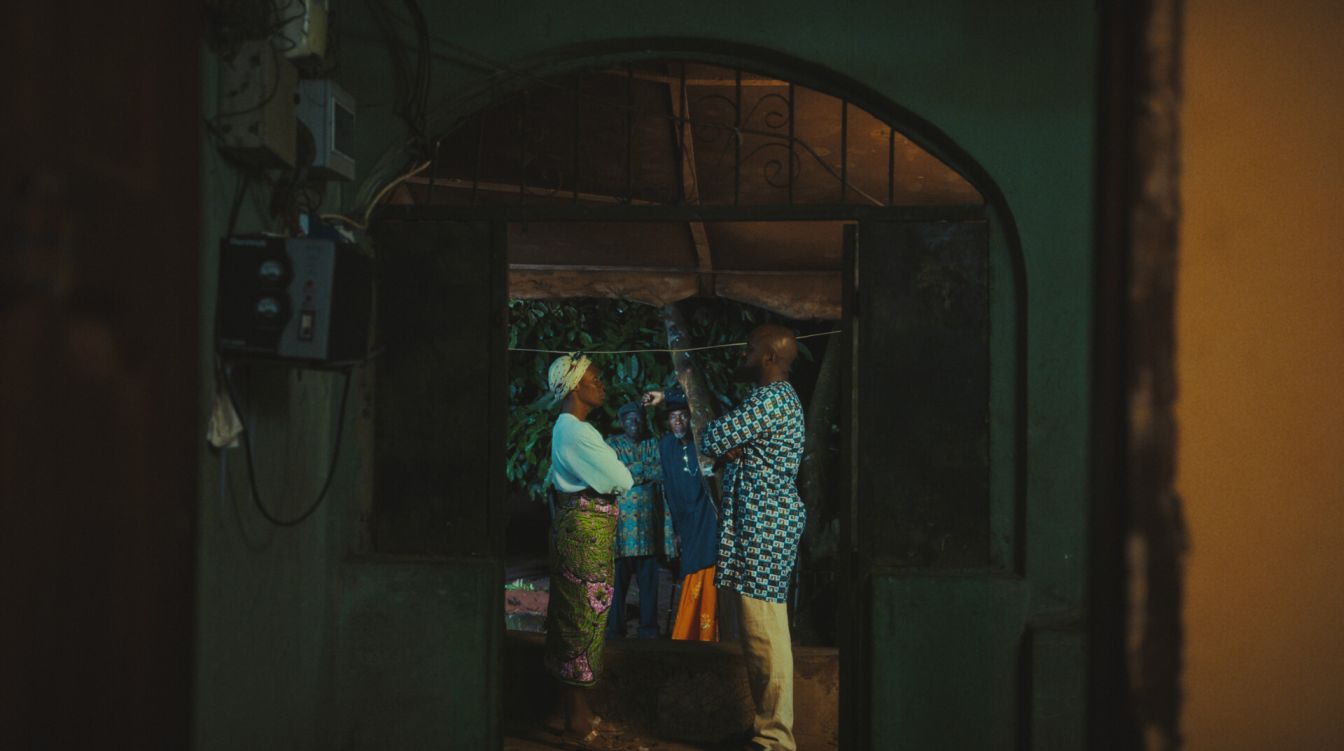
The narrative that unfolds from this premise is a snapshot of the loneliness and cultural humiliations that many women endure in the quest for male children, and how even the potential of a long-awaited son can be a bargaining tool for a woman who operates in a society that is as agnatic as it is natalist.
But power imbalances remain power imbalances, irrespective of what little agency a woman is able to assert within such a structure, and Her Daughters’ Mother remains cognisant of this notion. In one devastating scene, when Ejiro travels to Warri while the crisis rages on, Osato aggressively warns her: “Ejiro, if you wan kill yourself, fine. But if anything happen to my pikin, my boy, I go kill you first before you kill am”. It is a terrifying use of hyperbole, if one can call it that. And yet, it is an apt description of society’s treatment of women as valuable primarily for their capacity for reproduction.
From production design to cinematography, Chukwu visually frames the film’s titular mother and daughters as ever-conscious visitors in their new home, and Osato as a comfortable, omnipresent outsider within their story. But the cultural pressure for procreation and male heirs is not manifested solely through Ejiro and her girls. The pressures are also channelled through the man of the house, as Asaya subtly but visibly alters his demeanour the moment the possibility of a son becomes real.
It is evident in Osato’s mood and carriage around their household, in his treatment of Ejiro and her daughters, and in his active involvement in the preparation for the possible arrival of a son. While Ejiro noticeably struggles, Chukwu trains the camera on Osato as he conceals a smile at the news of a possible pregnancy, restrains himself from shedding tears of joy when he sees a baby bathtub, and hums with tempered excitement in the presence of a crib.
In capturing the performance of marriage and family life within these conditions, Her Daughters’ Mother also explores the sexual, economic, and psychological realities of patriarchal power imbalances in marriage, as well as the sacrifices of motherhood, intergenerational trauma, and the tendency for women’s relationships with men to affect their relationships with their daughters while also spilling into their daughters’ relationships with men, becoming both an agent of radicalisation against patriarchal expectations and an inheritable characteristic that passes on from mother to daughter.
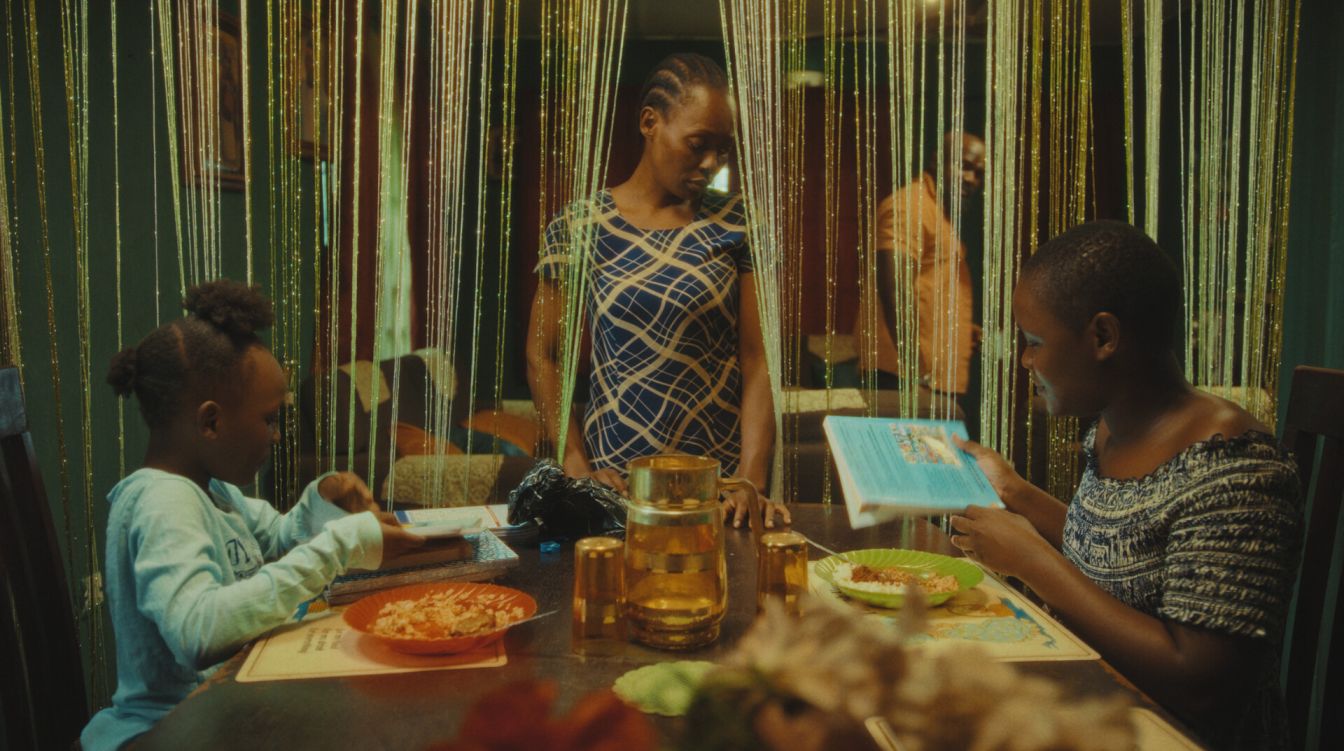
Ejiro, herself, is her mother’s daughter, their shared trauma reflected in the destructive marital situations they choose or have no choice but to stay in. Ejiata’s friendship with a seemingly well-meaning boy from school (Adeoluwa Akintoba)—a tender story of young love, including a particularly optimistic and picturesque sequence, carried especially by Okonyon—becomes burdened by the dangerously transactional relationship that her mother has with her stepfather. And their mother-daughter relationship has to compete with the trauma that Ejiro comes into motherhood with and the baggage that Ejiata was born into.
If there’s something about the story, the themes, and how the film approaches them that feels like reading a Nigerian work of literary fiction, that’s because Her Daughters’ Mother is indeed a film intended to feel like a combination of sorts between Buchi Emecheta’s The Joys of Motherhood (1979) and Ayọ̀bámi Adébáyọ̀’s Stay With Me (2017). Chukwu transfers her self-written story to the screen with a persistent literary disposition, from thematic preoccupations to the film’s pacing, editing, and visual design.
That style is both a boon and a bane, though more of the former. Her Daughters’ Mother occasionally lingers just a bit longer than it needs to. But like many good Nigerian works of literary fiction, it hits like a bittersweet hug from someone familiar—a moving, poignant tale of defiance and resilience in the midst of harsh societal realities.
Rating: 4/5
*Her Daughters’ Mother premiered at Film Africa, UK on 28th October 2026 and is headed to the Africa International Film Festival (AFRIFF) in November 2026. It was recently nominated for Best Debut Feature Film by a Director at the 2026 Africa Movie Academy Awards (AMAA).
Vivian Nneka Nwajiaku is a writer and film critic writing from Lagos. She has a master’s degree in law but spends most of her time consuming, studying and discussing film and TV. She’s particularly concerned about what art has to say about society’s relationship with women. Connect with her on X @Nneka_Viv