



As it stands, NO DAYS OFF offers a substantial amount of Smoke’s perspective but not quite enough musical variation through which to explore it.
By Yinoluwa Olowofoyeku
Kweku Smoke has built his career around motion. Born Paul Amankwah, the Ghanaian rapper emerged from Accra’s Hip-Hop scene with a sound rooted in Trap, Hiplife and street Rap, initially releasing music under the name YRS before gaining wider attention in 2019 through “Yedin”, his collaboration with Sarkodie.
His subsequent catalogue has developed at an unusually relentless pace, moving through a bevvy of EPs and albums including 2020’s Snoop Forever, 2023’s PLAYMAN, 2024’s Kweku Jesus, 2025’s WALK WITH ME, while maintaining a musical identity built around Ghanaian language, street-level storytelling, hard-edged rap and reflections on ambition, hardship and survival. His official biography describes a sound that combines West African rhythmic traditions with contemporary Trap and Afrobeats, while his own accounts of his career have emphasised the independence and labour required to build his catalogue without the backing of a traditional label.
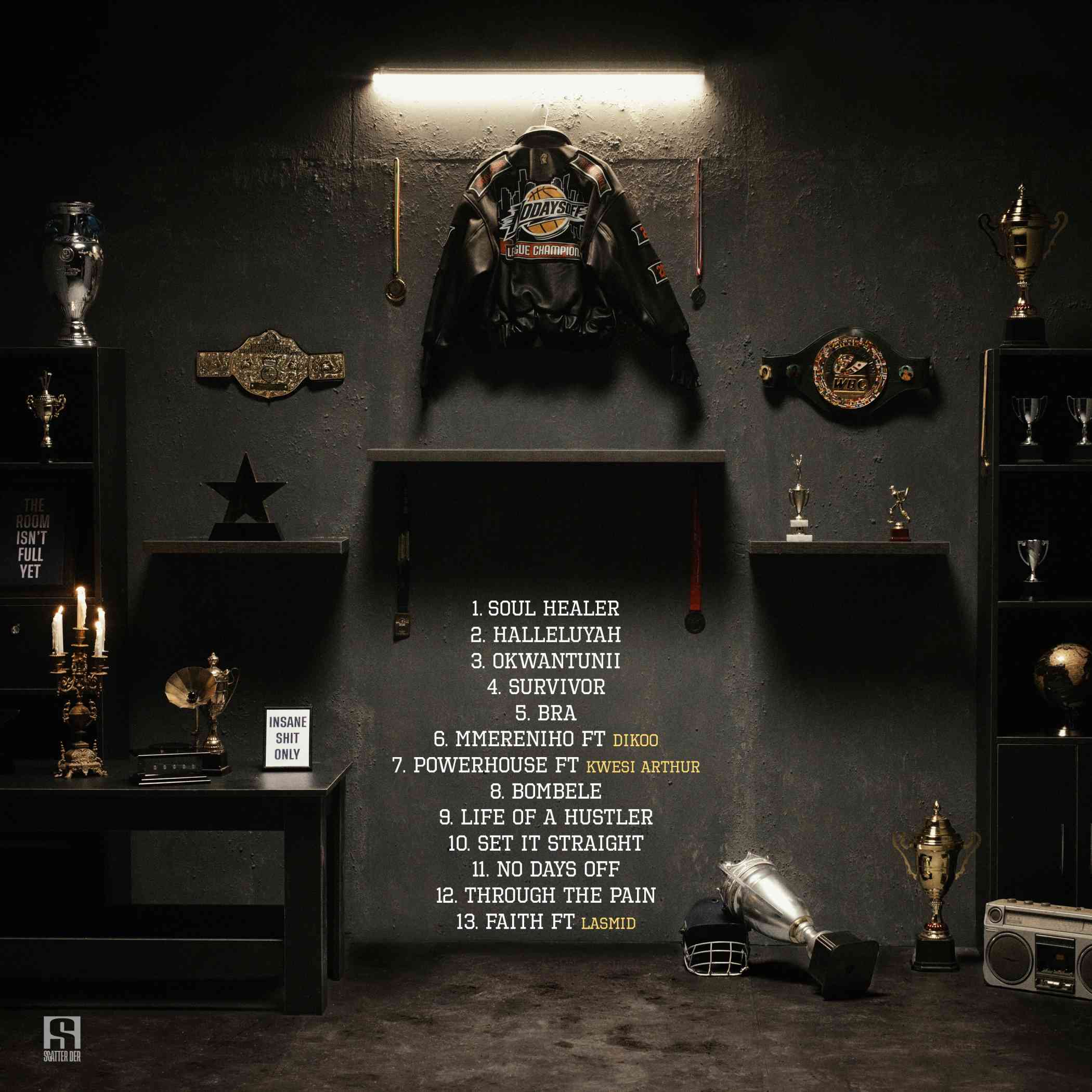
NO DAYS OFF, released on 4 September 2026 through Scatter Der, arrives as his seventh studio album, according to Smoke himself, following the momentum of WALK WITH ME, which has been reported to have surpassed 100 million streams worldwide.
Across its 13 tracks, Smoke brings Lasmid, Kwesi Arthur and Dikoo into a body of work that continues his fixation on hustle, survival and the refusal to become complacent, while its title turns the work ethic that has defined his career into the project’s central statement. In a career already characterised by constant output, NO DAYS OFF therefore arrives not simply as another addition to an expanding discography, but as a continuation of the philosophy that has carried Kweku Smoke from an aspiring rapper recording with friends to one of Ghana’s most prolific contemporary Hip-Hop voices.
“Soul Healer” opens NO DAYS OFF with dark, filtered Hip-Hop piano chords and a rich bass foundation before Kweku Smoke arrives almost immediately with an aggressive vocal performance. Hard-hitting Hip-Hop drums, rattling hi-hats, punchy kicks and a sharply cutting Trap snare give the record a blunt physicality, while Smoke largely sticks to a straightforward rap cadence, delivering his bars without much variation in flow or rhythmic dexterity.
A deep choral vocal sits underneath the instrumental, adding an almost spiritual dimension to the otherwise hard-edged production. The chorus introduces more melody, with Auto-Tuned backing vocals and upper-register harmonies layering around Smoke’s lead before the arrangement strips back for a softer bridge built around filtered, melodic piano and heartfelt singing. The song then explodes back into the hook, with the drums returning alongside wider layers of harmonised vocals across the stereo field, creating a large, emphatic finish.
Lyrically, the song establishes the album’s recurring relationship between hardship, survival and eventual triumph, with Smoke describing himself through the language of street experience and resilience. He declares, “Soul healer, street skills ya / fam old taker”, before reducing survival to a simple equation: “Experience is a loser joe wo nwuu ye a wo ye winner”. [Experience is a loser, if you don’t die, you are a winner.] That framing makes the song’s title feel less like a literal description than a statement about the lessons Smoke has taken from the streets and the experiences that have shaped him.

“Halleluyah” then turns that survival instinct towards gratitude, beginning with sombre strummed rhythm guitars beneath an emotional, heartfelt vocal performance. Gentle shakers sit alongside the guitars as the drums gradually creep into the arrangement, with snaps and clave-like percussion eventually giving way to the Trap-heavy hook: a heavy 808 kick, sharp hi-hats and Trap clap layered over the guitar foundation.
Smoke spends more time singing than rapping here, placing the song firmly in the Emo-Trap tradition, although his melodic movement remains relatively straightforward. The emotional weight is therefore carried less by elaborate vocal runs than by the sincerity of the delivery and, more importantly, the lyrics, where he attributes his progress directly to God. He sings, “Hyɛ me animonyam, to me pono kyere ma tanfo”, [Honour me, set a table before my enemies], before later insisting, “If I lose it all na me wo woa / won’t be a beggar”. The combination of divine gratitude and confidence in his ability to rebuild gives “Halleluyah” a sense of faith that complements the album’s broader survival narrative.
“Okwantunii” opens on a much larger cinematic scale, with synthetic strings wailing across an expansive intro before Smoke settles into a melodic rap performance. The production quickly reduces itself to a fairly straightforward Hip-Hop framework, with largely unchanged kicks, snares and hi-hats, including recurring open-hat patterns, while the orchestral loop remains the main source of atmosphere.
Smoke’s delivery is expressive but similarly direct, with occasional harmony lines and backing vocals appearing across the stereo field to provide some additional texture. Even the chorus uses drum dropouts to create space around the vocal, but the instrumental itself does not evolve significantly beyond the cinematic string foundation and the drum pattern. The result is a narrative-driven performance in which the storytelling, rather than technical rap dexterity, carries the song. That focus becomes clearer in the lyrics, which frame ambition through the experience of leaving home and pursuing opportunity elsewhere.
Smoke raps, “If I don’t risk I’m not playing / ma roles / Anything for Dollar / everyday I’m busting moves”, before reinforcing the relentless nature of that pursuit with, “The grind don’t stop me”. The song’s focus on risk, work and movement connects with the album’s wider portrayal of hustle, while also giving the track a broader perspective on the sacrifices involved in building a life away from familiar surroundings.
“Survivor” continues that introspective thread, beginning with filtered synthetic brass and large chords before a rich bassline and hard-hitting Hip-Hop drums establish a more forceful foundation. Smoke’s performance is notably more melodic here, using rapid-fire sung phrases rather than relying entirely on conventional rapping, and the vocal melodies are among the more expressive on the opening stretch of the album.
The beat remains relatively rigid, with incessant quarter-note hi-hats, pounding drums and a sharp snare, and the structure does not evolve dramatically, but the vocal performance introduces a greater sense of movement. That emotional quality becomes particularly clear in the lyric, “Abi afa mu awu o, m’atumi apue a metiri nkwa”, [Maybe I died within it, but I managed to come out and I am still alive.] The line captures the song’s central idea directly: survival is not presented as an abstract achievement, but as the result of enduring circumstances that could have broken him.
“Bra” provides a significant change of atmosphere, opening with a samba-tinged arrangement of filtered electric keys, ghostly atmospheric vocals, rich synth bass, high, wailing cinematic strings and marching percussion. When Smoke enters, grand piano chords reinforce the harmonic foundation while the marching percussion and hi-hats continue underneath his highly emotive singing.
He leans heavily into trills and expressive melodic phrasing, sounding genuinely pained as the arrangement gradually introduces energetic Hip-Hop drums, complete with steady hi-hats, a rounded, punchy kick and sharp snare flourishes. Sparse vocal harmonies appear around him, while the chorus takes on an almost pleading quality.
The lyrics confirm that sense of desperation, particularly when he sings, “Eno nti bra o, bra o bra / Bra fa w’ani behwe ma manee a me hunu yi”. [So come, come, come / Come and look with your own eyes at what I have seen.] He follows it with, “Medi yaw ma awershoo / kum me sumsum”, [I am in pain, sorrow is killing my soul], turning the song’s expressive vocal performance into something much more explicit. The marching percussion, expressive strings and haunting vocals then carry the record to its close, leaving it suspended in the same cinematic, wounded atmosphere with which it began.
“Mmereniho”, featuring Dikoo, returns to the darker Trap palette, using a haunting vocal loop, dark piano and synth keys to establish a repeating instrumental foundation before the familiar combination of rattling hi-hats, heavy 808 bass and Trap snap-clap enters. Dikoo delivers a straightforward rap verse, maintaining a relatively consistent flow and rhyme scheme, with occasional backing vocals providing small points of variation.
Smoke’s own writing, meanwhile, reinforces the album’s insistence on authenticity and self-made progress. “They want me to act like abi / some fucking Dbee”, he says, rejecting the idea that his success came from privilege, before making the position explicit: “I’m sticking to my truth and / my originality”. The lyric gives context to the song’s otherwise conventional Trap framework, presenting the collaboration as another assertion of where Smoke came from and the identity he intends to maintain as his circumstances change.
“Power House”, featuring Kwesi Arthur, initially follows the album’s darker aesthetic, with haunting vocal samples and dark piano forming the central loop while synthetic strings add another layer of drama. Smoke begins before the drums arrive, using a melodic rap approach that keeps returning to similar melodic notes while shifting the cadence against the syncopation of the piano. Once the drums enter, however, the familiar Trap language returns: rattling and triplet hi-hats, frequent open hats, hard kicks and sharp snare hits with small double-note flourishes.
Kwesi Arthur takes over the chorus with Auto-Tuned melodic singing, giving the section a psychedelic Trap quality as the drums drop away and leave more space around the vocals. The bilingual delivery between English and Twi also gives the record some additional vocal texture, but it is ultimately Smoke’s phrasing that provides most of the rhythmic interest.
The lyrics continue the album’s focus on self-made ambition, with Smoke presenting himself as someone whose progress has been earned rather than inherited. “My shoe clean, my heart clean, my mind clever”, he declares, before following it with, “Another day, to make my / fucking life better”. That combination of self-assurance and continued striving is central to NO DAYS OFF, where achievement is rarely treated as a reason to stop.
“Bombele” finally loosens the album’s sonic grip. Although the underlying drums remain recognisably Hip-Hop, with triplet hi-hats, straightforward kicks and snares, the slower tempo and dreamy, detuned melodic loop give the song a noticeably lighter bounce. The instrumental almost sounds like haunted mallet bells, creating a strangely playful atmosphere beneath Smoke’s melodic performance. The repeated “Bombele” hook is immediately catchy, while Smoke rides the beat with considerably more variation than on several of the preceding tracks, moving between quicker passages and slower, more spacious phrases and reaching into higher notes.
The simplicity of the beat gives him plenty of room to fill the space vocally, and the lyrics match that looseness by turning towards unabashed ambition: “Me hia Maybach / Me hia two big house in / Vegas / Dreams plenty, kotoku empty”. [I want a Maybach / I want two big houses in Vegas / My dreams are plenty, my wallet is empty.] The contrast between the grandness of the dreams and the emptiness of the wallet captures the song’s hunger succinctly, while the melodic performance and bouncing instrumental make “Bombele” one of the album’s more immediately enjoyable moments. It eventually closes with Smoke singing in a much more heartfelt, expressive register, allowing the track’s playful confidence to give way to something more vulnerable.
“Life Of A Hustler” returns to a simpler musical framework, built around a straightforward guitar chord progression and bass before the familiar Trap drums arrive with hi-hats, strong Hip-Hop kicks and clap-snare hits. A small cowbell-like percussion sound adds a little extra colour to an otherwise largely loop-based instrumental, but it is Smoke’s vocal performance that gives the song its character. His delivery is notably melodic, with relaxed, spacious cadences and carefully chosen melodies that sit somewhere between rapping and singing.
The chorus provides the strongest melodic anchor, tying the different sections together while allowing Smoke to maintain the conversational quality of the verses. The lyrics expand the album’s street-level world-building into a more personal account of what that hustle has cost him. He raps, “Pocket look crazy left the pain on the songs / Accepting all my losses, I’m writing all my wrongs”, connecting the music itself to the process of documenting his experiences. The song therefore works as both a hustle narrative and a reflection on the act of turning hardship into material, with Smoke’s relaxed vocal performance making the storytelling feel more lived-in than performative.
“Set it Straight” then darkens the atmosphere again with a grimy, industrial synth progression that sounds distorted and heavily textured. Unfortunately, the production falls back into the same familiar drum language, and the repetition becomes increasingly noticeable, right down to the use of a cowbell sound similar to the one heard on “Life Of A Hustler”.
The effect makes the song feel as though some of its possibilities have been left unexplored, particularly because Smoke himself delivers one of the more expressive performances on the project. He pushes his voice into a high, chest-led register, sounding almost as though he is pleading or belting through the bars, moving between English and Twi with a level of intensity that gives the performance considerably more emotional force than the instrumental beneath it.
The lyrics are equally direct, particularly when he addresses people whose interest appears tied to his success: “Only dey show face for the / kudi not the trend”, before contrasting that attention with the people who were absent when he had nothing. Later, he turns towards the loyalty that remains meaningful to him, telling his “brother for street” that he is proud of him. That emotional directness makes the limitations of the production more apparent, because there is clearly a more moving song inside Smoke’s vocal performance than the repetitive instrumental ultimately allows to emerge.
The title track, “No Days Off”, returns to the album’s now-familiar palette of haunting choral vocals, dark bells and atmospheric loops, this time joined by an unusual synth melody before another straightforward Hip-Hop drum pattern enters. There are some additional snare rolls and flourishes that give the rhythm a little more character, but the instrumental remains relatively static.
Smoke compensates with a vocal performance that moves between aggressive upper-register rapping and softer passages in a lower register, creating a more pronounced rise-and-fall dynamic than the instrumental itself provides. His delivery is forceful and expressive, at points approaching a belt, before dropping into quieter moments that give the song a sense of movement.
The lyrics make the title’s philosophy explicit, as he reflects on the hardship that preceded his current position: “Through depression I / fought for every dollar on / ma hand”, followed by the declaration that “The street respect yanfa ne / fom that’s shit you need to earn”. [Street respect does not come for free; it is something you need to earn.] The result is a portrait of perseverance in which success is treated as something built through repetition, hardship and endurance rather than something that arrived overnight.
“Through The Pain” then strips the arrangement back into a string-led soundscape, with a string quartet-like progression droning through the opening before introducing small counter-melodies once the drums arrive. Those drums are, again, recognisably the same Trap vocabulary that dominates much of the album: 808-heavy kicks, rolling and trilling hi-hats, open hats and a Trap clap. But the vocal performance changes the emotional texture considerably.
Smoke sings in a lower, more subdued register, using layered group vocals and harmonies to give the hook additional depth. The cadence remains simple across the verses and chorus, yet the combination of the minimal strings, restrained delivery and melodic choices creates a stronger emotional connection than the simplicity of the arrangement might suggest. He distils the album’s philosophy into a single reflective statement: “All this losses and lessons / thought me the hard way to win”. The brevity of the track works in its favour, allowing the emotional idea to land without overstaying its welcome.
“Faith” closes NO DAYS OFF with another notable shift in sound, beginning with pitched-up vocal samples and warm atmospheric pads built around a samba-leaning chord progression. Bass guitar introduces more lively movement, while filtered vocals that resemble a female choir sit around the chords, and the rhythm finally moves beyond the album’s dominant straight-ahead Trap template.
The heavy bass kick and Trap snare remain present, but the syncopation leans more towards Afrobeats and Afro-Pop, giving the song a looser rhythmic character. Smoke and Lasmid follow that change with a more melodic performance, with Lasmid taking much of the hook while Smoke uses softer lower-register singing in the verses. Harmony layers, backing vocals, ululations and ad-libs fill out the arrangement, with Lasmid in particular bringing a rich stack of vocal harmonies to the record. Some of those layers sit slightly more prominently than they might ideally, but they nevertheless contribute to the song’s full, warm vocal character.


The lyrics make the spiritual dimension of the album’s closing statement unmistakable. Smoke sings, “Se Yehowa tumi yɛ adeɛ / nyinaa a / Fa wo biribiara kye no oo”, [If Jehovah can do everything, entrust everything to Him], before returning to the idea of hope with “Anidasoo anya nnsaee oo / fa no nyinaa kye no oo”. [Hope has not ended; entrust it all to Him.] After an album so preoccupied with work, survival, money, pain and the consequences of ambition, the final song therefore places its faith in something beyond the hustle itself.
It is a fitting thematic counterweight to the title, suggesting that the relentless work ethic at the centre of NO DAYS OFF exists alongside a belief in divine direction. Musically, however, NO DAYS OFF ends without a grand final flourish. “Faith” simply reaches its conclusion and cuts away, leaving the project to close on the same understated simplicity that characterises much of its production.
Ultimately, NO DAYS OFF is a difficult project to assess because its strengths and limitations exist almost entirely on opposite ends of the same idea. Kweku Smoke’s remarkably high output is part of what makes the album feel so authentic to its title: he has a lot to say, he is constantly working, and the music reflects a life built around hustle, ambition and the experiences that come with relentless pursuit.
Across the album, Smoke draws from personal experiences, street culture, hard-earned lessons and the realities of chasing dreams, and in that respect, NO DAYS OFF is thematically competent and expressive of the artistic persona he has cultivated. He is consistently communicating what it means to graft, to want more, to deal with loss and adversity, and to keep moving regardless.
The problem is that the musical framework carrying all of that material is considerably less expansive than the subject matter itself. Production is where the album’s sameness becomes most apparent, with much of the 13-track sequence relying on variations of the same formula: dark, cold piano or synth loops, gritty textures, haunting choral vocals, relatively simple eight-bar melodic progressions and familiar Trap drums built around rattling hi-hats, heavy kicks and 808s, and sharp snares or claps. Even the drum sounds can feel remarkably consistent from song to song, with similar hats, kicks and snares repeatedly resurfacing, sometimes to the point where elements such as the cowbell in “Life Of A Hustler” and “Set it Straight” contribute to the impression that the same production vocabulary is being recycled. The relatively similar song lengths and structural approaches reinforce that feeling, leaving only a handful of tracks to provide significant changes in tempo, rhythm or sonic character. It creates a cookie-cutter quality that ultimately limits the album’s ability to express the full range of experiences Smoke is writing about.
His vocal performances do considerably more of the heavy lifting. Smoke is energetic, expressive and often forceful, moving between straightforward rapping and melodic singing with a conviction that gives even relatively static productions some life. There are moments of genuinely effective melody, strong vocal harmonies and particularly emotive performances, while the featured artistes contribute their own presence to NO DAYS OFF’s vocal palette.
Yet the same issue of variation persists in the vocals: established melodies often remain largely unchanged throughout a song, while Smoke’s flows and cadences tend towards straightforward patterns rather than demonstrating much dexterity or rhythmic experimentation. What the performances lack in agility, however, they often recover through sheer presence, intention and emotional conviction.
Lyrically, this is where NO DAYS OFF makes its strongest case. Smoke’s writing is rooted less in elaborate wordplay, punchlines or technical rhyme schemes than in diaristic storytelling, using personal experience, street wisdom, learned lessons, ambition and hard-earned philosophy to examine his relationship with work, money, survival and the people around him.
Some of the rhyme schemes can be clumsy, and there are moments of cliché, but there is genuine personality in the writing, particularly in the way Smoke shifts between recounting his own struggles, describing his dreams, reflecting on what it means to earn respect, offering advice to those coming behind him and considering what his life as a rapper represents within the larger story of his life.
Even when the language creates a barrier for listeners who do not understand every line of Twi, the conviction of the delivery makes it clear that there is substance behind the performance. That makes the limitations of the production all the more frustrating, because these stories could have benefited from a much broader emotional and sonic palette. As it stands, NO DAYS OFF offers a substantial amount of Smoke’s perspective but not quite enough musical variation through which to explore it.
For listeners primarily invested in Kweku Smoke as a rapper, the album provides plenty of the qualities that have defined his work: personal narratives, street-level observations, ambition, resilience and an unmistakable conviction in his delivery. But viewed as a broader artistic statement, the project feels overly reliant on the established conventions of straightforward Trap and Hip-Hop, leaving considerable room for greater experimentation, diversification and musical risk. Kweku Smoke clearly has stories worth telling; on NO DAYS OFF, it is the production that too often keeps those stories from reaching as far as they potentially could.
Lyricism – 1.5
Tracklisting – 1.5
Sound Engineering – 1.2
Vocalisation – 1.4
Listening Experience – 1.3
Rating – 6.9/10
Yinoluwa “Yinoluu” Olowofoyeku is a multi-disciplinary artist and creative who finds expression in various media. His music can be found across all platforms and he welcomes interaction on his social media @Yinoluu.