

As events continue through the remaining half of the year, the most interesting note is that we must learn crucial lessons from each one.
By Chimezie Chika
Even if 2026 started without too many ruffles, it was clear by March that this was going to be a year of events and upheavals. As we captured in the first quarter roundup of 2026, quite a bit happened. If the first quarter gave us opening salvos in an all-out war, the second quarter was the war itself. One hullabaloo following hotly on the heels of another—one literary kerfuffle after another—it has proven to be far more than what anybody expected, and the core arguments at the centre of each capture the breath of our contemporary literary concerns.
In late April, the acclaimed Zambian-American author and literary scholar Namwali Serpell made a thread on her X account (responding to an original video post by an X user called Justina over the difficulty of reading Toni Morrison’s Beloved) about her newly published book On Morrison, a study of Toni Morrison’s work and craft.
Serpell explained in her original response and others that Morrison’s works are written to be deliberately difficult because Morrison expects her readers to be intelligent and willing to participate fully in the reading and subject of the work. In response, some people on X argued that it is problematic to praise a deliberately difficult writer; others accused Serpell, a lifelong lover of Morrison, of having no basis for labelling Morrison’s works as difficult.
Immediately after this, one of the most significant upheavals of the year happened. We shall call it—as already labelled elsewhere on this platform—the Ernest Jesuyemi/NBCC affair. Nigerian poet and critic, Jesuyemi published an essay, “The Wrong Kind of Black Poet”, in Compact Magazine in early May detailing how he got accepted into the National Book Critics Circle Emerging Critics Fellowship and then got bundled out of it soon after on the basis, according to him, of his religious beliefs.

The problem was that someone had tipped off the people at NBCC that Jesuyemi had made a homophobic post on X in the past. NBCC, on the other hand, is an organisation that prides itself on “inclusivity”. Their explanation is that Jesuyemi’s beliefs are in direct opposition to their own in-house rules, and that those beliefs would harm his fellow participants. Jesuyemi’s essay is remarkably honest, and his criticism of the selectivity and tokenisation of the liberal notion of “inclusivity” is fully aware, but it also falters somewhat on its politics.
The response to Jesuyemi’s essay was huge and divisive—both in the positive and negative frame, the latter far outweighing the former. Particularly on X, the LGBTQ community hurled all manner of criticisms his way, and a number of essays were written as ripostes, one of which is published in Afrocritik by Chiemeziem Everest Udokwu. The question remains, however: Is NBCC justified by its inclusivity house rules, or was Jesuyemi deeply wronged by the subjectivity of those same rules?
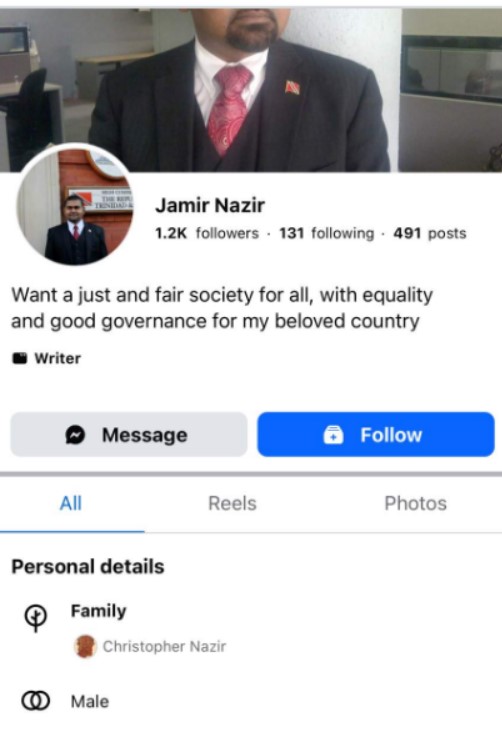
Then there was the biggest controversy of the year so far: Commonwealth Short Story Prize 2026. Beginning in the middle of May, the particular saga dragged for the better part of two months, and its consequences will still be felt in years to come. When the award announced its regional winners, readers immediately pointed out that one (or more) of the stories—a story by the Caribbean regional winner, Jamie Nazir appears to have been written by an LLM. They pointed to several AI tells. As more evidence emerged, the controversy became a worldwide affair. Commonwealth and Granta scrambled to save face, making inconclusive statements about the certainty of AI involvement in Nazir’s story, particularly. Chimezie Chika’s piece in Afrocritik argues with evidence that, AI or not, the people at Commonwealth know nothing about literature if they found Nazir’s poorly written story worthy of an award. Granta would later end its partnership with the Commonwealth Prize, while the latter doubled down in its stance that its shortlisted writers did not use AI and awarded the prize to the same Jamir Nazir on July 1.
What about Nazir himself? Well, his fellow Trinidadian writer, Kevin Jared Hossein, has interesting things to say, as Chika’s essay above revealed. Nazir had also given some self-explanatory interviews, the most revealing being the one in The Atlantic. (The above summary does not completely cover the breadth of this controversy and the reader is well-advised to use Google). It’s clear, in the end, that we have neither heard the last of AI theft in literature nor of the Commonwealth Prize. Time will tell.
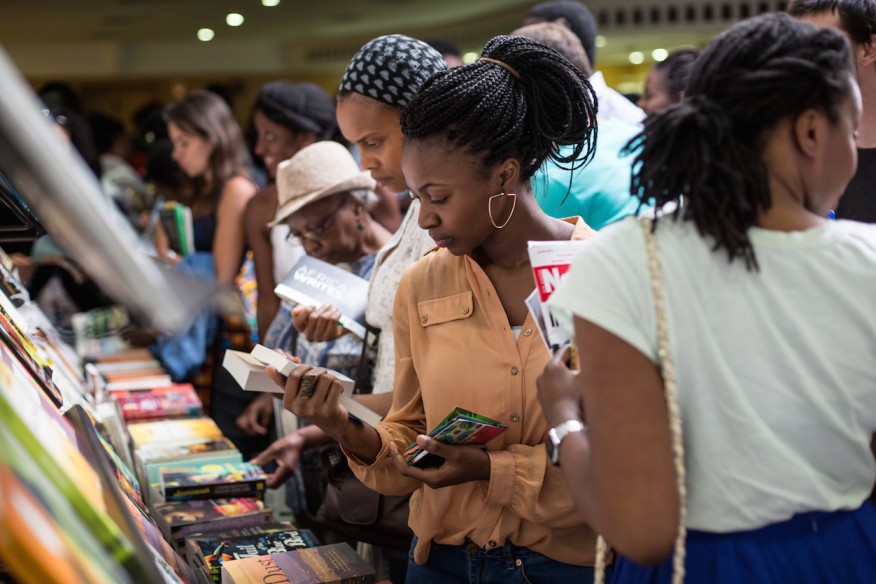
Around the time the Commonwealth issue first began to brew, a controversy erupted in Nigeria, which, for want of a better term, will be tagged: Book influencers vs Critics. It began with a post by Nonso Njoku arguing that publishers now favour influencers more than critics, outsourcing the job of critics to influencers. This caused a small controversy, with influencers vigorously defending their offices. But as all the arguments revealed, influencers and critics occupy different roles.
Influencers occupy the circle of discoverability in the book discourse while critics perform close reading. It could be argued that both are tastemakers with different criteria. If Nigerian publishers tend to lean toward book influencers, then it highlights that most of them lean more into marketing than literary appreciation. Is that a problem for the culture? It clearly is, but it’s more the fault of publishers than book influencers. By the end of the next month, book influencers would become embroiled in their controversy with publishers. But we will come to that.
Two related minor controversies/conversations that came from the Njoku matter are perennial arguments that occur on a yearly basis. One is about how many diaspora Nigerian novelists are unable to authentically capture Nigeria (a strand of the discourse argues that those portrayals of upper-class Nigerians are unrelatable to the vast majority of Nigerians; the other is concerned with an idea that Nigerian writers seem to set every story in Lagos, as if Lagos is the only place in Nigeria. These arguments are like tired adjectives—the last one is even baseless at this point—but it does not invalidate the issues of literary coverage and authenticity being discussed and demanded of our writers.
As if we are on an AI controversy spree, another story suspected of being generated by AI won the Harper’s Magazine Short Story Prize. A massive response followed it on X. Right around this time, two Nigerian poets were accused of using AI by Bridgette James, a poet and former police officer based in the UK, who runs a poetry prize. She was immediately attacked by the Nigerian poetry community and issued a Cease-and-Desist by the poets’ counsel. She would later apologise and withdraw her claims.


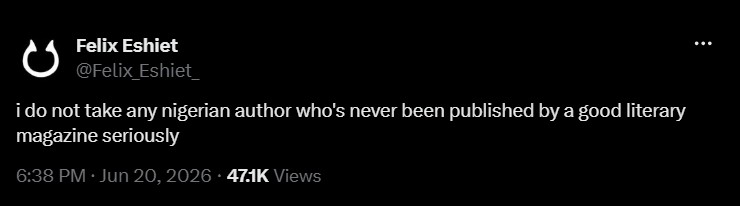
By late June, the Nigerian poet Felix Eshiet committed what is perhaps the literary blunder of the year in an X post in which he claimed that he only takes writers who have been published in “a good literary magazine” seriously. And of course he was attacked from all angles. Per many of the posts, it seems a mark of his own poor judgment and snobbery that he ascribes literary value to magazine publication.
And with Eshiet’s embarrassing statement, we are back in the discourse around influencers. In late June, a huge controversy between Nigerian book influencers and Masobe Publishing erupted. The Masobe vs Book Influencers Spat revolves around what the influencers saw as obvious exploitation of their willingness to promote books. It emerged first with an Instagram video by one Chidalu who more or less pitched for the boycott of Masobe by Nigerian book influencers.
The instigating grievance was that Masobe chose to pay influencers outside the book community to promote their books and ebook app while requesting free rep from book influencers. Sacchie, a notably rising book influencer, made a revelatory thread on X, detailing her—and her colleagues—grievance against Masobe. In the aftermath, many responses and comments pointed to a history of such issues with the publishing company—something many called an “anyhowness” culture.
Masobe, for their part, put out what can best be tagged a lukewarm response, which fails to address the influencers’ grievances. Masobe must understand that influencers are integral to the publishing ecosystem in Nigeria and around the world. It is not possible in the digital world of 2026 to sell a lot of books without book influencers creating a buzz around this. As such, the question here is one of where real value resides and where rewards for that value are being sent.
As events continue through the remaining half of the year, the most interesting note is that we must learn crucial lessons from each one. Each organisation or person involved or caught in each controversy must learn the proper lessons on how to forge their work to better reflect their goals and beliefs in relation to the society they live in.
Chimezie Chika is a staff writer at Afrocritik. His short stories and essays have appeared in or forthcoming from, amongst other places, The Iowa Review, Dappled Things, Channel Magazine, Terrain.org, Lolwe, Isele Magazine, Efiko Magazine. He is the fiction editor of Ngiga Review. His interests range from culture, history, to art, literature, and the environment. You can find him on X @chimeziechika1