


If a category can be reopened and reshuffled hours after publication, what confidence does anyone have that it won’t happen again?
By Emmanuel “Waziri” Okoro
There is a particular kind of fatigue that comes with covering the Headies Awards year after year. It is the fatigue of watching an institution that positions itself as “Africa’s biggest and most prestigious music award show” fumble the basics with a consistency that would be almost impressive if it weren’t so exhausting. To be honest, this writer is frankly tired.
The 18th edition nominees list, released a couple of days ago, is the latest instalment in that fumble, a list that is already rife with shortcomings. Noted, every year comes with a fresh round of excitement, parsing of category lists, arguments over snubs, and maybe the quiet pride of seeing an artiste’s name where it belongs. And every year, somewhere underneath that excitement, sits the same set of structural problems the Headies has never quite bothered to fix.
This piece is an attempt to name them plainly, one more time, in the hope that naming them enough times eventually forces a correction.
A Year Under Review That Refuses to Be a Year
Let us start with the arithmetic, because the Headies never quite can. One of the most persistent and least interrogated problems with the awards over the last decade is its handling of the “year under review”, the eligibility window meant to determine which songs and projects qualify for a given edition. In theory, this should be a 12-month stretch. In practice, it has never once landed there.
The pattern, once you lay it out, tells its own story. At the 2018 Headies, the review period ran from July 2016 to December 2017 (seventeen months). There was no ceremony at all in 2019. The 2020 edition then stretched the window to a startling eighteen months: January 2018 to June 2019. The years that followed offered little correction: fourteen months at the 2021 Headies, fourteen again in 2022, and fourteen once more in 2023. The 2024 edition held the line at fourteen months too, despite promising two ceremonies that year and delivering only one.
Last year, nothing happened at all; Nigerian music went uncelebrated by the show meant to celebrate it. Now, at the 18th edition, the submission window spans from the 1st of August 2024 to the 30th of April 2026, twenty-one months, the widest gap in the award’s twenty-year history.
When a review period balloons past a year, it stops functioning as a snapshot of a single creative season and starts functioning as a grab bag, throwing projects from different years into direct competition with each other regardless of when they were actually released or how the conversation around them has already moved on.
An album that dropped in the first month of the window and one that dropped in the last are, for all practical purposes, being asked to answer the same question, even though they were made for entirely different moments, competing against entirely different fields, and received by an audience whose tastes had shifted in the interim.
That is not a fair contest. The consequences of this are not hypothetical; the Headies have lived them before. At the 2021 edition, both of Burna Boy’s African Giant (2019) and Twice As Tall (2020) were in contention, with their songs featuring in some of the categories, even as the two albums had already been assessed separately by the Grammys, with Twice As Tall going on to win Best Global Music Album at its own, distinctly bounded, edition.
It is worth pausing on that comparison, because it is instructive. The Grammys, BET Awards, Brit Awards all operate on eligibility windows that critics can argue over at the margins, but that never balloon to seventeen or twenty-one months. A defined year under review is not a bureaucratic nicety but the mechanism by which an award show tells a coherent story about a specific period in an industry’s life.
Strip that mechanism away, and what you’re left with isn’t an award show so much as a periodic, loosely organised catalogue of whoever happened to release music since the last time anyone checked. If the Headies wants to be taken seriously as an arbiter of a given year in African music, it has to start behaving like one. That begins with committing, without exception, to a genuine twelve-month window, and holding itself to it the way every other major award show in the world manages to.
Home Is Always the Best Address
Then, there is also the matter of geography. The Headies has announced that its 18th edition, tagged “Africa to the World”, will be staged in Canada, a decision that, whatever the stated rationale, is bound to reopen a wound this publication and others have flagged before. Hosting an award show built around celebrating Nigerian and African music somewhere outside Nigeria or Africa is not a convention observed anywhere else. National and continental award shows tend to stay rooted in the places whose culture they claim to honour.
The 15th and 16th editions were held at the Cobb Energy Performing Arts Centre in Atlanta, and the complaints then were the same complaints now: what does it say about an industry when its most prestigious award show goes shopping for venues abroad rather than investing in the infrastructure to host its own moment at home?
The 17th edition, fittingly tagged “Back to Base”, returned to the Landmark Event Centre in Victoria Island, Lagos, a gesture that suggested the organisers understood the problem. That understanding appears to have been temporary. Some stakeholders will point to investment and collaboration opportunities as justification for the move to Canada, and those opportunities may well be real. Diaspora audiences matter, international visibility matters, and there is nothing wrong in principle with an African award show wanting a global stage.
But an award show’s first obligation is to the industry and audience it claims to represent, and there is no partnership abroad valuable enough to substitute for the simple act of celebrating African music on African soil.
Every edition staged outside the continent is, whether intended or not, a small signal to the artistes, the fans, and the industry at home that the real audience worth impressing sits elsewhere. That signal accumulates. It shapes how seriously the show is taken by the very ecosystem it claims to serve, and it is a cost the Headies keeps paying without ever quite reckoning with it.
A Next Rated Category That Doesn’t Add Up
The unusually wide review window has also scrambled some of the individual categories, and nowhere is this more visible than in Next Rated, the award meant to spotlight the most promising emerging artiste “poised for superstardom”.

This year’s nominees include Mavo, Llona, FOLA, Shoday, and Fido, and even a cursory look at the list reveals an obvious mismatch: FOLA is not in the same tier as his fellow nominees.
His trajectory over the review period has already outpaced what “emerging” implies. He enters the 18th edition as its most nominated artiste, with ten nods in total, including placements in major categories like Album of the Year, Best Male Artiste, Best Recording of the Year, Best R&B Album, and Song Writer of the Year. An artiste with that breadth of recognition across the marquee categories has, by definition, “already arrived”. He does not belong in a category built for those still on their way. The same argument can also be made for Mavo, who is not only the go-to for collaborations, but has carved a niche for himself in the industry.

The irony is that this dilutes the category rather than elevating it. Next Rated is supposed to function as a signal to the industry, a marker that says: watch this one, they are about to break through.
When a nominee has already broken through several times over in the same awards cycle, the category stops doing that work. It becomes redundant, a formality attached to a name that has already collected its due recognition elsewhere on the ballot, at the expense of artistes for whom the nod might have actually meant something.
Editing After Releasing A Nominees List Is An Eyesore
Perhaps the most damning item on this list, though, is the least defensible: a few hours after the Headies published its nominees list across its website and social platforms, the organisers quietly began editing it. Davido has since been added to the Best Male Artiste category; and Olamide’s “99”, featuring Young Jonn, Asake, Seyi Vibez, and Daecolm, has been added to the Song of the Year lineup.
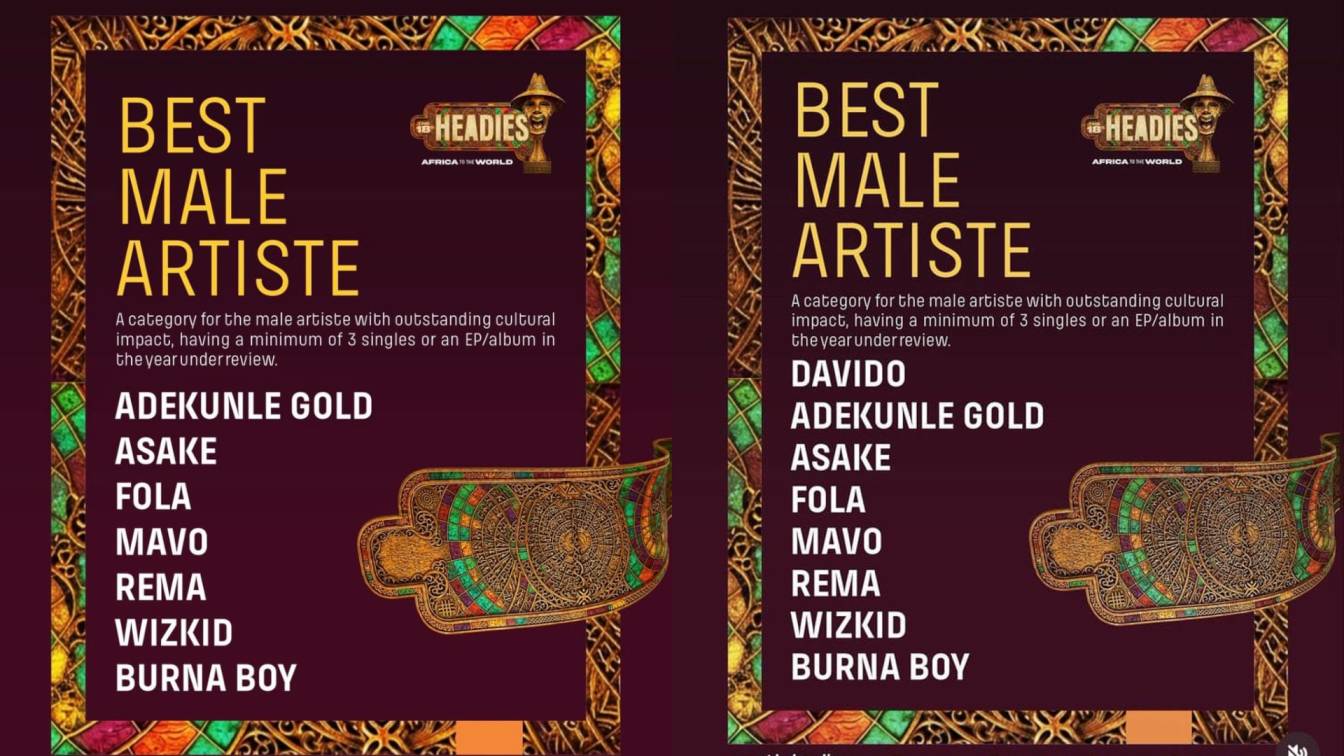
There is a broader culture of “anyhowness” that Nigerian institutions have normalised across public life, a tolerance for process that bends after the fact rather than holding before it, and the Headies has not been spared from it.
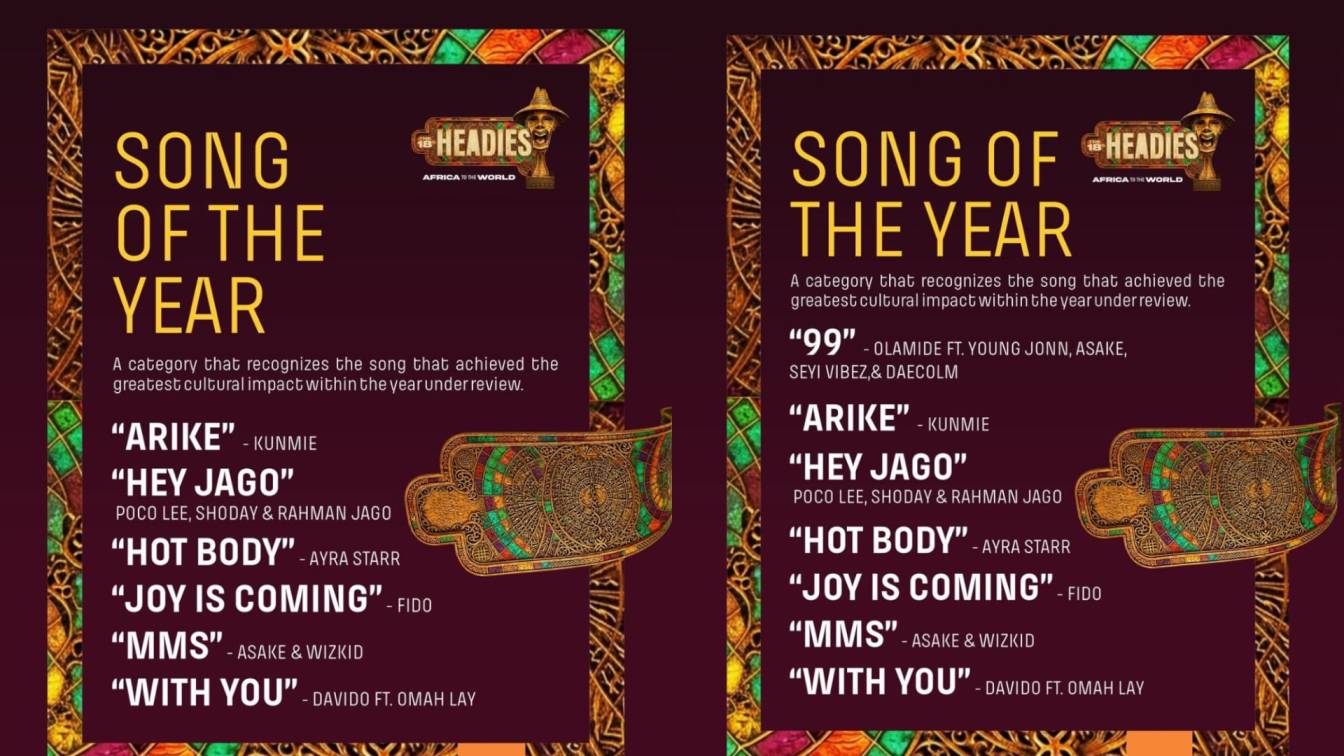
A nominations list is not a rough draft but the output of a process that is supposed to have already happened, a committee that deliberated and finalised its categories before making anything public. To publish and then quietly revise raises real questions about how that process actually worked, and whether “finalised” means anything at the Headies at all. Calling it borderline criminal is not hyperbole so much as an accurate description of what it does to the credibility of the exercise.
It also raises an uncomfortable question about everyone who was already on the list before the edits. If a category can be reopened and reshuffled hours after publication, what confidence does anyone have that it won’t happen again, quietly, before the ceremony itself? The artistes who made the cut on merit deserve a process solid enough that their nomination isn’t contingent on who gets added, or removed, in the days that follow.
There is more that could be said, and more that probably will need to be said again after the award has been organised. But after seventeen editions, the question worth sitting with is not what else is wrong this time. It is what it says about the future of the Headies that, after all this time, we are still here.
Emmanuel “Waziri” Okoro is a Nigerian writer and journo with an insatiable knack for music and pop culture, with bylines on Afrocritik, PM News, Tribune, The Sun, ThisDay, Vanguard, and The Guardian. When he’s not writing, you will find him arguing why Arsenal FC is the best football club in the multiverse. Connect with him on Twitter, Instagram, and Threads: @BughiLorde.